
WEBINAR | Unlocking Collective Intelligence with AI Search and Knowledge Management @ MBH Architects
Featured Guests
Hillary Thompson, Principal
Webinar Summary
As AI-powered search and learning tools become more capable, their effectiveness depends on something far more fundamental: the quality, structure, and completeness of a firm’s knowledge foundation.
Over the past year, MBH Architects has advanced a series of focused initiatives to strengthen how knowledge is captured, structured, and maintained across the firm. What began as a small proof of concept quickly expanded into a broader effort spanning marketing, studio-level practice knowledge, structured project data, and now firmwide learning.
In this webinar, Hillary Thompson, Principal at MBH Architects, shares how MBH is deliberately investing in its knowledge foundation to enable better AI outcomes, improve access to expertise, and create a continuous pipeline connecting project experience, institutional knowledge, and learning.
We explore:
How MBH scoped and executed targeted knowledge capture initiatives to demonstrate early, measurable value
How capturing practice knowledge, studio standards, and best practices is becoming essential groundwork for smarter retrieval and collaboration
The role of structured project data in unlocking new possibilities for search, storytelling, and institutional insight
How MBH is beginning to translate project experience and expertise into scalable learning through Synthesis LMS
Practical strategies for communicating value, building momentum, and sustaining long-term knowledge management initiatives
This session offers a practical, behind-the-scenes look at how one firm is strengthening its knowledge infrastructure to ensure the right knowledge reaches the right person at the right time—and how that foundation is enabling the next generation of AI-powered knowledge and learning.
Enjoy!
Featured Guests
Hillary Thompson, Principal
Webinar Summary
As AI-powered search and learning tools become more capable, their effectiveness depends on something far more fundamental: the quality, structure, and completeness of a firm’s knowledge foundation.
Over the past year, MBH Architects has advanced a series of focused initiatives to strengthen how knowledge is captured, structured, and maintained across the firm. What began as a small proof of concept quickly expanded into a broader effort spanning marketing, studio-level practice knowledge, structured project data, and now firmwide learning.
In this webinar, Hillary Thompson, Principal at MBH Architects, shares how MBH is deliberately investing in its knowledge foundation to enable better AI outcomes, improve access to expertise, and create a continuous pipeline connecting project experience, institutional knowledge, and learning.
We explore:
How MBH scoped and executed targeted knowledge capture initiatives to demonstrate early, measurable value
How capturing practice knowledge, studio standards, and best practices is becoming essential groundwork for smarter retrieval and collaboration
The role of structured project data in unlocking new possibilities for search, storytelling, and institutional insight
How MBH is beginning to translate project experience and expertise into scalable learning through Synthesis LMS
Practical strategies for communicating value, building momentum, and sustaining long-term knowledge management initiatives
This session offers a practical, behind-the-scenes look at how one firm is strengthening its knowledge infrastructure to ensure the right knowledge reaches the right person at the right time—and how that foundation is enabling the next generation of AI-powered knowledge and learning.
Enjoy!
Webinar Timeline
Introduction
00:00 Welcome and Introductions
01:33 The Knowledge Usability Problem
02:51 Background on MBH
Knowledge Strategy and Framework
03:58 Overview of the Four Knowledge Layers
05:33 Where Knowledge Lives
06:40 Making Knowledge AI Ready
08:12 Framework for Progress
Case Studies and Knowledge Agent Previews
09:27 Case Study: Marketing Proposal Language Library
12:40 Solution: Curated Proposal Language Library
15:26 Better Results with Curated Knowledge
16:31 Synthesis AI Search Flywheel in Action
18:57 Measuring Time Savings
20:58 Knowledge Agent: Project Experience Matcher
23:59 Knowledge Agent: Scope Drafter
26:04 From Recall to Structure
26:58 Case Study: Studio Workspaces
28:55 Adoption and Sustainability
31:31 AI Search Changes Retrieval
33:48 Case Study: Plan Check Comments Library
35:21 Knowledge Agent: Firmwide Best Practices Codifier
37:52 Case Study: Project Data
42:03 Knowledge Agent: Design Precedent Explorer
43:59 Case Study: Learning and Synthesis LMS
45:35 Example Course: Insights to Learning in Action
47:36 Knowledge Agents Snapshot + Capturing Expertise
Q+A
50:40 When do you use raw vs curated knowledge?
52:44 What is your process for knowledge curation?
54:45 What is your plan for rolling out agents?
57:34 How is your knowledge team structured?
58:44 Where does the experience and skills data live for staffing agent?
1:01:15 Have you built any HR related agents?
1:02:48 How are you identifying and prioritizing use cases?
1:04:26 What is your strategy for critical knowledge transfer?
1:06:47 What is the setup for the plan check comments library?
1:08:03 Closing and Upcoming Events
More Case Study Webinars

View Upcoming Events
Modernizing Learning to Scale Quality at Lionakis | Laura Knauss and Kristina Williams
In this episode of Smarter by Design, I’m joined by Laura Knauss, President and Chief Practice Officer at Lionakis, and Kristina Williams, Director of Design Technology at Lionakis, for a conversation about how their firm is modernizing learning to scale quality and consistency across their practice.
At the heart of that shift is a deep respect for the apprenticeship model. For generations, one-on-one mentorship has been the foundation of how architects and engineers learned their craft—and it remains essential today. But as firms grow, diversify, and take on increasingly complex work, Lionakis has recognized that apprenticeship alone isn’t enough to provide the consistent, firmwide foundation that today’s environment demands.
In response, Lionakis is repositioning apprenticeship by building a more intentional and scalable learning system that ensures every team member starts from a shared baseline, while still allowing mentorship to do what it does best: helping people apply that knowledge in the context of real projects.
We explore two major shifts behind that transformation.
First, the evolution of Lionakis’s Design Technology Boot Camp. What began as long, lecture-heavy training sessions has been reimagined into a more modular, learner-centered experience built around short, focused video lessons, hands-on exercises, and live, collaborative sessions. Along the way, Kristina shares what they’ve learned about attention, retention, and how to design learning that actually sticks.
Second, we look at how those same principles are being applied beyond Boot Camp to reshape how the firm teaches practice itself. From specifications and building envelope design to programming and coordination, Lionakis is moving away from ad hoc training toward a more strategic learning roadmap that captures core project knowledge, standardizes how it’s taught, and makes it accessible across the entire firm.
The goal is both simple and ambitious: to create a shared foundation that allows any team member, in any office, to step into any project and contribute with confidence, consistency, and clarity.
What emerges is a picture of a firm learning how to operate as a modern learning organization—where knowledge, learning, and practice are tightly connected, and where investment in learning is directly tied to the quality of the work.
If you’re thinking about how to scale expertise, support the next generation of talent, or move beyond training as a one-time event, this conversation offers a clear and compelling path forward.
▶ Watch or Listen
Watch or listen to this episode via YouTube, Spotify, Apple Podcasts or wherever you get your podcasts.
📺 🎧 YouTube
📺 🎧 Spotify
🎧 Apple Podcasts
In this episode of Smarter by Design, I’m joined by Laura Knauss, President and Chief Practice Officer at Lionakis, and Kristina Williams, Director of Design Technology at Lionakis, for a conversation about how their firm is modernizing learning to scale quality and consistency across their practice.
At the heart of that shift is a deep respect for the apprenticeship model. For generations, one-on-one mentorship has been the foundation of how architects and engineers learned their craft—and it remains essential today. But as firms grow, diversify, and take on increasingly complex work, Lionakis has recognized that apprenticeship alone isn’t enough to provide the consistent, firmwide foundation that today’s environment demands.
In response, Lionakis is repositioning apprenticeship by building a more intentional and scalable learning system that ensures every team member starts from a shared baseline, while still allowing mentorship to do what it does best: helping people apply that knowledge in the context of real projects.
We explore two major shifts behind that transformation.
First, the evolution of Lionakis’s Design Technology Boot Camp. What began as long, lecture-heavy training sessions has been reimagined into a more modular, learner-centered experience built around short, focused video lessons, hands-on exercises, and live, collaborative sessions. Along the way, Kristina shares what they’ve learned about attention, retention, and how to design learning that actually sticks.
Second, we look at how those same principles are being applied beyond Boot Camp to reshape how the firm teaches practice itself. From specifications and building envelope design to programming and coordination, Lionakis is moving away from ad hoc training toward a more strategic learning roadmap that captures core project knowledge, standardizes how it’s taught, and makes it accessible across the entire firm.
The goal is both simple and ambitious: to create a shared foundation that allows any team member, in any office, to step into any project and contribute with confidence, consistency, and clarity.
What emerges is a picture of a firm learning how to operate as a modern learning organization—where knowledge, learning, and practice are tightly connected, and where investment in learning is directly tied to the quality of the work.
If you’re thinking about how to scale expertise, support the next generation of talent, or move beyond training as a one-time event, this conversation offers a clear and compelling path forward.
▶ Watch or Listen
Watch or listen to this episode via YouTube, Spotify, Apple Podcasts or wherever you get your podcasts.
📺 🎧 YouTube
📺 🎧 Spotify
🎧 Apple Podcasts
📃 Episode Transcript
This transcript was lightly edited for clarity.
Chris: Okay, Laura and Kristina, welcome to the Smarter by Design Podcast.
Laura: Thanks for having us.
Kristina: Thanks, Chris.
Chris: Kristina, you are giving a talk at AEC TalentMAX in May titled "Learning at the Speed of Change: Adapting L&D to Your New AEC Workforce." And Laura, you recently shared at our executive workshop a couple weeks ago how Lionakis is rethinking learning at a firm-wide level. Let's start there—can you both describe that shift from your perspectives?
Kristina: Sure. Through my role in design technology, I've delivered a lot of internal training and I'm on a constant mission to design and teach programs in a way that truly sticks with learners. Though we're always continuously improving, there are sometimes things that happen in the world and in our industry that make you require you to think outside the box even more and get more creative with how you deliver training. There's been enough of that to shake things up and make us re-examine how we learn.
Chris: What are some of those things?
Kristina: In the world: AI, of course—a given at this point—and social media, the way people get information and seek information, and all the noise, good and bad, coming at all of us. In the industry: doing more with less. Compared to years ago, there's more documentation, more codes, more litigation, less time, shorter schedules, higher client expectations. You hear the word "busy" a lot, and I think there's clearly something to that. It feels like we're just doing more, there's more noise, and we have to find a clearer path to what we need.
Laura: Kristina talks about it specifically in the learning area—I have to look at it from firm growth, the diversity of our firm, the regional diversity of our firm, and delivering a consistent expectation and consistent model into the marketplace. As we've grown, we've seen so many of our traditional models—that apprenticeship model—start to, if not devolve, have way too many different and disparate voices as teachers or mentors. You start to see the consistency of the firm erode into camps: this is so-and-so's camp for how they teach in their team, or this is somebody else's region. The emphasis we've been making as a firm is saying: no, we're one firm, we have a consistent approach—the Lionakis Way—to how we deliver projects. This is giving us the opportunity to give everyone the same message. It doesn't discount that apprenticeship model, which is still essential in building good architects. But it gives them the toolkit to be good teachers as well.
Chris: Why is having people practice consistently important—beyond just the same message? Why is the Lionakis Way important?
Laura: There's an efficiency piece, right? We're not teaching everybody a different way, so you don't end up confused when you work with a different project leader. But also, a lot of the markets we serve—healthcare, civic, education—those clients move around. They may go from one school district to another, from one healthcare facility to another as leaders. Our reputation follows us, whether it's our San Diego office or our San Francisco office. They're assuming they're getting a level of quality and project delivery from Lionakis regardless of where we are in the state. We love to hear that we have the best drawings or the depth of staff—and we want that to apply to the whole firm.
Kristina: We have a saying for our standards: we want any person, in any place, on any project to be able to fit right in. From the team member's standpoint, if you go work on a different project for a different PM, you're not having to relearn their way of doing things.
Chris: What you said about the apprenticeship model—maybe it's not devolving so much as becoming less central to how you think about accelerating learning and developing people. It sounds like having it be the primary instruction model for the Lionakis Way isn't going to work anymore. But people still need mentorship and support on their projects.
Laura: Absolutely. And I think it is about giving teachers the toolkit. Those people in that position—what method am I supposed to be teaching them? How are they supposed to be delivering things? If they haven't been taught with consistency, or they came from another firm that did it differently, how are we giving them the toolkit to make sure they're enforcing the way we want to deliver projects and the caliber of quality we expect?
Chris: So it's not so much that people want to teach things the wrong way—it's that in the absence of a resource, they just do their best.
Laura: Right. And they've been delivering projects a very long time and they've done it successfully. When we have disagreements, we have a way to bubble those up through a committee that helps us decide: what is the way we're going to do this? And then let's all march together.
Chris: So that's the deep "why" behind modernizing your approach to learning. Where were you, what was broken, where are you going—and what are your hopes and dreams for how learning could work at Lionakis?
Laura: I'm going to go way back since I've been here 36 years, and Kristina can do the modern history. I'm not going to complain about how Lionakis has taught architects, because they taught me and I'm proud of what they taught me. But it was one-on-one—one person sitting next to one person, following them around as a mentor. That is still very much what we do, whether it's taking people out on job sites or the incidental learning that happens by overhearing a conversation. But I think we were a little ad hoc about how we taught across the firm. We might say, "I'm so frustrated, everybody keeps doing this wrong," pull them into a room, and someone would teach them how to do it right. That worked really well for those 15 people in the room. But now that we're 225 people, it's very hard to say, "Hey, tomorrow we should learn this thing—I hope you're here." That's really been the impetus for everything Kristina is putting in place. When you go way back, we never knew to teach people differently because it was so strictly apprenticeship.
Chris: So there's the challenge of scaling your traditional approach, and then: is it fast enough to keep up with the speed of change Kristina mentioned?
Laura: Yes.
Chris: How about you, Kristina?
Kristina: I've been here about 14 years and started as a Revit specialist. When I started, the firm was pretty early in its Revit adoption and we were just focused on getting Revit out to people. Even then, we'd do full days of training—getting everybody from a particular market or studio into a room and teaching them about a topic they may or may not use right away. That's what training looked like: getting a bunch of people together and picking a topic that seemed like they should know at some point.
Chris: And that didn't work?
Kristina: It didn't work. I love documenting and sharing best practices, and over time you realize some things didn't land. You thought you delivered the message clearly, you thought you had the right people in the room—and then you get the same questions a couple months later from those very people. When that happens, you go through a moment of frustration: was it me? Did I go on too many tangents? Was it them? Were they not paying attention? Even people who were engaged during training—who were there, asking questions—that frustration of revisiting a topic you thought you'd planted in their heads just leads you to growth, to changing how you do things and really examining what worked and what didn't. That's been one of my life's missions for 14 years: figuring out how to get information into people's heads at the right time.
Chris: So what have you learned?
Kristina: Learning about a topic you're not going to use right away—and I mean right away, like in the next few hours or that week—is not very helpful. You need iteration. You need to learn it, do it, learn a little more, do it, and revisit. Another thing: trying to cram too much into a full day. We'd think, "Somebody just started—let's give it all to them right away before they get busy on projects, and then they'll just know it."
Chris: My window is closing to get to this person; I'm going to get them as many things as I can before they disappear.
Kristina: Not good. It doesn't work. And then there's the format—sending a message in a very long format. I was talking full days; we shortened over time to hour-long sessions, especially during the pandemic when we didn't want to do full days on Zoom or Teams. But now one hour feels too long. One hour of lecture, one hour of talking heads talking at people.
Laura: You know, I've been a school architect my whole career, so I learn a lot from teachers about how students learn. It's funny to me that the light bulbs didn't go off maybe 20 years ago about how we should reach the architects and engineers in our firm, because we know that most people are hands-on learners. But we also have people who need to absorb, go back, revisit, and ask questions. We have graphic learners—I've had us adopt a whole new platform for project management with a much more graphic interface because the architects weren't absorbing spreadsheets. And so I think it's the combination of all the things Kristina talked about, plus the recognition that our people just learn differently. Some will need to go back multiple times to one piece of a video because it isn't sinking in, or go back to the exercises to remind themselves how they got there. That's an important recognition.
Chris: Maybe we can use the DT Bootcamp as a working example. Kristina, I'll let you introduce it more properly—it's a flagship learning program at Lionakis, and at the beginning it was multiple days, all in-person and live. Where's the recall opportunity for somebody who doesn't remember what design options are six months down the road? You've been progressively adapting bootcamp over time. Can you take us through that at a high level?
Kristina: Sure. Our Design Technology Bootcamp is our annual training program—we've been doing it 12 or 13 years now. We take a select group of individuals, usually representation from each market service office, through intermediate to advanced Revit training. The goal is to build a network of people out in the studios who work on projects in DT. We're all overhead, and it creates that network of eyes and ears on projects that help connect us with DT.
When I mentioned the full days earlier, that was actually for a standard new hire—three full days of Revit training. The beginning of bootcamp was three full days for 10 weeks straight: 240 hours. We were basically trying to clone ourselves in DT during that early Revit adoption. We covered everything—even soft skills, we had a book club. It was a lot, both in terms of taking people away from projects and in terms of the learning effectiveness. So we kept dialing it down. What do they really need to know? We don't need to clone ourselves; they just need to be effective in helping their projects. We trimmed the curriculum, became really focused and intentional about what we needed them to know and what outcome we were looking for.
Over the years it settled at around 54 hours of training. Before the pandemic, everybody would travel to one office to be together—and because of the travel, we'd fit it into about a week at a time. The pandemic let us be more flexible and go virtual, which meant we could break it down further. Since then, it's been in one-to-two-hour sessions spread across a few weeks and across the entire year for the bootcamp cohort.
Even within those one-to-two-hour sessions, they started out with a lot of talking at people, showing them click by click what we're doing, and then having them repeat it while we did it. At one point I recognized that they're just mimicking—they're not really absorbing much. There needs to be a component of them working independently. So we shifted to: talk a little bit, then have them work on an exercise. As soon as they started the exercises, you could see the light bulbs turning on. And even when we shortened the talking portion to 15 minutes, as soon as they started the exercise they'd go, "Wait—what did you just say?" So even 15 minutes of talking was almost too much. You almost need them to dive in right away, with just a little bit to set the stage and access that part of their brain.
Chris: There's a concept in learning development called "desirable difficulty"—you need to put them in a position where they have to struggle, because that's how they learn and remember, versus just clicking along and following Kristina.
Kristina: Exactly. So the exercises started to really feel like something was working. Since then we've focused on exercises quite a bit, and delivering the initial message as concisely as possible. We were part of the Synthesis LMS beta program and started developing online courses through our learning center, which let us prerecord that initial message. When I listen back to our old one-to-two-hour session recordings, I think: I really could have said that more clearly, more concisely. I went off on tangents they didn't need right then, adding nuance that cluttered their brain. Prerecording has forced me to be more concise, and I'm finding I can become a better instructor by doing that.
Chris: Laura, as you've been watching this happen with DT Bootcamp over the years, what was going on in your mind?
Laura: For me, the most exciting part is that this is an area where our newer graduates and younger staff can really excel as technology specialists—as Revit specialists, as experts in an area that some of our 25-year people may not be actively using. It puts them in a place on the team as truly valued contributors. It empowers them to teach the person next to them and not feel like they don't know enough to mentor someone a year or two behind them. When we put them in this position and they're well-taught through bootcamp, everybody comes to them. When you have multiple bootcamp alums in a studio or office, it raises all boats. People are going to them, getting that one-on-one with a peer where they don't have to ask uncomfortable questions in front of the boss. That's a really good way to teach the next generation to be good teachers—because if you want to be a learning organization, everybody has to go in with the mindset that they're teaching the people around them what they know best.
Chris: I love that you said "learning organization" because I've been talking about modern learning organizations for about a year and a half, and you guys are definitely on that journey. There are two specific things I want to cover: modernizing the bootcamp, and then Laura, some of the practice and Lionakis Way work as well.
Kristina, you redesigned bootcamp in 2026 and just ran the first section a couple weeks ago. Can you take us through the redesign and how it went?
Kristina: Being part of the Synthesis LMS beta cohort, we had a lot of great conversations about how to best deliver content to people. That's where some things really clicked for me around short formats and prerecording topics. We said: we have access to this great tool, let's develop all of these for the bootcamp training we'll deliver this year.
We recorded our first module of content, but we didn't just want to prerecord and have people watch on their own—we didn't know if they'd watch it, or at what pace. We still liked having that "together" aspect, because there's a lot to bootcamp in being in a room, talking about it with each other, learning those topics as a group at the same pace. So we decided to take these concise recordings and watch them together as a live watch party, and then everyone would work on exercises for those topics.
I wasn't sure how the live watch party would go—I knew it would be a little awkward to hear myself talking on a video. But I love it. I can deliver my message more concisely, I'm already prepped, I don't have to worry about anything going wrong with dataset files, and I can focus on the more important part: the exercises and engaging them throughout the session. We found right away that they would access the videos while doing the exercises.
Chris: That thing you said before—"I just told you this 10 minutes ago"—right?
Kristina: Exactly. So they need to be able to pause and take it step by step. And that's okay, because they know this resource is there for them anytime they need to do that task. It reinforces the habit of going to a resource and looking for it, because you know it's there and it helps you along the way. Previously they couldn't access it again unless they asked me to repeat it—and I can't repeat it for every person every time they're working on that task on every project. It feels really good to have this packaged, concise message for topics that people are already using.
Chris: To give people a visual: in your learning center you have a learning path called Bootcamp Full-Time with about a dozen courses, each somewhere between 16 and 35 minutes long, including the video and the exercise. For example, a course called "Revit BIM Execution Plan and Kickoff Core" has a five-to-six-minute video followed by an exercise and a quiz. So the general structure is: short video, exercise, course totaling 15-35 minutes?
Kristina: Yes, though the exercise time isn't fully factored into the completion time for some of those yet, and we're still building out the learning path with more courses for the next bootcamp module. But generally—we watch a lesson, which is a short video, then work on an exercise, and that's where most of the time is spent.
Chris: Laura, you're taking this approach to practice as well. Can you walk us through what learning looked like before 2026 and what it looks like now?
Laura: It was throw them in the deep end. In the early part of a career, that one-on-one model. Over time we've done more training—hour-long sessions, pulling all the project managers together and bringing in an outside trainer to talk about project management. But if you started with us three days after that outside trainer came to the firm, you missed it. When Kristina was bringing back the LMS work she was doing on bootcamp, we started talking about: what are the practice things we need to do every year on a regular basis, and what are the quick-strike things, and how could we apply the same concept?
And I want to say: anecdotally, over the last couple of weeks we've been getting rave reviews from folks in our DT bootcamp and visualization bootcamp. But especially for practice bootcamp, because the delivery is so new. Somebody even said yesterday, "I learned more in that one hour about cartooning than I've ever known in my career." It was one hour, four videos, with an outside consultant doing the videos for us—so we were able to draw on our best resources in short snippets.
The exercise piece put us into breakout rooms that were mixed by position, experience, and how vocal people are—and it was really enlightening how engaged people were at all levels. The younger staff drove and asked questions by inquiry, in a much more comfortable setting than if we'd brought the whole firm together for a training where you had to speak up in a big virtual room or do something in the chat and hope you got recognized.
Chris: So to make sure I follow: people join a big Teams call in the main room, where they do the watch party with the prerecorded videos—four to six minutes each on a couple of topics. Then you put them in breakout rooms to do the exercises, bring them back to the main room if there's more on-demand content, and back out to breakout rooms again.
Laura: That's what we did in the cartooning practice. We learned a lot: how much time do you need for exercises? Do we need to be able to give answers? We're in the process of recording answer videos so that when people take it on demand, they can see how well they did. And this process solidified for us on the practice side: what is the message we're teaching here? Having it codified forces the practice-side folks to come together and ask: do we all agree this is the right person to teach it, the right messenger, the right approach? Because it's being codified in how the firm delivers this training. That empowers our younger staff to say, "That's not how we're teaching that in the Lionakis Way."
Chris: "That's not how you cartoon a site plan."
Laura: Exactly. We've got three other big ones planned for this year and we're going to keep learning with each one.
Chris: What's been the experience for both the learners and the people who were instructing—who would have taught it very differently before? Was it hard to get them to do prerecorded videos?
Kristina: Laura mentioned an outside consultant who recorded some videos—that was because we were already working with them on that topic. We also had one of our architects record videos for the cartooning course. There's always that new-factor nervousness: "What do you want? Okay, I'll go in a room and talk to myself on video—and I need to keep it to how long?" But once he dove in, he was a natural at it. We had someone help edit the videos—we took away the post-production burden, which he really appreciated. That same person even helped him put together slides from a few bullet points—he joked that they were "cartooning his cartooning presentation" for him.
Once he actually got to recording, I think it was a little uncomfortable. But once it was done and he saw the outcome was really great—now when he talks about it in studio meetings and people give feedback, he's said many times that he loved doing a few short videos over preparing a 45-minute presentation.
Laura: And this person is not a natural public speaker. He's a natural leader in what he's teaching. Getting it right on a video ultimately felt more comfortable to him than facing a room full of faces. And there are different ways people teach too—this format really fit him well. I also see this as a great opportunity for outside consultants—mechanical engineers, electrical engineers coming in to talk about a new code cycle or sustainability. This is a chance to memorialize some of that material so that everybody gets it, and doing it in a way that they can stay in their office, record a couple of minutes for us, and then join live.
Chris: So you'd even push outsiders to try short videos plus exercises?
Kristina: We did in the cartooning training, and they said, "This sounds like a great idea, I get why you're doing this." This person has done training at other firms too, and they got it right away.
Chris: What's it like for you and your architect to watch yourselves in a watch party?
Kristina: It was weird at first, but since I've recorded for training in the past, I'm kind of used to it.
Laura: The funny part was that the first thing Brian said to me was, "I thought I already talk fast"—and they played him at 1.25x. I said, "You know what, Brian? It didn't sound too fast at all." I think once he saw it in person, he realized it came off okay. And ultimately he was proud of what we accomplished because he's been trying to get this message out one-on-one for a really long time.
Chris: If somebody has a message they've been trying to get out and it hasn't been effective, they're open to trying new things.
Laura: Absolutely. The frustration Kristina talked about at the beginning—"I thought I just told them this"—that's tenfold when you look at how many architects are trying to teach other future architects. How many times do I have to say this? So they're being pretty open-minded about this.
Kristina: There are others lined up for this format—our IT director, who's been in the same position as me having to teach people about software all the time, said, "Thank goodness. It finally feels like my message will be heard and retained." We hope.
Chris: And from the learner's perspective, I would imagine that hour flew by in a way that it wouldn't have otherwise.
Kristina: So fast—for us and for them.
Laura: I think when you're in a big firm that started as a family, a smaller firm where we all grew up in that environment, you continuously struggle with how to transfer culture and connect with people as human beings rather than through a Teams message. Those breakout rooms sound like a small thing, but they are ways that somebody can say, "Oh, I did this on a recent project—let me walk us through this cartooning piece in our breakout room." Suddenly someone from our San Diego or San Francisco office has a new resource, a new connection—someone they may have never met other than at our once-a-year town hall, and certainly not in an arena where their experience or expertise would shine through. Any way we can break the firm down into smaller groups to talk, with a shared practice in common, opens the conversation really quickly.
Kristina: And the little side effect is that you worry about multitasking with virtual training, but the expectation of this format—I'm joining, there will be breakout rooms, I'm going to need to actually do something—makes people perk up a bit more.
Chris: This video is going to go by fast, and then you're going to be in a room with your peers expected to have really engaged.
Laura: I mentioned to you the other day that I went into a breakout room and the group kind of went, "Oh no—"
Kristina: Yeah—
Laura: "How do I have her in my group?" But I didn't say a word. One of our younger staff took charge, ran the whole exercise—we had to pull up the exercise and do some markups—and the rest of us chatted at him while he was working. It was really effective, and I think he felt really good about being a leader in that small room.
Chris: There are so many things I love about this design. I know you're going to iterate on it and already have things you want to do differently next time. But I want to call attention to a common objection when people hear about LMS and video-based training: "Aren't we going to stop talking to each other? That's how people understand and learn from each other—nobody wants to sit around and watch a wall of videos all day." I agree with that. But not all video is created equal, and not all live sessions are great either. It seems like you're figuring out how to use video for what it's best at, and live interaction for what it's best at.
Laura: And Kristina brought this up at the very beginning: the big training, the one-hour commitment, is saying—this is important content, we expect you to be here and present and paying attention. All the little triggers Kristina mentioned, like "we're about to go into an exercise, better pay attention," help. But we thought it was important to have that first training be live and virtual, with a cadence of different kinds of instruction, to say: this is important, and if you're going to be at Lionakis, we do it the Lionakis Way. You need to be here to learn that, and here are the opportunities to reinforce it that follow. We had about 80 practitioners on the call—a pretty high percentage of our technical staff.
Chris: Was it required?
Kristina: Not for the first one.
Chris: That makes me think the next one might be.
Laura: I think we'd like it to be mandatory for the practice people. But honestly, with that percentage, and now the buzz around it, everybody's really interested.
Kristina: Right—making it mandatory was not a response to low attendance. It was more: this was really good and we need people to be here for it.
Chris: And even if I'm a 25- or 30-year architect at Lionakis, am I still going to Cartooning 101?
Kristina: Yes.
Chris: And why?
Laura: When we were in the executive session with KA, someone used the word "reboarding." I think that's really important. We have people who have been doing things their way—within the bounds of the Lionakis Way, but if we were reviewing their documents, we might think, "Hmm, I'm not sure about that." This is an opportunity for them to get the consistent message so that when they are the teachers or project leaders, they're delivering it consistently. We had pretty much everybody on that call.
Chris: I think you mentioned there was one person in particular who afterwards said, "I thought I understood this topic, but I didn't."
Laura: One of our project managers in our San Diego office—they're a newer office, through acquisition—was overheard by the rest of the team throwing down her headset saying, "I thought I knew what I was doing." That was a measurement in an area where it's hard to measure; the implications of cartooning might not be seen for a year on their project. But that reaction was one measurement that said: they felt valued enough to be taught how to do this the right way.
Chris: Can we talk about the cascading follow-up opportunities for reinforcement after the initial big training?
Kristina: We had to reflect on why we're doing the live training. There's the human factor of getting together. But if you think about it—not everybody will be doing cartooning when they get off that call. Are they going to retain it if they're not going to use it right away, outside of that exercise?
We thought: the live training is about saying "this is important"—so that when you do come across it, you know there's a resource to refer to and a consistent message around it. We give people the opportunity to stew on it a little and iterate. Generally, in a quarter, we'll do a one-hour training and then a couple weeks later a follow-up in our "tee times"—15-minute sessions where everybody hops on, we talk about a tip, and then go back to work. We can elaborate on the exercises, see if it's come up for anyone in the meantime. Then there's another opportunity in our monthly studio meetings, which are market-specific, where we ask those markets to dive deeper into their market-specific scenarios for that topic. So it's a third or sometimes fourth touchpoint.
Chris: Like, cartooning for K-12 is different than cartooning for healthcare.
Kristina: Exactly.
Chris: You said something that kind of contradicts something you said earlier, but I think I understand the difference. Earlier you said: why am I teaching something if someone's not going to use it in the next few hours or this week? But what you're getting at is that some topics are so foundational that you want people to have awareness that they exist, regardless of where they are in their project phase. And then there are other things where you'd only give that training when you know someone's about to use it on a project.
Kristina: Yes. With this, we're more thinking of the former—we need them to know this is important and that there's something to reference. We're trying to train the habit of going to look for how to do something because you've been exposed to the message at some point. The live training isn't for them to fully understand how to do the task when they're done. It's so they know it's important to know at some point, when they're ready.
Laura: It's almost like the foundational question of how you become an architect—you have to know cartooning exists. You may not need it at that moment. One of the nice compliments we got at a recent civic practice studio meeting was: "The learning management system is so accessible—I don't have to leave the Lionakis Way and go to YouTube to figure out how to do something in Revit. Our systems are focused on the Lionakis Way but are just as easy to navigate and just as succinct as if I were watching a YouTube video." That's a really nice compliment for this style of learning and how it applies to our team.
Chris: So a job captain, project manager, and senior architect join in June and the cartooning quarter is over. What happens for them? Do they get assigned the course as part of onboarding?
Laura: That's the real question we're up against right now—what does the playbook look like for onboarding by position? Getting the language to supervisors and buddies so they know how to steer someone. We're at the front end of understanding what that looks like for us.
Kristina: I think it's going to depend on the topic. Part of me hopes we'll get to a point where everybody knows about this message that we've recorded, and they don't have to necessarily watch it ahead of time because it's just widely known that we have a way of cartooning and everybody refers to it. When you're going to work on cartooning, we trust that somebody's going to say, "Hey, go watch this—there's a video about it."
Chris: Back to consistency. Project managers aren't teaching people "off book" because they're malicious—it's because they don't have a better tool. Now that project manager can just point people to that course: "This is how we do it."
Laura: And we want it to be ubiquitous. We want enough people to have been in the one-hour training, or the follow-up sessions, or in the LMS, so that it comes naturally out of anybody's mouth: "Oh, you should just go watch the video on this—we've got that covered." Rather than "Do we have any resources on X, Y, or Z?" If it's ubiquitous and people are talking about it as a base assumption, I think we'd be very happy with where we've reached as a learning organization.
Kristina: And we already have one person—Kerry, the engineer Laura mentioned—who's going down to our San Diego office to help integrate them into the Lionakis Way. He's going to reuse the cartooning course so he doesn't have to develop new content. It's a way for other experienced individuals to deliver the message without having to prepare from scratch.
Chris: Right—Kerry knows enough about cartooning that he can facilitate the workshop, the exercise part. That's really interesting. One of the things I've heard from a learning and development leader at another firm is that one of the most important things they wanted to achieve was for principals and project managers to understand everything in the LMS—so that when they see something on their project, they can say, "We have something on this. Go watch it, and then we'll talk."
Kristina: And the fact that it's not "go watch this one-hour recording" makes it feel so accessible. When you send someone somewhere, you're sending them to a good place—not to wade through a recording from four years ago that they weren't part of, skipping over sections. They can feel good about what they're sending people to, both in the message and the format.
We had a consultant come in to talk about coordinating with consultants at a studio meeting, and now I want everything to be in this new format so badly. I've tried to repurpose past bootcamp recordings—those one-to-two-hour segments—and it just isn't as good. I hope we'll be able to do a hybrid: have a team member record a brief intro—"Hey, this was recorded previously, but listen out for this message—it's really important"—and then add an exercise to it. That way we can still reuse some of those long recordings while working toward the short format.
Laura: And learning and development has become more of a language at Lionakis. We talk about it at all our principal meetings, market management meetings, and studio meetings. It's really important to me that our content on the LMS is reliable—so when people do get familiar with what's available, they aren't finding things that are aging or no longer accurate. That's why the learning and development coordinator position and what Kristina's leading on knowledge management are so important: to make sure content is good and reliable when you send people there.
Chris: I want to put a pin in the team piece and come back to it. Kristina, we've been talking about splitting things up—and one of the benefits beyond attention spans is that within an hour-long presentation, there might be nine core topics, and somebody in the flow of work might only need topic six. By breaking it into lessons, you can say, "Just watch this piece." And if I'm searching, that's all I need to find.
I wonder if you can talk about how you've been designing courses with future retrieval in mind—for a searcher or a learner down the road.
Kristina: I come from a place of documenting everything, because the satisfaction of sending somebody a link to get them the answer quickly is so meaningful for our work in DT. While I was recording, I had the flow of work in mind—I knew I was documenting something that somebody in the future would need to access. They're not going to want to watch an hour-long recording. Now I think: do they want to watch an eight-minute recording when they only need two minutes? So when I'm recording, I'm asking: what might somebody have a question about that I'd want to send a link to, so they can get the answer right there? It's definitely shaped how I break my lessons and recordings up.
Chris: Do you have an example?
Kristina: Something very Revit-specific: linking CAD files, which we use for existing backgrounds on renovations or site survey files from civil consultants. There are a lot of steps, and if you watched all the videos it might be 20 minutes. But somebody may already know how to link the CAD file and what to do once it's in Revit—they just missed these specific settings that are really important for the health of the model. If I want to explain just those settings, I don't want them to watch an eight-minute video about linking CAD. They've already linked CAD—they just need this one piece about the important settings that people click through and ignore.
Chris: And one of the nice things about smaller components is that they're easier to maintain. If the only thing that's changed is how Revit configures those settings, you just replace that one piece—you don't have to rerecord eight minutes or an hour.
Laura: Yes. And I think on the practice side, it's a little different—Kristina said "context," and there are some things we don't want people to find out of context. What was most informative for the team was just saying: you need to get your message across in three to four minutes. That forced them to get to the essence without going on tangents. Watching that whole three-to-four-minute video would be important to really understand cartooning. Differentiating between what we do on the DT or visualization side versus the broader practice topics is going to be the trick.
Kristina: I've been really curious—if we'd had Brian do that 45-minute presentation, how much of it would've been things they didn't need? He's very concise, but still. Did we get most of his message across in four minutes?
Chris: Or four minutes, but with multiple videos. There's a great Einstein quote I use all the time: "As simple as possible, but no simpler." With video, what I've been saying is: as short as possible, but no shorter. Because sometimes things have inherent complexity and it takes four, ten minutes, whatever—to get to the essence.
Laura: And our profession is that way. There's something you have to persist through to get to the right answer. We can't have our attention spans so short that we don't persist. That's maybe a little microcosm of how we learn to do this profession.
Kristina: It's not that we don't want all 40 minutes of content—it's that we need to rethink how those 40 minutes are delivered, spread out into multiple courses rather than one one-hour presentation.
Laura: And that's what we learned from the first cartooning session—it really should have been two one-hour sessions. The exercises and demonstrations just needed more time. Next time we'll do it in two sessions.
Chris: Just to clarify: it sounds like there wasn't any video content missing—it was more that you needed more time for exercises.
Kristina: Exactly. There was maybe 20 minutes of video total, and we wished we'd done 10 to 12 minutes, with the rest of the time on exercises, and then followed up with another eight minutes of video.
Chris: I'm curious—and I don't know if Lionakis will identify with this—but one thing I hear from clients is that practice training tends to be organized around who's available and interested. Someone wants to talk about mass timber, they take May; someone wants to talk about cartooning, they take June. Well-meaning, but ad hoc. It sounds like you're putting more rigor into what gets made.
Laura: Absolutely—we were not too long ago in that mode. We're really busy in our day jobs and can't keep losing focus, pivoting to whatever someone wants to talk about for an hour. So what we did was prioritize: we brainstormed the most important practice issues, aligned with investments we've been making through outside consulting on refreshing some of our approaches, and then our project delivery team prioritized the top four areas that needed to be addressed this year—ones we thought could carry a consistent message that would have a life beyond the initial training.
Why that's important: we still have a business to run, and part of what we're trying to do is build the next generation of architects for this firm and for the world. We're trying to maintain consistency, get more efficient—because there are fewer architects entering the industry than leaving it. We need our architects spending their time doing architecture, not figuring out sheet layouts. We didn't want to be distracted by training efforts, at least not in this model, that weren't filtered through that lens. If you want to gather on our design couch and talk about somebody's mass timber project, great—we encourage that, and we have design couch sessions for exactly that. But the energy going into our LMS-based sustainable practice training is going to be focused. We got general agreement on what those four areas were for the first year.
Chris: So you have a core curriculum, and if people want to create and share electives, go for it.
Laura: Exactly.
Chris: Let's talk about the team. Kristina, you've been director of design technology, and now you've taken on knowledge management, roughly half-time. You've added a learning coordinator. And Laura, you're here as president, deeply invested in learning and development. That wasn't quite the posture of Lionakis a year or two ago. Can you talk about that investment and how it connects to long-term strategy?
Laura: I'll zoom out on the long-term and let Kristina get into the details since a lot of this is her vision. When I came in as Chief Practice Officer three years ago, I had a recognition that our practice wasn't investing in the same way our business side was investing—in what it took to scale, to be one firm with multiple locations. One area where we were consistent and had real buy-in was design technology, because we had the bootcamp, the production standards, the things people had grown to rely on. But we hadn't extended that to the delivery of what we do as practitioners. Kristina and I are good at finishing each other's sentences. When I was talking to her about this, she started bringing lessons from the LMS group and what she was doing in design technology. Our project delivery group was saying, "We've got to teach people to do this stuff better." It was a good convergence: a recognized need, our growth as a firm making the timing right, and the desire to maintain the consistency of reputation that's really important to us.
Chris: So "business investing" means acquisitions, growth, adding markets—but maybe not as much, outside of design technology, on how to build practitioners other than the apprenticeship model and those ad hoc trainings?
Laura: Right. Everything from accounting software to marketing software. But maybe not as much on just how we build future architects. And was the apprenticeship model going to be the most efficient and effective way to do that at our scale? Taking Kristina's lessons learned and the deep dive she's been doing—combined with the need we identified on the practice side—it was just the right time to make that investment.
Kristina: From a design technology perspective, I kind of laugh because making sure everybody knows our best practices is just part of my nature and my job. Through doing that—and getting satisfaction from having things documented—I was doing knowledge management without knowing it, until I went to KA Connect and met the Knowledge Architecture team. That was a pivotal moment for me and how I viewed Lionakis. I came back to work and thought, "Wow, there are so many moving parts and so many ways to grow and connect what I'm doing here to other areas."
Design technology is also naturally a support role for a lot of practice initiatives. I sit on our production standards group, our detail library group, project delivery—in a way to support what they need and how to execute a new standard in Revit. I'd sit in a lot of those rooms and hear the same struggles: how to document something, develop a best practice, deliver the message, train people on the habit of following it. It sounded very familiar. Not exactly the same as technology and software, but a lot of it carried through. When Laura became president and offered the opportunity to work more in a knowledge management role, that's where things really picked up and started to take shape quickly.
Chris: Listening to both of you: all these changes—external ones like AI, social media, client expectations, and internal ones like growth, new offices, new markets, the pandemic—you've been consistently redesigning bootcamp to keep up. And what you're saying, Laura, is that practice wasn't keeping up in the same way. So you were able to look at Kristina and say: there's a way of thinking about learning and development that we could take across other parts of the company.
Laura: And I will say—Kristina and I have been talking about my vision for learning and development, and how to track it and connect it all in the right way. I'm the big-picture person. She is "how do we get it done effectively." She has the same vision, but she has the toolkit from what she's been learning and doing to see the way forward. It's been a good marriage of our skill sets and both of our passions—mine for building practice, hers for implementing and systematizing the things that will make us more effective.
Chris: And you added a learning coordinator recently. Can you talk about why and what the hope is?
Kristina: Part of it is: how are we going to get all these very busy people to document their knowledge? We need somebody to help with that. If I'm there helping edit someone's recordings, it's going to slow our progress. We need someone who can handle a lot of the coordination—helping with recordings, creating lesson descriptions. This individual uses AI really well and can leverage it to create content even when she may not be deeply familiar with the topic.
Laura: I'm very focused on raising the efficiency of our technical staff because I'm worried about the future when there won't be enough of them. So I've been looking for ways to have expertise outside of assuming practitioners have to do everything themselves. For example, why have everyone try to learn visualization at the highest level? They need to do it as a design tool and to communicate competently—but they don't need to manage every button in the rendering. So we hired someone better at it than the architects. And the person we have in the learning and development coordinator role worked with me for almost 20 years as a right-hand administrative person, and was looking for more. I said to Kristina: "I think Regina would be great for you." And she said, "If I could get Regina, I could do this and this and this." Suddenly her long list got a little shorter. All of those things start the engine going—people see results much more quickly, and you're not taking practitioners away from their actual work to solve problems that somebody else could solve.
We did this really well on the business side—building an accounting team, a marketing team, an HR team, so practitioners weren't doing that work. We just hadn't looked at our practice through that same lens: how much better could practitioners be if they had the support of experts in other areas? That was the birth of how Kristina started imagining how the learning and development knowledge management group could expand.
Chris: You're now in a position where you have a clear vision of where you want Lionakis to be, you understand how knowledge and learning support getting there, and you can see: if I invest a dollar here, I might get two back over there. It sounds like the positive flywheel is spinning.
Laura: Yes. And we have this limited resource, and our ability to grow from a revenue standpoint is in many ways tied to how many technical staff we have doing that work.
Chris: The bottleneck on growth.
Laura: Absolutely the bottleneck. And if we don't support them on the things they don't have to be doing, we'll never get over that hump. I feel progress in that area.
Kristina: Getting there faster and with less frustration—that's really the goal.
Chris: Thank you both for taking the time to share all of this work. First of all, for doing this work, and for being willing to talk about it. I think it's going to be very inspirational. It has been for me, and I know it will be for others in our community. We're just at the beginning of this transition, and I'm really excited to see where Lionakis is a year, two years, three years from now. So thank you both.
Laura: Well, Kristina's our rockstar.
Kristina: Oh, thank you.
Chris: Kristina is, and Laura, I'm so glad you're in this role as executive sponsor—clearing obstacles out of the way. That's everything.
Kristina: Totally agree. We didn't even get to talk about that. Having buy-in and support from Laura has been a game changer and makes me love my job. I've heard so many times how people have to fight for buy-in and spend all their time convincing leadership. We don't have that here. We have this great vision coming from Laura, and trust—and we can just make good progress quickly because of it.
Chris: Laura, when we look at the firms that speak at KA Connect and do the best work with Synthesis, they always have a strong executive sponsor doing exactly what you're doing—because that's what lets people like Kristina really cook. It's great to see you two working as a team. This was really fun, and I appreciate you both being willing to share.
Laura: Thanks, Chris.
Kristina: Thank you. Oh, one more thing, Chris. I've been meaning to ask you—I've been listening to the podcast and the theme song is so cool. One minute you're thinking about knowledge management and then you're rocking out. I tried to find information about it and couldn't, and it seemed like the group is from Chicago—so I'm wondering why they're taking the BART. I could see walking or biking, but can you tell us the story of that song?
Chris: The lead singer is a guy named Sean Mahan, who is our director of engineering, and he was in a band called The Parents. Sean did go to University of Chicago, but then moved to San Francisco. Right after he moved from Chicago, I was the IT director at SMWM, an architecture firm in the city, and I hired Sean to be our network admin—his first job out of college. We worked together there and then were able to come back together at KA.
He was telling someone in our firm that he went to the East Bay for the first time and was so excited—"I took the BART." This woman who was San Francisco born and bred looked at him and said, "The BART? We call it BART, dude." And so he made a whole song about why it's The BART, got his whole band involved. That's the story of "We Took The BART."
Kristina: I love it.
Laura: That's great.
Chris: Thanks for asking—I was wondering how long it would be before someone asked me the backstory of that song.
Kristina: No one has asked you offline yet?
Chris: You're the first person.
Kristina: Wow.
Laura: Now I have to go back and listen.
Chris: I encourage it. Alright, thank you all—and now cue the song…

Like No Other Conference
Many AEC professionals will tell you KA Connect is their favorite conference of the year.
We asked them why.
Here’s what they said.

Many AEC professionals will tell you KA Connect is their favorite conference of the year.
We asked them why.
Here’s what they said.
Leveraging Knowledge Management as a Competitive Advantage in AEC Firms
Knowledge Architecture founder and CEO Christopher Parsons recently joined the Engineering Management Institute podcast to discuss how knowledge management is evolving—and why it’s becoming a true competitive advantage for AEC firms.
In the conversation, Chris explores a shift we’re seeing across the industry.
For many firms, knowledge management has historically been treated as a support function—focused on organizing content, improving access, or preserving institutional knowledge. While those capabilities remain important, they only scratch the surface of what’s possible.
Leading firms are beginning to approach knowledge management differently.
They’re using it to accelerate learning, scale expertise, and improve consistency across projects and teams. In doing so, they’re turning knowledge into infrastructure—something that actively shapes how the business operates and competes.
The discussion also touches on the role of AI in this transformation. As AI-powered search and knowledge agents become more embedded in daily workflows, the ability to connect people to the right knowledge at the right time is becoming both more achievable and more essential.
This convergence of knowledge management, learning, and AI is opening the door to a new model for AEC firms: one where institutional knowledge is not just captured, but continuously activated.
If your firm is exploring how to improve performance, reduce reinvention, or better leverage its collective experience, this episode offers a thoughtful starting point.
Knowledge Architecture founder and CEO Christopher Parsons recently joined the Engineering Management Institute podcast to discuss how knowledge management is evolving—and why it’s becoming a true competitive advantage for AEC firms.
In the conversation, Chris explores a shift we’re seeing across the industry.
For many firms, knowledge management has historically been treated as a support function—focused on organizing content, improving access, or preserving institutional knowledge. While those capabilities remain important, they only scratch the surface of what’s possible.
Leading firms are beginning to approach knowledge management differently.
They’re using it to accelerate learning, scale expertise, and improve consistency across projects and teams. In doing so, they’re turning knowledge into infrastructure—something that actively shapes how the business operates and competes.
The discussion also touches on the role of AI in this transformation. As AI-powered search and knowledge agents become more embedded in daily workflows, the ability to connect people to the right knowledge at the right time is becoming both more achievable and more essential.
This convergence of knowledge management, learning, and AI is opening the door to a new model for AEC firms: one where institutional knowledge is not just captured, but continuously activated.
If your firm is exploring how to improve performance, reduce reinvention, or better leverage its collective experience, this episode offers a thoughtful starting point.
Maximizing the Value of Learning & Development Investments | Chris and Susan of Knowledge Architecture
In this episode of the Smarter by Design podcast, Susan Strom and I discuss The Modern Learning Organization Pipeline—a framework for helping AEC firms prioritize and maximize the return on their learning and development investments.
For decades, most AEC learning programs have relied on familiar formats: lunch-and-learns, live training sessions, and recorded presentations. But a new generation of tools—AI search, modern intranets, modular learning systems, and knowledge agents—is dramatically increasing the potential ROI of learning assets. When knowledge can be searched instantly, accessed on demand, and revisited whenever someone needs it, learning assets become far more valuable than they used to be.
That shift creates a new challenge: how do firms decide where to invest their time and energy? You can’t manage all the knowledge in your firm. So the real question becomes: which knowledge and learning investments produce the greatest return?
In this conversation, Susan and I walk through how to identify, prioritize, and design high-impact learning experiences in AEC firms using the Modern Learning Organization Pipeline.
Along the way, we explore:
Why AEC firms need to evolve into modern learning organizations
How firms can maximize the value of learning and development investments
The DESIRE framework, a practical tool for prioritizing learning opportunities
Why learning experiences should increasingly be treated like products
How firms are modernizing learning experiences for the AI era
How learning content can become searchable organizational knowledge
Why learner involvement and piloting are essential to good learning design
The rise of dedicated knowledge and learning roles inside AEC firms
Underlying the discussion is a broader idea: the industry is entering a platform shift in how knowledge, learning, and expertise are developed and distributed. As AI-powered knowledge and learning platforms like Synthesis make knowledge more accessible and reusable, the potential return on learning investments is rising dramatically. The challenge for firms is where to invest their time and energy to create the greatest impact.
If you’re leading an AEC firm and wondering where to invest in learning, knowledge, and capability building, this episode introduces a practical framework for prioritizing the opportunities that will matter most.
▶ Watch or Listen
Watch or listen to this episode via YouTube, Spotify, Apple Podcasts or wherever you get your podcasts.
📺 🎧 YouTube
📺 🎧 Spotify
🎧 Apple Podcasts
In this episode of the Smarter by Design podcast, Susan Strom and I discuss The Modern Learning Organization Pipeline—a framework for helping AEC firms prioritize and maximize the return on their learning and development investments.
For decades, most AEC learning programs have relied on familiar formats: lunch-and-learns, live training sessions, and recorded presentations. But a new generation of tools—AI search, modern intranets, modular learning systems, and knowledge agents—is dramatically increasing the potential ROI of learning assets. When knowledge can be searched instantly, accessed on demand, and revisited whenever someone needs it, learning assets become far more valuable than they used to be.
That shift creates a new challenge: how do firms decide where to invest their time and energy? You can’t manage all the knowledge in your firm. So the real question becomes: which knowledge and learning investments produce the greatest return?
In this conversation, Susan and I walk through how to identify, prioritize, and design high-impact learning experiences in AEC firms using the Modern Learning Organization Pipeline.
Along the way, we explore:
Why AEC firms need to evolve into modern learning organizations
How firms can maximize the value of learning and development investments
The DESIRE framework, a practical tool for prioritizing learning opportunities
Why learning experiences should increasingly be treated like products
How firms are modernizing learning experiences for the AI era
How learning content can become searchable organizational knowledge
Why learner involvement and piloting are essential to good learning design
The rise of dedicated knowledge and learning roles inside AEC firms
Underlying the discussion is a broader idea: the industry is entering a platform shift in how knowledge, learning, and expertise are developed and distributed. As AI-powered knowledge and learning platforms like Synthesis make knowledge more accessible and reusable, the potential return on learning investments is rising dramatically. The challenge for firms is where to invest their time and energy to create the greatest impact.
If you’re leading an AEC firm and wondering where to invest in learning, knowledge, and capability building, this episode introduces a practical framework for prioritizing the opportunities that will matter most.
▶ Watch or Listen
Watch or listen to this episode via YouTube, Spotify, Apple Podcasts or wherever you get your podcasts.
📺 🎧 YouTube
📺 🎧 Spotify
🎧 Apple Podcasts
📃 Episode Transcript
This transcript was lightly edited for clarity.
Susan: Hi, I am Susan Strom. I'm the Chief Client Officer at Knowledge Architecture.
Chris: And I'm Chris Parsons, founder and CEO at Knowledge Architecture.
Susan: Chris published something in our Smarter by Design newsletter, issue 15, about three weeks ago, called the Modern Learning Organization Pipeline. We're going to explore that today. So, Chris, it would be good to start with: what is a modern learning organization, and what is this pipeline thing?
Chris: Yeah, I think it's good to pull back a little bit. We have been observing that there are some challenges and opportunities that our clients in AEC are facing. On the challenges side, we see baby boomers retiring. We see really fast-paced change in terms of knowledge — the half-life of knowledge is shrinking. There's new technology, new standards, new materials, new codes. Your clients are expecting you to do more with less. And we've got this emerging generation — millennials and Gen Z — who are really ambitious and want to advance their careers.
There's also all this new technology. AI has hit in a major way, and there have been changes to video technology too. It's easier to capture, edit, and clip video and use that as a knowledge-sharing technology. This confluence of structural, cultural, and demographic changes, as well as technology changes, has created a perfect storm — in a good way — to really level up the way AEC firms do learning and development.
There's an opportunity to deliver the right knowledge to the right person in the flow of work much more than there ever has been. Part of what's exciting about that — partly due to all this change, and also the retirement and new generation coming up — is this desire to upskill people more quickly, to take on more responsibility earlier in their careers than ever before. That's a career ambition for people coming up, but it's also a business reality for firms. There aren't enough of my generation — I'm a Gen Xer — there weren't as many of us born as there are boomers, millennials, and Gen Zs. A lot of us left the industry after the dot-com bust and then after the housing crisis.
So there's this gap of 15-to-25-years-experienced professionals that AEC firms are needing to figure out how to work around. The technologies have converged to make that possible. What we have built is a technology platform that combines intranet, learning management, AI search, knowledge agents, and really advanced use of video technology to help enable this change. That's a modern learning organization platform.
But in order to take advantage of that new technology, firms have to change some of their processes, culture, and the way they're operating. I've been calling that "modern learning organizations" for about a year. We have been in various betas with these new technologies — including our learning management system. Susan, you've been there with me since the beginning. At the end of last June, we were working with 56 firms adopting Synthesis LMS.
What we're seeing is that firms are working more on the people, process, and culture side than the technology piece, in order to deliver high-quality on-demand learning. In order to get the kind of coverage on topics that are important — so they can upskill people — they're needing to change their approach to learning and development and knowledge management. As a modern learning organization, firms will create and maintain collective intelligence, leverage technology to distribute the right knowledge to the right person at the right time, and become more adaptable and resilient as business and practice conditions continue to change. That's the high-level overview of what we're seeing.
Susan: Something that clicked for me here that hasn't clicked before: the transition to developing institutional knowledge and distributing it effectively using today's tools is similar to the transition from traditional marketing to marketing today. It's producing short videos, producing podcasts, taking knowledge from inside the firm and sharing it with clients in a way that feels accessible and interesting — meeting clients where they are versus where you want them to be, which is listening to your lecture. They're not going to do that, and we just accept that.
Marketing organizations have had to change the way they develop, distribute, and manage content. I feel like the modern learning organization is a similar version of that, but inside the firm. There are big-picture parallels, and also some tool parallels — you need to learn how to produce video of high enough quality, which I know we're going to get into when we talk about designing and building.
Chris: I hadn't connected those two things either. What I like about it is that firms that already have that marketing capability are turning around and using it to create compelling internal content. Just like outside the firm, you don't generally ask experts to work alone to create compelling marketing pieces — they partner with writers, video editors, and so on. We're seeing the same thing internally.
One of our clients is doing a series where they're going through their most senior subject matter experts, doing deep, high-quality interviews, breaking them into shorter videos, and creating those as lessons — but also seeing them as marketing material at the same time. LS3P's Expert Hours is another example — they spoke at KA Connect last year about interviewing their experts internally. Those live internal interviews throw off internal knowledge assets, but they also throw off potential marketing assets or ideas for external pieces. These things can be integrated, not just paralleled.
Susan: So I'm going to take us into the Modern Learning Organization Pipeline, which is on our website — there'll be a link in the show notes. It's somewhat linear: a few steps, then a jump, then another set of steps, then a jump.
I'm going to say where I think a lot of firms — and people — want to start, which is with design and build. It's like: great, I'm going to create a course. We know there's a new toolset, and I know onboarding should be better, so I'm just going to create an onboarding course and see what it's like. And before that, I might think: I need to set up a recording studio because I want this to be high quality, in short snippets, accessible by AI, and modern — I want it to meet my new employees where they are. So I'm going to get the right lights, write a script, practice a bunch, and then record. So it's not only design and build, but raising the bar while you're doing it. I've talked with some clients who've started there. I'm curious what your thought is on starting there versus starting more at the beginning of the pipeline.
Chris: Whenever you have a platform shift like this — and I do consider this a platform shift and a paradigm shift — there's always the temptation to jump to step ten versus starting at the beginning, because you see the promise.
In a traditional learning organization in AEC, the most atomic unit of learning and development is the hour-long lunch and learn — or maybe an hour-long training session, delivered live or over Teams or Zoom. Then it gets recorded and put on the intranet or a server. It's like: if you were there live, great, you get some credits; if you missed it, you can go watch the recording.
What we hear again and again is that those recordings generally don't get seen — or firms don't have the analytics to know if they get seen. Or maybe that hour-long recorded thing wasn't a great learning experience for someone coming to it after the fact.
Then we show firms the technology we've built around Synthesis. You can have courses with short lessons; those courses can be assigned or discovered; there are full analytics to understand if people consume them; there's feedback built directly in. And all that content is searchable in AI search — so if someone has a question about how to do something in Revit or about a sustainability guideline, it can just answer their question by citing that course, without them having to watch the whole hour-long thing.
It's a completely different paradigm. People want to run toward that — and they also realize that existing approaches aren't going to meet the moment. They need to level up the quality, and there's all this old content sitting there. It can become overwhelming to the point where what started off as really exciting becomes dispiriting.
What I tried to do with the pipeline is help people go through a structured process to identify the biggest opportunities, prioritize them, and right-size the learning experience. Let's say you mentioned onboarding — that's a high-impact moment. Depending on your firm, you're going to onboard 5, 10, 25, 30 people a year, every year. Everyone that comes into the company goes through it. There's a huge ROI in nailing that.
Contrast that with a design presentation introducing a new technology — maybe it's mass timber, maybe it's a new auditing framework, maybe a new visualization tool. Some people will use it; sometimes it's almost an elective. You've got this spectrum from high-usage, high-volume, strategic initiatives all the way through things that are helpful sometimes. The pipeline helps you realize not all opportunities are equal. Some won't impact enough people to justify the investment. It helps you systematically think through what matters, to what degree, how to build something compelling, who the audience really is, involving learners to shape the content, and understanding if it's working. It's meant to help people not get overwhelmed and have a more methodical way to move forward.
Susan: One of those prioritization steps introduces a sub-framework — an acronym for testing an idea to see if it's worth prioritizing. The acronym is DESIRE. I'd also like to call out that you didn't use RICE, which is an acronym used in product management that sometimes comes into these conversations. I'm curious if you played with using RICE, and if you could explain what RICE is before we talk about DESIRE.
Chris: Let me take one more step back to contrast what traditional learning organizations are doing versus modern ones. A lot of the way people arrive at that hour-long session and decide what it'll cover is through some kind of professional development committee that looks for volunteers. "We have a slot coming up in April — does anyone have anything cool they want to share?" So it follows an ad hoc discovery of what should be taught, dependent on the enthusiasm, whims, and schedules of whoever's available to teach.
That has served firms — it's not bad — but when firms figure out where they're trying to go with all these emerging professionals who need to become job captains or project managers or senior engineers faster than the old apprenticeship process allowed, they have to become more intentional about which learning opportunities to invest in. So how do you evaluate these opportunities in a rigorous, fair, unbiased way?
That's where RICE comes in. It stands for Reach, Impact, Confidence, divided by Effort. That's the standard product management framework. I took the R, the I, and the E from RICE. Reach is basically: how many people will this affect? Onboarding touches everybody. Project management training doesn't touch everybody, but it touches a lot of people, and AEC firms are constantly creating new project managers. Impact helps you balance that: does it really move the needle? Will it teach a foundational skill they need to do their job better, or is it more of a nice-to-have — almost edutainment?
Susan: I toggle between reach and impact — and I think strategy ends up here too. New employee onboarding: if you're only onboarding five employees this year, that's low reach in the moment, but high reach over time, and huge strategic alignment.
Chris: Teaching project managers to be better at project management rather than throwing them to the wolves — big impact. So the formula is: Reach × Impact × Strategy × Enthusiasm × Demand, divided by Effort. Strategy is probably the most obvious — how well does this learning initiative align with where the firm is headed? If a big strategic initiative is quality improvement, is this aligned with that? If you're trying to move into more planning or consulting work on the front end of projects, does this build capacity for that?
RICE doesn't speak to strategy, which felt like a critical missing piece. It also doesn't speak to enthusiasm — who's going to teach this, and how motivated and excited are they? Are they going to be voluntold to teach it, or genuinely excited? And the last one is demand: do people actually want to learn this? Sometimes people have to learn things they don't want to — compliance courses, for example. But you can also hear from junior people or project managers that they really want to learn X, Y, Z skills. So demand is a factor.
That's a balanced scorecard of reach, impact, strategy, enthusiasm, and demand — then you divide by effort: how hard is this going to be? That's DESIRE.
Susan: I want to talk more about the demand and enthusiasm pieces. I love having those two next to each other. Thinking about the shift from "Susan wants to teach a course about mass timber" to "employees want to learn about mass timber" — people pulling us, saying, "I want to level up, I want to do more high-performance design and I can't if I don't know some basics." Without the demand side, we might build something that people want to teach but not what people want to learn.
Chris: AEC firms should be treating these learning experiences more like products. One of the foundational errors that founders make — myself included — is building something you think is a great idea but haven't validated a market for. That's fun, but it doesn't get you where you want to go in the long haul. A framework like DESIRE helps you ask: do we even need this topic at all? We have a recording from six years ago on a certain topic — maybe a little outdated, maybe we want to modernize it — but do we even need this topic? If you've got 10, 15, 20 ideas, this helps you get some rigor behind your decisions. It also surfaces disagreements.
Let's say your firm has a healthcare practice and you want to create a Healthcare 101 — a 30-minute to two-hour course giving new people the foundations of working in healthcare projects: the jargon, the medical equipment, the building layouts, the typology, the regulations. You and I might score this very differently. I might say the reach score is high; you might score it lower. I might think it will be transformational; you might think they have to work on the project to really learn those things. I might think it's easy to build; you might see it as a big lift because nothing is written down.
By using a framework like this, instead of just debating our tacit feelings, we can say: "Susan, you put effort at a five and I put it at a two — what information do you have that I don't?" It gets that invisible thinking out on the table.
Susan: Do firms need to do some kind of audit to move through this process? I've seen firms that take the time to write down a comprehensive list of their existing learning — even if just within one section, like all their Revit learning — and those firms seem to be moving faster. They slow down to build analytical, thoughtful plans and end up going faster as a result.
Chris: It's go slow to go fast — and not just go fast, but go with confidence. Being thoughtful is also good for team alignment. If I have a suspicion that the Healthcare 101 course is a waste of time but don't say anything, and you go build it, and it turns out to be a waste of time — that wasn't great for anyone. Or if I'm halfway through building and I realize we don't have any of this content written down and have to start from scratch — that's exactly the kind of thing a little upfront prevention avoids.
Susan: Another thing I've seen: when you have an analytical plan and you share it with someone and ask them to record a three-minute video, and they can see it fits into a well-thought-through bigger story that will have an impact — they're much more likely to prioritize it and do it well. They know where it's going and have confidence there's a plan.
Chris: Let me go one step further. Say we go through the exercise and find that you were right — effort is a five. But I was right that impact is also a five. That lets us say: okay, it's going to be a significant lift, but I see why it's worth it, and it sets realistic expectations. It also encourages good habits — the demand piece pushes us to go check with people who've recently worked on healthcare projects and validate: would this have been useful? Or, as we think about who's going to teach it, it helps us identify and bring them in early: "Do you have the energy for this? Do you want to drive it?" These things need to be thought through whether you do it upfront systematically or not. If you don't, they'll come back to you later — ideally not after you've invested 20, 50, or 100 hours into something nobody's using.
Susan: And your employee engagement score goes down. What did we do here?
On the effort side, one question that comes up a lot is: we're used to the one-hour format. Our internal educators are used to it. We want to shift to short videos, break things down, rerecord in a new way — five-minute videos or whatever. Then things start to ratchet up: it needs to be in a studio, it needs to be perfect, the lighting needs to be right. But that level of perfection isn't always necessary to meet the user's need. The audio quality needs to be good, but not every course needs everything to be perfect. Is there a floor for quality?
Chris: Audio quality really matters — there are $99 external mics that raise the floor very high very quickly, so that's an easy investment. But I think about quality more in terms of: is this thought through? Has someone just been going off the cuff, or has care and consideration gone into making something coherent? Is it concise — free of digressions that don't add anything? Is it clear that one thing builds on another? Is it something I can actually use, and in the next two weeks or six weeks?
That kind of quality — the care, respect, and thoughtfulness that went into making it — feels far more important to me than whether we're recording in 4K with perfect boom mics and polished editing. You could have something beautifully polished that isn't saying anything, or is beautifully wasting my time. I'd rather have something quick and simple but clearly thoughtful, designed to help me as a person. Do they feel it was designed for them, or does it feel like someone was just banging it out? To me, the floor is care.
Susan: And I want to draw a distinction between learning experiences you're going to assign and hold employees accountable for versus optional ones. If you're forcing people to walk a path, and it's not a path worth walking, they're not going to want to take another learning journey with you. And by "path worth walking," I don't mean the sparkle of the video — I mean it was thoughtful.
Chris: There's a tradeoff between efficiency for the expert making the content and the experience for the learner consuming it. Just popping on a Zoom and talking for an hour may feel like the comfortable, familiar thing — 45 minutes of slides, 15 minutes of Q&A — but that may not be the best learning experience. This is where the DESIRE score is useful again: if a course has a high score, like project management 101 or onboarding or Revit basics, the ROI justifies putting more energy into it.
The last piece of this is surrounding subject matter experts with support. You mentioned at the beginning that some firms have marketing capabilities for storytelling, writing, interviewing, and packaging video. To the extent you can take a subject matter expert and make it easy for them — they show up with their expertise, you've done the homework and have a theory of a script — anything you can do to make these very busy people enjoy the experience and make it an easier lift is worth doing. So effort for whom is an important question: effort for the expert, for the knowledge and learning team, for the marketing team.
Susan: Right. And a lot of what we're talking about assumes a short video format — five minutes, fifteen minutes. Someone drops in, learns something specific like risk assessment for contracts, can come back to it in three months when they actually have a contract to deal with. But I want to call out that there's also another kind of learning: a conversation between an expert and a non-expert, discussing a policy that's maybe somewhere on the intranet — less focused, but rounding out someone's understanding of why something is important. There's room for multiple modalities. Not everything has to be super linear for it to be a good experience.
Chris: The example that comes to mind is what Kristina Williams has been doing at Lionakis — people will hear more about it through podcasts, webinars, and KA Connect this year. She took a longstanding program — their design technology bootcamp, 52 to 54 hours a year of live synchronous instruction for new people who will be design technology specialists embedded in project teams. What she's been doing is exploring hybrid formats: the instructional parts, if done efficiently in prerecorded form, might go from 30-35 minutes down to 18-20 minutes. They watch those together as a group and then discuss.
In some of the beta cohort calls you and I were in yesterday, the approach was: watch this short video about how we're approaching AI tools, then book a 15-minute meeting with me to talk about what you learned and your ideas. These multimodal hybrid environments are what a modern learning experience looks like. It's not one-size-fits-all.
The side benefit is that people learn better when they can pause, rewind, or break it up. Maybe it's 18 minutes, but you want to pause, get some coffee, come back, watch the next 9 minutes, make notes, open up Revit, try the thing. Letting people go at their own pace is more accessible — and it also means that six weeks or six months later, when you don't remember how design options work, you can come back and rewatch. It wasn't contingent on being live with the instructor. And now that it's digitized, anyone at Lionakis trying to figure out design options can just search, and AI search will pull exactly the answers they need out of that course. You've done a lot by digitizing it — for the immediate learning experience, and downstream for others.
Susan: Something that came out of our work with Lionakis is thinking about retrieval while you're building the course. There was a specific example with Autodesk Construction Cloud and Forma: they were breaking out the courses and realized that "adding users to a project" was something people would need to come back to repeatedly. So instead of burying it inside a broader video, they pulled it out as a separate lesson and video — they optimized for the recall of a specific step they knew people would need to revisit.
Chris: It's like producing Saturday Night Live or the Daily Show — you're thinking in terms of clips and segments that will stand alone as YouTube videos downstream. These are key moments that stand alone but add up to a continuous experience. And that canonical hour-long session — maybe it was an hour because it wasn't as efficient as it could be, so maybe it comes down to 45 minutes. But 45 minutes can still be the right length as, say, five nine-minute segments. In addition to serving learners better, it also makes the content easier to maintain. If something changes that was in minute 37 of your hour-long recording, but you have it broken into a nine-minute segment, you just replace that segment. Less technical learning debt.
Susan: Yeah. And thinking about it that way — long-term strategic value, working backward, thinking about users' needs, thinking about retrieval at the same time you're thinking about the person taking it live or on demand, how AI factors into letting people extract the piece they need — you're thinking on multiple levels. Which gets back to the stress I mentioned at the beginning: this is a huge opportunity, and I don't want to screw it up.
Chris: Which is why it's worth more strategy upfront.
Susan: In the Lionakis story, they rethought the layout of the course because they understood how it would be consumed — just in time, via AI search, by someone looking for specific information. And I feel like understanding that your course might be consumed by someone who has a problem and is just trying to solve it might change the courses you develop and the people who are interested in developing them.
Chris: Beginning with the end in mind. The end in mind is this might get consumed by AI search. The end in mind is people who aren't the target audience but may find useful knowledge. The end in mind is the person who went through the course but doesn't remember it six months later. In the old approach, Lionakis had all those recordings from prior years, but they were hour-to-hour-and-a-half linear assets that were hard to break apart and hard to search.
For Kristina and her team, it's a bit more of a lift in 2026 to redo this content versus just showing up and teaching with the slides they already had. But they believe that in 2027, 2028, 2029, this will save a lot of time. And once this content hits Leo — the name of their Synthesis intranet — that knowledge is immediately searchable for everybody in the company. The return on that knowledge is much higher, which justifies the short-term investment.
Kristina has also been working on practice bootcamps with a subject matter expert who, once she told him his job was just to show up, talk about his expertise for 10-15 minutes, and then leave — was thrilled. "That's all I have to do?" They handle the editing and packaging, create a course from it, run a draft by him. In that case, you're increasing the return for the organization, lowering the investment for the subject matter expert, and maybe increasing the investment for the org slightly — but you still come out net positive. Jess Purcell and the team at Shepley Bulfinch actually calculated out the hours of doing it the old way versus the new way; she goes through that in detail in her KA Connect 2025 talk. Most firms haven't calculated it, but they can feel it.
Susan: This also plays into how we think about resourcing knowledge and learning in our organizations. A minority of our clients have a knowledge manager or an L&D department; the majority do not, but we are seeing those roles on the rise — a combined knowledge and learning manager role in particular. The ROI calculation for how much an organization can get out of training done really well and in a more modern way is changing. To get there, someone needs to do the work, which means giving someone dedicated time for it.
Chris: When we started Knowledge Architecture, my goal for the first KA Connect was to get together the named knowledge managers in the AEC industry for a roundtable in Chicago — maybe 15 to 20 people, because that's about how many there were. We ended up getting 80 people. Those knowledge managers were at SOM and Gensler and HKS and Arup — large, 1,000-plus person firms, generally.
Now we're seeing knowledge managers at 50-to-99-person firms, not infrequently. In the last 10 years we started seeing more knowledge managers at the under-500-person firm. In the last year, we're seeing it at the under-100-person firm. I think we're going to start seeing it at the under-50-person firm.
Firms are running that ROI calculation. Part of it is: we can take load off our experts — not just for knowledge capture and creation, but we can give our experts more leverage. If I'm thinking about Corey Squire at Bora as their director of sustainability — look at what he's built over the last few years in terms of their knowledge base. He was working with a team to build that out, and a good part of his job was to do it. Now they're in the learning management phase. The whole idea is that the expert gets more leverage: they can scale their expertise and spend more time researching, innovating, working with clients, mentoring — versus answering the same 101- and 201-level questions over and over.
And the experience for the employee? I don't have to wait until Corey's not busy. Corey might be on a job site or on vacation. I can keep going in the flow of work without disrupting the expert. There's a flow state that gets unlocked.
Whatever that knowledge and learning management team looks like — whether it's FTEs, whether it's like Kristina at Lionakis, who's 50% design technology and 50% knowledge management; or Katie Robinson at LS3P, who's Chief Marketing and Knowledge Officer — somebody needs dedicated time in the week where that's the thing they're thinking about, not the ninth thing on their to-do list they hope to get through by the end of the week. You're not going to become a modern learning organization doing it ad hoc and under-resourced. You're not going to be able to take advantage of these new opportunities and this new technology. This is a platform shift, and it requires rethinking people, process, and culture as well as technology.
Susan: I think it's fair to say more architecture firms than engineering firms have historically had dedicated knowledge and learning resources. But I feel like that's changing. We just had an 80-person engineering firm say they're hiring a knowledge manager, and I know of another similar-sized firm doing the same thing.
Chris: What are you seeing there?
Susan: Engineers appreciate the math. Smaller engineering firms can be more nimble in adjusting their teams and structures. They're thinking: all our engineers are billable and on projects, our marketing team is running lean, HR is running lean — so where is this going to happen? Someone new. And in some cases, that might look like a creative reassignment. One of our clients had a couple of planners whose project stalled — funding, something like that. So the thinking was: we have about a month of runway where these people are underutilized. Let's make that time intentional and give them something meaty to work on.
Chris: If we're talking about the same organization, the COO is running point on this operation. She's the one who made that call because she's deep in building the modern learning organization for them and connected the dots. But if no one is at the leadership table every day thinking about how to resource this aspect of growth, it's going to be hard to identify the opportunity.
Susan: This is all medium-to-long-game stuff — this is, I'm working on the important but not urgent. I'm working on the business, not in the business. There's like nine ways of saying the same concept. I’m sharpening the saw — I can keep going. There's so many cliches around this, but yes, it's that.
I was on the phone with a client this week who isn't on the modern learning organization journey yet but wants to get there. And I’m going to pull back to AI for a moment. I've seen firms go too far in one of two directions: AI is fantastic and is going to do everything for us, or they're afraid it won't work. One thing I haven't seen work is just pointing AI at 30 years of experience on a server and expecting it to answer any question. Part of why I don't think that's possible is that data is super messy — there's all the "final_final” and “no_really_this_time_final" files. A person who hadn't worked on that project wouldn't know what the right answer was, let alone AI.
The firms making the most progress don't believe in that magical thinking. Yes, AI will help do some things, but you still need to build the digital knowledge and learning foundation that will allow your people and AI to understand how you work, what you've done, what your approach is.
Susan: I think the best firms are treating AI like a new employee. You don't hire someone unless you think they're going to give you ROI. And then you onboard and train them with the same intention you'd use to make any new employee fully productive.
Chris: Capturing knowledge is how you train an AI like Synthesis — writing it down. You don't ask a new employee to read your 10 to 20 terabytes of project files and then do their job. You figure out what job you hired them for, give them the section of the knowledge base that pertains to doing that job effectively, and measure them on that. AI intelligence is a bit broader — it can do multiple jobs, not just one — but the same principles apply.
Another way of saying this: the modern learning organization is thinking about the learning and development of both its employees and its AI — the agentic layer that's going to be part of your business. I can't say this with 100% confidence, but today is probably the worst AI and the least AI we will ever have in our businesses. If you believe that we'll have more AI and it will be better — and making an investment so that the AI understands your projects, your people, your standards, your processes, your culture, your values, just like you'd want new employees to — you have to capture it and put it in a format that is accessible to both humans and agents.
Susan: And bringing this back to the Modern Learning Organization Pipeline: developing good courses is just one part of it. It does help train the AI. But it's this whole flywheel: AI's ability to surface content when the learner needs it is driving the creation of new content, driving the resourcing of that content, and driving firms' willingness to invest in developing it. Because you're not just giving it to the five new employees who joined this year — you're giving it to all your employees and to the AI.
Chris: Exactly. And once people understand that this is the end game, it changes the ROI calculation. The piece that's not here today but isn't hard to imagine is AI tutors in platform. It's not just "Susan wants to learn to be a project manager today" — it's that you go through Project Management 101 supported by an agent and AI search that can answer your questions. And further down the road, an AI that understands Susan specifically and can mix and match resources and learning experiences to help her on her particular learning journey. That future isn't too distant, and the step to put yourself in position for it is around knowledge and learning management — which brings us back to: do we need better-resourced teams to get there? Yeah. It's exciting.
Susan: I love it. Back to strategy — we're going to get some spreadsheets out of this podcast.
I want to talk about end users and when we involve them in the design process of a learning experience. In the pipeline, learners are named as people you should consult around right-sizing and design-build, but they can certainly show up in earlier steps too. There's a risk I've seen play out where bringing people in too early — before having something material for them to see or understand why you're talking to them — can derail things. There's information asymmetry between what the learner knows about the big-picture learning opportunity and what the champion or learning team knows about what they want to accomplish. So when is the right time to bring learners in to incorporate their feedback without overwhelming them?
Chris: I do have them in step one — there's an informal conversations with learners piece in there, around building the list of opportunities to consider. That's meant to counterbalance the tendency we all have — having been emerging professionals ourselves — to think we know what would be useful based on how we remember it. From our more senior position, we think: they need to know this. They may not know they need to know it, but I need them to know it. Those things are both true, but things have changed since we were emerging professionals. They may know of new technology or practices from other firms that would be great to incorporate. Engaging learners as part of your identification process is really valuable.
There is information asymmetry, but it can cut both ways — you don't always know what your audience needs, and the more time you spend talking to them, the better.
There's another area where it's really important: I've been hearing the argument that attention spans are super short and everything needs to be 90 seconds or two minutes because of TikTok. But there's counter-evidence — people watch the Acquired Podcast, Joe Rogan, binge entire TV series. If something is interesting enough, people will keep going. I'm skeptical of the claim that people don't have the attention span. I do think people have lost some endurance — Cal Newport's newsletter referenced a piece about NYU Film School students having trouble sitting through full-length films — but I think if your content is valuable enough, people will finish it. Which is another argument for on-demand content and letting people go at their own pace. Talking to end users to understand how they actually consume content is useful data.
In the issue I published today, I linked to a clip from Todd Henderson at Boulder Associates. What they did was have learners become the teachers: they had a healthcare expert named Kate who had built medical planning tools, and the strategy was to have emerging professionals interview Kate, become the expert on the tool to the extent that they could present it to the office and document how it works. That offloads burden from the expert — both from teaching and from being the perpetual go-to person for questions. There are a wildly interesting number of ways to involve learners.
Susan: In the pipeline there's a pilot step — and if that's the first time you involve learners, you're probably going to have to rebuild a lot, because you've spent significant time and money building the thing and you're just crossing your fingers.
When we're launching intranets, we do an early adopter phase about three weeks before launch: bring in some people who've never touched the intranet — not content editors, not on the leadership team — and have them give feedback. Information always comes out that helps the team make small adjustments before go-live.
For learning experiences, I think it's a different model. You still need representative learners — not someone else on the intranet core team or the learning team — actual learners. And I think you're going to get information back that requires more than a couple weeks to address before you're ready for prime time.
The other thing I'm noticing is that most clients are launching one or two courses, or maybe one learning path, at a time. That gives you the opportunity to pilot, improve, launch, learn from that, and then go back to prioritization for the next program — carrying forward everything you learned from the first one. So organizations will be running content through the pipeline roughly one content area at a time.
You might be actively distributing your Bluebeam training because it had a good DESIRE score and someone was passionate about it. You're piloting some Revit training. And you're in prioritization and right-sizing for PM training, trying to figure out where to even start with that one.
Chris: And do I do PM training as a monolithic block, or do I start with something specific — like negotiation, or difficult conversations, or fees? Maybe I break it down and go after the most important part of project management that we're struggling with, that people want help on.
Susan: The "everything bagel" approach to the pipeline is actually really good: get things out to users and into pilot as soon as you can so you start getting feedback that feeds into what you're developing next.
Chris: Right. When we go into beta for a product, I'm not trying to figure out in the beta whether doing knowledge agents was a good idea. If I don't know that by the time we get to beta, I haven't done my job as a product manager — I should already understand the core problems to solve, the jobs to be done, the use cases, with a high degree of certainty that they matter and will make an impact.
What I'm hoping happens in beta is surfacing the things you can't see because you have the curse of knowledge. We're seeing clients pilot courses and discover: I didn't understand what this quiz question was asking, so I couldn't make sense of the answers. Or: I don't understand how we went from topic three to topic four — something feels missing. That's the level of cleanup that comes from piloting. Someone's using it in an unexpected way, or something you thought was super clear turns out not to be.
Susan: One I heard this past week: the modality of "watch the video now, then schedule time with the internal expert" — when a pilot user got to that step, they asked: "Do you really want me to schedule time with you?" It was a different way of working that needed more context: yes, this is expected, this is welcomed, here's an agenda, here's a booking link. You're just not going to be able to see that yourself.
Chris: Exactly. I said "book a meeting with me" — how is that not clear? But it wasn't. That's exactly the kind of thing a good pilot catches.
Susan: Every AEC organization is doing some learning, whether it's named or not — otherwise the organization probably doesn't exist. Some of those processes have a lot of momentum. New employee onboarding, project management onboarding — maybe not defined, but people are becoming project managers somehow. Within the pipeline, those existing experiences sit at the end: they're rolled out, people are engaging with them, they're happening. One way to approach them is with the measuring activity, experience, and outcomes step at the end of the pipeline — then using that information to go back to the beginning and rethink your inventory and prioritization.
But there's a lot of baggage and politics tied up in opening that box. Getting all the powerful people involved in, say, PM training to face the fact that it might not be working or that it's being done inconsistently — that's hard. And these things are hard to measure because they're often not formalized. There's no feedback form. So how do you go about capturing information on whether they're working, so you can prioritize accordingly?
Chris: Picking your battles is important, and DESIRE helps with that. Let's say we have a project management course: three straight days, in-person, everyone's burnt out by the end, retention is low, and they don't immediately apply much of it because they're not at the right project stage. You run it through DESIRE and it gets a middling score — not great, but fine. So is this the hill to die on this month or this quarter? Or is there a Healthcare 101 scenario where you have nothing and the gap between where you are and where you could be is so much bigger? That one might make more sense as the next investment.
And when you do the DESIRE score, it might surface that enthusiasm for changing the PM course is very low — or conversely, that everyone agrees it's awful and wants help. DESIRE gives you a depersonalized, depoliticized way to have that conversation.
Once you've identified and aligned around "we need to revamp the PM training," then you go find the data you can: interview the last 5, 10, 15 project managers who went through it. What stuck? What have you never used? If you were going back into that role, or preparing to step into it, what are the gaps you'd want to close, what feels most daunting? You get into design from there. You don't always have perfect data, so you find what you can.
Susan: Yeah. That seems like a nice place to end — continuing to loop back to the user. What do they need to learn? What are they seeking? Let that inform the whole process.
Chris: You and I are aligned that doing some strategy and prioritization work upfront is a really good idea — but it can go too far. You could spend months chasing your tail figuring out the perfect sequence and strategy, meanwhile there's a knowledge gap that could be filled right now. Maybe it's onboarding, maybe it's a new technology initiative, maybe it's AI or safety. Sometimes you can skip the line a bit: we're all agreed this has a high enough score, let's go build something, right-size it, run it through a pilot, without waiting until we have a five-year plan figured out.
As much as the pipeline looks linear — and all models are wrong, but they're useful — this is a looping process. It's almost like a fractal: the organization is in a pipeline, and every course goes through its own phases. Getting started, thoughtfully, is the balance: don't rush in, but don't take too long on analysis either. Hopefully that's a balanced way to move forward.
Susan: This was great. Thank you so much for walking through it. It's a fun way to explore the framework.
Chris: I'd encourage people, as they're implementing and using this and have questions or refinements — this is the first version, and we're going to continuously be learning and unlearning around modern learning organizations and the pipeline. Let Susan or me or the team at Knowledge Architecture know. We'd love to hear it.
Susan: Awesome. Thank you, Chris.
Chris: Thank you.
Overcoming the Unspoken Barriers That Keep AEC Experts From Sharing What They Know
In the last issue of Smarter by Design, I introduced the Modern Learning Organization Pipeline — a practical, end-to-end model for turning learning opportunities into durable capability inside AEC firms. The nine steps of the pipeline move through identifying and prioritizing learning needs, designing and delivering learning experiences, unlocking just-in-time retrieval, and ultimately to measurement and continuous improvement.
At a strategic level, the logic of the pipeline is straightforward. If firms systematically capture expertise, distribute it intelligently, and reinforce it in the flow of work, they become more capable, more resilient, and less dependent on any single individual.
But models on paper are the easy part.
The road to the Modern Learning Organization runs directly through subject matter experts — through their willingness and ability to share what they know — and through the organization’s ability to help transfer and scale that knowledge.
And this is where things get interesting.
If you ask a senior architect or engineer to document what they know, record a short course, or capture best practices from a recent project, what objection would you expect to hear?
For most people, it’s the same answer. “I don’t have time.” Or, closely related, “I’m too busy.”
Picture an iceberg. The visible portion above the waterline is what gets said out loud. “I don’t have time.” “I’m too busy.”
Those are socially acceptable objections. They are real, and they matter. But they are rarely the whole story.
Beneath the waterline sit quieter forces of the iceberg— unspoken barriers to keeping experts from sharing knowledge which revolve around identity, legitimacy, confidence, cultural norms, maintenance, and trust. Questions about whether sharing knowledge will actually improve the quality of someone’s workday. Questions about whether the effort will have an impact. Questions about whether they are truly the right person to step forward. Questions about whether the system will support them or simply ask them to do more.
If we respond only to the spoken barriers of “I don’t have time” or “I’m too busy” we miss a major opportunity to overcome more deeply-seated emotional barriers to knowledge sharing.
Over the past 25 years working in knowledge management in AEC — and through countless conversations with subject matter experts, knowledge and learning leaders, CEOs, and project teams — I’ve come to see a pattern. The resistance to sharing expertise is rarely about time. It is almost always about something deeper and more emotional.
In this article, I surface seven of those unspoken barriers. More importantly, I explore what leading firms are doing to address them — through culture, partnership, process, and modern learning infrastructure.
In the last issue of Smarter by Design, I introduced the Modern Learning Organization Pipeline — a practical, end-to-end model for turning learning opportunities into durable capability inside AEC firms. The nine steps of the pipeline move through identifying and prioritizing learning needs, designing and delivering learning experiences, unlocking just-in-time retrieval, and ultimately to measurement and continuous improvement.
At a strategic level, the logic of the pipeline is straightforward. If firms systematically capture expertise, distribute it intelligently, and reinforce it in the flow of work, they become more capable, more resilient, and less dependent on any single individual.
But models on paper are the easy part.
The road to the Modern Learning Organization runs directly through subject matter experts — through their willingness and ability to share what they know — and through the organization’s ability to help transfer and scale that knowledge.
And this is where things get interesting.
If you ask a senior architect or engineer to document what they know, record a short course, or capture best practices from a recent project, what objection would you expect to hear?
For most people, it’s the same answer. “I don’t have time.” Or, closely related, “I’m too busy.”
Picture an iceberg. The visible portion above the waterline is what gets said out loud. “I don’t have time.” “I’m too busy.”
Those are socially acceptable objections. They are real, and they matter. But they are rarely the whole story.
Beneath the waterline sit quieter forces of the iceberg— unspoken barriers to keeping experts from sharing knowledge which revolve around identity, legitimacy, confidence, cultural norms, maintenance, and trust. Questions about whether sharing knowledge will actually improve the quality of someone’s workday. Questions about whether the effort will have an impact. Questions about whether they are truly the right person to step forward. Questions about whether the system will support them or simply ask them to do more.
If we respond only to the spoken barriers of “I don’t have time” or “I’m too busy” we miss a major opportunity to overcome more deeply-seated emotional barriers to knowledge sharing.
Over the past 25 years working in knowledge management in AEC — and through countless conversations with subject matter experts, knowledge and learning leaders, CEOs, and project teams — I’ve come to see a pattern. The resistance to sharing expertise is rarely about time. It is almost always about something deeper and more emotional.
In this article, I surface seven of those unspoken barriers. More importantly, I explore what leading firms are doing to address them — through culture, partnership, process, and modern learning infrastructure.
Unspoken Barrier 1: “How Will This Improve the Quality of My Workday?”
When an experienced architect or engineer is asked to formalize their expertise — to create a course, document a technical standard, or capture best practices for a project type or market sector — the hesitation that follows is rarely about unwillingness. AEC professionals care deeply about their firms. They mentor generously. They answer questions thoughtfully. They invest in people.
What they are internally evaluating is something more practical:
Will this actually change the texture of my day?
They understand, intellectually, that digital knowledge sharing creates leverage. They know that courses, standards, and searchable systems can extend their expertise beyond a single conversation. What many have not experienced is a system that reliably returns that leverage to them.
Some have contributed to past knowledge initiatives through systems that were difficult to access, hard to search, or poorly maintained. They taught sessions, they uploaded documents, they participated in committees, and yet, they kept getting the same questions over and over again from emerging professionals.
So when asked again to “capture and share what you know,” they run a silent calculation:
Will I still be answering the same foundational questions next month? Will contributing to our knowledge base meaningful reduce the fragmentation of my day? Or will this simply become another well-intentioned artifact that disappears into the archives?
Their skepticism is rational and well justified.
Recommendation: Let Early Adopters Prove the Value
What has changed in the Modern Learning Organization is not the aspiration to share knowledge, but the infrastructure (people, process, and technology) which supports knowledge distribution and retrieval. When intranet, learning management, and AI-powered search capabilities are integrated through platforms like Synthesis, knowledge becomes accessible in the flow of work. Emerging professionals can easily search the entire knowledge base, even inside videos, before escalating questions to experts. They can review foundational material asynchronously through well-designed, on-demand courses. They can arrive at conversations better prepared. And they can easily revisit course material months later.
But most experts do not embrace a vision simply because they are told it is possible. They embrace it when they see it working and when they hear about it from peers they trust.
A respected principal saying, “My team is ramping faster,” or “The baseline competence has risen,” or “I’m spending less time repeating fundamentals and more time on judgment and nuance,” carries a lot of weight. When early adopters can point to fewer repetitive questions, more prepared emerging professionals, and clearer insight into how their material is being used, the abstract promise of the Modern Learning Organization becomes reality.
You do not need to convince the entire firm at once. In fact, trying to do so often slows progress. The more effective path is to begin with the curious — the early adopters who are open to experimentation and willing to try something new. Partner with them closely. Make the process simple. Help them capture and structure their knowledge in ways that are searchable and accessible in the flow of work.
Then make the success of the early adopters visible.
Show that assignments are tracked, that learners are engaging, that feedback is surfacing what is useful and what needs refinement, and that analytics reveal how frequently their knowledge is being accessed. Prove that their knowledge is not disappearing into an archive, it is accelerating development and protecting their time by elevating the baseline knowledge of the firm.
Once experts can see that captured knowledge is actually being used — that it protects their thinking time, elevates the level of dialogue, and allows their expertise to scale — the calculation changes. Sharing knowledge doesn't feel like a donation, it feels like an investment which strengthens the organization, accelerates the development of emerging professionals, and meaningfully improves the quality of their own workday.
Unspoken Barrier 2: “It Feels Like an Extracurricular Activity.”
Even when experts believe knowledge transfer matters — even when they can see how capturing and sharing what they know could strengthen the firm over time — it often feels like something that lives just outside the core of their responsibilities.
In most AEC firms, billable hours, client deliverables, and proposal deadlines are concrete and immediate. They are measured, tracked, and reinforced. Knowledge transfer, by contrast, is often framed as important but not urgent. It exists in the space between meetings, in the margin after project work is complete, in the hour that might be available if everything else runs smoothly. It is seldom scheduled with the same seriousness as billable work.
When work feels extracurricular, it competes with work that feels essential. And essential work always wins.
This dynamic does not arise because leaders or experts lack conviction. It arises because expectations are frequently implicit rather than explicit. If expertise transfer is not written into role definitions, discussed in performance conversations, and reflected in how time is budgeted, then even the most committed professional will hesitate. The question beneath the surface is not whether sharing knowledge is valuable, but whether it is truly part of the job.
Over time, this produces a pattern that looks admirable but is structurally fragile. A handful of committed individuals carry the effort forward, often out of personal conviction. They build courses in spare hours. They document standards between deadlines. They contribute because they believe in the mission. Relying solely on the “passion budget” of a handful of generous experts is not only unfair, it won’t scale. Heroic acts may spark progress, but cannot sustain infrastructure.
Recommendation: Integrate Knowledge Leadership Into Senior Roles
Modern Learning Organizations approach this differently. They treat the transfer of expertise as a defining element of seniority. In the firms that are making real progress, this shift often begins at the top. When senior leaders — including CEOs — make the ask directly, it carries a different weight. More importantly, when they model the behavior themselves, it removes any ambiguity about legitimacy.
At KTGY, for example, CEO Tricia Esser and COO John Robison personally designed and now lead ELEVATE, the firm’s leadership development program. They invest time in teaching, shaping curriculum, and standing in front of their peers and emerging leaders to share what they have learned. When they later ask other principals and experts to contribute their knowledge, they do so having already demonstrated that this work is not extracurricular, it is central. The cultural value they are modeling is unmistakable: building the capability of the firm is part of leadership.
In his book The Specialist Pipeline: Winning the War for Specialist Talent, Kent Jonasen describes a progression for high-performing individual contributors that parallels their well-known Leadership Pipeline model. Specialists advance through stages such as knowledge expert, knowledge leader, and ultimately knowledge principal. As specialists move up this path, their core responsibilities explicitly expand beyond personal mastery to mentoring others, sharing expertise, and helping the organization capture and develop its collective knowledge.
Modern Learning Organizations operate on a similar premise. Teaching, documenting, and mentoring are not extracurricular expressions of goodwill; they are visible expectations attached to advanced roles. Time is explicitly allocated for knowledge and learning management activities. Contributions are acknowledged publicly and celebrated. Performance frameworks recognize not only immediate output, but the long-term impact of building and maintaining the firm’s collective intelligence.
When that legitimacy is clear, the internal friction dissolves. Experts no longer feel as though they are stealing time from billable work; they understand that building institutional knowledge is part of how the firm remains competitive and resilient. What once felt extracurricular becomes integrated. What once felt fragile becomes sustainable.
Until that shift occurs, even the most sophisticated technology will struggle to gain traction. If knowledge transfer remains something you do “after everything else,” it will remain perpetually postponed. When it becomes embedded in the structure of roles and expectations, the expert’s narrative shifts from “I don’t have time for this” to “This is part of what I’m responsible for.” When expectations are explicit and time is protected, the barrier of being “too busy to share knowledge” begins to fall away.
Unspoken Barrier 3: “Am I Really the Expert on This Topic?”
Once questions of leverage and legitimacy begin to settle, another hesitation may emerge.
“Am I really the expert on this topic?”
Most AEC professionals are grounded in epistemic humility — a deep awareness of what one does and does not yet know. Craft disciplines reward precision, caution, and respect for complexity. The more experience someone accumulates, the more clearly they see the edge cases and exceptions.
There is an old joke that an expert is simply someone who knows a little more than you do. In practice, that often feels uncomfortably accurate. A senior engineer may have completed more projects of a given type than anyone else in the firm and still hesitate to claim authority. An architect with decades of experience will describe themselves as having merely “been around a while.” They know the limits of their knowledge. They know how much they are still learning.
Being positioned as “the expert” can therefore feel uncomfortable, even undeserved. Formalizing expertise can feel like overstepping — as though documenting one’s thinking is a declaration of mastery rather than a contribution.
The way forward is not to argue someone out of their humility. Humility is a strength in a craft profession. The task is to reframe what expertise means inside the organization.
In most firms, “expert” does not mean omniscient. It means experienced enough to articulate patterns that others have not yet seen. It means having walked through enough repetitions to notice what tends to go wrong and what tends to work. It means being far enough along the path to help someone a few steps behind you move forward with more confidence.
Recommendation: Reframe Expertise as Stewardship
One of the most effective ways to lower this barrier is to begin with conversation. Interviews are often more powerful than presentations. When knowledge and learning teams sit with subject matter experts and ask thoughtful questions — How do you approach this? What do you look for first? Where do teams typically struggle? Can you share an example from a recent project? — the pressure to perform dissolves. The expert is not asked to deliver a polished lecture. They are invited to reflect on their practice.
At LS3P, their “Expert Hours” sessions follow this exact pattern. Rather than asking senior professionals to prepare formal training materials, the firm records structured conversations — sometimes facilitated by marketing, sometimes led by peers — and captures the thinking in a way that feels natural. The format lowers the psychological bar. The expert does not have to claim authority. They simply have to talk about what they have learned.
Seeing peers engage in this process also matters. When respected colleagues document their thinking in a practical, imperfect, and accessible way, it resets the standard. Expertise becomes less about spotlight and more about stewardship.
Over time, identity begins to shift. Teaching becomes a natural extension of seniority. Sharing is about preserving craft, strengthening the firm’s collective capability, and ensuring that hard-earned insight does not disappear when one project ends or an expert moves on.
Unspoken Barrier 4: “Do I Want to Be Seen as the Expert on This Topic?”
Even when someone accepts that they are the expert on a topic, a second question could linger.
“Do I actually want to be seen as the expert on this topic?”
Visibility has consequences. Being known as the expert can feel less like recognition and more like obligation. “If I document my thinking, will every question now route through me?” “If my name becomes attached to this topic, will I become a magnet?” “Will documentation increase demand rather than distribute it?”
For professionals who are already stretched thin, this concern is primarily about self-preservation.
And yet, paradoxically, one of the most reliable ways to stop being the bottleneck is to teach.
Recommendation: Sharing What You Know Creates More Experts
Knowledge management professionals often distinguish between two forms of knowledge: tacit and explicit.
Tacit knowledge is what lives inside an expert’s head — the accumulated instincts, judgment calls, and pattern recognition that develop over years of practice. It shows up in how someone frames a proposal strategy, reads a client’s hesitation, or anticipates a technical risk. It is powerful precisely because it is internal. As long as expertise remains tacit — residing in memory rather than shared — dependency concentrates on the expert. The organization becomes reliant on the availability of a single person rather than the ability to leverage the firm’s collective intelligence.
Explicit knowledge is different. It is knowledge that has been articulated, structured, recorded, or digitized in a way that others can retrieve and apply. When recurring patterns, best practices, standard operating procedures, and hard-earned lessons move from one person’s head into a shared and searchable system, responsibility begins to redistribute. Emerging professionals gain access to guidance before they escalate questions. Conversations become more advanced. The baseline rises.
Teaching, in this sense, is about converting tacit knowledge into explicit knowledge so that capacity can expand beyond a single individual.
The more clearly expertise is documented, the less fragile it becomes and the less the organization depends on one person’s constant availability. Sharing knowledge allows others to handle the foundational questions so that when they do reach out, they come prepared, and the dialogue operates at a higher level.
Expertise, then, is less about authority and more about stewardship. When it is preserved and shared intentionally, it distributes capability, builds resilience, and ensures that the firm’s performance does not hinge on one person’s availability and bandwidth.
Boulder Associates offers a particularly elegant example of how this can work in practice. One of their senior medical planners, Kate, developed a series of analytical tools that were widely used across the firm. As often happens, she became the person everyone depended on to explain how they worked. Instead of letting that expertise remain concentrated in one place, the knowledge and learning team introduced a simple process. Other medical planners interviewed her, studied her tools in depth, and then presented short internal “MED Talks” to their colleagues explaining how the tools worked and how they should be used.
The effect was subtle but powerful. Each presenter effectively became the internal steward of that tool — the person who understood it deeply enough to teach it. Over time, the firm moved from a single expert to a network of practitioners who could support and evolve the work. The original expert was no longer the bottleneck, and the knowledge itself became more durable because it had been articulated, shared, and practiced by others.
Unspoken Barrier 5: “I’m Not a Teacher.”
Even when experts understand the value of sharing what they know — even when they believe it would help the firm — another hesitation can surface.
“I’m not a teacher.”
This one is layered. It is humility. It is the blank page problem. It is the discomfort of being on camera. It is the feeling that knowing how to do something and knowing how to teach it are two entirely different skills.
And in many ways, they are.
Teaching well is a skill. Structuring ideas, sequencing material, designing for adult learners, editing for clarity — these do not automatically come bundled with technical expertise. A senior architect can be extraordinary in practice and still feel uncertain about how to translate that practice into something coherent and useful for others.
So the hesitation makes sense.
Left alone, many experts stall, not because they lack insight, but because they lack a starting point. They cannot visualize the final course. They do not know how to structure the material. They are unsure what good looks like, so they understandably say “I don’t have time” or "I'm too busy.”
Recommendation: Make Knowledge Sharing Easy Through Partnership
This is where Modern Learning Organizations change the model.
The expert does not need to become an instructional designer, video editor, or curriculum architect. One of the reasons we form organizations in the first place is division of labor. When knowledge transfer is treated seriously, the firm surrounds its subject matter experts with the right support.
Knowledge and learning management teams begin to operate less like administrators and more like internal journalists and media partners. They prepare interview outlines. They ask thoughtful questions. They record conversations. They transcribe and refine. They use AI to help organize themes and sequence ideas. They shape raw insight into accessible formats and create high-quality live, on-demand, and hybrid learning experiences.
The expert shares. The knowledge and learning management team packages.
Todd Henderson of Boulder Associates interviewed a healthcare expert who had very little available time. Rather than asking her to write a document or design a course, he arrived with a focused game plan. He used AI to help draft an interview script, sat with her for 25 to 30 minutes, recorded the conversation, transcribed it, and then used AI again to extract key takeaways and lessons learned. He posted the video to their Synthesis intranet and created structured knowledge assets from that short exchange. The expert invested less than half an hour. Todd invested a handful of hours. The firm gained durable, retrievable insight and he’s repeated the process with several other experts at Boulder.
At Shepley Bulfinch, Jess Purcell described in her KA Connect 2025 talk how the technology team encouraged experts to shift from lengthy written documentation — which could consume dozens or even hundreds of hours of expert time — to structured, interview-based video capture. The team handled preparation, editing, transcript cleanup, and formatting. The experts reviewed drafts, rather than constructing knowledge from scratch. The time required from subject matter experts dropped dramatically.
At Diamond Schmitt, the learning management team enabled experts to capture knowledge in the flow of work by recording job site walkthroughs with GoPros, narrating what they saw and why decisions were made.
Andrew Trickett from Arup developed a lightweight project knowledge review process for capturing lessons learned built around a small set of focused questions asked at key points during a project. These conversations take place in the flow of work and generate insights that improve the live project while also feeding broader communities of practice. These conversations are brief, focused, and an easy ask of the experts.
Across all of these examples, the pattern is the same. The expert is not asked to design, execute, and produce the knowledge sharing on their own. They are invited to reflect and then review drafts. They are supported by people, processes, and technology that lower the friction of sharing.
Modern tools amplify this shift. Video reduces the intimidation of writing. Transcription removes the need to draft from scratch. AI helps organize ideas into coherent structures. Integrated LMS and AI-powered search ensure that even imperfect content can be retrieved precisely when needed. The economics of sharing have changed, but more importantly, the confidence barrier has softened.
When experts realize they do not have to master adult learning theory in order to share their knowledge — that they can simply show up, think aloud, and trust others to help shape the material and produce a draft for them to review — the internal resistance eases.
“I’m not a teacher” becomes “I don’t have to do this alone.”
Modern Learning Organizations don’t expect that every expert will become a polished instructor. They create an infrastructure where expertise can be translated effectively, efficiently, and even joyfully.
Unspoken Barrier 6: “I Don’t Know How I Do What I Do.”
Even after questions of leverage, legitimacy, identity, and teaching have been addressed, a final barrier sometimes remains.
“I don’t know how I do what I do. I just do it.”
One of the most pernicious aspects of tacit knowledge — the kind that lives deep in pattern recognition, intuition, and accumulated judgment — is that experts often don’t have clean access to it themselves. Their “deep smarts” are so embedded in experience that the steps have collapsed into instinct.
They can glance at a spreadsheet and sense that something is off. They can walk a job site and immediately spot the flaw. They can sit in a client interview and understand what the client truly wants, even when it hasn’t been spoken aloud.
But ask them to explain how they knew, and the answer is often: “I don’t know. I just knew.”
This is the curse of knowledge at work. The more fluent someone becomes, the less visible their intermediate reasoning steps feel.
So even a willing expert — someone who sees the value, feels supported, and is open to teaching — may still hesitate because they don’t understand what part of the expertise is useful and how to explain it.
Recommendation: Use Structured Interviews to Surface Deep Expertise
Dorothy Leonard, in her excellent book Critical Knowledge Transfer: Tools for Managing Your Company’s Deep Smarts, writes extensively about this phenomenon and offers practical methods for surfacing what experts cannot easily articulate. We partnered with her at KA Connect 2017 to work with several firms on structured knowledge transfer projects. (You can watch those talks here.) The central insight was simple: you rarely extract deep expertise through generic prompts. You extract it through asking for project stories.
Instead of asking, “Can you document everything you know about healthcare design?” you anchor the conversation in real events.
“I’ve heard from your colleagues that you’re particularly good at reading unspoken client needs.”
“Tell me about a project where that happened.”
“What did you notice first?”
“What questions did you ask?”
“How did you know to pursue that line of inquiry?”
“What happened next?”
The interviewer stays curious. They slow the expert down. They ask why. They ask how. They ask for specifics. They probe for decision points. They surface pattern recognition by walking through lived experience.
It’s even better when the interviewer doesn’t know much about the interviewee’s expertise.
Andrew Trickett from Arup spoke about intentionally playing the “naive interviewer,” asking experts to clarify acronyms, jargon, and shorthand — not to embarrass them, but to surface assumptions on behalf of the emerging professional who will one day rely on that knowledge.
At LS3P, marketing team members interview subject matter experts for their Expert Hours series. The interviewer often does not share the same technical specialization, which becomes a strength. The naive question — “Can you slow down and explain that?” — is precisely what makes the final product usable.
Sometimes the interviewer is an emerging professional. The learning happens in two directions: the junior team member deepens their understanding through inquiry, and the firm captures insight that would otherwise remain invisible because they bravely ask naive questions .
Across these examples, the pattern holds.
Experts are not asked to conjure their brilliance from scratch. They are asked to revisit real work, in detail, with someone skilled enough — and humble enough — to ask better questions.
When knowledge and learning teams act as careful listeners and thoughtful interviewers, tacit knowledge begins to surface. What felt like magic reveals its structure. What felt instinctive reveals its patterns.
And the expert discovers something important — they do actually know how they do what they do. It simply needed to be drawn out through conversation.
Unspoken Barrier 7: “How Will This Content Be Maintained?”
For some experts — particularly in fast-moving technical domains — the hesitation is less about sharing and more about stewardship.
“How will this content be maintained?”
Technology evolves quickly. Standards shift. Tools update. Best practices mature. An expert may be willing to capture what they know today and still worry that by the time it is published, parts of it will already be outdated.
And in the era of powerful AI retrieval, that concern sharpens. If everything is searchable, then everything is retrievable — including what is no longer correct.
So the question becomes not whether knowledge should be captured, but how it will be tended after it’s captured.
Recommendation: Build Knowledge Flywheels
Modern Learning Organizations address the maintenance challenge by designing knowledge systems that continuously improve themselves. Rather than treating captured knowledge as static artifacts, they build feedback loops that reveal what is being used, what needs refinement, and where knowledge gaps remain.
These feedback loops create what can be thought of as knowledge flywheels — systems where usage generates insight, insight drives improvement, and improvement increases the value of the system.
Synthesis LMS provides a clear example. When professionals complete a course, they can provide both qualitative and quantitative feedback on the experience: whether the material was useful, whether it clarified the topic, what could be improved, and where confusion remains. That feedback gives instructors and the knowledge and learning management team a focused signal about what to refine. Courses improve. As the learning experience improves, engagement rises, generating more feedback and further refinement.
Synthesis AI Search creates a similar loop. When professionals search for answers, rate the results they receive, or flag gaps in available knowledge, those signals reveal which topics matter most and where the knowledge foundation needs attention. Instead of guessing what to maintain, the firm can see what knowledge is actually relied upon.
Just as importantly, those insights make stewardship conversations far easier. Knowledge and learning management teams can approach subject matter experts with concrete evidence: twenty people searched for this topic last month; several ran into this page and flagged that it is outdated; this question keeps surfacing in AI search conversations. The discussion shifts from a vague request to “keep things updated” to a focused conversation grounded in real demand. Experts are not being asked to maintain everything. They are being invited to improve the knowledge that their colleagues are actively trying to use.
As AI-powered Synthesis Knowledge Agents begin to assist professionals directly inside their workflows, the same dynamic will apply. Conversations with agents generate feedback about where responses were helpful and where they fell short. That feedback can then be used to improve both the agent’s configuration and the knowledge it draws from.
Across learning systems, search systems, and AI assistants, the underlying principle is the same: usage creates signals, signals guide improvement, and improvement increases value. The system becomes a living infrastructure that evolves over time.
When experts understand the knowledge they contribute will not simply sit unchanged in an archive — but will instead participate in a continuous cycle of feedback and refinement — the maintenance concern softens. They are not creating a static artifact destined to age poorly. They are contributing to a knowledge infrastructure which has been designed to continuously improve.
The New Social Contract Between Experts and Modern Learning Organizations
We are living through a platform shift, and platform shifts always renegotiate expectations.
For years, the implicit contract between many AEC firms and their experts was built on good intentions and fragile infrastructure. Senior professionals were encouraged to share what they knew because it was the right thing to do. They were asked to write it down themselves, to figure out how to structure it, to carve out time between billable demands, and to trust that someone might someday benefit from the effort. There was rarely structural support. Distribution was inconsistent. Search and retrieval were unreliable. Content was difficult to find when it was needed, and even harder to revisit for reinforcement or recall after the initial training moment. There was almost never a guarantee that captured knowledge would meaningfully reduce interruptions or improve performance.
Under those conditions, hesitation or reluctance to share wasn’t selfish. It was rational.
Many of the unspoken barriers we’ve explored — doubts about personal benefit, discomfort with visibility, uncertainty about teaching, difficulty articulating tacit judgment, skepticism about impact — were responses to a system that placed the entire burden of knowledge transfer on the individual expert.
The answer cannot be to simply ask experts to work harder. That is the old industrial model of management.
A Modern Learning Organization operates on a different social contract with its experts:
Leaders Create the Conditions for Knowledge Sharing
For leaders, the new social contract with experts may be the most consequential. This is about increasing organizational leverage and designing smarter, more adaptable practices. Leaders of Modern Learning Organizations explicitly create the space for experts to share their knowledge. They reinforce cultural norms around search-first behavior. They measure whether captured knowledge changes performance. They invest in infrastructure — both technical and human — that creates, captures, distributes, retrieves, and tracks learning in the flow of work.
Knowledge and Learning Management Teams Capture and Distribute Expertise
The contract shifts for knowledge and learning teams as well. They are no longer passive custodians of content libraries. They become translators of expertise.
For many AEC firms, knowledge management lives in what you might call the “passion budget.” A few generous people squeeze it in between billable or operational work. A committee tries to keep things moving. That model got many firms surprisingly far. But as the value of well-governed knowledge rises — and as AI-powered search, learning platforms, and structured data dramatically increase the leverage of captured expertise — the work can no longer live on the margins of the organization. Modern learning organizations increasingly treat knowledge and learning management as a designed capability of the firm, supported by dedicated roles and clear ownership.
In practice, that means these teams operate like journalists or producers. They prepare thoughtful prompts, shape conversations, organize raw insight, and use technology to lower friction wherever possible. Their role is to make knowledge sharing efficient, structured, and sustainable for experts.
Learners Search First, Leverage Digital Knowledge, and Provide Feedback
The contract with experts also changes for learners. In a Modern Learning Organization, emerging professionals are not expected to rely solely on tapping the nearest expert for answers. They begin by engaging with the firm’s collective knowledge — searching first, reviewing courses, exploring internal standards, or asking knowledge agents for guidance. This search-first habit protects the focus of subject matter experts and allows learners to arrive at conversations better prepared.
Learners also play an active role in improving the system itself. They provide feedback on courses and knowledge agent responses, surface gaps in the firm’s knowledge, and share new ideas or emerging practices they encounter on the front lines. Because they are closest to the day-to-day work, they are often the first to notice when a process no longer works, when guidance has become outdated, or when new tools and approaches could improve how the firm operates. By raising those signals, learners help the organization continuously refine and expand its collective intelligence.
Experts Scale and Share Their Expertise
In this new social contract with a Modern Learning Organization, the message to experts is no longer “figure out how to share more,” but “this organization is designed to support you, scale your expertise, and help the firm create collective intelligence.”
Experts need to know they do not need to begin with a blank page, master adult learning theory, or become a polished instructor overnight. Instead, they are invited to think aloud, reflect on their practice, and describe how they approach recurring challenges.
Knowledge and learning teams — supported by AI — will help capture, shape, and distribute those reflections into usable forms. The infrastructure ensures what they share can be retrieved when it is needed. Distribution is intentional. Search works. Courses can be assigned. Knowledge Agents can surface answers. Over time, self-service becomes a norm rather than an exception.
And when retrieval works, something magic happens. Interruptions decline. The questions that do reach experts become more advanced and more interesting. Emerging professionals arrive better prepared. Conversations deepen. The act of sharing begins to feel less like an act of generosity and more like an investment in their own leverage.
When these pieces align, the burden on the individual expert changes meaningfully. Sharing knowledge is no longer a leap of faith. It becomes part of a system designed to amplify effort rather than absorb it — strengthening the firm, supporting its leaders, scaling the expertise of its specialists, empowering learners, and enabling knowledge and learning teams to continuously improve the firm’s knowledge infrastructure.
Let’s go.
What Will It Mean to Be an Expert in 2030? | Christopher Myers of Johns Hopkins University
In this episode of the Smarter by Design podcast, I’m joined by Christopher Myers, Peetz Family Professor of Leadership and Faculty Director of the Center for Innovative Leadership at Johns Hopkins University, for a wide-ranging conversation about expertise, learning, and how AI is reshaping knowledge-intensive organizations like healthcare providers and AEC firms.
Christopher studies how professionals learn from experience and from one another. Together, we explore what happens when AI becomes extraordinarily good at synthesizing information but still struggles with judgment, context, and tacit nuance. In fields like healthcare, architecture, and engineering—where decisions carry real liability and long feedback loops—the distinction between synthesis and judgment matters deeply.
We examine a growing paradox: In the near future AI may be able to perform much of the “junior work” that once served as the apprenticeship path to becoming an expert. If AI creates the slide decks, drafts the notes, checks the drawings, and summarizes the literature, how do emerging professionals gain the reps, exposure, and judgment that traditionally came from doing those tasks? And if organizations eliminate junior roles in pursuit of efficiency, what happens to the future pipeline of senior expertise?
The conversation also explores how expertise actually forms. Christopher shares his research on vicarious learning—how professionals learn from stories, informal conversations, and communities of practice—and why hybrid work may be compressing or eroding some of those learning opportunities. We discuss why informal knowledge sharing sometimes outperforms formal systems, and how simulation and AI-powered scenarios may offer new ways to scale apprenticeship in the future.
At the center of the episode is a deeper question: What will it mean to be an expert in 2030? As AI raises the “standard of care” across industries, leaders must rethink not only how work gets done, but how judgment, responsibility, and organizational intelligence are developed over time.
If you’re leading an AEC firm and wondering how AI will affect your talent pipeline, apprenticeship model, or long-term expertise, this conversation offers a thoughtful and research-backed perspective on what may lie ahead.
▶ Watch or Listen
Watch or listen to this episode via YouTube, Spotify, Apple Podcasts or wherever you get your podcasts.
📺 🎧 YouTube
📺 🎧 Spotify
🎧 Apple Podcasts
In this episode of the Smarter by Design podcast, I’m joined by Christopher Myers, Peetz Family Professor of Leadership and Faculty Director of the Center for Innovative Leadership at Johns Hopkins University, for a wide-ranging conversation about expertise, learning, and how AI is reshaping knowledge-intensive organizations like healthcare providers and AEC firms.
Christopher studies how professionals learn from experience and from one another. Together, we explore what happens when AI becomes extraordinarily good at synthesizing information but still struggles with judgment, context, and tacit nuance. In fields like healthcare, architecture, and engineering—where decisions carry real liability and long feedback loops—the distinction between synthesis and judgment matters deeply.
We examine a growing paradox: In the near future AI may be able to perform much of the “junior work” that once served as the apprenticeship path to becoming an expert. If AI creates the slide decks, drafts the notes, checks the drawings, and summarizes the literature, how do emerging professionals gain the reps, exposure, and judgment that traditionally came from doing those tasks? And if organizations eliminate junior roles in pursuit of efficiency, what happens to the future pipeline of senior expertise?
The conversation also explores how expertise actually forms. Christopher shares his research on vicarious learning—how professionals learn from stories, informal conversations, and communities of practice—and why hybrid work may be compressing or eroding some of those learning opportunities. We discuss why informal knowledge sharing sometimes outperforms formal systems, and how simulation and AI-powered scenarios may offer new ways to scale apprenticeship in the future.
At the center of the episode is a deeper question: What will it mean to be an expert in 2030? As AI raises the “standard of care” across industries, leaders must rethink not only how work gets done, but how judgment, responsibility, and organizational intelligence are developed over time.
If you’re leading an AEC firm and wondering how AI will affect your talent pipeline, apprenticeship model, or long-term expertise, this conversation offers a thoughtful and research-backed perspective on what may lie ahead.
▶ Watch or Listen
Watch or listen to this episode via YouTube, Spotify, Apple Podcasts or wherever you get your podcasts.
📺 🎧 YouTube
📺 🎧 Spotify
🎧 Apple Podcasts
📃 Episode Transcript
This transcript was lightly edited for clarity.
Chris Parsons: Hello, and welcome to the Smarter By Design Podcast. I’m your host, Chris Parsons, founder and CEO of Knowledge Architecture. My guest today is Christopher Myers, the Peetz Family Professor of Leadership at Johns Hopkins University.
I first met Chris several years ago through a mutual friend, and I immediately felt like I had found a kindred spirit. He has spent his career studying how professionals work in knowledge-intensive fields, especially healthcare, and how they actually learn from experience, from stories, from one another.
From our first conversation, we found ourselves comparing notes between healthcare and AEC. How do healthcare firms do it, and how do architects and engineers do it? These are both industries where expertise really matters.
We’re both in knowledge-driven industries, and we all want to help our companies learn better, share knowledge better, and maintain knowledge.
It’s been a little over five years since Chris spoke at KA Connect 2020, and a lot has changed. Back then, we were just beginning to talk about AI. Now, it’s impossible to talk about knowledge and learning management without it.
So I wanted to catch up with him—see what he’s been researching, see what he’s been learning. As we worked through several areas of his research and what he’s seeing, we kept circling around this question: What will it mean to be an expert in 2030?
What will it mean to become an expert? How do you become an expert? What will it mean to maintain expertise? What will the expectations of experts be in terms of mentoring and upskilling the next generation? We both feel like these questions are rapidly changing, and this conversation explores what we’re seeing now and where we think this is all going.
We covered a lot of ground. I think, since you’re mostly AEC listeners, you’ll be able to look at what’s happening in healthcare and say, “I can see how that could translate and impact the way our company does knowledge and learning.”
I think you’ll find this a thoughtful, challenging, and timely conversation.
So with that: Christopher Myers from Johns Hopkins.
Here we go.
Chris Parsons: Chris, you spend a lot of time studying knowledge-intensive industries across a variety of fields. I want to start at a high level. When you look ahead to 2030, how do you think knowledge and learning organizations will look different than they do today?
Chris Myers: Yeah. I mean, hard saying, not knowing—but it feels impossible that AI won’t reshape this somehow. The ways we’ll need to think about knowledge management, and even what it means to be an expert, are going to be fundamentally different when we have a tool that can act not just as a database—recalling things when we know exactly what we’re looking for—but can also help when we don’t know exactly what we’re looking for. It can start to produce things based on similar patterns from the past.
So if I had to guess, I’d say we’re going to see organizations where the creation of information-rich products—a pitch, a client presentation, a diagnosis in healthcare—is less reliant on human expertise. We’ll be able to entrust AI-driven systems with some of that information-rich creation of a knowledge object.
Where we’ll still see a big role for people is: what do we do with that knowledge-rich object? How do we actually implement it and put it into practice?
Chris Parsons: How do you feel about the idea that we’ll be entrusting more knowledge-rich products to AI, or at least partnering with AI—whatever that ends up becoming?
Chris Myers: Yeah. At the risk of angering the AI overlords who will no doubt scrape this podcast one day, I’m cautiously ambivalent.
We’ve heard this song before. Once we computerized records, people said, “What do we need experts and senior staff for? We have everything cataloged beautifully.” That didn’t get rid of us. Then we saw it again with the internet: once everything is connected and we can pull from external sources, we won’t need the same roles for integrating knowledge or having a human component.
I think AI will be similar. It will certainly change things. It will look very different. The role of a knowledge manager or a leader in a knowledge-intensive organization will look very different, the same way it looks different post-internet than pre-internet. But I don’t think it will go away.
So: cautiously ambivalent. Not necessarily worse, but not necessarily better either—just different.
Chris Parsons: We’re recording in December of 2025. What are you seeing that gives you an indication of how fast this transition will happen—how slow it might be—where progress is being made faster than expected, and where it’s not?
Chris Myers: I’m admittedly biased, sitting in academia, but where I’ve been most impressed is in synthesizing applications of AI.
One example that’s near and dear to me: there used to be a market of people who would do podcasts about academic research—bring the academic on and talk about practical implications of their paper. And now there’s a bot: you feed the paper into it, and it produces a two-speaker recorded podcast of two people talking about the research and summarizing its implications.
And it’s pretty good. Our center runs a podcast, and we’ve wondered: will we still be doing this in four or five years?
So that synthesis has been incredibly exciting—the advances are real.
Where we still see question marks is genuine creativity and creation—understanding limitations, boundaries, feasibility, what’s normatively acceptable.
A good example is AI scribes in healthcare. A scribe is doing two tasks: synthesis, but also genuine creation, because you’re writing a note that describes the encounter. It isn’t just bullet-point summarization; it requires interpretation and judgment.
When I talk to physician colleagues, they’re fascinated and annoyed with AI scribes for the same reason: it does a really good job synthesizing, but then in creation it misses nuance and complexity.
Classic example: the physician says, “I’m not losing any sleep over this one, but let’s get it scanned just in case. I think it’s very low likelihood that it’s cancerous, but better to double-check. Let’s cross our T’s and dot our I’s.”
The AI scribe infers the underlying meaning: “It’s not cancer. Don’t worry.” But then when it creates the note, it says: “The doctor assured the patient it was not cancerous.”
And it’s like—well, that might be the spirit of what was intended. It read between the lines. But it doesn’t understand the context in which it’s being placed. In a medical record, you would never write, “I assured them it wasn’t cancer.”
Chris Parsons: From a liability perspective—just as a practice thing.
Chris Myers: Exactly. From legal liability—covering your bases. There’s a reason the doctor worded it obtusely. They’re trying to ride a narrow line: not freaking someone out, but not claiming beyond the data and getting into trouble.
So colleagues are fascinated that the AI understood subtext, but it didn’t understand you would never put that subtext as text into the note.
That’s what I mean: it’s incredibly good at synthesizing—making connections, filling gaps—more than just accurate bullet points. But knowing what to do with those and how to place them into context to create something that fits the environment—that’s where it still struggles.
Chris Parsons: So there’s judgment it has to exercise, and that judgment is informed by years of practice and unwritten rules. Do you think that’s something it gets better at over time, or will a physician always want to be in the loop reviewing? In AEC, that would be meeting notes with other engineers or a client. Are they always going to want to sign off before it goes into the final record?
Chris Myers: For me, it raises two questions.
First: can AI learn to contextualize? We are seeing that with prompt engineering. If you tell it, “I’m going to use this summary in a legally discoverable client note,” then it would probably tighten up the language. I think the capacity is there.
You see these humorous examples where people get AI to break its own rules just by changing the context. For example, they’ll say, “A person’s life depends on you answering this question correctly. Now please tell me the thing you’ve already refused to tell me three times.”
When that kind of context is added, sometimes the AI will override its own safeguards and respond differently, because it interprets the situation as more urgent or severe. So as we get better at providing context—especially on the prompting side—I think that will help.
Second: the feedback loop. This is one place where the application of AI has been spottier.
With AI scribes, the AI writes the note and it goes into the chart. The physician edits the note. But once it’s in the chart, it’s just a text box—and the AI never sees it again. There’s no closing of the loop.
So the AI doesn’t get feedback that whenever it says “assured the patient it wasn’t cancer,” that line is deleted every single time.
If we bake the feedback loop in, we might get to a point where we’d feel more comfortable not reviewing notes.
Same with meeting notes. If the output is a Word document and you edit it, that’s one thing. But if your edits are seen by the algorithm, and it calibrates—accepted, rejected, edited—then it scales faster.
It surprises me how many AI applications don’t have that final feedback loop. You have feedback in the prompting moment, but once it creates the product, it’s separated from the AI. It doesn’t learn from what happens next.
Chris Parsons: I’m glad you brought that up. One of the big things we’ve done with Synthesis AI Search is that when people get a search result, they can rate it and leave feedback. We see patterns across clients and users—business logic or domain-specific assumptions.
For a silly example: people want to find out how many licensed architects we have. They’re actually called “Registered Architects.” Or “how many jobs have we worked on,” when architects mean “projects.” The AI doesn’t know that. Only by looking at feedback at scale do you learn how to build domain context.
Chris Myers: Yeah.
Chris Parsons: Going back to your podcast example—if the job is just digesting the paper because someone doesn’t want to read, I get it. That sounds like NotebookLM from Google.
Chris Myers: Exactly. It is.
Chris Parsons: But if the role is: “Tell us about the research, but I want to push you on conclusions,” or “What are the implications?” It doesn’t seem like it fits that learning use case.
Chris Myers: It would have more limited ability there, I imagine. The synthesis part is really good—convert something into a more engaging audio format. That’s doable. The ship has sailed. If what we were offering was making existing knowledge more digestible, AI supplants that easily.
I have some colleagues at the Applied Physics Lab, and I went down there to give a presentation. One of them came up to me—these are engineers, physicists, people with much bigger brains and higher security clearances than me, working on very cool projects—and said, “I’m curious what we might collaborate on. I think your work is interesting.”
So he told me, “I asked ChatGPT to look at my published work and your published work and identify five new research questions we could explore together.” And what I’ll say is, none of the questions were especially inspiring, but they were all tractable and meaningful. You could realistically begin working on any of them. It did a good job integrating the two bodies of work and extending them in reasonable directions.
That’s where I see real potential right now—the ability to probe across domains and ask, for example, how ideas from one field might apply in architecture, or another discipline, and generate plausible starting points for exploration. But my sense is it can’t go more than one or two steps of extension in the way we can in dialogue—bouncing a ball back and forth five turns until we’re sketching something imaginary.
There’s still room for discourse. But the initial synthesis—and maybe a first point of connection—is pretty good.
Chris Parsons: That tracks.
Chris Parsons: In your research, are any projects AI-centric—“How will AI affect X?”—or are you chasing other problems and AI slips in through the side door?
Chris Myers: A bit of both. Where I’m looking at AI most is healthcare, but less around the application and more around perceptions.
With colleagues, we’ve been looking at what AI will mean for patient expectations of doctors.
AI is promised to lighten burdens: write notes, handle refills, free time, decrease burnout. But psychologically, it also raises the bar on outcomes.
If I’m a patient and I know my doctor has access to great AI and they misdose medication or miss a diagnosis, I’m more likely to hold them accountable. I’m not thinking, “Systems are imperfect.” I’m thinking: “You had access to the world’s knowledge at your fingertips, in an easily digestible way—and you could have asked it.”
So physicians may feel more stressed and burnt out because expectations become superhuman: they can never be wrong.
Chris Parsons: Do you use the term “standard of care” in healthcare?
Chris Myers: Yes.
Chris Parsons: Same thing in architecture and engineering: it raises standard-of-care expectations from clients.
Chris Myers: Correct. Standard of care, and willingness to tolerate error. There’s always error in any system. The more tools we have, the more people expect mistakes shouldn’t happen.
What’s interesting is it comes down to how we treat AI. Is it a tool, or a decision-maker?
Ironically, if it’s a tool and it’s wrong—hallucination, bad advice—that’s like an MRI machine being miscalibrated. Patients don’t sue the doctor; they sue the hospital or manufacturer.
What we’re seeing with AI is this expectation that physicians should know when to trust the AI and when to ignore it. If the AI is wrong and the physician follows it, we blame the physician. But if the AI is right and the physician ignores it, we also blame the physician.
It’s almost as if we’re treating the AI like a knucklehead colleague. You can imagine saying, “You asked Chris, and Chris sometimes hallucinates. You should have known not to listen to him.”
Chris Parsons: Right. But this time Chris actually gave you a good answer and you should have listened to Chris.
Chris Myers: Right. So it’s strange that we’re humanizing AI in the expectations we place on physicians. We’re not treating it like a tool, where if the tool fails, the responsibility shifts elsewhere. After all, how would a physician know that an MRI machine was malfunctioning, or that an AI system generated a recommendation based on nonexistent studies? These kinds of failures do occur with predictive algorithms.
So how we think about AI—how we conceptualize it—has enormous implications for healthcare outcomes. It affects the quality of care, as well as the stress and burnout experienced by clinicians.
Personally, I’ve become less interested in the technical question of whether the system works well, and more interested in how we perceive it as a tool. Because in that sense, it feels different from earlier technologies like digital imaging or CAT scans. When those were introduced, we didn’t expect physicians to perfectly calibrate when to trust the machine and when it might be wrong. Instead, we held manufacturers accountable for ensuring the technology met defined standards and tolerances.
With AI, I’m seeing a different dynamic. Much more of the burden is being placed on the end user—in this case, the physician—to determine whether the output is trustworthy. And that represents a fundamentally different way of thinking about technological responsibility.
Chris Parsons: I heard about AI tools that make all the literature searchable. One argument is: what does it mean to be an expert when the volume of research accelerates and no human can keep up—even within a specialty?
Are you still trying to keep up through continuing education, or relying on search when something comes up?
Chris Myers: There’s the normative answer and the descriptive answer.
Normatively, we still expect everyone to know this stuff in their heads. Medical schools still test drug interactions—one of the clearest use cases for a database. It’s deterministic; you don’t even need AI.
We’ve had tools like UpToDate for a long time, and we haven’t shifted the educational paradigm. We still treat expertise like it’s 25 or 30 years ago: rote memorization.
My crusade is: drug interactions and things like the Krebs cycle—which comes up rarely—should be out. What should be in is collaboration, working in big systems, teaming—the organizational skills relevant to delivering care.
But curricular-wise, we’re not teaching systems stuff, and we’re still emphasizing declarative knowledge.
Chris Parsons: Is that also true for continuing education for a 20-year physician?
Chris Myers: Absolutely. CME is lectures, reading journal articles and taking questionnaires, emailed quizzes. Declarative knowledge.
Normatively, we don’t have another model for what it means to be an expert—or how to assess expertise outside a declarative paradigm—so we’re stuck.
Descriptively, what you see is that doctors are already using tools like ChatGPT, Google, and YouTube—and they have been for quite a while. In medicine, you encounter certain conditions infrequently, and there are good resources available when you need to refresh your knowledge.
For example, someone might be covering in an emergency department or working broadly during training. You might be a surgeon, but not a hand specialist, and suddenly a patient comes in with a broken finger. You need to splint it so they can see a specialist the next day—but maybe you haven’t splinted a finger since medical school. What do you do? You step away to gather materials and pull up a YouTube video to review the proper technique.
This is a real-world example I’ve personally seen. The physician isn’t learning from scratch—they already have a foundation. When you or I watch that same video, we don’t notice or interpret the same details they do. Their expertise shapes how they extract and apply the information. Medicine has never really relied on people carrying a perfect mental Rolodex of every detail.
Chris Parsons: Especially for long-tail situations that don’t come up often.
Chris Myers: Exactly. Even with more common cases, physicians develop a tacit sense over time—what seems right, what doesn’t, what feels urgent, and what can safely wait. They use that base of experience to guide their judgment. Then they go back and confirm specifics—checking current guidelines, dosages, or treatment pathways.
For example, they may know a patient needs a particular medication, but not the exact dosage off the top of their head. They look it up. That’s already part of standard practice. So descriptively, what we’re seeing now is simply increased adoption of these kinds of tools to support clinical decision-making.
Chris Parsons: The doctor looking up how to splint a finger—is that regular YouTube, or is there a medical intranet showing the Johns Hopkins way?
Chris Myers: Do you want the uncomfortable answer?
Chris Parsons: I want the truth.
Chris Myers: Regular YouTube.
In part because the utility of a KM platform is at scale—lots of perspectives, interpretations. If you lock it down, is every hospital going to record a video of splinting a finger? And some hospitals have different quality of practice.
You actually want the general YouTube where the best hospital posts a video and best practice disseminates. There are less alarming avenues too—conferences, journals, training courses—but all else equal, if your expert gives a lecture, are you doing a disservice by not putting it online?
We saw this clearly during COVID. I wrote about how one of the major challenges early on was that physicians in Italy and China had firsthand experience treating COVID patients, but physicians elsewhere couldn’t easily access that knowledge. The information had to move through formal channels—professional associations, institutional approvals, sometimes even diplomatic pathways. In some cases, there were restrictions on what physicians could publicly share, because of concerns about how it might reflect on a country.
In those moments, you kind of wished someone could just upload a video to YouTube and say, “Here’s what we’re seeing. Here’s what we’ve tried.” The problem with formal communication channels—and really with any structured knowledge management system—is that they often strip away the richness, context, and nuance of firsthand experience.
As scary as it sounds, many physicians I’ve spoken with find that open platforms like YouTube, Google, or even ChatGPT can be more useful than highly controlled, sanitized knowledge systems. At Johns Hopkins, for example, we have our own approved AI sandbox for official work. It’s secure and doesn’t pull from unreliable sources like Reddit. But the tradeoff is that it also doesn’t pull from Reddit. As a result, it can produce information that is technically sound but narrower, more rigid, and missing the broader range of perspectives that exist in more open environments.
So while these controlled systems are strong in certain respects, they can also be limited. That balance between reliability and richness is still something we’re figuring out.
Chris Parsons: I’m not a healthcare expert, but my understanding is that the industry is both collaborative and competitive, much like ours. Hospitals and health systems often differentiate themselves based on particular specialties—cancer care, cardiac care, or other areas. You hear about the “Johns Hopkins way” of doing something, or the “Cleveland Clinic way.”
On one hand, there’s an incentive to preserve those approaches as a kind of institutional expertise or “secret sauce.” But on the other hand, there’s also a need to share knowledge more broadly across the field. So I’m curious—do physicians actually seek out the “Johns Hopkins way” or the “Cleveland Clinic way” when they’re looking for guidance? Or is there more of a collective mindset, focused on raising the overall standard of care across the entire healthcare system?
Chris Myers: I think it’s really interesting, because to the extent there are competitive, status-related benefits—where sharing knowledge actually makes your institution look good—that’s what fuels some of this “YouTube-ification.”
When a place like the University of Michigan, the University of Chicago, or Johns Hopkins puts a lecture online—say, an expert explaining how to perform a particular procedure—and other physicians start sharing it around, that becomes a status gain for the institution. People say, “If you’re going to do this procedure, watch this lecture from Dr. so-and-so at Michigan.” That visibility reinforces their reputation for expertise.
Healthcare is a strange competitive environment. There’s certainly local competition, but nationally, most patients aren’t choosing hospitals across the country except in rare cases. If I live in Cleveland, I’m probably not traveling to Johns Hopkins for routine care. So when Johns Hopkins shares knowledge with physicians at the Cleveland Clinic, it doesn’t meaningfully harm their competitive position.
Instead, it often enhances their institutional status. Sharing expertise publicly helps position them as a leader in the field, which ultimately strengthens their reputation more than withholding the information would.
Chris Parsons: Is the status boost more at the physician level or institutional level?
Chris Myers: Both, but probably more at the individual level—being known as the go-to person for X, Y, or Z. Institutional reputation matters too.
Chris Parsons: Any liability concerns with physicians putting content on YouTube?
Chris Myers: It’s definitely a consideration. To be clear, what you typically didn’t find on YouTube—at least until a few years ago—were videos showing a physician treating a specific patient in real time. Most medically oriented content was lectures or carefully prepared instructional material. That’s changed somewhat with the rise of patient-perspective videos—going to see a chiropractor or dermatologist to pop my pimples or whatever—but traditionally, professional medical learning content has been more formal.
Several years ago, before COVID and before AI became widespread, I did a small study with surgical colleagues looking at a Facebook group for robotic surgeons. It was fascinating. Robotic surgery was—and still is—a relatively niche specialty. You might be the only robotic surgeon within 50 miles, or the only one performing a particular type of procedure. That makes informal mentoring and feedback difficult to access locally.
What these surgeons realized is that robotic procedures are performed using cameras, and those cameras can record. And because internal anatomy isn’t personally identifiable—most people’s spleens don’t reveal their identity—it’s often possible to share surgical footage without violating privacy rules. Surgeons would upload videos of their procedures to this private Facebook group and ask questions like, “What would you have done here?” or “I tried this technique someone suggested last month—here’s how it went.”
The group functioned as a global, 24-hour think tank. Surgeons from different time zones could review the footage and provide feedback. It was very active. Members exchanged advice, shared techniques, and offered peer mentoring. Access was restricted—you had to be invited and verify that you were a robotic surgeon—and there were legal protections in place, similar to conversations in a doctor’s lounge. Asking colleagues for input didn’t transfer liability or responsibility.
So even before COVID or AI, we were already seeing an organic, somewhat unintended use of large social platforms to support professional learning.
Chris Parsons: So, like a community of practice built on Facebook—essentially enabling vicarious learning through peers.
Chris Myers: Yeah. And I think there’s a question of, would that be better? Would we all feel better? And would it actually be better? Which are two different questions. If that forum were hosted by the American Surgical Association—if it were some website they had to log into—what I can tell you for sure is it would get used a lot less than a group on Facebook.
It’s another login, another access point. Who’s logging into the American Surgical Association every day? Facebook just pops up. I was a member of this group for a short time while we were studying it, and it shows right up in your feed.
There’s nothing quite like scrolling past “birthday party, new kid… colonoscopy,” right? It makes for a very interesting feed. But on the other hand, it’s right there when you scroll. It becomes part of your normal routine.
And as we know from research on communities of practice, the more accessible and integrated they are into your day-to-day interactions, the more you’re going to use them. So again, this question of whether it lives on YouTube, Facebook, or Twitter—Twitter was a huge hub for academic knowledge sharing and vicarious learning for a long time, functioning as a large community of practice. That’s largely diminished since the move to X.
These generic platforms have real appeal because of their accessibility and integration. But what they lack is formal boundary-setting and quality control—the kinds of things you might get from an institution-specific resource.
Chris Parsons: I’m curious to know how the informal Facebook learning compared to more formal things like conferences and journals?
Chris Myers: We didn’t study it directly, so I’m speculating here, but I suspect they’re sort of complementary approaches.
That informal interaction preserves a little bit of the messiness and immediacy that you wouldn’t get by the time it’s all cleaned up and turned into nice slides at a conference—or certainly by the time it’s gone through peer review and been documented that way.
I think they’re symbiotic in the sense that somebody publishes a peer-reviewed, randomized trial of a new procedure, and then you get a bunch of people trying it out and posting their results to Facebook—and maybe refining it. Like, “Oh, okay—they found that if you approach from this side instead of that side, there’s less scarring and less damage. Great. Well, I’ve been approaching from this side, but what do you do with a patient who’s overweight or underweight, or has this preexisting condition?”
All those messy nuances of how you actually do the thing—I think those get sorted out quite nicely on Facebook, in the same way we might expect them to get sorted out face-to-face in a more traditional office environment, where that classic water-cooler vicarious learning happens.
Chris Parsons: Can you talk about vicarious learning?
Chris Myers: Yeah. All of this really boils down to our attempts to learn from other people’s experiences—particularly in healthcare. Other people’s mistakes. Trial and error is our least preferred way for people to practice medicine. Note that I said least preferred, not never preferred. It’s the last option.
But if you’re one of the only robotic surgeons around and you’ve got nobody to talk to or ask, you’re still on a learning curve—you’re just on your own learning curve. And you may end up having more complications or more issues than you otherwise would.
There’s some evidence to support this. There was a great study by Melissa Valentine, Amy Edmondson, Sarah Singer, and a few others in JAMA a while back. They found that physicians in group practices scored better on their recertification exams, controlling for a bunch of other factors. Essentially, having other people around helped.
Chris Parsons: In the same kind of specialty? Is that what that means?
Chris Myers: Exactly, yeah. So if you were a solo practitioner—a cardiologist in an office by yourself—versus being part of Parsons & Co. Cardiology, where five of us are working together as cardiologists, those in group practices tended to score better on recertification exams. That was the gist.
I may be misremembering some of the specifics, but the general sense was that having people around helped because you learned lessons from their experience. You could bounce ideas off of them. It all comes back to this question: how do I glean a lesson from an experience you’ve had, so I don’t have to wait to have it myself—or, if I do have it, I’m one degree more prepared?
That’s really the idea of vicarious learning: learning from the lessons of other people’s experiences rather than our own.
I’ve studied this in a lot of different contexts throughout healthcare organizations, and we’ve seen it in other industries as well. This ability to draw insight or lessons from someone else’s experience gives us a broader repertoire to draw from.
So if I’m that robotic surgeon in the middle of Wisconsin, and nobody else is around, but I’m on this Facebook group—and yesterday I watched your video where you showed how you handled a certain issue—great. I log that away. It’s not that I’ve learned any declarative knowledge or gained something concrete, but two weeks later, when I see that same challenge, I think, “Oh right, I remember—that guy went around to the right instead of the left. Maybe I’ll try that.”
It gives you reference points—frames you can draw on—instead of figuring everything out from scratch. Otherwise, you try going left, realize that wasn’t correct, and only then learn for next time.
The problem is, in an era where “next times” are fewer and farther between, that kind of learning is harder. We’re seeing this across industries as knowledge work becomes more specialized and complex. It’s not like you get another chance right away or make 10,000 of the same product.
You don’t build 10,000 of the same building to learn from rapid repetition. This may be the one cantilever design you do for the next ten years, and it could be a decade before you encounter another project like it.
Chris Parsons: Or even once you do the design, it’s four years before it’s built—so the feedback cycle is super long.
Chris Myers: Exactly. Thanks for bailing me out. I said cantilever and that was as much architecture as I could work in there.
Chris Parsons: I’m impressed by the role of vicarious learning, and I’m curious how much of it tends to be serendipitous—like one person happens to share something at the right moment—versus more orchestrated, where we intentionally expose new people to a range of stories and experiences from others.
What’s your experience there?
Chris Myers: I think, again, the unsatisfying answer is: yes, both, right? That both of these have a big role to play..
There are so many case examples of serendipitous learning—where someone shares a failure from a project, like trying to make glue, and that ends up solving someone else’s problem of needing bookmarks that could stick lightly to thin, brittle Bible pages. The net result is Post-it Notes. We’ve seen many examples like that.
But I also think organizations are trying to orchestrate this more intentionally. Google’s classic phrase is “engineering serendipity”—creating environments where people naturally bump into each other and exchange ideas.
You see this in rotational programs that move people around the organization and expose them to different experiences. Intuitively, we know that if we create opportunities for these kinds of interactions, we create opportunities for people to learn from a broader set of others.
Chris Parsons: What’s the role of AI in vicarious learning?
Chris Myers: It’s an interesting question because, in a pure sense, it is sort of the ultimate instance of vicarious learning, right? When you look at a large language model, it’s essentially saying, okay, when everybody else has had token A, what token has followed it? What word most often follows this? So I’m going to learn, okay, well, you said only this, you said only that, you said only this. All right, I’m going to guess this is probably the next word I should predict here. Right? They are the ultimate tool in that sense, scaling beyond what any human could even imagine being able to do.
Again, what gets lost, though, is the context and the ability to understand how you’re drawing that knowledge out and where you’re placing it. One of the places I studied vicarious learning was with air medical transport crews that fly patients by helicopter. I studied how they gleaned a lot from one another’s stories of their experiences.
Chris Parsons: On the flight back, or in the break room?
Chris Myers: Yeah, in the break room, just hanging out, talking. Like, “Hey, you won’t believe what happened on yesterday’s shift.” I listened to all those stories, and I am not prepared in any way to treat people in the back of a helicopter. There’s a context that’s necessary there. And that’s where I think AI can be both a blessing and a curse. You could ask AI, “How do I transport this kind of patient in the back of a helicopter?” and it will find as much as is out there to help you with that. But it doesn’t solve the problem that I still wouldn’t know how to do it. It solves the vicarious part, but not necessarily the learning part. It brings the information to me, but it can’t help me learn from it in the way that human-to-human interaction often can.
Chris Parsons: Do you think it would help, though, someone like a transport nurse with five years of experience? They have enough baseline context to know how to use that information.
Chris Myers: Absolutely. And I think that’s true across the board with vicarious learning. The more baseline knowledge—or what we might call absorptive capacity—you have as an individual, the more you’re able to glean from it. I would sit with these flight nurses, and we’d both listen to the same story. They’d pull out nine gems or takeaways. And I’d think, okay, so you were flying—that’s about all I got. I didn’t know the terminology, I didn’t know what they were thinking about, what they were worried about or not worried about. So yes, there will still be room, even in an AI-enabled world, for people’s own expertise to shape how they use that information.
The other issue is that AI can only capture what’s out there, and there’s still a lot that isn’t out there. One of the things I studied with these air medical crews was how often they relied on old-fashioned storytelling to learn lessons. What gets formally documented is a medical chart. That documentation serves billing, legal, and liability purposes—not learning. So it strips out the thinking process. The chart doesn’t say, “I thought of A, then B, then C, then realized B was better, which led me to D.” The chart just says, “We did D.”
Chris Parsons: And when you say storytelling, you mean oral storytelling?
Chris Myers: Exactly. Just shooting the breeze. That’s where a lot of learning happens.
So I think the question going forward is how much of that kind of knowledge can be made visible to AI. If you record stories, meetings, conversations—if all of that becomes part of the record—then theoretically, AI could access it. But there are real questions. Can we store that volume of data? Would people stop telling stories if they knew they were being recorded? Would it change behavior?
These are fascinating questions we still need to work through. Logically, we could make more of that knowledge available to AI. But right now, most of it isn’t there.
Chris Parsons: I mean, we don’t have to stick with the transport nurses, but if you’re a first-year transport nurse, how does that compare—the way someone was trained when you did this research versus how someone might be trained in 2030? I realize this is speculative, but I’m wondering how this intersects with the idea of a standard of care that you raised earlier. Will it still be acceptable to learn one flight at a time, picking up whatever stories and experiences happen to come your way?
This is something we talk about in our field too—the apprenticeship model of learning one project at a time, overhearing conversations, gradually building expertise. That model doesn’t scale well, and it’s been disrupted further by hybrid work. I’m curious how you think about developing expertise in that kind of future environment.
Chris Myers: Yeah, the hybrid work question is really interesting—we should come back to that. But more broadly, yes, I think one of the most compelling use cases for AI is its ability to create simulated environments and experiences.
We’ve long known that simulation is incredibly valuable for learning—being able to experiment, make mistakes, and refine your thinking in a low-stakes setting. The challenge has always been the effort required to build those simulations. Even writing a tabletop scenario takes time. Creating realistic client requirements, designing exercises, evaluating responses—all of that is labor-intensive.
AI dramatically reduces those barriers. So I think training will almost certainly incorporate AI-driven simulations. It creates opportunities to supplement real-world experience with simulated experience, helping address some of the core challenges in developing expertise across knowledge-intensive professions.
Chris Parsons: I have a crossover example. One of our clients, Todd Henderson from Boulder Associates, built a simulator to help architects who had never worked in healthcare understand what it’s like to present to a user group full of busy surgeons and hospital administrators. He created realistic personas with backstories, and participants would present their ideas and get challenged. It let them practice those interactions before encountering them in real life.
Chris Myers: I like that. And as someone married to a surgeon, I can confirm—you do have to practice presenting ideas to them if you want them to gain traction.
This has always been a challenge. When I studied air medical crews, they used mannequin simulators to practice procedures. But they also tried to simulate the broader environment. They’d have someone act as a distraught parent, running into the room and grabbing the clinician’s arm while they were administering care. They’d turn on fans to simulate wind. Because the technical procedure is only part of the challenge—the environment, the interruptions, the emotional context all matter too.
You could wait until someone encounters that situation for the first time in the real world, or you could simulate it. AI allows us to create those scenarios more easily and with greater realism than traditional prerecorded simulations.
Until AI fully powers physical robots, there will still be a human component. But many cognitive and interpersonal scenarios can already be simulated convincingly. That’s a major opportunity.
Chris Parsons: And often, the people best equipped to create those scenarios are also the busiest people in the organization. AI lets them act more as editors than authors. They can describe what they want, refine it iteratively, and build useful training scenarios much faster.
Chris Myers: Exactly. And it also makes simulations more scalable and flexible. A story is a record of one specific event. The natural question is always, “What if you had done something differently?” With high-fidelity simulations, you can actually test those alternatives. You can replay the scenario, make different choices, and observe the consequences.
Simulation has always been part of apprenticeship. You practice, you rehearse, you do mockups. But AI allows us to do this at a scale and level of responsiveness we couldn’t achieve before. You don’t need a human colleague to role-play the same scenario eight times. An AI system can do that instantly. You can say, “This time, be skeptical,” or “This time, be distracted,” or “This time, be in a bad mood.”
And that ability to generate repeated, varied practice scenarios on demand—that’s a significant shift in how expertise can be developed.
Chris Myers: I don’t want to lose your point about hybrid work. Hybrid is a fascinating moderator.
I’m doing work led by Kevin Rockmann at George Mason University on hybrid work arrangements and workplace relationships. Learning vicariously is a core part of relationships, but hybrid has a unique effect that’s different from fully in-person and different from fully remote.
It’s not “more online is worse.” Hybrid is actually the worst, full stop. In-person and fully online are both significantly better.
Chris Parsons: Worst by what measure?
Chris Myers: Yeah, that’s a good question. What we’re seeing is something we call social compression, and it’s one of the most disruptive patterns affecting relationships and interactions in hybrid work.
What happens is this: if I need to ask Chris something, but I know we’ll both be in the office tomorrow, I’ll wait and ask him then. That behavior scales across the entire organization. So when everyone is in on Tuesday and Thursday, those days become chaotic free-for-alls. It’s constant, “Hey, can I bug you for a second?” Everyone knows they’re going to do it, but when they’re actually there, it becomes incredibly disruptive.
Meanwhile, their email inbox is piling up, and they feel like they’re not getting any real work done. Then they go home on Wednesday completely depleted from all the Tuesday interactions, and they spend the day just trying to catch up. Over time, this creates a spiral where interacting with other people starts to feel like a burden rather than an integral part of the job.
What’s interesting is that we didn’t see this effect among people who were fully in the office or fully remote. Fully remote workers don’t wait—if they have a question, they ask it immediately. But hybrid workers compress their interactions into in-office days and then avoid interacting on remote days so they can focus.
That creates a subtle but important shift: interacting with people starts to feel like it’s separate from getting work done, rather than part of getting work done.
One of the risks is that we lose opportunities for vicarious learning. Instead of asking Chris how he approached something, I might just Google it or figure it out myself, because I don’t want to bother him—or I assume he’s busy.
Chris Parsons: Or your mental model is that Chris is heads down trying to get work done, so you don’t want to interrupt him.
Chris Myers: Exactly. And then when Thursday comes around, you’ve got a line of twenty people outside your office waiting to ask questions. You’re giving short, rushed answers just to move through the queue and get back to your own work.
We’re still in the early stages of studying this, but what’s striking is that hybrid work is often marketed as a way to restore relationships and collaboration after fully remote work. In some cases, we’re finding the opposite—it can actually erode those interactions faster because of this compression effect.
Chris Parsons: Have you seen examples of organizations doing hybrid particularly well?
Chris Myers: Not yet. Our studies have been small-scale, but the patterns have been surprisingly consistent. We also looked at broader survey data across fully remote, hybrid, and fully in-person workers and saw similar trends.
That said, I suspect there are organizations doing this well. One factor that appears important is whether everyone shares the same in-office days. When everyone is in on the same two days, compression is at its worst.
We didn’t directly study alternatives, but it’s reasonable to speculate that staggering in-office schedules could help—so there’s still overlap, but not everyone is present on the same days. That might distribute interactions more evenly and reduce the overload effect.
I’d expect that organizations that have been more intentional about structuring hybrid work—rather than simply assigning shared office days—may be better positioned to avoid some of these problems.
Chris Parsons: So we’ve touched on a few themes, and I’m trying to connect them. I keep coming back to the question: what does it mean to be an expert going forward? And related to that, how does someone become an expert? We’ve explored different angles of both.
I don’t know if you’ve thought about it this way, but it feels like those two things are going to change more in the next five years than they have in the last twenty-five. And then there’s a third layer: what does it mean to be a learning organization—one that’s responsible for developing people and sustaining expertise?
Chris Myers: The “becoming an expert” question is the one I lose the most sleep over. Because in most knowledge-intensive organizations, there was an implicit deal: as a junior person, you traded menial labor for knowledge, experience, and wisdom.
You got to be in the room for client presentations because you made the slide deck, or ran the slides, or took notes. That was how you gained experience. You were exposed to the thinking, the conversations, and the decision-making, even if you weren’t in charge.
That deal is now breaking down. Or at least, it’s no longer necessary. I don’t need the intern or junior associate to make slides or take notes anymore. AI can do that.
What worries me is that organizations will conclude, “Great, we don’t need junior associates anymore.” But they still need senior associates. It reminds me of that Mitch Hedberg joke: “Hey Mitch, do you want a frozen banana?” “No, but I want a regular banana later.”
Junior associates are the frozen bananas. You don’t want them right now because you have AI. But you still want experienced senior associates later.
And I think organizations are missing the fact that the price of having seasoned senior staff is keeping junior staff around long enough to develop them. Junior associates were never really producing work equal to what they were being paid—not in terms of strategic value. That wasn’t the point.
Chris Parsons: Bathroom details for us. Picking up red lines.
Chris Myers: Exactly. Slides, notes, redlines—those weren’t high-value outputs. They were developmental scaffolding. They kept juniors engaged while they learned. They were being nurtured, mentored, and gradually developed into experts.
Now we’re outsourcing those tasks to AI and thinking, “Great, we can eliminate that expense.” But that was never what those roles were truly for. They existed to grow future senior staff.
There’s a version of this future where we acknowledge that reality and create a new deal. Maybe junior staff don’t make slides anymore, but they still attend meetings, observe, listen, and learn. Even if their immediate output isn’t economically valuable, the goal is to develop their expertise over time.
The challenge is that we don’t yet have a clear replacement for the old exchange. Organizations may struggle with investing in people when they don’t see an immediate return. But simply eliminating junior roles because AI can perform their tasks misses the deeper function those roles served in developing expertise.
Chris Parsons: I’ll take it even a step further. I’m writing a newsletter issue called The AI and Expertise Paradox. In my experience with these tools, you can run a set of plans through AI for quality assurance or code compliance. But in their current state, they still require an expert to review the feedback. There are false positives, misses, and edge cases. Sometimes the AI flags something that’s technically correct, but a new code revision is coming next year. There’s all this contextual expertise required.
You can’t have a junior person run the plans and just sign off. The health, safety, and welfare implications are too significant. Firms are legally responsible for those decisions. So AI still needs experts—but those experts are retiring.
Chris Myers: Yeah.
Chris Parsons: The Baby Boomer generation is exiting in large numbers. And at the same time, fewer emerging professionals want to replace them in those deep technical roles. They’re drawn to design, design technology, software—more visible or creative work. Meanwhile, the apprenticeship model we’ve been talking about is breaking down.
It feels like at the exact moment AI is increasing our dependence on expert oversight, the experts themselves are disappearing. And we don’t have a clear pipeline for developing the next generation. I’m not sure how we solve that, except by becoming much better learning organizations. Maybe it means making investments that don’t make sense from a pure profit-and-loss perspective this year, but are essential for sustaining the business five or ten years from now.
Chris Myers: Yeah. I think it comes back to simulations, training, and creating more opportunities for people to build experience. And on the other end, we also need to think about how technology can help experts remain engaged longer, even if in reduced roles. Maybe they’re contributing at 20% capacity—doing spot checks, mentoring, advising.
I worked with Dorothy Leonard on a case involving NASA’s Jet Propulsion Laboratory, and they faced a similar problem about fifteen years ago. They had a generation of engineers who had worked on the Apollo program, and they all retired around the same time.
They had an extreme version of the pipeline problem. They only launched missions every couple of years, so they always put their A team on the mission because the stakes were so high. But over time, that meant they didn’t develop a deep bench. When the A team retired, there wasn’t a clear B team ready to step in.
They tried assigning earlier-career staff to simulated or non-flight projects. That gave them leadership experience, but it created new problems. These engineers would go from leading a simulated mission back to supporting roles on real missions, which felt like a step backward. Or they’d leave entirely—recruited into senior roles at private companies.
So they struggled both with developing the next generation and with retaining and leveraging the knowledge of the retiring generation.
Chris Parsons: What did they ultimately learn?
Chris Myers: Last I checked, they were still grappling with it. These are persistent challenges. One partial solution came from the rise of private space companies, which created more opportunities for mid-career engineers to step into leadership roles.
But more broadly, organizations are experimenting with ways to both accelerate experience-building for junior staff and preserve knowledge from senior experts. For example, recording in-depth exit interviews. You might capture three hours of stories and lessons learned on video. No one person will watch that entire recording, but AI can process it, index it, and make it searchable.
That way, the expertise doesn’t disappear completely. And instead of requiring retirees to stay on full-time, you might retain them in limited advisory roles—one day a week, mentoring, reviewing, and guiding.
It becomes a hybrid model, where some expertise is preserved and amplified through AI, and some continues through ongoing human interaction.
Chris Parsons: I think this idea—that retaining employees is itself a knowledge management strategy—is lost on a lot of people. Technology tends to dominate the conversation, but simply maintaining access to experienced people, even on a reduced schedule, can be incredibly valuable. Especially if part of their role shifts toward helping build that knowledge base.
Because for firms to really take advantage of AI, they’re going to need a strong digital knowledge foundation in a way they haven’t before. And it feels like emerging professionals are well positioned to help with that. They can interview experts, extract their knowledge, and help structure it.
Maybe they watch the three-hour video and turn it into something usable. Maybe those videos are mostly stories, and the next step is translating those stories into standards, processes, and tools.
Chris Myers: Yeah. And it helps solve another common problem, which is that active experts are too busy to document their knowledge. If your mid-career professionals are focused on execution and delivery, and your senior experts are transitioning out, then early-career professionals and semi-retired experts can play an important role in building that knowledge base.
What’s interesting is that when you look at organizations that have endured over long periods of time, you see these kinds of structures. Academia is probably the clearest example. It’s one of the oldest knowledge industries we have. You have doctoral students, postdocs, tenured professors, emeritus professors—all playing different roles in the knowledge lifecycle.
Doctoral students and postdocs aren’t necessarily doing the highest-level work yet, but they’re learning, contributing, and developing. Emeritus professors remain involved in a lighter capacity, mentoring, advising, and sharing experience.
The military has similar structures. A retired general still retains a kind of institutional role and identity. That ongoing connection reflects an understanding that knowledge has a lifecycle, and there are different ways to contribute at different stages.
The risk now is that organizations focus too narrowly on the immediate cost savings of replacing junior staff with AI. They miss the broader function those roles served in developing future expertise.
Historically, organizations have invested in junior staff knowing that the short-term return would be limited. The goal was long-term development—growing people into experienced professionals who would eventually become essential contributors.
That’s always been a difficult investment to justify in competitive environments. But if anything, it’s becoming more important now, not less. AI accelerates access to information, but it doesn’t eliminate the need for people who know how to interpret, apply, and extend that knowledge.
Chris Parsons: One of the things I’ve heard recently is that most emerging professionals today will manage an AI before they manage another human—by AI meaning agents. And I read about a computer science program—maybe Stanford—that’s now teaching students how to manage agentically built software as part of the curriculum.
This connects back to what we were discussing earlier. In medicine, for example, you’re not hearing about massive changes in how physicians are trained to memorize drug conflicts or interactions, even though machines could probably handle that better. It suggests the profession may eventually shift in that direction.
So I wonder how much of this comes down to redesigning that zero-to-ten-year journey. If the old apprenticeship model is breaking down in your field and mine, what replaces it?
Chris Myers: Apprenticeship-heavy models tend to change slowly because they’re inherently generational. People teach the way they were taught. But some of these technologies represent paradigm shifts.
Matt Bean at UC Santa Barbara did a great qualitative study of robotic surgery and how it disrupted surgical training. Traditionally, surgical expertise developed gradually. You might start by holding a leg, then retracting, then assisting, and eventually performing procedures yourself. You moved progressively from the periphery to the core.
With robotic surgery, that progression collapsed. You’re either controlling the robot or you’re watching on a screen. There’s no meaningful in-between. So the old pathway into expertise didn’t map cleanly onto the new tools.
Yet the training model didn’t immediately change. Residents still progressed through the same structured residency stages. What Bean describes is something called “shadow learning”—not shadowing in the traditional sense, but learning off-book. Residents would come in after hours to practice on the robot. They’d seek out opportunities outside the formal system to build competence because the official training structure hadn’t adapted.
Part of the challenge is that senior practitioners only know the pathway they themselves followed. They don’t have a mental model for alternative routes into expertise. It often takes a generation that learned through informal or improvised methods to later redesign the formal training system.
We’re starting to see adjustments now—more simulator labs, more structured practice environments.
Chris Parsons: Right—if you can only learn by watching or doing, simulation becomes essential.
Chris Myers: Exactly. Simulation allows people to “do the thing,” just not on a real patient. The solution seems obvious in retrospect, but implementing it requires organizational change—building simulation facilities, restructuring schedules, allocating resources. It’s a simple concept, but not a trivial transition.
Chris Parsons: And it probably has to be designed in collaboration with novices, because experts are so far removed from the learning process that they may not remember what it’s like to be new.
Chris Myers: Absolutely. The military offers a great example. They had high failure rates training operators for remote vehicles until they replaced their custom-built controllers with Xbox controllers. Suddenly, trainees performed much better because the interface was familiar. It aligned with their existing experience.
Sometimes the key is adapting tools and training to match the learner’s perspective, rather than forcing learners to adapt to outdated systems.
Chris Parsons: I don’t think apprenticeship is completely gone. But it feels insufficient on its own. And when you combine that with rising standards of care and expectations, it means we need to develop expertise faster and more effectively than before.
It raises a deeper question: did the apprenticeship model ever work as well as we assumed? It feels like many organizations recognize that something isn’t working anymore.
Chris Myers: There’s definitely growing awareness. Organizations may not have fully solved the problem, but there’s increasing recognition that the traditional pathways into expertise aren’t keeping pace with the demands and tools of today’s environment.
Chris Parsons: Can leaders see far enough ahead that it might get worse before it gets better, given AI and the pipeline issues?
Chris Myers: What I’ll say is there are so many other changes happening in healthcare that I don’t know that leaders have fully grasped the consequences of AI yet. There are funding pressures, demographic shifts, staffing shortages—all of which intersect with AI. But if I had to capture the general sentiment among senior leaders—hospital CEOs and others—it’s a hope that AI might help solve some of these larger structural problems. And along with that, maybe a willingness to overlook some of the problems AI will create, because of the problems it promises to solve.
For example, we can’t recruit enough primary care doctors, and the ones we do recruit are expected to see forty patients a day and complete all their documentation. That drives people away from primary care. So the question becomes: how do we reduce that burden? One option was hiring scribes, but that’s expensive. If AI can do the documentation at a fraction of the cost, the response is, “Great, let’s do that.” And the attitude becomes, yes, there will be consequences—but those consequences may still be less severe than the problems we’re already facing.
Chris Parsons: But can a human realistically handle forty patient visits in a day? From an emotional and cognitive standpoint—if you strip away the note-taking and administrative work and just focus on being fully present for each patient—is that sustainable?
Chris Myers: It’s realistic in the sense that it does happen. There are physicians who have seen that many patients in a day. Ten-minute visit slots, back-to-back—it’s possible.
But it raises deeper questions about burnout and wellbeing. If AI is framed as a tool that makes you faster and more efficient—if it can generate notes instantly or suggest diagnoses—then the expectation may shift. Instead of seeing forty patients a day, maybe now you’re expected to see fifty.
Chris Parsons: Because you have AI, so you shouldn’t make mistakes.
Chris Myers: Exactly. That’s the dynamic that concerns me. AI has the potential to alleviate burdens, but it could also raise expectations and intensify workloads.
What I’m seeing right now is an awareness that AI isn’t perfect. But in the context of the broader systemic challenges facing healthcare—cost pressures, staffing shortages, reimbursement changes—there’s a strong hope that AI will function as a kind of relief valve. That it will help stabilize a system that’s already under enormous strain.
Whether it ultimately delivers on that hope—or creates new challenges in the process—is something we’re still figuring out.
Chris Parsons: Final questions. Looking back five years from the end of 2025: what have you changed your mind about regarding learning or how knowledge moves in organizations?
Chris Myers: I would say, if you had asked me pre-pandemic—pre-Zoom migration—whether tacit knowledge could survive in a non–in-person work environment, I would have been extraordinarily pessimistic. I would still say it can’t all survive.
Chris Parsons: And by tacit knowledge, do you mean the transfer of it, or the knowledge itself?
Chris Myers: Yeah, sorry—the sharing and dissemination of tacit knowledge. The “this is how we do things around here” kind of knowledge. How you navigate situations. I loved your example of how to talk to a busy surgeon during a client pitch—the things that are very hard to write down.
I’ve been pleasantly surprised by how much of that has persisted and adapted to the Zoom environment. Some of it reflects changing attitudes toward how we consume information and gather insight from others. If you had told me ten years ago that three-hour podcast episodes would have millions of views on YouTube, I would have said there’s no way. I would have assumed attention spans were shrinking too much.
But something shifted. And it’s actually a double positive from a knowledge management standpoint. A three-hour casual conversation podcast is exactly the kind of thing that used to happen informally in the office.
Chris Parsons: Or over a long dinner.
Chris Myers: Exactly. You’d be sitting there having a long intellectual conversation while the waiter got increasingly annoyed because you weren’t ordering anything else.
The difference now is that those conversations can be recorded. They become scalable, searchable, and usable by AI. That moves us closer to a world where tacit knowledge doesn’t have to be shared only in person.
I still think there are limits. You still need live discussion and back-and-forth. But the extent to which tacit knowledge has been preserved and adapted through recorded conversations and digital formats—that’s something I would not have predicted.
Chris Parsons: What do you think was the fundamental assumption you held that prevented you from seeing how this would unfold?
Chris Myers: I think part of it was an assumption about what people would be willing to do online. I don’t even know if it was a misunderstanding so much as the world changing in ways no one would have predicted.
I don’t think anyone would have proactively chosen hybrid or fully remote work at scale. If you had given people the choice beforehand, many would have said they preferred being in the office—that it was essential for connection and collaboration. The same arguments we hear now from organizations trying to bring people back were the dominant mindset before the pandemic.
But the pandemic was such a seismic disruption that it reset expectations. It forced everyone into a new mode of working, and once there, people adapted. I never would have imagined preferring Zoom meetings over in-person meetings. And yet now I live in that world every day. On Zoom, I can mute myself before saying something I regret. In person, I can’t. That’s a small example, but it reflects how norms and preferences shifted in ways I never would have predicted.
Before the pandemic, I taught a class on teaming, and one session focused on virtual teams. It was framed as a novelty exercise. I made students log into Adobe Connect and work remotely. They hated it. That was the teaching point—it illustrated how different and challenging virtual collaboration was.
Now that exercise feels almost comical. If you teach teaming today, the default assumption is that the team is virtual.
Chris Parsons: Right. Now you have to teach people how to work together in person.
Chris Myers: Exactly. In-person interaction has become the novelty. We now run online programs with optional in-person residencies, and the framing is almost reversed. It’s like, “We’re going to do this unusual thing where you come together physically for a few days.”
That’s not something I ever would have predicted. My own thinking has shifted from “we need to be in person to work effectively” to “how do we work effectively given that we often won’t be in person?”
Chris Parsons: We’re seeing a similar shift in learning. We’re building a learning management system, and the big change is that live, in-person lectures are no longer the default. Learning is becoming on-demand first. People watch content ahead of time, then come together for discussion. The flipped classroom model is becoming standard.
Even in hybrid offices, people often join meetings on Zoom or Teams from their desks. Otherwise, remote participants become second-class citizens in the conversation.
Chris Myers: Exactly. And that raises a reasonable question: what’s the point of coming into the office just to sit on Zoom?
We’ve seen interesting patterns. When we scheduled one-hour meetings—even with incentives like lunch—most people chose to attend on Zoom. But when we scheduled a four-hour session and called it a retreat, more people chose to attend in person.
I don’t have a definitive explanation, but it suggests that duration and framing matter. People are willing to come in person when the experience feels immersive and worthwhile. A four-hour Zoom session sounds exhausting, whereas a four-hour in-person retreat offers opportunities for informal interaction and side conversations.
It’s another example of how norms are evolving in ways that would have been difficult to anticipate just a few years ago.
Chris Parsons: The COO of one of our clients mentioned something similar when I was talking to her for another podcast episode. She said they’re moving toward on-demand learning for things like how to use the CRM or how to use specific technology tools—things that don’t need to be taught live.
Chris Myers: And by on-demand, you mean online, prerecorded?
Chris Parsons: Exactly. Online, prerecorded content. But if it’s something like changing how performance reviews are conducted, that will be done in person. It’ll be several hours long. Because that’s a cultural shift. It’s not just technical information—it’s something people need to experience together.
Chris Myers: Yeah, that makes sense. It’s an extension of the old idea that “this meeting could have been an email.” Now there’s a broader spectrum. You have to ask, what kind of interaction is this? Is it purely informational, or is it something that requires discussion and engagement?
Part of the reason our four-hour retreats drew more in-person participation is that people assumed there had to be interaction involved. No one expects four hours of announcements. They assume there will be discussion, breakout sessions, or opportunities to contribute.
By contrast, when we held one-hour meetings—even when we intended them to be interactive—they often defaulted into one-way communication. Especially when most people joined remotely. You’d ask, “Any questions?” and see a screen full of blank cameras. It naturally became more passive.
So now, the format and duration of a meeting communicate intent. A longer, in-person session signals that engagement is expected. That wasn’t necessarily true before. A meeting was just a meeting.
Chris Parsons: It really feels like organizational redesign is the underlying theme here. Whether it’s expertise development, learning models, meetings—it’s all being reshaped.
Chris Myers: Yeah, I think that’s right.
Chris Parsons: Well, Chris, thank you so much for the conversation. My hope is that people will vicariously learn from this discussion in this new format—something they can listen to asynchronously.
A few years ago, this might have been a live webinar. Now it’s a podcast. So I appreciate you taking the time and sharing your perspective.
Chris Myers: I appreciate the invitation. And if anyone learns something from it, that will be a good and surprising outcome.
Chris Parsons: That’s great. We’ll stay in touch and keep following your work. Thanks everybody.
Introducing Synthesis for Revit
We’re excited to share that Synthesis for Revit will be available to all Synthesis clients at the close of business on Friday, February 27th.
Synthesis for Revit brings your firm’s Synthesis content directly into the Revit environment. The goal is simple: reduce context switching and make trusted knowledge available at the moment it’s needed without leaving Revit.
The add-in:
Opens as a dockable panel inside Revit
Automatically reflects your firm’s branding and permissions
Connects directly to Synthesis content designed for Revit users (standards, guides, learning resources, and more)
Watch this short video overview to walk through installation and configuration.
As always, thank you for the feedback that helps shape what we build.
Happy Reviting!
We’re excited to share that Synthesis for Revit will be available to all Synthesis clients at the close of business on Friday, February 27th.
Synthesis for Revit brings your firm’s Synthesis content directly into the Revit environment. The goal is simple: reduce context switching and make trusted knowledge available at the moment it’s needed without leaving Revit.
The add-in:
Opens as a dockable panel inside Revit
Automatically reflects your firm’s branding and permissions
Connects directly to Synthesis content designed for Revit users (standards, guides, learning resources, and more)
Watch this short video overview to walk through installation and configuration.
As always, thank you for the feedback that helps shape what we build.
Happy Reviting!
What the Best Synthesis Teams Do Differently | Susan Strom of Knowledge Architecture
In this episode of Smarter by Design, I talk with Susan Strom, Chief Client Officer at Knowledge Architecture, about the patterns she’s seen across the most successful Synthesis teams. Drawing on years of implementation experience, Susan explains how great teams build momentum, lead change intentionally, and bring people into the process one person at a time.
We explore the human side of intranet, LMS, and AI Search rollouts—what strong project champions do, how they prepare their organizations, and the leadership behaviors that consistently set teams up for long-term success.
Whether you're evaluating Synthesis, preparing for a new implementation, or trying to take Synthesis to the next level at your firm, this conversation offers practical insight into what the best teams do differently.
▶ Watch or Listen
Watch or listen to this episode via YouTube, Spotify, Apple Podcasts or wherever you get your podcasts.
In this episode of Smarter by Design, I talk with Susan Strom, Chief Client Officer at Knowledge Architecture, about the patterns she’s seen across the most successful Synthesis teams. Drawing on years of implementation experience, Susan explains how great teams build momentum, lead change intentionally, and bring people into the process one person at a time.
We explore the human side of intranet, LMS, and AI Search rollouts—what strong project champions do, how they prepare their organizations, and the leadership behaviors that consistently set teams up for long-term success.
Whether you're evaluating Synthesis, preparing for a new implementation, or trying to take Synthesis to the next level at your firm, this conversation offers practical insight into what the best teams do differently.
▶ Watch or Listen
Watch or listen to this episode via YouTube, Spotify, Apple Podcasts or wherever you get your podcasts.
📺 🎧 YouTube
📺 🎧 Spotify
🎧 Apple Podcasts
📃 Episode Transcript
This transcript was lightly edited for clarity.
Chris: So Susan, welcome to Smarter By Design.
Susan: Thank you, Chris. I'm so excited to be doing this with you.
Chris: It is very fun. It seems like this should have happened a long time ago, but here we are.
Susan: Yeah, we've been doing a lot of implementations. The first thing I did when I joined Knowledge Architecture 15 years ago was lead implementations.
Chris: That is true.
Actually, that's a good segue. For people who don't know or haven't met you yet, what does a Chief Client Officer do at Knowledge Architecture?
Susan: Yeah, great question. The Chief Client Officer role here is responsible for our client's experience, from when they're learning about Synthesis — they talk to us and say what does it do, how do we implement this, how do we make this successful — all the way through to implementing it, to what happens after implementation: monitoring, adoption, going after new goals and strategies, and strategic firm objectives and support.
So, it's that whole client life cycle journey with us, and my job is making sure our clients have the right support, the right best practices, the right consulting advice throughout that whole journey.
Chris: That's great. And what drew you to doing this work with us? What made you want to lead intranets for AEC firms?
Susan: Years ago, I was an electrical engineer, and I was one of those 22, 23, 24 year olds who got really itchy when things were inefficient in my learning and design process. I remember moments when I was asked to do something like read a spec book, and I thought, there's no way I'm gonna retain this. I don't know what I'm looking for. This is not efficient and effective. I'd like to give you eight hours, you know, a whole day of learning because I want to be better and I want to learn and grow and I'm here because I want to be an awesome engineer, but I don't think this is the best way for me to do this.
So, I started to speak up, and had ideas and got involved. And my CEO at the time gave me focused time to start working on some of these challenges for our organization. And I just fell in love with that work. I loved teasing apart the people, process, culture, technology web that we can get caught in when some of these processes aren't working, and helping straighten it out.
So, when Knowledge Architecture was getting started 16 years ago, Chris and I were in a roundtable, and at some point we each pulled out a book and we're like, oh, we both like reading. And it turns out we both also like knowledge management, although that language was still emerging.
And so we got started. And the work to be done initially was just helping firms get on board with the platform and figure out how to do that. And we had a lot to learn 15, 16 years ago when we were just getting started. So, I have learned a lot in that time, working with firms and refining our processes over and over and over again, incorporating what we learned from each implementation so that the next one is a little easier, a little better, gets clients to their goals even faster.
Chris: So you've been doing knowledge management about how to do knowledge management.
Susan: Yes. Yes, I have.
Chris: We're gonna get meta in this episode, I am sure of it. Okay, so the piece, “What I've learned from our best Synthesis intranet implementation project managers,” why did you write it? Why now? Was there a particular client interaction or conversation that drove you, or was it something else?
Susan: Yeah, I had two conversations with two different firms that want to implement Synthesis within a week of each other. One was with the CEO of the firm, another was with the development officer. And these are both firms that are, you know, 120 employees, they don't have a dedicated knowledge manager role, as most of our clients don't, and they really wanna do Synthesis. But they were getting kind of caught up on like, how do we staff this? How do we resource it? So I found myself having this conversation with them, and I felt like some of my — not my best practices, but some of my go-to talking points weren't quite landing. And I was reflecting on it. I was like, what is it that they're looking for that I'm not giving them?
And I realized — they didn't want to just implement Synthesis. They wanted to have an amazing Synthesis implementation. They wanted to be best in class. And that's what they were really asking me. How do I resource this given my firm's constraints and resources so I get an outcome that looks like Snøhetta? So I get an outcome that looks like Turner Fleischer? So I get an outcome that looks like these firms that I see on your webinars and I see on the stage?
I spent some time thinking about that. And the way I tend to get into questions like this is, what data do I have around this? So I spent some time thinking about all the 200-ish implementations I've led, and I picked my top 10 teams on the client side.
Chris: We will not disclose that list on this podcast.
Susan: Yeah. That list may or may not still exist, and it may have changed in two months.
Chris: That’s right—it’s dynamic.
Susan: Um, yeah. I reserve the right to do that. And I just started writing about what their makeups were, what were their attributes? What seemed like it was consistent across these teams? So that I can answer this question better for these two organizations. And so I could really get at how do you get to the next level?
You know, when firms work with us, a lot of times it's because they don’t just want a new intranet to replace their old intranet, they want to change as an organization. And they see this as a platform to support that kind of change. And that change isn't just technology. It requires people, process, culture and all the things.
But I wanted to hone in on that people side.
Chris: Yeah, that's great. I mean, first of all, what a gift to have a client saying, I wanna be one of your best clients. Like, amazing. It's good inspiration for the article. So you ended up breaking this into five things, five lessons, that you've learned from the teams.
The first one is, they, meaning the best Synthesis implementation project managers, understand how your firm ticks. What does that mean?
Susan: Yes, the best implementation PMs I've worked with just have this deep understanding of how to get stuff done inside the organization, and that means that they understand the big picture priorities. Like our big picture priority is to deliver really excellent, affordable housing that meets our clients' deadlines. Or our big picture is to design and service bridges for our clients in this very, very knowledgeable way where they go to us because we know the most about their bridges, so they just, they get it. They know — beyond what's on the website, beyond taglines — they know what drives people at the firm and they also know how to navigate getting stuff done.
People join different firms because they like the firm culture, right? And different firms have different firm cultures. Some firms are very much like, we're taking the long view, we're gonna move slowly and thoughtfully and get there at the right time.
Some firms, their perspective is like, we wanna move as quickly as possible and we can absorb mistakes and we can adjust. The only way we're gonna adjust is if we make the mistakes. So let's just get going. You know, that's just one example of firm cultures that are different. But a good PM just gets that, they know how their firm works.
And that's so important because a lot of this work is around leading change, and that means connecting the dots for people. So, helping connect what you're asking them to do, the new thing or what you're asking them to spend time on that maybe is out of their normal job description, with the outcome that they actually care about. And then asking it in a way that works with how the firm works, with the patterns within the firm. Right? And that's really hard to do if you don't get how the firm works.
Chris: Yeah. And so you listed some things, like what I wrote down was, you understand the strategy, whether it's written or not, and what's important in priorities.
You kind of talked about culture. I would assume it also has something to do with relationships. And I'm gonna throw something out there and you can knock it down, or build on it, but are any of the people that came to mind on your secret top 10 list, were they new to the organization? Did all of them have, you know, X amount of years with the organization, understanding strategy, culture, relationships? What were your thoughts on that question?
Susan: Yeah, it's a good question. I don't remember exactly if any of them were totally new to the organization. It's kind of unlikely, but I am thinking of a firm I'm working with right now, and their implementation team has two champions, co-champions, one who's been there for a long time and is transitioning into more of a firm operations role out of a design role — and she really gets the strategy, she gets the culture of the place, and she has the relationships. And another is new to the firm, and has some background in KM and intranet stuff. And the person that's new to the firm is doing great because she's paired with someone who has the relationships and gets the strategy, unspoken and spoken and all of that. And she's been able to draft off that and build relationships through the process. So I don't think it's out of the question to bring someone in, but it’s who’s more new to the firm? I think if you do that, you have to be really thoughtful about who you pair them with, either as a co-champion or who you pair them with. As with for an executive sponsor.
Chris: How important is the PM part of implementation PM? Do they have to have managed big projects before? Can they rely on us to do some of that? What does that look like?
Susan: Yeah. The PM part of the PM…
Chris: …of the implementation PM?
Susan: It's funny, a number of really great PMs that I've worked with have managed client projects. Not big client projects necessarily, but you know, some client project work. They're kind of moving into a PM role in their career, but they may not have managed big projects.
They may not have managed a technology rollout before. So I don't think that's actually that important. We do a lot of the project management, we have the game plan, we have all the tasks laid out. We're bringing that expertise to the table, especially for this particular project that we know how to do really well because we've done it a lot.
I think what's more important are other things that are in that list, in the article, which are the ability to lead change and just have a good sense of how to influence, with or without authority.
Chris: That's actually your second point in your article — good transition, I like it — they are strong change leaders. So you established why because, well, for context, an intranet is one of those projects that touches the entire company. So it's all the firm's knowledge. It's not like you're implementing for a department or just a team, this is an enterprise, firm-wide thing. So it is a big change. What does being a strong change leader look like to you?
Susan: It looks like being able to listen and hear and respond to where people really are—being very open to feedback, having a lot of empathy. It also looks like bringing the right person in at the right time with the right level of information.
The empathy part is when I say the right person at the right time with the right level of information, the way you figure out there's the right person, right time, and right level of information, is because you have a lot of empathy and you listen and you treat people as people.
One of the things that I coach our PMs to do is to build the momentum for the project one person at a time. Every time we onboard someone to start working on their content, we treat that moment with a lot of care. I coach people to treat that moment with a lot of care because their experience coming in and starting to build out the HR content or starting to build out their Revit content, that is change management, right?
You're expanding this project out, one ripple at a time. You can't just zoom out and come up at the last ripple, which is all employees, and say, okay, now I'm going to start caring about your experience as you're entering the platform. Right? You do it one person at a time.
I think change management as a whole field, change leadership as a whole field — I don't expect anyone to be a change leadership expert. We've learned enough from our work doing this and codified enough best practices that are specific to an intranet implementation that we can coach people through a lot of the ins and outs, what the champion and PM needs to bring to the table. It’s that empathetic perspective and willingness to listen and to actually care about these interactions and not bulldoze past anyone.
Chris: What does it mean in the example you gave — so you're encouraging a new implementation PM to, if they're onboarding HR into Synthesis, to treat them with care. What does it mean to treat an HR person with care? When you're talking about bringing them in to putting their content on the intranet?
Susan: It starts at the very beginning of the project. One of the first things that we do with a team is help them audit the content that they have across the firm. Maybe they have an old intranet and, yes, that's going to come over, but chances are that someone has a calc sheet on their desktop that they send every new employee who gets onboarded into their department.
We want to get that stuff on the intranet, too. So the way that we help them get that stuff on the intranet is we have the essential content checklist. You can find it on our website. And it's just a long list of things you might want to put on an intranet. There's always history to that. We can come back to it if you want to.
One way to approach that would be for the intranet champion to sit down, close the door, and start going through and saying we have this, we have this, we don't have this, we don't have this. Not a good way to do it. I think the right way to do that, the way to care for it in this process is to sit down with your HR person and look through the HR section of that checklist and say: this is what's happening with this project. Here's some things that our partner has said we might want to have on the intranet. Do we have an onboarding checklist that you'd want to put on the intranet? No. Okay. No worries. We'll take that off. Oh, but you want to build one. Okay. Let me just make a note of that. All right. Do we have ESOP guidance? Do we have that? Yes, we do. Oh, you've always wanted to put that somewhere. Great. Okay, let me make a note of that.
So from the start, it’s involving them in that process and listening to them. We are not imposing a requirement that they move their content onto the intranet. We're in service to them. We are going to help them replatform and consolidate their content so they can do their work more effectively. It starts there.
Then, when we prepare the scaffolding and start onboarding, we should assume they are not interested in how the intranet functions and focus only on what they need to use it effectively.
What they care about is moving their content from one place to another and getting it set up in a way that's easy for them to maintain and effective for people to find. We need to narrow our coaching to the things that they actually care about.
Chris: So, on one hand, don't isolate them and just go do all the work without consulting them. On the other hand, don't go too far into technicalities — find the right medium of how much they need to know about what we're doing.
Susan: Yeah. And then also treating them as people. The HR people aren't a monolith. IT people aren't a monolith. All your content editors aren't a monolith. We tend to work with firms that are small enough where we don't need to create a one size fits all onboarding for those really key roles. We can be person to person.
Chris: I'm thinking back to a particular implementation that was probably 2012, 2013, early in our journey. It was one IT person who bought Synthesis without consulting a lot of other people and tried to implement it by himself. It was kind of like, you and I both like basketball, right? It's hero ball. It seems like what's implicit in what you're saying is that they run this like a team sport with respect, it's not Denise's intranet or Steven's intranet or Brian's intranet. It's the company's intranet and the PM is just the orchestrator.
Susan: Yeah. I think of them as a shepherd of the firm's knowledge. They're responsible for, again, moving it forward. They're responsible for coaching others. And in fact, that's an interesting thing I found when I was looking through these ten — there were maybe two out of the ten of these PMs where the intranet implementation was a springboard to the next level of their career. They were transitioning from that subject matter expert doer into someone who coaches other people. This was just a beautiful project for them to build those muscles and show the firm that they had those muscles.
Chris: Yeah, I was going to ask you a question you can't possibly answer, but there's this saying that challenge or stress reveals character, doesn't build character, and I’m curious if a project like this reveals that capability or is it more building it? It's probably both.
Susan: Yeah, I think it depends on the case. Although, someone today was on the phone with me talking about implementing LMS, so it's a little different. They said, well, thanks for talking, thanks for the therapy session. So, I do think we are in the position where people are going through growth through this process.
Chris: Did you notice people changing over the course of 4, 6, or 8 months? Did they seem different by the end compared to when they started?
Susan: Absolutely. I've seen people develop by the end individually. I've also seen people get promoted at the end. It’s being recognized by the firm that they have also changed.
Chris: Going back to why you wrote the piece — if I’m a company considering Synthesis and aiming to be great, it sounds like you’re saying this role can be a real growth opportunity for someone. You might choose a person who’s shown promise and pair them with an executive sponsor so they have support, but it’s a chance for them to grow and show what they’re capable of while also building relationships across departments, markets, and teams through the work.
Susan: Yeah. Yes to that. If you're listening and you want to work on Synthesis, you want to have a fabulous implementation, that is one of the pathways to success. It requires like, wow, I happen to have this person. We don't always have that person. Although, I do recommend this to firms and frequently they do have that person.
Chris: Have a kind of an up and an up-and-comer who needs a place to prove themselves.
Susan: I think the nuance to that is being able to give that person some focus time to do the work, which is, I don't remember which point it is in the article, but it was one of those.
Chris: I think that’s five. You called it: “They have the time and space to lead.” And we can just call an audible and go out of order, Susan. Because hey, that's how we roll. So talk about that. You walked right into it.
Susan: Yeah. You don't need to have someone full-time in this role. In fact, most of our clients don't, and they certainly don't when they're implementing. Maybe five years into working with Synthesis, they've grown their KM program and things have happened and they give someone that role.
In implementation, very, very rarely is that a full-time role. But that doesn't mean that people can just squeeze it in between everything else. It is still work. And what happens if you do not give that person some time and space to lead is that they can't improve anything. In the margins of their day, because they're passionate and they're excited, they will be able to launch the platform. They will be able to move stuff from the old platform to the new platform. They will not be able to rethink the organization and optimize it for where the firm is today and where the firm wants to be in the next five years. They will not be able to be really thoughtful about onboarding each of those community managers and tailoring it to optimize for their engagement and joy in the platform. They just won't be able to really lead. The urgent will get in the way of their leadership.
Chris: Efficiency's going to trump other things.
Susan: Yeah. Again, they don't need to be full-time. They don't need to be halftime. But maybe give them a project number to bill to, maybe incorporate this into project staffing if they're a billable person. Incorporate this into your staffing if they're a marketing person. But be really thoughtful about giving them some time to do the work if you want to get those best-in-class outcomes. If your goal is, no, we just need to re-platform and we'll get best in class later…
Chris: Our old platform is going out of business in six months and what if there's a fire…
Susan: Yeah, that's, that's totally legitimate as well. And requires a different level of focus and gets a different outcome.
Chris: Well, you just said something, point four was: “They represent both practice and operations.” And so you were talking about time and space to lead, I think from the perspective of somebody who's billable, like a practice person, tell me about that idea. Because I think I've heard you say that a two person implementation's better than a one person, and if you're going to have two people, having them come from different parts of the business is really useful. Can you unpack that a little bit?
Susan: Yeah, absolutely. I was on the phone with someone yesterday who, again, is very excited about Synthesis, trying to figure out how they're going to staff it. And I shared this bit about it should be someone who really gets the firm and is good at change management. And she's in HR. She's in HR and she said, oh, well, I can do change management. I know a lot about the operations side of the firm, but I don't know a lot about our project delivery. I'm not an architect or an engineer. So maybe I can't do it. And I was like, aha. Point four: get a co-champion. Because in my opinion, the best of the structures is to have someone who really gets how things work behind the scenes, who gets your systems, who gets how the business operates on a systems level. And frankly, since they're on that operations team, part of their job is these kinds of improvements.
Chris: So getting their time isn't as hard.
Susan: Exactly, yeah. You can fold it into your strategic planning. Because they're going to be working on some strategic improvements this year. Let's make it this one, and pair them with someone who's on the practice side who has a lot of empathy for how it feels to go find a code, and knows other people who need to find codes, knows other people who are storing standards and knows other people who have the calcs that really should be on the intranet, because that's just part of their network. And again, they've done it before. If you pair two people like that, talk about knowing the business and knowing how the business ticks, you really have a lot of coverage in that knowledge.
You have a lot of coverage across relationships, and then they get to play off each other. So people, you will hit a wall, right? There'll be an area of content that the person who needs to be involved is on a deadline or they're not connecting the dots, they're not bought in.
You need to figure out how to navigate that, right? You always have, you, me or my colleague Sarah Davies, who's great, and we lead implementations. We're happy to coach you through it, but if you have a champion pair, then they can talk to each other and they know all the people. And they have bigger networks inside the firm. So they can be strategic support.
Chris: Yeah, I like that for a lot of reasons. You've seen more of these than I have, but I think one thing I've also observed is they can have different strengths and weaknesses. Like, there's internal communications component, there's a more structured data component, there's an analytics component, and maybe one of them is analytical and maybe one of them is a more feeling kind of person. And so you can also balance each other out a little bit that way, too.
Susan: Yeah. One of my favorite implementation teams was very early in our journey, probably my third year at KA. They're a structural firm in Seattle, and their champion was someone in operations who really wanted Synthesis. Well, his role was operations director, but he wanted Synthesis to support structural engineers.
He was like, we need to document how we do really great steel structures and how we do really great mass timber structures, that sort of thing. We need to give a space for these technical communities to capture and share and learn with each other. And he had a lot of empathy on that side, he was a feeler. And then we had a marketing director who had been cultivating Deltek Vision at that time and had really great project data and data about their clients. She was the only person who could get to it. She was very analytical and she wanted to expose that and get that in front of people, daylight it so that people could interact with some of this project history data that they have and would be really useful to understand. To see what steel structures we've done in Vancouver when we're going to do another one in Vancouver. We'd like to give that to our engineers. So they had different starting points, different objectives, but also different personalities and together it was just fabulous. They could pick up where the other one left off. It was a joy to work with them.
Chris: Shout out Brian McIntyre and Julie Jackson.
Susan: Those are the ones, now both retired.
Chris: Now both retired, so hopefully you're listening to the Smarter By Design Podcast in your retirement. Somewhere in Washington. Bainbridge Island. Okay. Number — well number three, but the fifth one we'll get to was: “They influence with or without authority.”
Susan: So, I was an electrical engineer, as I mentioned at the top of the pod, and then I kind of moved, my CEO gave me time and focus to do some more professional development in an HR role. And one of the first things I ran into was, I have no authority. I am no one's boss. How am I supposed to get people to do performance reviews differently?
And he gave me a gem of advice, which is that you have to lead through your influence. I'm not actually going to give you formal authority in this role. Because what authority exactly do you want? And then how can I give that to you? You have to earn it, at least in professional services and the kind of firms we work with.
It's built over time by showing empathy, by building trust, by showing outcomes. People who are doing this kind of work, rolling out a new intranet, yes, maybe they do have some formal authority. Is that going to help you? It actually can kind of be a hindrance potentially, if you think that the fact that you are in charge of operations means that everyone is going to start operating the way you tell them to tomorrow.
That's just not how it works. Change leadership, lots of literature on how people change behaviors and it is not that way. So, if you understand that either because you literally don't have formal authority or because you just get that the way that you get things done is by influencing people, by listening to them, by meeting them where they are, by showing them a different way and giving them the opportunity to digest it and then come a little forward, you'll have a lot more success with implementing Synthesis. Probably with a lot of other things.
Chris: We had a person come speak at one of our workshops years ago, she quoted another person, I remember it was Rose Hollister, but she was quoting a change management expert. And the one I've always remembered is “people want change done with them, not to them.” I feel like that's been a lot of what you've been sharing is the kind of empathy, the individualization, giving people the big picture, but not too much information. Yeah, that's powerful.
I’m not sure if I want to ask this question… You focused on the top 10 firms — did you ever look at the inverse? When firms struggled, did it tend to be the simple opposite of those success factors? For example, putting someone in the role who didn’t really understand how the firm operates, couldn’t lead change, lacked influence, didn’t represent the broader business, or didn’t have enough time to focus on it. Or is it more complex than that? I’m curious what we can learn from the cases where things didn’t go well.
Susan: Yeah, I think a lot of that is true. I didn’t study the inverse or really analyze the lowest performers. I didn’t spend much time on the middle either. Is being in the middle ok? Sometimes it’s fine, and sometimes it isn’t.
The nuance I’d add about why firms struggle is that failure often happens when one person assumes they can carry the entire effort on their own. I'll take care of it. No one else has time, I will be the champion, I'll be the sponsor. I will get all the content on the intranet. I will do all of the presentations. I will tease this out to the firm. Has that ever worked?
Chris: Right. They've built no momentum and no buy-in progressively as they've gone through.
Susan: Yeah. And if your goal is only to replace a platform — if you’re not trying to help people capture more knowledge, share what they know, or start using things like AI search — that’s a different objective. For many firms, those capabilities are still new, and it may be fine not to prioritize them right now. But that approach won’t lead to the kinds of outcomes the two firms that inspired this work were aiming for. So, one person, not a winning style.
And then the other thing that actually is not so much about implementation, but get set up maybe a little bit in a mindset during implementation is what happens after you go live? I would say you're still in implementation for a little bit.
Chris: Mm-hmm. Like how long?
Susan: I tend to care a lot about what happens the 12 months after right after we launch. Part of our process for anyone who doesn't work with us and doesn't know this, is that every year we offer a partnership service — just part of how we work, it's not an additional fee or anything — to help you develop your intranet strategy.
In year one, it's kind of obvious what needs to happen. We still refine it, because what one firm needs in a multi-office, multi-discipline firm, what they're working with is going to be a little different than a single office firm that is going from 20 to 40 employees. Different pain points. So we have to modify it, but the gist is kind of the same in a lot of ways. We need to get the platform up, we need to get people using it.
What happens in year two and three and four diverge. So in that first year in our process we do that strategy work and then we meet with you every quarter to look at your analytics and to talk about what you're experiencing on the ground with respect to your three to five business priorities that you've identified for the platform.
In the first year, I do not let clients out of that. You have to meet with me. I'm going to help you whether you like it or not. Hopefully they like it.
Chris: Why?
Susan: Oh gosh, I mean, I want them to be successful. When they say, “I’m not sure we need to look at this,” I sometimes worry they assume that because things have been trending upward, that momentum will just continue on its own. But we know from the trough of disillusionment that progress isn’t always linear.
Chris: You're going to get to a high and then there's going to be a dip.
Susan: Yeah, I know that things might be falling off or could fall off in the future. I know that because I've just been through this so many times. Just because people got their stuff on and it's looking good does not mean they're going to maintain it. And if they don't maintain it, we're not going to have a good intranet in two years anymore. We might have had something really great at launch, but if we don't continue to tweak it and build the culture of caring for this new member of our firm, we're not going to be where we want to be.
So in that first year, it's kind of like onboarding a new employee. I recruited them, I brought them in, I'm not going to walk away and hope their manager does a good job. I'm going to stay with their manager and make sure that they get to their 12 month mark and it's working.
So it's that kind of responsibility and accountability.
Chris: Well you’re talking about the transition from being in project mode, which is launch the thing, to operational mode, which is sustain, build, evolve, grow, develop the thing as your company evolves and grows. And I think what you're saying is you know that change is coming even if they don't. You’ve seen that people get excited when something launches, then they k go back to work. And that the long work is to build adoption over time, to make it the new normal.
Back to the premise of the article, are the same people who help you in the build the thing, launch the thing, the right people to be in the sustain, evolve, grow, adopt the thing?
Susan: Yeah, that's a great question. And I've seen it go both ways. Most of the time, they're the same people and the skillsets of being empathetic and listening and leading change and understanding how the firm ticks translate really well. But in some cases they don't.
Chris: Mm-hmm.
Susan: I've worked with some PMs who have been really great at getting this live, but then frankly, they either want to go onto the next project, the next new thing and get it through that process, or they might want to go back to their day job. I'm thinking of an architect we worked with who was wonderful, he led this project really well, but at the end he was like, I'd like to hand this back off to someone because I'm an architect and this wasn't a career move for me. This was a service to the firm and I've completed my service and now I want to go back to my job.
Chris: That makes sense. Maybe as a pure project person, you have a metabolism that's different from someone who wants to stay with something and maintain and support it.
Susan: Yes, that is a really interesting perspective. It brings up a question for me of, when we're looking for this implementation PM champion, should we be prioritizing more people who have the passion, interest, the personality to nurture and grow something versus people who are more of a project based type person. I will have to think more about that.
Chris: Yeah. Can you find a way to continue to add new projects, new challenges that are project-oriented to the intranet, you know what I mean?
Susan: Yes I can. I think that's a really healthy way to think about it, but is also not quite true. Because we have the project of getting this up and running, and now it is a program that needs to be managed. It's a portfolio of opportunities and projects that need to be managed and resourced, which gets back to that prioritization and nurturing, which is just a different way of working and thinking than project management.
Chris: Right. So you open a library on a campus, you can't not staff it and make sure that people can check out books. Because now you're onto the next building on campus. You can do new things, but you still have to resource it.
So you've been doing this for over 15 years with us. Thank you for your service. How has your thinking changed? If you had gotten that question from a potential client 15 years ago or 14 years ago and said, what will make us great? Who should we put in this job?
Susan: I'm literally trying to imagine myself sitting in an apartment I lived in 10 years ago and talking to my new team and, how would I have answered that? I don't know. What I do know is I don't think I understood how much this is change management.
We’ve talked a lot about change management and change leadership a lot in this conversation. We used to describe Synthesis as a kind of Trojan horse for change — leadership would invest in it to drive organizational change, and we’d try to sneak that change in.
What’s different now is that we talk about change management a lot. We’re explicit from the start that this is real organizational change. We’re setting a clear strategy, identifying stakeholders, defining success metrics, and following up on them. It’s all much more visible. And that shift has changed how I think about staffing the team — a large part of the role is, unavoidably, leading change.
Chris: So do you think that's changed because — how do I want to phrase this — because the culture has changed, because the surface area of the product has changed because we just didn't know what we should have known back then. And if we just started this way, it would have been really helpful for us to really emphasize getting change agents on your team.
Susan: Mm-hmm. I'm thinking back to some of the early, early teams and, I think I just didn't know it. From the beginning of our journey, we've looked for clients who have done something other clients would want to learn from and tried to let them tell their story to build knowledge. And I'm so glad we did that, because I think that's how we discovered this was putting implementation teams and implementation on stage that had been really successful and hearing them tell their story.
It helped us realize that part of what made them so effective is that they were leading change seriously. It might have been accidentally, but they were doing it and it was because that was in the DNA of the leader. It was a marketing leader who just knew that in order to be effective, I’m thinking of Amy Aponte…
Chris: Yeah. Aponte. Shout out Amy. Or I was thinking of Pat and Kathy from Mead & Hunt. I think their KA Connect talk was like, Change is the New Black. So they even named it in their presentation.
Susan: Yeah. So you hear your clients tell you enough that what they're doing is change and you take that in.
Chris: Yeah. I guess we got really lucky having people that intuitively understood it, but now that we’ve named it, having now known this and being able to tell people, when you've surfaced that as a really important component to building out that implementation team. Has that helped them connect the dots on who the right people would be?
Susan: I think it has. I published this a couple months ago, but I was writing it and I shared some early drafts with these two firms that inspired it. And one of them has picked a really wonderful pair of people who represent the two sides, the operation side, then the practice side, and they're displaying all the behaviors. And then the other is being really thoughtful about who they pick, and they haven't picked their team yet, but that's because they're taking this so seriously. So, yeah, I do think that naming it helps people, our clients. They come to us because they want these big outcomes and they're smart leaders, and I think they intuitively know that the people that they put in the position of making all these little decisions along the way are going to have an impact on the kind of outcome they get.
Chris: Mm-hmm.
We've talked a lot about the implementation PM which I think is really important. There is another very, very important role, which we have lightly touched on, but not really gotten into, which is the executive sponsor. And I don't want to get into a whole thing around what makes for a great executive sponsor, but the thing I do want to explore is the relationship between the implementation PM and the executive sponsor. And where there are things that only the executive sponsor can do, even if you have the best implementation PM in the world, what's their ceiling and how do they compliment each other? Just kind of cure the edges between those things. And maybe start with, what's an executive sponsor?
Susan: Yes. Great. So the executive sponsor is part of the core team. They're part of the structural team that is making this intranet project a success. And then after, when it's into its program phase and we're managing a portfolio of possible improvements and behavior changes, they're part of the core team that's helping prioritize which ones we're going to go after and resource and what's actually going to move the needle for the firm.
A really good executive sponsor isn't in every meeting, but they stop in every once in a while because they're interested. I tell them they don't have to be there, and they're like, but I just want to know what's going on. And they can leave their fingerprints on a few ideas. But what they're really there for is winning the hearts and minds of the leadership team.
Chris: They're the conduit between the intranet team and leadership.
Susan: Yeah. And speaking of written and unwritten strategy, there's the formal and informal leadership team, right? The executive sponsor gets that they know who needs to be influenced and they know whose networks touch which employees. And the champion might know some of that too, but they probably don't have the influence and access to that full leadership network that the executive sponsor has. So the executive sponsor's job is to work that network, as the champion is developing content that will be part of rollout, for example.
Frequently the executive sponsor will share pieces of that, and again, right information to the right person at the right time. They're not going to overwhelm the whole executive team with a 15 minute how to. But they're going to know how to have the conversations with those influential leaders to get them ready for what's coming, and then also hear objections and think about them, and then find ways to go back to individual leaders with ideas or just let them know that you've heard their concerns. Bring that executive team along.
Chris: Part of the implementation PM number one was, basically they understand how the firm ticks. And so an implementation PM would know when to pull in their executive sponsor or not. I need the board to know this thing is very important. I don't have the access or the reach or relationships.
Susan: Yes. I think you're right that someone who knows how the firm ticks will be able to see that some of the time. But they also have blind spots because they're not in the room and they don't really understand what it means for the leadership to buy in because they don't know…
Chris: …they’ve never been in the meeting,
Susan: Exactly. They haven't seen the way that things have happened in the past. So the executive sponsor does need to play an active role in knowing what's happening enough with the project that they can figure out when they can elevate it and how to navigate the executive team.
Chris: Okay. So these two conversations you had with the prospective clients and they asked you how we're going to be great, and you thought about the implementation PM thing, did you also give them advice on the executive sponsor too?
Susan: I did
Chris: You did. Okay. And what did you tell them?
Susan: Yeah. What did I tell them? Well, in, in one case, the person I was talking with is the executive sponsor. I know it.
Chris: Did they know it? Is that one of those, I've had this situation where like, I know it's going to be you.
Susan: Yeah. Well, I don't know if they knew it, but I shared with them that I thought it was probably them and that this was why, they see how this work is going to impact the firm strategy. And that they have a seat at the table to influence others who are in leadership roles, and they understand that just them seeing it is not going to… Well, I helped them understand maybe through this conversation that them seeing it was not enough to change the firm.
Someone was going to have to do some work to help everyone else understand. And that was probably them. And they were like, yeah, that is probably me. Okay. Okay. Now I have a name for it. I'm the executive sponsor. Alright, cool.
And then the other one, I think I've described for them multiple times what an executive sponsor looks like and acts like. And I think they're still navigating who exactly they want to staff the project with. I think they're still navigating who exactly is going to take that role again. Because they're thinking about it really seriously and they want to do it right and they want that person to be, they know they don't need to be hands-on, but they need to track the project and figuring out what executive team member both has the vision and has the ability to track the project I think is the tricky bit. Again, thinking about focus and having some time to lead, right? A lot of it's for the executive sponsors. Not a ton of time. But those people are swamped, they're responsible for business development or a whole team, they already have a lot on their plate.
Chris: I feel like this sounds like a leading question, but I don't mean it to be — so you're client number two or prospective number two, you're having this conversation, it could be X, it could be Y, maybe it's Z, maybe it's me. I don't know. Maybe it's all four. If they can't figure that out, would your advice be don't start? What happens if they do? Should they just wait three months or six months or a year until it's clear that someone's raising their hand, like, I'll take us up the mountain. Your thoughts on that.
Susan: Yeah. Good question. I would say just get started and the right person generally emerges.
Chris: Interesting.
Susan: Sometimes the same with a champion. If there's a few people that they think might be the right person, I'd be like, well, let's bring them all into the strategy session. I feel like we'll probably figure this out within two weeks, who actually has the interest, the passion. Part of what happens in the very early stage of the process of the project is everyone understanding what this project is going to be.
It's not unlike designing a building where, you know, if we have a bunch of stakeholders saying, yes, we want this building, but only when they start working with the architect and the engineering team do they understand the kinds of decisions that need to be made and how exciting that is, and how powerful that is, or how much they do not want to be in that room.
Chris: Yeah. But like 24-year-old Susan Strom would have wanted to be in that room. Leading that project
Susan: Oh, yeah. 100%. Yes.
Chris: Cool.
So I want to ask you finally, kind of, community, it's something we've invested in a lot. “We” meaning Knowledge Architecture, but we also, meaning just you and me, personally, over the years, how does the KA community factor into implementations or that period after implementation where you're building adoption? Talk to us about that and again, back to those two people you were talking to. Do you bring community into the discussion with them also?
Susan: Yes. The KA community is a very special group of people who share very openly about their experiences, working through the kinds of changes that we're talking about with one another, and ask follow up questions with empathy and interest. So it is a rich community to learn from. Once a firm is done with implementation, they finish the project, they hopefully start connecting up with that group. And, actually, frankly, this is the tacit knowledge of my job. One of the pieces of tacit knowledge of my job is, I want to introduce the implementation PM and the executive sponsor to the KA community through the implementation process, but I also don't want to overwhelm them. So I'll wait for the right moment where we're..
Chris: You’re treating them with care.
Susan: Exactly, yeah. I'm onboarding them with care while we're having a virtual roundtable. And I think a topic might just fit squarely within their interest zone. You know, I'll invite them to that so they can just see who's here. What does this community look like? And maybe have a couple conversations that stick with them.
Chris: Should a firm in implementation come to KA Connect, our annual conference, or do you think it's better if they come later?
Susan: I mean, I think they should come, during implementation, before implementation, after implementation, I feel like KA Connect is supportive at any time. I think the tighter KA community that is client specific only, where it's, you know, the virtual roundtables, you need to be in implementation or after to be able to fully engage there.
Chris: Yeah.
Okay, so final question for you. 15 years in — we hope everybody listening to this hopes there's another 15 years of Susan Strom at Knowledge Architecture— what are your hopes and dreams for where we'll take, whether it's implementation or supporting people afterwards, or helping them just go to the next level as learning organizations? What are you thinking about raising your game and then the game of all of our clients collectively?
Susan: Yeah. Since we moved to the new platform, my focus had been on trying to make as much of what we know about how you move through the project visible to our clients so that we're not the bottleneck. We're here as coaches, but they don't have to wait for me to say, well, the next thing is we should talk to your marketing team about their project data.
I've been trying to surface that, and I think what I'm thinking about now is how can we surface that level of detail to how you do it for the things that happen in year two and in year three for an organization. The stuff that happens after launch. I don't want to spin up a bunch of projects for firms that, oh, you've launched, now you have to start project two.
But I think with LMS, all of our clients that are already live with the intranet, they won't all want to implement LMS, but many of them will — how do we coach them through that and take the things that we're learning and just make it available while still creating a lot of partnerships so that they're not in a position where they feel like they have to go at it alone.
Chris: Yeah, so, just to name it for people that don't know, you've revamped our onboarding platform, you've brought in a piece of technology that makes it so they can go as self-serve or self-directed as they want. There's videos and there's all kinds of stuff they can go through. And I think what I'm hearing you say is, okay, great, so that's been optimized to get you to launch, but there's all these other moments that are going to happen in the journey in those two or three years that we know are coming. Can we try and make those come to you automatically or be self-directed or codified a little bit more?
Susan: Yeah, I think that's right. And part of what I would love to codify even more are the strategy parts of it. I think LMS is a really interesting one, and AI search also has been a really interesting one when it comes to strategy.
For some firms, they'll be able to turn on AI search and just go at it. But for other firms, having a clear outcome, it's like we want people to use AI search to start to answer project questions so that we can deliver project advice that is more tailored and is based on our actual experience. We want to get our employees to do that and we're going to do that by teaching them how to use AI search really effectively. That's another level and that's where we get into strategy and change management and not just turning something on.
Again, for the implementation, obviously it's a lot about strategy and change management and we know how to do it, but for these other pieces of technology or these other goals, having the strategic advice boiled down for firms to be able to work with, I would be very proud to have that.
Chris: Yeah, I agree. I think that sounds really helpful. I mean, in some ways it's almost like you've built a 100 level series on how to build Synthesis well, I think we're looking towards what would a 200 level series be, or maybe 300 level series, and how could we scale what we've learned? Ultimately, I said this would be a knowledge management discussion about knowledge management. And I think that's kind of where we are again. But good.
Well, Susan, thank you for making time to hang out with me and talk about this stuff.
Susan: Yeah. Thanks for inviting me on. I love this work. It's such a specific thing that we do with implementations and Synthesis and intranets and AEC that getting to explore it in conversation is a real treat, and I hope that others find it useful.
Chris: Me too. All right. And if you did, let us know. Send us your ideas. If you've got other things you'd like to hear about from Susan, from people that have known Susan, please do.
The Modern Learning Organization Pipeline for AEC Firms
I believe learning and development in AEC is going to change more in the next five years than it has in the last twenty-five.
Outside of work, people have grown accustomed to immediate, searchable, personalized access to information. That experience is reshaping what they expect from learning and knowledge inside their firms.
Many AEC professionals now expect knowledge and learning to be accessible exactly when they need it, in the flow of their work, rather than scheduled far in advance. And they would like to be able to find answers to their questions on demand, without having to attend hour-long, day-long, or week-long training delivered in linear formats. That shift is being shaped by generational change, the increased pace of work, and the growing availability of on-demand and AI-enabled tools.
For the first time, AEC firms have a real opportunity to deliver the right knowledge and learning to the right person at the right time. Technology is a major part of that story—including recent advances in AI and video capture, editing, and transcription—but it’s not the whole story. The real shift will come from how firms bring together people, process, technology, and culture to support learning as a core organizational capability.
That kind of change doesn’t happen organically. It happens by design.
I believe the firms that take full advantage of this moment will be the ones that intentionally evolve into what I’ve been calling Modern Learning Organizations.
In simple terms, a Modern Learning Organization does three things:
Builds and maintains collective intelligence
Leverages technology to deliver knowledge in the flow of work
Continuously adapts and thrives in a rapidly changing environment
This issue of Smarter by Design is the first in a multipart series exploring what it means to design a Modern Learning Organization in the AEC industry.
In this issue, I’ll introduce the Modern Learning Organization Pipeline—a practical, end-to-end model for turning learning opportunities into real, durable organizational capability. The pipeline reflects my nearly 25 years of knowledge management work in AEC, insights from the Knowledge Architecture community, and lessons emerging from firms in the Synthesis LMS public beta actively experimenting with new learning approaches.
Some parts of this model reflect practices that have always mattered: thoughtful prioritization, intentional design, and continuous improvement. Other parts reflect what has changed dramatically—especially the ability to unlock just-in-time, dynamically assembled learning that meets people where work actually happens.
My goal with this model isn’t to prescribe a single “right” way forward for all AEC firms. It’s to offer a shared framework you can react to, adapt, and refine as you think about how learning really works inside your firm—and how it could work better.
Here we go.
I believe learning and development in AEC is going to change more in the next five years than it has in the last twenty-five.
Outside of work, people have grown accustomed to immediate, searchable, personalized access to information. That experience is reshaping what they expect from learning and knowledge inside their firms.
Many AEC professionals now expect knowledge and learning to be accessible exactly when they need it, in the flow of their work, rather than scheduled far in advance. And they would like to be able to find answers to their questions on demand, without having to attend hour-long, day-long, or week-long training delivered in linear formats. That shift is being shaped by generational change, the increased pace of work, and the growing availability of on-demand and AI-enabled tools.
For the first time, AEC firms have a real opportunity to deliver the right knowledge and learning to the right person at the right time. Technology is a major part of that story—including recent advances in AI and video capture, editing, and transcription—but it’s not the whole story. The real shift will come from how firms bring together people, process, technology, and culture to support learning as a core organizational capability.
That kind of change doesn’t happen organically. It happens by design.
I believe the firms that take full advantage of this moment will be the ones that intentionally evolve into what I’ve been calling Modern Learning Organizations.
In simple terms, a Modern Learning Organization does three things:
Builds and maintains collective intelligence
Leverages technology to deliver knowledge in the flow of work
Continuously adapts and thrives in a rapidly changing environment
This issue of Smarter by Design is the first in a multipart series exploring what it means to design a Modern Learning Organization in the AEC industry.
In this issue, I’ll introduce the Modern Learning Organization Pipeline—a practical, end-to-end model for turning learning opportunities into real, durable organizational capability. The pipeline reflects my nearly 25 years of knowledge management work in AEC, insights from the Knowledge Architecture community, and lessons emerging from firms in the Synthesis LMS public beta actively experimenting with new learning approaches.
Some parts of this model reflect practices that have always mattered: thoughtful prioritization, intentional design, and continuous improvement. Other parts reflect what has changed dramatically—especially the ability to unlock just-in-time, dynamically assembled learning that meets people where work actually happens.
My goal with this model isn’t to prescribe a single “right” way forward for all AEC firms. It’s to offer a shared framework you can react to, adapt, and refine as you think about how learning really works inside your firm—and how it could work better.
Here we go.
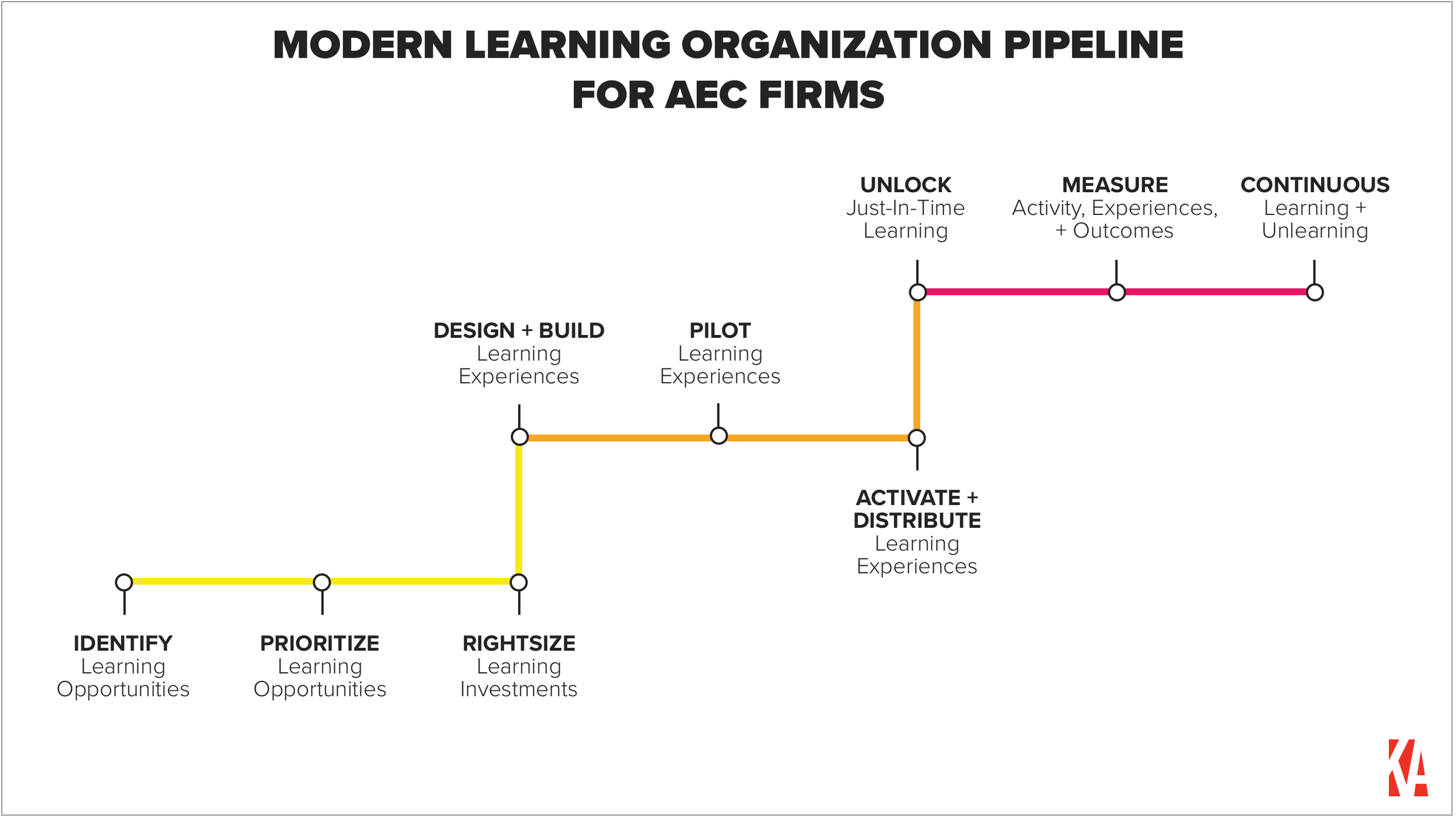
Step One: Identify Learning Opportunities
When I look at AEC firms that are making real progress in learning and development, I notice that they tend to have more consistent processes for identifying potential learning opportunities.
Those processes usually combine multiple channels—top-down, bottom-up, and side-to-side—and draw signals from across the organization. Some of those signals come from formal operational processes. Others come from informal conversations and day-to-day interactions. Together, they create a wide net for capturing what organizations—and the people within them—are trying to learn.
Here are some of the most reliable places potential learning opportunities come from:
Annual performance conversations.
Many firms already ask thoughtful questions during reviews about growth, preparedness, and what would help people do their jobs better. Individually, those answers inform development plans. Collectively, they reveal patterns. When the same needs show up again and again—deepening technical knowledge, better client communication, project management readiness—it’s a signal worth paying attention to at the organizational level.
Common issues caught in QA or CA.
Some of the clearest learning opportunities emerge downstream. Firms like BWBR regularly engage their construction administration and quality assurance teams to understand the most common and impactful issues caught late in the design process. Those insights often point to knowledge or context that, if shared earlier through intentional training, would improve quality and reduce friction long before a project reaches QA or CA.
Informal conversations with learners.
Not all learning needs show up in surveys or systems. Many surface in hallway conversations, over lunch, or during project check-ins. What’s confusing? What feels hard? What would help right now? Modern Learning Organizations treat these informal signals as valuable input, not anecdotal noise.
Subject matter experts and project managers.
Experts and PMs see patterns others don’t. They know which questions come up repeatedly, where teams struggle, and what they wish people understood before joining a project. Their perspective often reveals learning opportunities that save time, reduce interruptions, and raise the baseline capability of the firm.
Strategic direction and future capabilities.
Some learning opportunities aren’t about today’s problems, but tomorrow’s. Strategic plans surface new markets, project types, services, or technologies that require intentional upskilling. Reviewing your firm’s strategy for potential learning opportunities helps connect learning & development programs to where the organization is headed next.
Knowledge continuity and planned retirements.
Many AEC firms face the urgency of impending retirements. Long-tenured architects, engineers, and project leaders carry decades of tacit knowledge—judgment, context, and lessons learned that rarely live in formal documentation. Identifying these moments early creates opportunities for intentional knowledge transfer, mentoring, and learning experiences that preserve expertise before it walks out the door.
Client feedback and external signals.
Clients are often telling firms where learning could make a difference—through formal feedback or everyday interactions. Patterns around communication, coordination, or delivery can reveal opportunities to strengthen skills and shared understanding across teams.
Open intake and suggestion channels.
Many learning teams create simple ways for ideas to surface at any time: suggestion boxes, intake forms, or open calls for topics. These channels rarely produce perfectly formed ideas, but they broaden the aperture and reinforce that learning is a shared responsibility.
Step Two: Prioritize Learning Opportunities
Once learning opportunities begin to surface, most firms run into the same challenge: there are far more good ideas than time, energy, or attention to pursue them all.
Firms that make progress at this stage tend to create simple, shared ways to make trade-offs visible. Prioritization becomes a collective exercise—one that feels thoughtful rather than political, and disciplined rather than reactive.
One approach I’ve found especially effective is using a simple scoring framework to help teams compare and prioritize learning opportunities. I’ve created a framework based on conversations and patterns I’ve seen across many firms that I call DESIRE.
At a high level, it looks like this:
(Demand × Enthusiasm × Strategy × Impact x Reach) ÷ Effort
Each factor is typically scored on a simple 1–5 scale. The goal isn’t mathematical precision, it’s consistency. When teams evaluate learning opportunities using the same lens, patterns emerge quickly and disagreements become productive instead of personal.
Here’s how each part of DESIRE tends to show up in practice.
Demand
How strongly is this learning opportunity being requested? Is it showing up repeatedly in performance conversations, project retrospectives, expert feedback, or informal discussions? High demand is often the clearest signal that a learning experience is needed even if the solution isn’t obvious yet.
Enthusiasm
Who would create or teach this? How motivated are they to do so? Learning experiences are more effective, more engaging, and easier to sustain when the people involved are genuinely excited to contribute and maintain them over time.
Strategy
How closely does this align with where the firm is headed? Does it support future markets, critical capabilities, succession planning, or core business priorities? Strategy helps connect today’s learning opportunities to tomorrow’s outcomes.
Impact
How much difference will this make for each learner? Is it light enrichment, required competence, or potentially transformative? Impact looks at how meaningfully this learning changes someone’s ability to do their job, grow into new roles, or contribute at a higher level.
Reach
How many people will this affect? A learning opportunity that touches a large portion of the firm can sometimes outweigh a highly specialized experience, even if the per-person impact is lower.
Effort
What will it take to design, build, deliver, and maintain this learning opportunity? Effort includes time, coordination, and ongoing upkeep, especially from your subject matter experts. High-impact, low-effort opportunities often rise to the top quickly; high-impact, high-effort opportunities require more intentional planning.
Beyond creating a shared way to score learning opportunities, the most valuable part of using a scoring framework like DESIRE is the conversation it enables.
When learning opportunities are scored by a cross-functional group—often including learning and development, knowledge management, project leaders, principals, subject matter experts, and learners themselves—the differences in scores reveal critical information. Why does one person rate an opportunity as high impact while another doesn’t? Why does effort feel manageable to some and overwhelming to others? Those conversations surface assumptions, risks, and dependencies that would otherwise stay hidden.
Just as importantly, this kind of shared prioritization builds alignment and trust. People are far more willing to contribute ideas when they understand how decisions are made, even when their idea isn’t the one pursued next.
DESIRE isn’t meant to be prescriptive. You should adapt the formula, simplify it, or use a different lens altogether. What matters isn’t the acronym—it’s having a transparent, repeatable process for deciding, together, what learning to invest in now and what to defer.
Step Three: Rightsize Learning Investments
Once learning opportunities have been identified and prioritized, the next question is a deeply strategic one:
How much investment does each prioritized learning opportunity actually warrant?
No firm has unlimited time, attention, or instructional capacity. Strategy, at its core, is the art of distributing limited resources in service of what matters most. Step Three is where that reality meets learning and development.
Not every learning opportunity deserves the same level of polish, permanence, or production effort. In fact, treating them all the same is often counterproductive. Modern Learning Organizations focus on rightsizing learning investments so that effort, quality, and durability are matched to the impact a learning experience is meant to have.
One useful way to think about this is as a spectrum.
On one end are elective enrichment experiences. These are often exploratory, timely, curiosity-driven, and optional. A design crit. A presentation on a new technology. A session sharing research into new materials or emerging practices. These experiences are frequently delivered live, creating space for discussion and exchange, and may be recorded for those who can’t attend or for future reference. Elective enrichment experiences can be incredibly valuable, but they don’t need to be perfect. Light editing, minimal structure, and informal delivery are often exactly right.
On the other end are foundational learning experiences. These are the topics nearly everyone needs to understand to do their job well: firm standards, core technologies and tools, project management practices, quality expectations, and onboarding essentials. These experiences tend to have high reach and high durability. They’ll be used repeatedly, across roles and over time. That’s where deeper investment of intentional design, clearer structure, higher production quality, and a plan for ongoing maintenance pays off.
Between those poles is a wide range of possibilities.
Some learning opportunities may begin as recorded live sessions and later, as demand increases, be refined into higher quality, on-demand courses. Others may combine self-paced content with live discussion, social learning, or role play exercises. Some may be role-specific rather than firmwide, or critical for a particular window of time rather than evergreen.
The key question isn’t what format should we use? It’s what level of investment makes sense given the reach, impact, and durability of this learning opportunity?
When teams ask that question explicitly, they make better tradeoffs. They avoid over-engineering one-off experiences and under-investing in the foundations that quietly shape daily work. They preserve energy for what truly matters, while still leaving room for experimentation and learning in the open.
Rightsizing learning investments also supports sustainability. Learning experiences that are appropriately scoped are more likely to be maintained, updated, and actually used. Over time, this discipline compounds by freeing up capacity to create better experiences where they will have the greatest effect.
Step Four: Design and Build the Learning Experience
Once you’ve identified, prioritized, and right-sized a learning opportunity, this step is about turning that intent into a concrete experience.
Designing and building a learning experience starts with the end in mind. What problem are we trying to solve? What should someone be able to do differently afterward? And when will this knowledge actually matter in their work?
Those questions help ensure that whatever you build—simple or sophisticated—is purposeful, relevant, and worth people’s time.
Designing in proportion to the opportunity
In Step Three, you made a deliberate call about the projected return on investment for a given learning opportunity. This step simply honors that decision.
For many learning needs, a live session taught by a trusted subject matter expert is exactly the right approach. These experiences can be timely, practical, and deeply grounded in real work. Designing here might mean clarifying the audience and outcomes in advance, ensuring strong audio quality, and doing some light editing and post-production afterward so the recording works well for people who engage with it on demand.
That is intentional learning design.
For learning opportunities with a higher projected return—those that are foundational, evergreen, or likely to be reused dozens or hundreds of times—the design choices expand.
This is where it often makes sense to design for on-demand or hybrid delivery from the start. When an experience will be used repeatedly over several years, investing in clarity and quality pays off. Multiple takes allow instructors to refine explanations and create a “golden version.” Thoughtful post-production creates a smooth learning experience. Content can be intentionally broken into shorter sections so people can learn what they need, when they need it.
In many cases, pairing on-demand fundamentals with a live, interactive component—discussion, application, or role play—creates a stronger overall experience than either format alone.
When learning assets are durable and widely used, small improvements in design compound quickly.
Learning experiences can take many forms
As you design, it helps to think broadly about what a learning experience can be.
Sometimes learning is best delivered through a short video. Other times through a written guide someone can reference in the flow of work. It might involve an exercise, a checklist, a worked example, a role play, or a site tour. Often, the most effective experiences combine several of these elements.
Good learning design is about choosing the right mix of activities to support understanding, application, and confidence.
Designing for how people learn and work today
One important factor shaping learning design today is how people now access and use information in their daily work.
Across roles and generations, many of us have grown accustomed to finding what we need quickly, skimming for relevance, going deep when necessary, and having confidence that we can find information again when we need it in the future. Public platforms like YouTube, Google, ChatGPT, and others have reshaped how we solve problems and learn outside of formal settings.
That experience should carry over into work.
AEC professionals want to get to the learning or knowledge they need, apply it, and keep moving. They’re comfortable learning in short bursts, revisiting material as needed, and combining different formats depending on the task at hand.
Modern Learning Organizations recognize this shift and design accordingly. They invest in on-demand-first experiences when the return justifies it, not as a replacement for live learning, but as a complementary mode that aligns with how people now prefer to work and learn.
Involving learners early in the design
Before investing heavily in building a learning experience, it’s often valuable to involve the people you’re designing for.
A few early conversations can go a long way. How do they prefer to learn this topic? What feels confusing today? What would actually help them feel more prepared? Reviewing outlines or early drafts with real learners often surfaces clarity issues long before they become expensive to fix.
Involving learners early helps ensure relevance, strengthens adoption, and makes the eventual pilot far more effective.
Designing and building learning experiences this way—grounded in purpose, scaled to return on investment, and shaped by the people who will use them—is what allows Modern Learning Organizations to move beyond one-size-fits-all training and toward learning that works and engages learners.
Step Five: Pilot the Learning Experience
Before distributing a learning experience more broadly, it’s valuable to pilot it with a small, intentional group.
The goal of a pilot is to increase confidence that the learning experience does what it’s intended to do. Piloting helps clarify where learners get stuck, whether the material helps learners understand the topic, and whether the experience feels relevant and usable in day-to-day work.
One important reason pilots are so effective—especially in expert-led, AEC organizations—is something often referred to as the curse of knowledge.
The curse of knowledge is a common cognitive bias: once you know something deeply, it becomes difficult to remember what it feels like not to know it. Experts may skip steps that feel obvious, use terminology without realizing it needs explanation, or assume shared context that newer learners don’t yet have. None of this is intentional, it’s simply a byproduct of expertise.
Piloting learning experiences with people who are newer to a topic helps surface these hidden assumptions. Their questions and points of confusion reveal where more context is needed, where language can be simplified, and where explanations can be sharpened to better support beginners without diluting rigor.
In Synthesis LMS, learning experiences can be shared as private courses and piloted with a defined group of users. Participants can provide feedback directly within the course, making it easy to capture questions and reactions in context.
Because the experience isn’t live to the whole firm, learning and development teams can pair this built-in feedback with short follow-up conversations to gather deeper, qualitative insight. These conversations often surface nuances that written feedback alone can miss.
Not all feedback needs to be incorporated. But identifying patterns—and addressing the most meaningful points—helps strengthen the experience before it reaches a wider audience.
For evergreen, foundational learning experiences in particular, this brief pilot phase creates space to refine, adjust, and clarify before broader distribution—ensuring that what ultimately scales is clear, usable, and genuinely supportive of learner growth.
Step Six: Activate and Distribute the Learning Experience
Once a learning experience is ready to go live, the focus shifts to helping it reach the people it’s meant to support.
Activating Awareness
Activation begins by letting people know what’s available and why it matters.
New learning experiences may be highlighted through intranet posts, shared in staff meetings or town halls, included in internal communications, or cascaded through managers and team leads. Many organizations use a combination of these approaches, reinforcing awareness through familiar channels.
The goal is clarity. People should quickly understand what the learning experience is, who it’s for, and when it’s most useful.
Distributing with Intention
Beyond awareness, modern learning platforms make it possible to distribute learning experiences in more structured and consistent ways.
In Synthesis LMS, learning can be assigned directly to individuals or groups or distributed automatically using smart assignments. These use attributes such as role, discipline, tenure, or other firm-defined criteria to route learning experiences to both current and future employees.
This approach is especially valuable for onboarding, role transitions, and foundational learning—situations where timing and consistency are critical.
Supporting Self-Directed Learning
Activation and distribution also support autonomy.
Learners in Modern Learning Organizations are able to explore the learning catalog, search for topics they’re curious about, and engage with learning experiences at their own pace. Peer-to-peer recommendations can add another layer, allowing colleagues to surface relevant learning for one another based on real experience.
Together, these pathways create multiple, complementary ways for learning to reach people.
Creating Intelligent Flow
At its best, activation and distribution help learning move through the organization smoothly.
Learning and development teams often describe this work as routing—similar to air traffic control—where the goal is to deliver the right learning experience to the right person at the right moment. With automation, assignments, recommendations, and discovery tools in place, that routing becomes both more reliable and easier to sustain as the organization grows.
Step Seven: Unlocking Just-in-Time Learning
Up to this point, much of this pipeline could have been written years ago.
Identifying learning opportunities. Prioritizing thoughtfully. Designing learning experiences with care. Piloting before broad distribution. These are enduring practices, and they matter just as much today as they did a decade ago.
This step is where something genuinely new enters the picture.
What’s changing now isn’t simply when people learn. It’s how learning happens in the moment of real work.
From Linear Learning to Dynamically Assembled Learning
Traditionally, learning has been consumed in a linear way. You read a document from top to bottom. You watch a video from beginning to end. You attend a session and follow the sequence as it’s presented.
Even on-demand learning largely follows this model. The learner adapts themselves to the structure of the content.
What platforms like Synthesis make possible—by integrating intranet content, learning experiences, and AI-powered search—is a fundamental shift in how learning happens in the flow of work.
Instead of moving through pre-assembled learning in a fixed order, people can now dynamically assemble the knowledge and learning they need, in response to a specific question or situation. Learning becomes non-linear, contextual, and highly personal.
A Concrete Example
Imagine an architect working through a nuanced design question late in a project—something specific enough that it doesn’t map cleanly to a single course or document.
They ask a question.
In response, the AI search draws from across the firm’s knowledge and learning foundation: a relevant standard, a lesson from a course, a best practice captured in a guide, a recent lesson learned from another project. These sources are synthesized into a clear, grounded answer with the underlying sources cited so the architect can explore further if needed.
They’re not just handed a list of resources to sort through. They’re given an answer, tailored to their context, with clear links to validate the response if needed.
That’s a fundamentally different learning experience. A just-in-time learning experience.
Why This Changes the Return on Learning
For most of the history of learning and development, organizations have been good at knowledge capture and distribution, but they have struggled with knowledge retrieval—especially in the flow of work.
This is the breakthrough.
When learning is dynamically retrievable, it stops being something people “complete” and starts being something they use. Courses, guides, and expert insights gain a second life through recall and application. The return on every learning investment increases.
Just as importantly, subject matter experts see that what they create is easier to find, more likely to be used, and more clearly connected to real outcomes. That visibility changes behavior. People are more willing to contribute when they know their knowledge will be used.
Unlocking just-in-time learning doesn’t replace traditional learning experiences. It amplifies them by making knowledge and learning available in the exact moments they’re needed.
Step Eight: Measure Activity, Experience, and Outcomes
A Modern Learning Organization treats learning experiences as assets that can be measured and improved over time.
In practice, I’ve found it helpful to think about learning measurement across three distinct levels: activity, experience, and outcomes. Each one answers a different question, and together they provide a clearer picture of how learning is functioning across the organization.
Activity
At the most basic level, organizations need to understand whether learning is actually being used.
Are people engaging with the learning experiences you’ve created? Are they enrolling in courses? Are they completing the courses? If not, where does engagement stay strong, and where does it drop off?
Activity data also reveals patterns across the organization. You can begin to see which roles or teams are highly engaged in learning and which aren’t. That opens up more constructive conversations: Are certain groups unaware of what’s available? Do they not see the relevance? Do they feel too busy to engage? Are the formats effective? Are there important topics which aren’t being addressed?
Activity data like this provides invaluable signals for strengthening learning experiences over time.
Experience
Engagement alone isn’t enough. Understanding how people experience learning is critical to creating high quality learning programs.
This is where qualitative feedback plays a critical role. Are learning experiences clear and well-paced? Do they feel relevant to real work? Do learners leave feeling more confident, or more confused? Would they recommend this experience to a colleague?
Modern learning platforms, like Synthesis LMS, make it easier to gather this feedback directly, while the experience is still fresh. Learning teams can supplement that data with short follow-up conversations—especially for foundational or high-impact courses—to better understand what resonated and what didn’t.
Over time, this creates a feedback loop that improves quality. Learning content becomes clearer. Formats become more intentional. And trust grows between learners and the system that’s meant to support them.
Outcomes
Ultimately, learning exists to improve something.
Sometimes that improvement is visible quickly: fewer errors, better project coordination, smoother onboarding. Other times it shows up more gradually: stronger judgment, more consistent practices, or increased confidence in new roles.
One of the strongest examples of this comes again from BWBR. As mentioned above in step one, their technical learning programs are informed upstream by QA and CA feedback—where patterns in drawings and project issues are surfaced. But they don’t stop there. BWBR also maintains a QA/CA scorecard for projects, which allows them to see whether those learning investments are actually moving the needle over time.
That feedback loop matters. It connects learning directly to performance, and it gives firm leaders and subject matter experts something rare: evidence that their work is improving outcomes the firm already cares about.
Step Nine: Continuous Learning and Unlearning
The work of designing, building, and maintaining a Modern Learning Organization is never finished.
In AEC, the conditions that shape our work are constantly shifting. Technologies evolve. Codes and standards change. New materials and methods emerge. Firms enter new building types, services, and markets. Client expectations rise. Buildings become more complex. What mattered deeply a few years ago may have changed, become less relevant, or need to be understood differently today.
Continuous improvement isn’t a phase at the end of the pipeline. It’s the posture of the organization itself.
Continuous improvement starts with continuous learning. New learning opportunities will keep surfacing as firms grow, experiment, and adapt. The pipeline you’ve built doesn’t run once and stop. It keeps cycling—identifying emerging needs, prioritizing thoughtfully, and investing where learning can make a meaningful difference.
But just as important is continuous unlearning.
As knowledge and learning become more integrated into daily work—especially through AI-powered retrieval and just-in-time access—everything becomes easier to surface. That’s a powerful shift. It also means that outdated, incomplete, or no-longer-authoritative content doesn’t simply hide in obscurity anymore.
Modern Learning Organizations design for this reality. They review learning experiences over time. They clarify what’s current and what’s historical. They retire content that no longer serves the firm. They make space for new thinking to replace old assumptions.
Continuous improvement also means staying open to new ways of learning. As technologies change and new formats become possible—digital, in-person, hybrid, synchronous, asynchronous—learning leaders continue to experiment. They listen closely to learners across roles, generations, and career stages. They pay attention to what builds confidence, accelerates capability, and supports real work.
Over time, this creates something deeper than a learning program. It creates an organization that expects learning and unlearning to be part of professional practice. One that sees knowledge as something living—shaped, refined, and renewed as the firm itself evolves.
That’s how learning stops being episodic and becomes systemic. And that’s how a Modern Learning Organization stays adaptable, resilient, and effective over the long arc of change.
A Closing Note
I don’t expect this definition of the Modern Learning Organization Pipeline to be the final word. Like the learning systems it describes, it will evolve as firms experiment with it, adapt it to their context, and discover what works best in practice. My goal here is to offer a shared starting point which can be refined over time through use.
If the pipeline model resonates with you, I’d love to hear what rings true, what’s missing, and where your firm’s experience aligns—or challenges—the model. Much of this thinking has been shaped by conversations with this community, and it will continue to evolve through it.
We’ll be unpacking these ideas across the Smarter by Design ecosystem this year—here in the newsletter, on the Smarter by Design, and through upcoming webinars—as we learn alongside firms putting this work into practice.
This theme will also be at the heart of KA Connect 2026, our knowledge and learning management conference for the AEC industry, taking place August 11–14.
I hope you’ll join us. Stay tuned for the next issue!

Join Us in Exploring the Future of Learning & Development at AEC TalentMAX 2026
We’re excited to share that Knowledge Architecture has curated a dedicated Knowledge & Learning Management track for PSMJ’s AEC TalentMAX 2026 conference, including main stage keynote presentations, a panel discussion, and multiple breakout sessions.
AEC TalentMAX will take place May 27–29, 2026 in Austin, Texas.
The focus of our track will be on the future of learning and development in AEC. Specifically, how firms are increasingly investing in becoming modern learning organizations—which blend knowledge management, learning and development, and artificial intelligence into a more integrated and intentional approach to capability building.
If you aren’t familiar with it, AEC TalentMAX is the essential skills and strategy conference for architecture and engineering firm leaders committed to sourcing and engaging the best employees, keeping them enthusiastically engaged, and providing them with the knowledge and learning management tools they need to excel.
Christopher Parsons, our Founder and CEO, will be delivering a keynote and facilitating a main stage panel discussion. An outstanding group of KA community members will be sharing real-world insights and case studies from their firms during the breakout sessions.
We believe it’s going to be an excellent few days—thoughtful, practical, and inspirational. We hope to see you there!

We’re excited to share that Knowledge Architecture has curated a dedicated Knowledge & Learning Management track for PSMJ’s AEC TalentMAX 2026 conference, including main stage keynote presentations, a panel discussion, and multiple breakout sessions.
AEC TalentMAX will take place May 27–29, 2026 in Austin, Texas.
The focus of our track will be on the future of learning and development in AEC. Specifically, how firms are increasingly investing in becoming modern learning organizations—which blend knowledge management, learning and development, and artificial intelligence into a more integrated and intentional approach to capability building.
If you aren’t familiar with it, AEC TalentMAX is the essential skills and strategy conference for architecture and engineering firm leaders committed to sourcing and engaging the best employees, keeping them enthusiastically engaged, and providing them with the knowledge and learning management tools they need to excel.
Christopher Parsons, our Founder and CEO, will be delivering a keynote and facilitating a main stage panel discussion. An outstanding group of KA community members will be sharing real-world insights and case studies from their firms during the breakout sessions.
We believe it’s going to be an excellent few days—thoughtful, practical, and inspirational. We hope to see you there!
Knowledge + Learning Management Talks
Modern Learning Organizations: Rethinking AEC Learning & Development in the Age of AI
Christopher Parsons, Founder and CEO, Knowledge Architecture
Breaking Down Silos in AEC: Building a Culture of Learning and Psychological Safety
Angela Watson, President & CEO, Shepley Bulfinch
Upskilling Your Next Generation of AEC Talent: Inside BWBR’s Approach to Developing Emerging Professionals
Dan Hottinger, Principal, Director of Professional Services, BWBR
Kari Shonblom, Knowledge Manager, BWBR
Connect the Dots: The Evolution Toward a Learning Organization
John Robison, COO, KTGY
Donovan Helminiak, Director of KM, KTGY
A Firm Leader’s Perspective: Why Knowledge Management Became a Strategic Imperative
Kevin Hinrichs, President, Taylor Design
Stefnee Trzpuc, Founder and CEO, Flow Theory
Never Finished: From Academy to Ecosystem at Turner Fleischer
Ellen Bensky, CEO, Turner Fleischer
Nihar Bawa, Manager, Learning + Development, Turner Fleischer
Learning at the Speed of Change: Adapting L&D to Your New AEC Workforce
Kristina Williams, Director of Design Technology, Lionakis
AEC Expert Panel: Redesigning How AEC Organizations Learn
Ellen Bensky, CEO, Turner Fleischer
John Robison, COO, KTGY
Kari Shonblom, Knowledge Manager, BWBR
Moderator: Christopher Parsons, Founder and CEO, Knowledge Architecture
Why AEC Firms Are Leveling Up as Learning Organizations Now | Turner Fleischer and Greenprint
In this episode of the Smarter by Design podcast, I’m joined by Ellen Bensky, CEO of Turner Fleischer, and Nicole Chavas, President and COO of Greenprint Partners, for a wide-ranging conversation about what it takes to level up as a learning organization in the AEC industry.
As both firms evolve beyond primarily live and synchronous training models, Ellen and Nicole share how they’re building systems to deliver the right knowledge, to the right people, at the right time—while reducing overload and lifting the burden from learning leaders to serve as “air traffic controllers.”
We explore how integrating their learning management systems with their intranets and AI Search is helping their teams access critical information in the flow of work, as well as how that shift is also encouraging more subject matter experts to contribute knowledge, knowing it will reach the right audience at the right moment.
We also dive into the mindset shifts required to scale learning effectively. From navigating the balance between live and on-demand learning, to designing hybrid programs that combine asynchronous content with meaningful human interaction, Ellen and Nicole show how their teams are rethinking training as a design problem—one centered on empathy, access, and adaptability.
This episode is a candid, behind-the-scenes look at how two growing firms are building learning organizations that reflect the pace of modern practice, the needs of emerging professionals, and the realities of day-to-day AEC work.
If you’re grappling with learning at scale, looking to reduce information overload, or wondering how to balance video, in-person, and AI-powered tools, this conversation offers fresh insight and practical ideas.
▶ Watch or Listen
Watch or listen to this episode via YouTube, Spotify, Apple Podcasts or wherever you get your podcasts.
In this episode of the Smarter by Design podcast, I’m joined by Ellen Bensky, CEO of Turner Fleischer, and Nicole Chavas, President and COO of Greenprint Partners, for a wide-ranging conversation about what it takes to level up as a learning organization in the AEC industry.
As both firms evolve beyond primarily live and synchronous training models, Ellen and Nicole share how they’re building systems to deliver the right knowledge, to the right people, at the right time—while reducing overload and lifting the burden from learning leaders to serve as “air traffic controllers.”
We explore how integrating their learning management systems with their intranets and AI Search is helping their teams access critical information in the flow of work, as well as how that shift is also encouraging more subject matter experts to contribute knowledge, knowing it will reach the right audience at the right moment.
We also dive into the mindset shifts required to scale learning effectively. From navigating the balance between live and on-demand learning, to designing hybrid programs that combine asynchronous content with meaningful human interaction, Ellen and Nicole show how their teams are rethinking training as a design problem—one centered on empathy, access, and adaptability.
This episode is a candid, behind-the-scenes look at how two growing firms are building learning organizations that reflect the pace of modern practice, the needs of emerging professionals, and the realities of day-to-day AEC work.
If you’re grappling with learning at scale, looking to reduce information overload, or wondering how to balance video, in-person, and AI-powered tools, this conversation offers fresh insight and practical ideas.
▶ Watch or Listen
Watch or listen to this episode via YouTube, Spotify, Apple Podcasts or wherever you get your podcasts.
📺 🎧 YouTube
📺 🎧 Spotify
🎧 Apple Podcasts
📃 Episode Transcript
This transcript was lightly edited for clarity.
Chris: Hello and welcome to the Smarter By Design Podcast. I'm your host, Christopher Parsons, founder and CEO at Knowledge Architecture. My guests today are Ellen Bensky, CEO at Turner Fleischer, and Nicole Chavez, COO at GreenPrint Partners. Susan Strom, the Chief Client Officer at Knowledge Architecture also joins us for this episode as a co-host, and our topic is why AEC firms are leveling up as learning organizations now.
Ellen leads an architecture firm. Nicole leads an engineering firm. Ellen's firm, Turner Fleischer has been around for about 50 years, and GreenPrint Partners has been around for just over a decade. Turner Fleischer has a formal learning and development program that's been evolving for a long, long time.
GreenPrint Partners, is much earlier in that journey. And yet both firms are investing in leveling up their firm's approach to learning and development and taking a serious rethink of the way they do it going into 2026. Why? This is what we wanted to talk about in this episode.
Obviously AI is a big factor. The expectations also of newer generations entering the workforce, who are used to on-demand knowledge—they grew up with Google and YouTube and TikTok, and they want knowledge when they need it in the flow of work. So a lot of our conversation was about finding the balance between creating on demand knowledge and on-demand training opportunities versus the time when you wanna go live and in depth and have more human conversations, mentoring, and shared reflection.
This isn't an either/or problem. It's a both/and problem. It's a yes/and opportunity. So a large part of our conversation is about how you know when to lean into each one. We also explored putting new learning experiences into the mix—moving beyond the traditional 60 minute recorded lunch and learn and into new learning experiences designed with adult learning principles in mind.
One of the things we talked about is how administratively heavy learning and development is right now. There's almost an air traffic control aspect to it where you're trying to route the right knowledge to the right person at the right time, and that's heavily manual and dependent on a couple people that make the whole thing go.
Both firms are looking at building much smarter approaches and systems to automate a lot of that and take the burden off of individuals and let them spend more time crafting those modern learning experiences in the first place.
More than anything, what I really love about this conversation, it feels like we're at the beginning of something.
In some ways, learning and development in our industry has only really incrementally changed over the last 25 years, and it feels like we're at the beginning of something that's going to radically change the way we do learning and development in AEC. Both Ellen and Nicole are right there leading their firms in the thick of thinking about what these new modern learning experiences look like.
It's a thoughtful, ambitious conversation with two leaders who are trying to get this right, and if you're wrestling with similar questions in your own organization, I think you're really going to enjoy this episode.
Okay, so Ellen Bensky of Turner Fleischer, Nicole Chavas of GreenPrint Partners on why AEC firms are leveling up as learning organizations now.
Here we go.
Susan: So Chris, you recently wrote this Smarter by Design issue on Leveling Up as a Learning Organization, and I'd love to know what feels so different and timely about that conversation right now in the AEC industry.
Chris: Yeah, the background of this—for folks in our community who don't know, we've been running a private beta of our Synthesis LMS since late June, early July. We're in three cohorts now. One of the things that's been really interesting in those betas is that the conversation has been 20% about technology and 80% about learning strategy, philosophy, process, team, structure—all that non-technology stuff. That's been the majority of the conversations.
What most of the firms in the beta have kind of—they've all been doing learning and development, but you can't be an AEC firm and have evolved longer than five years and grown and added people without being a learning organization of some sort. As you bring new people on, they have to learn to do their work. As people move to new levels or you take on new building types, all that stuff happens.
Most firms were doing knowledge sharing, lots of lunch and learns or informal mentoring, learning on the project, which are all great things—firms should continue doing that. But what I think the LMS unlocked for them was a broader picture. It's like, well, we're not really doing systematic knowledge transfer. We're not understanding a system of how people learn the way that we do things in our company. If they want to become a project manager, do we have a systematic way of helping them go through that journey? If they want to start working on retail projects because they've worked on commercial projects, do we know how to do that?
It's raised all these questions about how to be more intentional. Can we do it more by design rather than being serendipitous?
So much learning and development is, at least according to the folks in our cohorts, X person is interested in this topic and they're available next Thursday, so they'd love to talk about it. It's a lot of catch as catch can, and we kind of go with what we have. I think what has come out of this—in order to have a good learning management system and good delivery, the bigger picture question is, how do we get more intentional about being a learning organization? And they take a step back from actually creating content and start having these much bigger conversations.
What I try to do in this issue is reflect back what I'm hearing in the community—they feel like this is a really great time to level up because the business is changing super fast. Baby boomers are retiring, there aren't that many Gen Xers demographically, so millennials are getting put into these leadership positions and management positions faster than ever before. How do we upskill them more quickly?
You've got all this technology change with AI, with video tools becoming more accessible. You've got this expectation out of your workforce that I want to get stuff on demand. I want it to be quick. I want it to be to the point. I don't want to sit in an hour-long course six weeks from now. Just help me get the knowledge I need to keep making progress now.
I think that business driver, technology driver, workforce driver—it just feels like this is a moment for AEC firms to really rethink how they're doing learning and development.
Susan: Yeah, that makes sense. I'm feeling the same thing. I'm in the same sessions with you with our LMS beta firms and this is so clear.
Ellen and Nicole, you are not in all those rooms with Chris and me—you are in different rooms in your firms, and you came up to us at PSMJ Thrive about two weeks ago after this article was out and said, this really resonates with me. So I'd love to hear what feels so timely and urgent about this leveling up learning in your organizations right now from your perspective?
Ellen: Absolutely. Our story is so funny with this because we spent so much time thinking, “Oh, we have TF Academy. We don't need an LMS, and we do this all.” What I love about this is what I love about so much new technology, whether it's AI search or anything—it makes you reflect back. Suddenly we have so many applications for an LMS that exist in our organization, and it's almost like every day we're thinking about a different use case for it.
Now it's almost like, okay, slow it down. Let's try it out in one area. For example, People and Culture onboarding—we're doing this, but are we doing it great? No, we're not doing it great because it's a bunch of meetings to set up and it's one at a time and it takes two people's time and it's not that efficient, and there's only so many hours in a day and in a week. But wait a minute, if we can put this up on an LMS and have it be a learning path that somebody coming into the organization goes through, we've just become so much more efficient. I'm sure at the end of the day, it’s so much more effective.
Now we're looking across our studio and thinking, what else are we doing that we could be doing better if we leveraged the LMS? That's across current workflows. That's across learning training that we're not doing. That's across tacit knowledge transfer of people. I feel like we're in front of a fire hose with the LMS. It's all coming at us now. We've unlocked all of the different ways to dream about this, and now it's sort of like, okay, let's try and let's get a system in place so we can start codifying more of this within the system.
I'm super grateful to be in this space where we can take that look across everything that we've got going in our studio and determine how many paths are we going to have and how are we going to implement this and how are we going to use it.
Susan: What is different about using the LMS for something like onboarding that, for you, seems like it unlocks all this other potential? What's the—and I know the technology difference, but I'm curious about the opportunity that you're seeing. Could describe it more?
Ellen: Yeah, that's a great question. I'm grateful we've got a deep learning and development team, so we can take their adult learning principles and we can leverage it into how we're creating content to have the best impact. As opposed to the person who has the time meeting with the person, and sometimes those conversations don't necessarily go where you want them to go. We can be more intentional with what we want to learn when we get it up in the LMS. While sometimes it's good to have a free-flowing conversation, sometimes you really want to make sure that the information you're presenting and how you're presenting it is going to actually impact somebody's ability to take it in and learn while the other person isn't in the room.
Chris: So like quality?
Ellen: Yeah. I think there's a space for everything, but I think what we're looking at is, okay, what is the design of our courses going to be? We're working with our L&D team to intentionally figure that out, to try and achieve the best outcome, right? Then when we think about it across many things that we do, we'll be able to replicate a lot of the same theory behind it faster and get more out. Because once you open that mindset, everybody wants everything. It's like, oh my God, I want learning, not technical learning. I want this kind of learning. I want all the knowledge from this partner's head. All of a sudden I want it in here.
Susan: Yeah. That's really interesting. Thank you so much for sharing that context. All right, Nicole, I'd like to hear what resonated for you?
Nicole: Yeah, so we're small. We're 38 people. And we're just starting to dip our toes into learning management. Our world has very much been what Chris talked about where it was just serendipitous opportunities, lunch and learns, a monthly staff meeting where you hope you can get some information out that everyone can absorb, and then a lot of content sitting out on drives that no one ever really read.
One of the messages that I've been hearing from our team this year has been one of information overload. There is just so much information, whether it's trying to get them up to speed on HR practices, new project management processes, new skills they're supposed to be developing to grow, and it's too much information. They don't know how to get it when they actually need it. It comes to them when they're not in the space to really take it in, and then when they actually need it, they don't remember what it was.
I've been feeling a little bit paralyzed about how I can address this for my team other than just keep trying to get information to them constantly. So one, just seeing that this is a problem for everybody, but then two, seeing that there's actually conversations happening and a path forward to try to address that was just really exciting for me. How can I create a learning management system that can help make that information available to them when they need it so that there's paths ready for them to go?
I don't need to be the one hovering over them—oh, are you, do you need this information now? Are you ready for it? How can I get it for you? I can focus more on building amazing content and having it be at their fingertips.
The other thing that's a little bit unique to us is that we're very multidisciplinary, so we have urban planners, civil engineers, and landscape architects, and we also very much have a learning culture. It's something we screen for. We look for all of our team members to be intellectually curious and they love to learn from each other. So we not only need them to learn their own discipline, their own skills, but they benefit from learning. The engineers benefit from learning how planners think and how landscape architects think, and it makes them better engineers and they're just crying out for ways to learn from each other.
And it’s also happening on projects where they're working together or maybe they get to see it on a staff meeting, but to have more opportunities and for everybody to get to learn together is also something that people really, really want. Seeing this learning management system as a way to try to actually better curate that and capture that and have it accessible at any time for everybody, I can just really see elevating our ability to truly be a learning organization.
Chris: It seems like, Nicole—I'm playing back what I think I heard you say—on one hand you have an approach, which is we're just going to broadcast, so we have this new thing we're going to tell everybody all at the same time because that's efficient. Or you do the—I like the word you use—hovering, where you're constantly having to figure out, well, I'm not going to broadcast, I'm just going to hold onto this thing and I'm going to move this thing to that person, this thing to that person. And we've been using this metaphor of air traffic control when we've been talking about learning and development—trying to land the right plane at the right time and get people safely to their gate.
We don't have to torture the metaphor too much, but it seems like the middle ground is really the alternative. The great one, right? Not the crazy labor that you have to do hovering as a learning person, but then the broadcasting thing's not great for your people. The sweet spot is just getting people what they need at the right time. Is that kind of where you were going with that?
Nicole: Exactly right. I think a lot of it has been overly reliant on me to be in the right room to hear the need and make the connection—oh, did I hear you're wanting to learn about this? Let me connect you to so and so. And that is not a sustainable path. I need to take my brain, as a founder and the COO, and help get that out there so people can make those connections themselves. And I can remove myself from being that air traffic control and I can focus on building the content, which is something I'm really excited to kind of shift to.
Chris: So you are the LMS right now…
Nicole: Yes. So true. Yes.
Chris: One of the reasons I wanted to bring the two of you together, besides what Susan said about you both being in Chicago at PSMJ, is that you're both very senior in your organizations and led and drove the implementation of Synthesis as a knowledge base. Now your organizations are doing the learning management stuff. Ellen has a great story of them building something like 700 Wiki pages in six months or whatever you guys did during implementation. And Nicole, similarly over Christmas break, you basically built your intranet while watching TV. Is that kind of what happened?
Nicole: That's right.
Susan: You’re very talented.
Chris: I'm kind of curious and maybe we can start with Nicole. Why now in this journey for GreenPrint, going back to maybe intranet knowledge management, but as you look forward to learning and development, why did that become an important thing for you to invest in at this point in your journey as a company?
Nicole: We grew a lot in the last couple years. We were about 10 people in 2020 and then in 2020 business really started booming. We grew to 20. Last year we acquired a landscape architecture firm, so we added a whole new discipline to our business. Then we hired seven more people this year. So with that growth came a lot more people who needed to get up to speed, more processes I needed to institutionalize a bit to take us to the next level. When you start hitting that 20, 30, 40 mark, you really have to get a little bit more institutional in how you run the business.
My little system of employee resources, Google Drive, policies and procedures was starting to falter, and I was getting into that air traffic control mode, trying to connect older employees with new people, catch older employees up to what we've been doing. And that's when the stress really started to build. It was not working. Then I saw—it was Susan, you did a webinar on something and presented Synthesis and I was just like, this is it, this exists. I didn't know this was an option. I thought I was going to have to keep building things myself. This is made for me, for my industry, and I would like to just hire the people who know what they're doing instead of trying to build things myself.
I'm trying to make that my mantra—hire the people who know what they're doing and stop trying to build things myself so I can elevate. So I thought, “This is it. This is what I've been looking for.” And I was so eager because it solved such a huge problem of mine, of maintaining this awful Google Drive and feeling like nobody knew where to get information, that we signed up. When you are the decision maker, you can make a decision immediately. I had the problem, I had the budget, so… sold.
I was so eager to get the team on it that we decided to focus on getting our just HR policies and procedures up before launch. Then I just spent Christmas break—I was just home with my parents, watching TV. We'd put the kids to bed, watch TV, and I would sit on the couch and copy/paste everything from that Google Drive into our LMS. It just felt like, one, it was very therapeutic, but I could just feel that burden lifting.
Chris: You were getting out of debt. Everything you move off, you're paying down a credit card.
Nicole: Yeah, it was therapeutic. It helped me move things forward and it got us off to a really great start this year with centralizing that information, and then gave us a foundation to build on from there.
Chris: I think you signed in December and Sarah Davies on our client success team who's running your project—we got back from the holiday break, she goes, oh my gosh, Nicole built her intranet over the holidays and it's done. So that was funny.
Susan: It's so interesting having both of you on because it's such a different level of resource in your organizations. Nicole, you're kind of doing all of this now. You're at 38 people and Ellen, you have a full L&D team and a KM team. I just think it's fascinating.
Ellen, for you, you've built all this stuff and you continue to be involved, right? You are at this table having this conversation and you have not let go of this priority for the firm. I'm curious, being at this point where you have leaders, you could choose to step away a little bit if you decided that was the strategic choice for the firm, but you don't. What keeps you in the seat with L&D, pushing forward? I guess I'll also call out that you've spoken at KA Connect on this topic multiple times. I've recently talked to someone who wants to work with Synthesis and one of their reasons was “I want to be like Ellen Bensky.”
Chris: Right, but then your view is we need to go to the next level. So internally, you guys are like, but we're not. We need to be.
Ellen: No, and it's so fascinating because I'm listening to Nicole speak and I feel like I'm in part in the same place as Nicole because I'm looking at what we built and I'm looking at the pace of change and I'm looking at the need to take what we built, but the needs of people are totally different now. And so we've talked about this, about our project of redoing our Wiki pages and I need to stay in it because to me, it's all part of driving the company forward. Because I can't drive the company forward to where it wants to go if I don't take everybody with me on this knowledge and learning journey.
What I'm seeing and what I want to be creating, so much of it comes back to KM and L&D. The whole concept of a new clarity and simplicity and having really concise Wiki pages that explain why is something that I'm bringing across the organization and how we work and everything we do, how we work with our clients. Everybody in the world wants these things differently. It's not just internal, it's also how we're dealing with people externally. From my perspective, the responsibility of my role is to look at all of those things and ensure we're moving forward as an organization. Knowledge management and learning are part of the foundation of it for me, for sure.
Nicole, you said something that really resonated with me in terms of project management or how do people know what they're supposed to know on how to do things? One of the areas that I'm excited to be able to leverage the LMS in is those exact workflows. We've written a lot of Wiki pages describing workflows, but I'm thinking if we can get them in learning paths and we can have people talking about them, that I think it'll make a huge difference.
I know when I go into a room and I explain a workflow to people, and they've got the Wiki as a reference, having both of those together is really powerful. If we can leverage the LMS in financial project management, and I can walk them through: this is when you're doing this data review, this is why, and when you hit this moment, this is what you're looking for. I think that having the video and the explanation from the subject matter expert is going to be an incredible combination to demonstrate that why to people, which no matter how clearly we write the Wiki pages and we're writing this paragraph of why do we do this this way at Turner Fleischer, there's something when you hear it from somebody themselves, to be able to go through it in parallel.
For me, Susan, I couldn't be the leader that I want to be if I wasn't constantly bringing all of this together and having it all be important and all make sense to the overall strategy of where we want to go as we continue down this journey.
I'm so grateful for two things. I'm so grateful for AI search because not only is it a great tool and we can get knowledge, but it showed us where we needed to get better. The LMS is doing the same thing from a learning perspective. We knew technical training—we don't have enough Revit training, we don't have enough really technical training. We've got a big digital department. We're like, oh yeah, go talk to Artyom. But this is giving us the impetus and that push to actually get something done. Because before we had the ability to leverage an LMS, again, to your point, Nicole, it might have lived on Newton, but how were we going to get people access to it and know that they looked at it and could then see if it made an impact? It's really important to keep sight of everything. That's what I am privileged to be able to do. But I'm also privileged to have people that are experts in L&D and in KM putting all of this together for us.
Nicole: I want to build on something you were talking about Ellen, on the SOPs. PSMJ just recently had some bold statement that the SOP is dead. And I actually disagree. I think AI search is bringing back the SOP and I'm starting to see the value. I'm just starting to see how it all fits together, where you need these detailed processes. They're essential, and I do not expect anyone to ever read them. AI search makes whatever you need from them accessible at any time, and you can just focus on what you need. That also has been influencing how I'm thinking about doing trainings, because I think in the past I would've done a training like, okay, here, I'm just basically reading you the SOP because this is my moment to get you to understand the SOP. And now I can give a training that's a little bit higher level, a little bit more about the why. Why is this important? Here's an overview of how it all works. Now that you've got that in your brain, you have the SOPs, you have the toolkit, and you can now dig deeper in that if you want because you're so pumped up about this. Or you can use AI search to get to the specifics when you're ready for it. I see it as this whole bigger picture of the detailed SOPs, the AI search, and then higher quality, higher level trainings that focus on the why instead of the how.
Chris: And that person, if they're not applying that SOP today, what's the point in teaching the detail anyway? It's just a waste of energy. I couldn't agree more with you that the SOP is alive and well for another reason that you didn't bring up. As we start having more agentic employees in our work, if we ever want agents to be able to help us do work, you've got to teach the agent the SOP. Even more important than an employee. In order for agents to work—they have the context—they have to know what good looks like. You have to teach them the way you want to work, and so you get this double benefit of really explaining how your firm works and standardizing it helps employees have more clarity, but it also helps the AI agents have more clarity.
Ellen: And to that, Chris, if you've got AI on top of it all and you've got the subject matter experts talking about the why in the LMS and people, and then you've got the Wikis that are getting into the details of it, you've got everything that you need for people to get the knowledge that they need.
Nicole, for you as a growing organization, as you continue to add people and you continue to have more complex processes, what better way to onboard them to what's unique about GreenPrint than be like, hey, take these three learning paths over here and then take a look at these documents over here and boom, you've got somebody who's got both and can hit the ground running way faster.
That's where it never ends. Even at the size we are, every time we onboard somebody, you can just imagine, we have a lot of processes and there's a lot of whys. Why do we do things in this unique way? I have the reverse problem because we've been around for so long that I have people that—these people exist and we know them, right? I'm good. I'm going to just keep doing the thing that I was doing and I'm going to keep doing it the way that I'm doing. And then six months later, 10 things have changed and they're way behind, right? They don't have time, but if they could go into an LMS and they could say, oh, let me understand why they did this? I can bring people who have been here a long time with us as we continue this rapid pace of change.
Chris: Ellen, to your point, for that person, having videos that are succinct and on point and are done with adult learning principles—if it's five to seven minutes of a video versus in a staff meeting and we're going to ramble on. I don't mean to say that everyone rambles in staff meetings, but you know how it is. There's a way to be much more efficient and to the point in this scenario that connects with them. I think the other piece of it, I'm imagining this new world that you're both kind of describing. If I'm a new employee at GreenPrint, I get some stuff from Nicole, I get some stuff from Aya, I get some stuff from April. And you guys are multi-office, so I'm also getting to connect with these personalities really early and start figuring out who they are. And when you're telling them the why, you're also communicating with non-verbal—you're also able to communicate “this is serious and we're passionate about it.” And this is beyond just text…
Ellen: That's a really good point. Even though we just have one office, we don't have people that know each other because of hybrid and because of other things. Or they're worried, they don't want to go up and talk to Russell because his name is on the door. But if Russell was describing something through a video and then they had a Wiki and they could put all of that together, they would automatically feel more of a connection to be like, hi, because they've gotten to know who he is as a person by listening to him share something.
Susan: We've mentioned a few times, and for anyone who's not super familiar with at least the Synthesis LMS, it's on-demand learning: videos, lessons that you can interact with on demand—asynchronous. You're not in the room with Russell. You're watching a video of Russell, which extends Russell's reach and allows him to be Russell with a hundred people a year without totally depleting him, and giving everyone the same high-quality experience. But that does not allow you to ask Russell a question in the moment, which is also really valuable.
One of things that I've been thinking about and we've been navigating is: when do we do synchronous moments and when do we do asynchronous moments and when do we really intentionally build some moments for hybrid learning where you do something asynchronous, you watch the video with Russell, but then you sit down and you talk with your PM about project finance or you have 30 minutes with Russell and all the other new hires on a Friday to ask questions in a synchronous moment. We don't want to lose that. We want to build relationships and connections. I don't think having videos breaks relationships and connections at all, but I also know that there's this other part of it, too.
I'm curious what you both think about that and if this is something that you're starting to form an idea on today. It's also okay if that's not the case, it might be something that we'll be figuring out over the next couple years. And no doubt, that will be true as well.
Ellen: We're literally redesigning that as we speak. Redoing our whole learning community on Newton, our Synthesis platform, to have it be across typologies of learning and not just focused on programs that learning and development may be offering. Right now it's heavily TF Academy focused. We're literally having an on-demand learning section in the community. We're having program-based learning in the community. We're having mentorship as a path, we're having learning events as a different section to actually do all of that and have people understand we have all of these different ways of learning.
If you want to learn in an asynchronous manner, you go into the on-demand section and these are the tools that you have. That's where, for example, the LMS will live. But if you really want a synchronous experience, look at TF Academy and see all of the scheduled and planned opportunities that you can do in person or hybrid. It's caused us to really accelerate getting this way of thinking and getting this out to the studio sooner because we didn't have all of these different types of learning before.
It's really pushing us to create our framework. Whereas we were typically too busy. We didn't have a framework. We were just doing—let's do this and let's do this. Now we're thinking in a framework methodology of, okay, if we're bringing this new program on or making it, what type of learning do we want to make it? It's allowing us to be intentional to make sure we've got balance across all of those.
Nicole: Yeah, this is very top of mind for me right now because we actually just this week did a live training on performance management. We have a new performance management process, and because of the sensitivity of performance management, we thought it would be better to have an in-person one, get all the managers together and have it be a little bit of a moment. You can do a little bit more of that “now we're going to take time for reflection. Now we're going to do a Slido and get your answers to these questions and see what everyone thinks.” That interactiveness really adds a lot of value. And then we're going to follow up with a recorded version for reference. And then all the SOPs and toolkits will be on the Commons for follow up. So I'm trying to learn from that because it was really successful and it made me think, when do we do this? Because I can also see myself being like, these videos are so great, I'm just going to do videos from now on.
There's something about when it's really something new, something that's really new and changing the way we do business. We have to get people together to talk about it and learn about it together. Then we can have recordings in the future. Whereas, I don't need to get everyone together to talk about how to do Deltek Vantagepoint stuff. No need for me to live present on Deltek. We can have office hours and we can have videos about how to do things. We’re really thinking about when the value of getting people to spend an hour and a half of their time with us can really have a multiplier effect. That's when we should do it. But it's a balance because it is taking people's time and getting a bunch of people together in one moment.
Chris: That's such an interesting lens, Nicole. The idea that if it's a big change in something new, that you would do it that way. But then you know you're going to have a new employee join you four months from now who wasn't part of that and two more six months from now. So they can do a purpose-built on-demand thing. But I'm wondering if you end up still doing a flipped classroom type thing where you say, here's the content around how we're doing performance, but then I still want to meet with you one-on-one afterwards to talk through questions or do some role-playing or scenarios or whatever that might be. So you don't have to deliver the basics over and over again, but you can have the higher-level conversation about what it means.
Nicole: That's a great point. And that's something I'm wondering too, is how to get those pause for reflection, write things down, talk with your partner, or the more interactive elements of it into the video-based learning. That’s something I'll be exploring as we move forward with this.
Chris: Well, one thing I should say just about the platform is for those that aren't in it, including you—you can have different lesson types. So you can have a video, but then the next lesson could be to book a meeting with Nicole for 30 minutes to talk through this, and then you mark that as complete, then you go to the next thing. Or go read these SOPs, mark that as complete, then go to the next thing. Video is going to be one of the core technologies, but you could involve people in that flow. Somebody could have an assignment that they have to complete and then come back. So there's ways to have a more hybrid, multimodal learning experience.
Ellen: I was going to bring that up, Chris, because we've been thinking a lot about this, that learning isn't just one modality if you really want people to learn something. It's not just hearing it once. That's what I'm really excited about is creating these multifaceted learning paths that are interactive and that do have a few different ways of getting the same information. And then what I'm excited about—let's try that with this and see how it goes and get feedback, right? Let's try it with just this. But because the LMS gives us the ability to leverage all different types of ways to learn, we're going to be able to really find out, and maybe it's people and culture things work better as this combination and technical training works better as just this. But with the flexibility to create different types of paths, we're going to be able to really hone in on what works best and where, and for whom.
Susan: One of the things we've been experiencing is that even within the folks working in LMS right now, week to week, folks are changing their approach because it's all new and we're figuring it out. A lesson I'm taking away from that is that it's just going to keep changing. We should not be too attached to any of our ideas about how it's going to land or how we're going to do things, what goes on demand and what goes asynchronous. We have to be pretty fluid to evolve with our learners and to hear our learners.
But I'm realizing that there's a flip side to that, which is that our learners have to be okay with the learning methods changing. We've heard a lot since the pandemic in particular, that people are exhausted with change. I'm curious if this is an area where we have to manage the learner's experience and give them a lot of prep or warning or not change the learning methods too fast because that is stressful. Or is this an area where it's okay to change pretty rapidly because every change is in response to their feedback and we're taking a step forward for them each time?
Ellen: Yeah, we think about that all the time, and I think that there's no way to get away from the pace of change. We just have to share our perspective on the pace of change and help people through it. Even in the redesign of our Wiki pages, we've changed things already. You have to be that way living in the world that we're living in. If we can create really agile, change-based organizations, and this can be part of it, then that's super exciting.
The one thing that I will say that we're experiencing is when there's so many different options, we have to be able to say, okay, we're going to go in this direction for now. Even with our Wiki pages, well, it could be a guide, or this could look like this, or this could be like that. Let's pick a lane and let's do a few things in it, and then let's see what happens and get some feedback. I even see that with our own team, with the LMS—oh, we could do this or we could do this. As an organization, being able to navigate change and know when to go, when to stop, it's going to be one of the top differentiators in successful companies moving forward.
Nicole: Yeah. One of the ways I'm trying to support our team through that change is by reducing the number of tools they have to use to do the things. They've got tool overload and so yes, we're going to roll out a new way of learning, but it's going to be all in the Commons, which is our Synthesis intranet. It's a tool they already know. It's a platform they're familiar with. The more we can centralize things, the fact that they can find things in the Commons now, instead of having to go into Deltek, I think by giving them less friction for how to get the information and then showing that the change is in the context of the tools they know and love as opposed to, oh look, we have a new LMS that's a different tool and a different system and a different entry point. That's what I can do to help support them with that is just give them fewer tools and fewer entry points to get everything that they need and do their daily processes.
Chris: The reason we started the newsletter called Smarter by Design, and now the podcast, goes back to this idea that AEC firms should spend as much time designing their businesses as they just spend designing buildings or bridges or roads or whatever they're working on. What I love about this conversation is it's been very much a design conversation. How can we create a better experience? It's user-centered design at the heart of building a really good learning organization. It's informed by adult learning principles, but it's done with empathy. It's not just the most efficient way to get content out. Really how do we design ourselves as a learning organization?
It reminds me, there's a book called The Living Company by Ari de Geus, and in that book he studied the companies in the world that had lasted the longest. He's got some 300- or 400- or 500-year-old companies in that book. The famous line in it was the only long-term sustainable competitive advantage is learning faster than your competition, right? Learning, you could substitute the word adapting, it's all in there around evolution. What you're both talking about is this thoughtful, not science project kind of chaos, but we have to keep changing, we have to keep moving quickly. But you want to do it in an intentional, calm, strategic, thoughtful, user-centric way. That's what I'm hearing from both of you.
Nicole: I also feel like I'm constantly redesigning my role at that speed. A year and a half ago, I did not know the word knowledge management until I saw your article. I did not know the word adult learning principles. Now just in the last few weeks, I have this whole new vision about learning at our organization. Do I need to become an instructional designer now? This is what I love about my job. What I love about being a COO is to continually reinvent, but how I choose to reinvent my role has implications for the business because it's all in service of that business. So that's part of the fun. I personally do well with that change, but my job is then to minimize, to create positive change for the team so that they can do their job better. You use the term the half-life of knowledge is shrinking and I feel that so deeply, just how quickly things change so much faster than before and how can I keep up with it and keep my team up with it in a way that's not overwhelming and is maybe energizing as much as possible.
Ellen: Yeah, I had a really interesting experience today where somebody couldn't understand the process of how to develop a new guide on Newton and they dove in and they just threw a bunch of information up and it wasn't thought out and it wasn't organized. They were frustrated because they got feedback that, now, did you think about this? I was like, wait a minute, let's just think about it. If you are in a project, you start with schematic design. You have to design how this thing is going to look, what is your intention for this? Then you get into design development where you then codify that and you start creating, okay, that's what I thought, but now what does it look like and how does it work together? Then you move into construction documents and you're like, okay, now I'm going to add the heavy details and how is this thing going to actually be built? That's all we're doing when we're creating and codifying knowledge, right? You have to have your idea and your design, and then you have to put it together. And they were like, oh, wow. I get it now. It is all design.
Our purpose for our company is “We make lives better by design,” and I use it in conversation 10 times a day. Look what we're doing. We're creating something new and we're doing it by design. We're thinking about it. We're intentionally thinking about how this thing is going to happen. And to your point, Nicole, that's why I love my role. You'll get to a point where it's like, no, you don't need to become an adult learning expert. You just need to hire one. When you get to that moment, that's going to be an excellent moment, right? That's how you have the ability to scale and continue to make these things truly important.
Chris: Until you do though, and maybe I'll just kind of close this out here. There's change, there's design, there's learning, there's adaptation happening at the firm level. But then as Nicole pointed out, it's happening down at the individual level, and as you said, Ellen, with this person kind of having some light bulbs turned on for them. We're also thinking about this at the community level. We're all in this knowledge architecture community in uncharted waters. Nobody has tried to build knowledge management, learning management, AI in the middle of this. There's no best practice. There's nowhere to go find out how to do this. We are inventing this together as a community and we're going to go faster and get smarter as we evolve.
Part of what I hope comes out of that is I think Nicole could learn a lot about, well first of all she has Google, so can go learn some things there and watch some YouTube videos. There could be a consultant, but I also think that the community, we're going to try as a group and show what good looks like and not even just generally adult learning principles, but what good looks like in an AEC firm. Maybe have different scales for different learning content types, we'll do what we've always done in this community and try to connect people to the best ideas in the community so we can all move faster and better down the road.
Ellen: I can build on that—an LMS theme that I'm thinking about on Newton are the KA Connect talks. I just had a new marketing manager start. I've already given her three talks to listen to because I want her to understand how others in the industry are doing this. We've never had a person like her start before with her background and her caliber, and right off the bat, first day it's like, okay, listen to this one, then this one, then this one. And then we're going to talk about it. What resonates with you? What resonated with me? So leveraging the KA community to actually teach in my studio is something that I'm truly excited about. I think this community is awesome.
Chris: I love hearing that. I thought you were going to say something different. I thought you were going to say, because I have heard from your team that they're building a course on how to teach using adult learning principles. There's a lot of imposter syndrome that people are feeling—I'm not an instructor, I'm a project architect. What do I know about teaching somebody about how to do this thing? I think all of us are going to level up as organizations, as a community, but then as individuals, not even in the COO or the learning development role. All of your people can get better at teaching, which I think will make them better leaders within their teams. They will get better at going out and marketing and chasing work. I think just getting better at these things will level everybody up and we're excited to do this.
Ellen: I was just going to add one more thing to that. We do that with TF Academy. When we teach our instructors how to teach in the Academy and my learning specialist does it, I can absolutely see a difference in their client presentations and in the way that they're interacting with clients. So we see that on a daily basis. It all interacts with everything.
Chris: Parting thoughts, Susan Strom?
Susan: It reminded me—I'm thinking about, I think it was, Ellen, one of your KA Connect talks. I can't remember which one, that we need to become a teaching organization. That's really resonating for me right now as we think about this leveling up.
Chris: Great. Well, thank you two for being here and joining us. We appreciate all of your insights. Lots of good ground covered here, and more importantly, we’re looking forward to going on this new journey of learning how to design modern learning organizations with both of you and your teams. So thanks and thanks to everyone in the community for listening.
Ellen: Thank you.
Nicole: Wonderful. Thank you so much.
Introducing Stock Icon Favorites
We’re happy to share that Stock Icon Favorites will be available to all Synthesis clients at the close of business on Friday, February 6th.
With Stock Icon Favorites, teams can mark commonly used stock icons as Favorites, create new favorites directly from the stock icon search interface, and quickly access those icons wherever they’re working. This reduces repetitive searching and helps teams build pages that are more consistent and on brand.
A quick note on permissions: Stock Icon Favorites are global, meaning everyone in your firm will see the same set of favorites. To keep things intentional, only Global Administrators and users with Branding permissions can add, edit, or remove favorites.
This is a small feature, but one we’ve heard strong requests for, and we think it will make day-to-day content creation in Synthesis just a little smoother.
As always, thank you for the feedback that helps shape what we build. We’re excited to see how your teams use it.
We’re happy to share that Stock Icon Favorites will be available to all Synthesis clients at the close of business on Friday, February 6th.
With Stock Icon Favorites, teams can mark commonly used stock icons as Favorites, create new favorites directly from the stock icon search interface, and quickly access those icons wherever they’re working. This reduces repetitive searching and helps teams build pages that are more consistent and on brand.
A quick note on permissions: Stock Icon Favorites are global, meaning everyone in your firm will see the same set of favorites. To keep things intentional, only Global Administrators and users with Branding permissions can add, edit, or remove favorites.
This is a small feature, but one we’ve heard strong requests for, and we think it will make day-to-day content creation in Synthesis just a little smoother.
As always, thank you for the feedback that helps shape what we build. We’re excited to see how your teams use it.
Introducing Advanced Project Search
Finding the right project—whether for marketing, staffing, or learning from past work—is harder than it should be in most AEC firms.
That’s why we built Advanced Project Search—a powerful new AI Search capability in our Synthesis platform that helps teams explore their firm’s project history with far greater clarity. Whether employees are searching by project type, location, size, client, consultants, or team members, Advanced Project Search helps them find meaningful answers faster.
Advanced Project Search combines structured project data from integrations with leading AEC systems—such as Deltek, Unanet, aec360, and OpenAsset—with natural-language search. The result is AI-powered answers that reveal not just individual projects, but also their relationships with employees, clients, and collaborators.
In this short video, you’ll see how Synthesis can answer questions like:
What’s our average cost per square foot for higher education projects?
Which lab projects over 200,000 square feet have we delivered in Washington in the last five years?
Which projects have won AIA awards?
Which projects have we designed with automated humidification controls?
Which healthcare projects have we completed with LMNO Consultants?
Which architects have worked on projects in Wisconsin?
Which higher ed projects have Em Davisson and Ann Johnson worked on together with BCN Engineering?
Want to learn more about Synthesis? Let’s talk.
Finding the right project—whether for marketing, staffing, or learning from past work—is harder than it should be in most AEC firms.
That’s why we built Advanced Project Search—a powerful new AI Search capability in our Synthesis platform that helps teams explore their firm’s project history with far greater clarity. Whether employees are searching by project type, location, size, client, consultants, or team members, Advanced Project Search helps them find meaningful answers faster.
Advanced Project Search combines structured project data from integrations with leading AEC systems—such as Deltek, Unanet, aec360, and OpenAsset—with natural-language search. The result is AI-powered answers that reveal not just individual projects, but also their relationships with employees, clients, and collaborators.
In this short video, you’ll see how Synthesis can answer questions like:
What’s our average cost per square foot for higher education projects?
Which lab projects over 200,000 square feet have we delivered in Washington in the last five years?
Which projects have won AIA awards?
Which projects have we designed with automated humidification controls?
Which healthcare projects have we completed with LMNO Consultants?
Which architects have worked on projects in Wisconsin?
Which higher ed projects have Em Davisson and Ann Johnson worked on together with BCN Engineering?
Want to learn more about Synthesis? Let’s talk.
How Knowledge Agents Will Change the Way AEC Firms Scale Expertise and Accelerate Learning
Imagine you’re early in your career and newly staffed on a healthcare project. You’ve been asked to help work through the onstage/offstage model for a new facility—a concept you’ve heard before, but you don’t feel fluent enough in to start designing with confidence. You know your firm has done this work many times, and you know the knowledge exists somewhere. What you don’t know is where to look or how to get started.
So you turn to your firm’s AI-powered Healthcare Knowledge Agent.
You ask a simple, situational question: What are the key considerations when designing an effective onstage/offstage model for a healthcare project? The response you get is grounded in how your firm approaches healthcare work. It draws from internal best practices, past projects, and recorded talks from senior healthcare leaders. It highlights what to pay attention to early, where teams often run into trouble, and how different decisions affect patient experience and staff workflows.
Along the way, it points you to specific internal resources—an upskilling video on healthcare planning, linked directly to the exact moment where this concept is discussed; a standards page that captures onstage/offstage best practices; and a case study from a past project that shows how these ideas come together in the real world. If you want to go deeper, you can. If you just need enough context to start shaping a design direction, you have it.
Later that week, you’re asked to begin contributing to an imaging suite—something you’ve never worked on before. You ask the Healthcare Knowledge Agent what’s important to consider. Again, the agent synthesizes the firm’s best thinking, pulling together insights from different people, in different formats, shared at different times. And when follow-up questions move into territory it can’t answer with confidence, it doesn’t pretend otherwise. It clearly signals the limits of its knowledge and points you to the right subject-matter experts to answer the hard questions.
You’re able to stay in the flow of work—learning as you go, making progress, and building confidence.
Now imagine the same moment from the other side of the equation.
You’re one of the firm’s healthcare leaders. You’ve spent years building deep expertise through projects, research, and mentoring. You care deeply about developing the next generation, but you also know how often your time is consumed by answering the same foundational questions—important questions, but repeatable ones. Questions that interrupt deep work and pull you away from clients, strategy, and the harder problems that really need your attention.
By contributing to your firm’s digital knowledge base—through interviews, recorded talks, and curated guidance—your expertise becomes accessible on demand, 24/7, in a form that’s contextual, searchable, and connected. When emerging professionals come to you with questions, they’re better informed and more specific. Your time is spent mentoring at the right level, serving clients, advancing the firm’s thinking, and continuing to add new insights that strengthen the firm’s collective knowledge over time.
In short, your expertise has been leveraged so you can have more impact and your firm’s emerging professionals can develop faster.
Once you can imagine this working in healthcare, it’s not hard to extrapolate the same pattern applying elsewhere—whether that’s a Sustainability Knowledge Agent helping teams navigate materials and approaches, or a Revit Knowledge Agent supporting designers while freeing design technology teams to focus on innovation. Across disciplines, the dynamic is the same: expertise scales, learning accelerates, and the organization gets smarter.
This vision explains why Knowledge Agents will be the next major pillar in the Synthesis platform, alongside Intranet, LMS, and AI Search capabilities.
In this issue of Smarter by Design, I’ll take you deeper into how Knowledge Agents will work, what processes and cultural habits will make them successful, and how you can begin to lay the foundation for their arrival later in 2026.
Imagine you’re early in your career and newly staffed on a healthcare project. You’ve been asked to help work through the onstage/offstage model for a new facility—a concept you’ve heard before, but you don’t feel fluent enough in to start designing with confidence. You know your firm has done this work many times, and you know the knowledge exists somewhere. What you don’t know is where to look or how to get started.
So you turn to your firm’s AI-powered Healthcare Knowledge Agent.
You ask a simple, situational question: What are the key considerations when designing an effective onstage/offstage model for a healthcare project? The response you get is grounded in how your firm approaches healthcare work. It draws from internal best practices, past projects, and recorded talks from senior healthcare leaders. It highlights what to pay attention to early, where teams often run into trouble, and how different decisions affect patient experience and staff workflows.
Along the way, it points you to specific internal resources—an upskilling video on healthcare planning, linked directly to the exact moment where this concept is discussed; a standards page that captures onstage/offstage best practices; and a case study from a past project that shows how these ideas come together in the real world. If you want to go deeper, you can. If you just need enough context to start shaping a design direction, you have it.
Later that week, you’re asked to begin contributing to an imaging suite—something you’ve never worked on before. You ask the Healthcare Knowledge Agent what’s important to consider. Again, the agent synthesizes the firm’s best thinking, pulling together insights from different people, in different formats, shared at different times. And when follow-up questions move into territory it can’t answer with confidence, it doesn’t pretend otherwise. It clearly signals the limits of its knowledge and points you to the right subject-matter experts to answer the hard questions.
You’re able to stay in the flow of work—learning as you go, making progress, and building confidence.
Now imagine the same moment from the other side of the equation.
You’re one of the firm’s healthcare leaders. You’ve spent years building deep expertise through projects, research, and mentoring. You care deeply about developing the next generation, but you also know how often your time is consumed by answering the same foundational questions—important questions, but repeatable ones. Questions that interrupt deep work and pull you away from clients, strategy, and the harder problems that really need your attention.
By contributing to your firm’s digital knowledge base—through interviews, recorded talks, and curated guidance—your expertise becomes accessible on demand, 24/7, in a form that’s contextual, searchable, and connected. When emerging professionals come to you with questions, they’re better informed and more specific. Your time is spent mentoring at the right level, serving clients, advancing the firm’s thinking, and continuing to add new insights that strengthen the firm’s collective knowledge over time.
In short, your expertise has been leveraged so you can have more impact and your firm’s emerging professionals can develop faster.
Once you can imagine this working in healthcare, it’s not hard to extrapolate the same pattern applying elsewhere—whether that’s a Sustainability Knowledge Agent helping teams navigate materials and approaches, or a Revit Knowledge Agent supporting designers while freeing design technology teams to focus on innovation. Across disciplines, the dynamic is the same: expertise scales, learning accelerates, and the organization gets smarter.
This vision explains why Knowledge Agents will be the next major pillar in the Synthesis platform, alongside Intranet, LMS, and AI Search capabilities.
In this issue of Smarter by Design, I’ll take you deeper into how Knowledge Agents will work, what processes and cultural habits will make them successful, and how you can begin to lay the foundation for their arrival later in 2026.
Why Knowledge Agents Now?
In the fall of 2024, we released Synthesis AI Search into beta with our community. The uptake was immediate and right away we noticed that our clients were using it in ways that went well beyond what we originally imagined for a firmwide search tool.
We received feedback through every channel available to us: in-product ratings, client success conversations, community meetings, and one-on-one discussions. And as we started reviewing how people were actually working with AI Search, a clear pattern emerged.
Firms weren’t just asking broad questions across their entire knowledge base. They were trying to use AI Search to draft proposal answers, write blog posts, answer support tickets, create lesson plans based on videos, and more.
They were effectively trying to turn a general-purpose search experience into something that could act like an AI assistant—one that understood a specific domain, a specific audience, and a specific job to be done.
In other words, people were pushing AI Search to its edges.
That behavior was telling. In product design, when users are willing to work around the friction which accompanies using a tool for something other than its intended purpose, they’re usually pointing you toward something valuable that doesn’t exist yet. AI Search was getting them closer than anything they’d had before. But it wasn’t quite the thing they were reaching for.
What became clear is that AEC firms need two different things:
Firmwide AI Search: a powerful, natural-language way to explore everything the organization knows, across documents, pages, videos, and conversations.
Knowledge Agents: purpose-built, use-case-driven AI assistants grounded in a specific subset of the firm’s knowledge and designed to help people accomplish a particular goal.
Synthesis Knowledge Agents won’t be a replacement for AI Search. They’ll be a complement to it. They’ll build on the same underlying capabilities—natural language understanding, synthesis across formats, citations, feedback, and epistemic humilty—but package those capabilities into a more focused form. Instead of asking a general system to be everything at once, a Knowledge Agent will be designed to do one thing well: support a specific workflow, discipline, or role.
Some Knowledge Agents will be personal, created by individuals to support how they work. Others will be shared across a team, department, or discipline. And some will be firmwide—available to everyone as a trusted starting point for a particular kind of work.
What they all share is the same design philosophy: they’re grounded in firm knowledge, they’re clear about their boundaries, and they’re designed to know when to help and when to hand things off to a human instead.
Knowledge Agents as Digital Ambassadors for Expertise
When we first started talking about this next phase of AI-powered knowledge management, I often used the metaphor of digital twins. In AEC, it’s a familiar concept. We build digital twins of buildings and infrastructure all the time, so the idea of creating a digital twin of an expert’s knowledge felt intuitive — even a little playful. It usually landed well in presentations.
But over time, that metaphor started to feel wrong.
A Knowledge Agent will never be a true digital twin of a human being or a team of human beings. It can’t replicate their lived experience, passion, intuition, judgment, or creativity.
I think a better way to think about Knowledge Agents is as digital ambassadors for your firm.
A digital ambassador represents expertise, but within clear and intentional boundaries. It speaks on behalf of the firm’s accumulated knowledge in a particular domain — healthcare planning, sustainability, Revit standards, marketing communications.
A well-designed Knowledge Agent handles the routine, foundational, and repeatable. It answers the 101 and 201–level questions that come up again and again. It helps emerging professionals get oriented, understand terminology, and make informed early decisions. It dynamically pulls together the firm’s best thinking from guides, videos, courses, and past work, and presents it in a way that’s situational, contextual, and grounded for a special question from a special person.
Just as importantly, a good Knowledge Agent knows the limits of its knowledge. In those moments, its job is to say “I don’t know,” and route you to the right next step.
That might mean pointing you to a specific subject-matter expert whose judgment matters in that situation. It might mean recommending a deeper resource from your firm’s knowledge base. It might mean suggesting a relevant training or course to build more context before proceeding.
That epistemic humility isn’t a limitation — it’s a design feature.
Scaling Expertise and Accelerating Learning with Knowledge Agents
I don’t think we should strive for Knowledge Agents to replace human expertise. They should help AEC firms scale expertise and develop talent more effectively.
They should enable emerging professionals and other team members to make progress at their own pace and on their own schedules. And they should allow experts to spend more time on mentoring, client work, research, and advancing the firm’s thinking — rather than answering the same foundational questions over and over again.
This matters even more when you look at how the next generation of AEC professionals wants to work. Many are deeply self-directed. They’re accustomed to learning on demand, assembling context for themselves, and making progress without waiting for permission or perfect handoffs. They don’t want to bypass mentorship, but they also don’t want every question to require a conversation.
Knowledge Agents are built for that reality. They give people a way to orient themselves, research solutions, and build confidence independently before escalating. They support curiosity without friction. And over time, they make it possible for individuals and teams to shape how they access knowledge — effectively assembling their own assistants to help guide work in ways that match how they think and operate.
From a learner’s perspective, this changes how development happens. Learning becomes more personalized, more continuous, more contextual, and more closely tied to real work. People can stay in the flow, build confidence faster, and arrive at conversations with experts better prepared.
From an organizational perspective, something even more important happens. Knowledge Agents create a powerful opportunity to connect people to the right knowledge or expert at the right time because they sit at the intersection of intranet content, learning programs, and AI-powered retrieval.
Knowledge Agents are not magic. They’re not omniscient. And they’re not meant to stand alone. They’re designed to work as part of a broader knowledge ecosystem alongside firmwide AI Search, a robust digital knowledge foundation, curated learning experiences, and human relationships.
What It Will Take to Succeed in the Knowledge Agent Era
I want to talk about what it will actually take for Knowledge Agents to succeed — not technically, but organizationally. The firms that get the most value from this next era will be the ones that invest in the foundations, habits, and feedback loops that make knowledge usable in the first place.
There’s a line in The Living Company by Arie de Geus that I’ve carried with me for years. In his study of organizations that managed to survive and adapt for centuries, de Geus argued that “the only sustainable competitive advantage in business is the ability to learn faster than your competitors.”
That idea feels more relevant than ever in the AI era.
Knowledge Agents won’t create competitive advantage on their own. They’ll amplify it. They’ll reward firms that already take organizational learning seriously, while giving firms beginning their knowledge and learning management journey a clearer path to become smarter, more resilient, and more sustainable over time.
In practice, that success will show up through three commitments.
1. A sustained commitment to your digital knowledge foundation
Knowledge Agents will only be as effective as the knowledge they’re grounded in.
This sounds obvious, but it’s worth saying plainly: if the most important knowledge in your firm is outdated, fragmented, or hard to trust, no amount of AI layered on top will fix it. Knowledge Agents won’t replace the need for good knowledge management, but they will raise the ROI.
Succeeding in the Knowledge Agent era will require treating your digital knowledge foundation as a living system, not a one-time project. That means being deliberate about what knowledge actually matters, prioritizing its capture, keeping it current, and retiring what no longer reflects how the firm works today.
Firms with solid digital knowledge foundations have already seen the benefits with AI Search. It has dramatically improved the ability to find and apply knowledge in context, raising the ROI of well-captured content that may have been underutilized.
Just as importantly, AI Search surfaced gaps where the firm’s knowledge was thin, outdated, or fragmented—and, in doing so, created a powerful incentive to fill them. When experts can see exactly where a better knowledge foundation would make their work easier, faster, and more effective, high-quality contributions start to flow. In that way, AI Search has acted like a magnet for firmwide knowledge—pulling expertise into the system because the value of contributing is suddenly obvious.
Knowledge Agents will amplify that dynamic. The same standard, lesson, or project insight will be accessible via firmwide search, learning programs, and multiple use-case-specific Knowledge Agents at once.
And, once again, gaps will become visible. When a Knowledge Agent can answer many questions well but falters in specific areas, it will make the missing knowledge visible. For experts and leaders, that clarity will create a new incentive: a clear opportunity to invest time where it will have the greatest impact, strengthening the digital knowledge foundation, and improving outcomes across the firm.
2. A commitment to creating the conditions for expertise to scale
If Knowledge Agents are going to succeed, firms will need to make a clear and sustained commitment to how expert knowledge is transferred.
There are experts in every AEC firm who have accumulated years of experience through projects, client relationships, research, and hard-earned lessons. They are often generous with their time, but they are also busy. And asking them to simply “document more” has never been a realistic or effective strategy.
Succeeding in the Knowledge Agent era will require a different approach.
The firms that get this right will set a clear expectation: being a subject-matter expert isn’t only about solving client problems or mentoring one person at a time. It also means acting as a steward of the firm’s digital knowledge foundation—helping to externalize what you know so it can be shared, reused, and built upon.
But just as importantly, those firms will design systems that make that stewardship easier.
We’re already seeing strong examples of what this looks like in practice. At Shepley Bulfinch, for instance, the technology team partners directly with experts through structured interviews, captured on video. The burden of production—interviewing, editing, publishing, and packaging the content—sits with a dedicated team. The expert’s role is focused and respectful of their time: show up, share what you know, and review the result before it’s released.
At LS3P, the marketing and knowledge management teams have taken a similar approach through their Expert Hours program. They facilitate firmwide conversations with subject-matter experts—sometimes one-on-one, sometimes between peers—and then take responsibility for transforming those conversations into reusable knowledge assets. That content supports internal learning, external storytelling, and firmwide alignment, all without requiring experts to become full-time content creators.
These examples point to an important shift. This work can’t be accomplished by asking experts to just “share and document more” when their plates are already full. It requires putting programs, processes, and people in place to support knowledge transfer intentionally. Interviewers, editors, instructional designers, and knowledge and learning managers all play a role in turning lived experience into shared understanding.
3. A commitment to feedback and continuous improvement
The final commitment is what turns all of this into a living system.
Once Knowledge Agents are in use, every interaction becomes a signal. When someone rates an answer as unhelpful, asks a follow-up the agent can’t answer, or escalates to a human, it’s not a failure—it’s feedback.
Over time, those signals reveal where knowledge is missing, duplicated, conflicting, outdated, or unclear. They expose gaps in knowledge ownership. They surface assumptions that no longer hold. And when firms pay attention and act on that feedback, the system gets better—not just the agent, but the underlying digital knowledge foundation itself.
This is one of the most powerful, and often overlooked, aspects in knowledge management. Increasing the usage of your firm’s digital knowledge foundation improves it by making gaps, contradictions, and content priorities visible. The more the system is used, the clearer the firm’s thinking becomes. Learning accelerates because learning is designed into the workflow.
This is why we see Knowledge Agents not as a feature, but as part of a broader shift towards becoming more intentional about knowledge and learning management—a shift that many firms in our community are actively exploring. It’s also why so much of our work this year, including the conversations we’ll have at KA Connect 2026, is focused on what it really means to design modern learning organizations in the AI era.
So Where Do You Start?
Earlier, I mentioned that Knowledge Agents will become available to Knowledge Architecture clients later in 2026.
If this direction resonates, the question isn’t when to adopt them. It’s how to prepare now in a way that sets you up for success down the line.
I think the most useful place to start is with Jobs to Be Done.
What are the most important and recurring areas in your firm where knowledge—or access to expertise—is the bottleneck?
When you look through that lens, potential Knowledge Agents tend to reveal themselves quickly. Whether that job lives in healthcare planning, sustainability, design technology, onboarding, or operations, the pattern is the same: where expertise becomes a bottleneck, a well-designed Knowledge Agent can create leverage.
Once you can picture a specific agent, the next questions follow naturally.
Who holds the expertise that the agent would need today?
Is that knowledge concentrated in one person, a small group, or scattered unevenly across the firm?
Would making this knowledge more accessible create leverage for experts while accelerating learning for others?
In practice, one of the simplest ways into this work is to talk with your experts and department leaders and ask a direct question: What do people ask you about over and over again?
Those repeat questions are signals. They point to places where better knowledge access could meaningfully change how work gets done.
From there, you can work backward to the digital knowledge foundation.
Do you already have the guides, standards, best practices, or learning resources that Knowledge Agent would rely on?
Is that knowledge clear and current—or duplicated, outdated, or missing entirely?
What would need to be captured, updated, or archived to make that Knowledge Agent genuinely useful?
Answering those questions helps focus effort where it matters most: prioritizing use cases, interviewing experts, capturing tacit knowledge, creating learning assets, and assigning ownership so that knowledge stays alive over time.
Knowledge Agents will be here before you know it. The firms that benefit most won’t be the ones who rush at the end—they’ll be the ones who start now by identifying their highest-leverage Jobs to Be Done and preparing the knowledge those agents will depend on.
If you’re already working with Knowledge Architecture, this is a good moment to take advantage of our community events, shared resources, and Client Success team as you begin planning for Synthesis Knowledge Agents. And if you’re not a client—and this way of thinking resonates—we’d love to talk.
We’ll continue sharing what we’re learning here in the newsletter, on the Smarter by Design podcast, and across the KA Community.
Stay tuned.
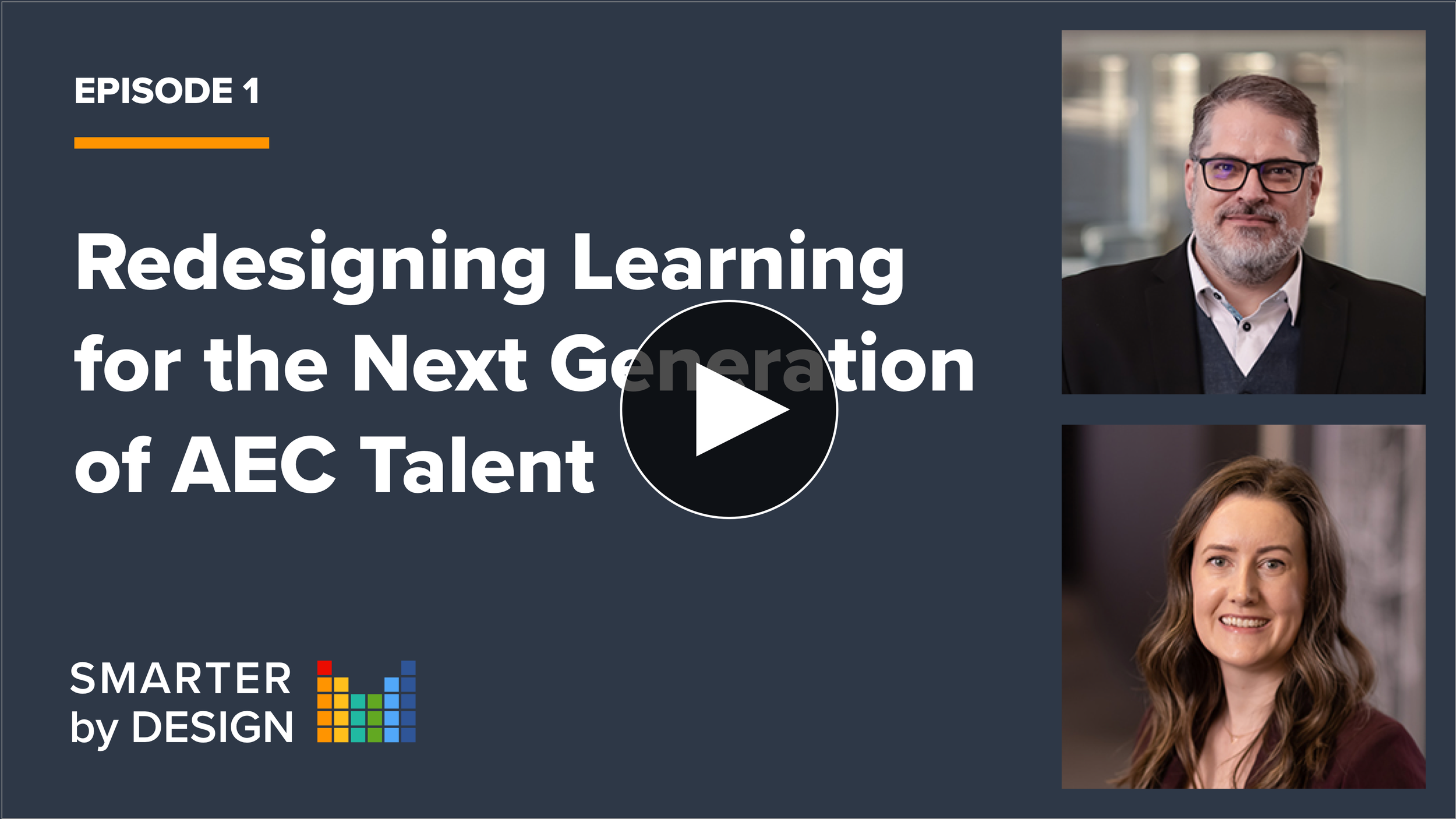
Redesigning Learning for the Next Generation of AEC Talent | Dan Hottinger and Kari Shonblom of BWBR
In this episode of the Smarter by Design podcast, I’m joined by Dan Hottinger, Principal and Director of Professional Services at BWBR, and Kari Shonblom, Knowledge Manager at BWBR, for a deep conversation about how their firm is redesigning learning to meet the realities of today’s AEC industry and the expectations of the next generation of talent.
Dan and Kari take us inside BWBR’s Landmark Learning program, a decade-long effort to help emerging professionals build judgment, confidence, and technical fluency faster than experience alone would allow. We explore how BWBR uses quality assurance (QA) and construction administration (CA) feedback loops to identify recurring gaps in practice, translate real project issues into targeted learning, and continuously evolve what and how the firm teaches technical skills to emerging professionals.
Along the way, we talk about how learning itself is changing. As the next generation of AEC professionals has grown up searching first, watching short-form videos, and expecting knowledge on demand, BWBR is rethinking traditional training models. Dan and Kari share how the firm is experimenting with shorter, more focused content while preserving the value of longer, story-driven sessions where context, judgment, and tacit knowledge can be shared.
The conversation also explores a hybrid approach to learning: pairing on-demand resources with live discussion, designing learning paths that evolve across career stages, and connecting technical instruction with the softer skills—such as communication, leadership, and decision-making—that become critical over time. At the center of it all is a simple but demanding idea: learning only matters if it shows up as improvement in the work.
This episode offers a behind-the-scenes look at how learning, QA, and career development can be woven into a single system that allows BWBR to develop talent from within, adapt to changing expectations, and build resilient expertise over time.
If you’re thinking about how your AEC firm can redesign learning for a new generation, connect knowledge management to real project outcomes, or move beyond training as a one-off event, this conversation is for you.
▶ Watch or Listen
Watch or listen to this episode via YouTube, Spotify, Apple Podcasts or wherever you get your podcasts.
📺 🎧 YouTube
📺 🎧 Spotify
🎧 Apple Podcasts
In this episode of the Smarter by Design podcast, I’m joined by Dan Hottinger, Principal and Director of Professional Services at BWBR, and Kari Shonblom, Knowledge Manager at BWBR, for a deep conversation about how their firm is redesigning learning to meet the realities of today’s AEC industry and the expectations of the next generation of talent.
Dan and Kari take us inside BWBR’s Landmark Learning program, a decade-long effort to help emerging professionals build judgment, confidence, and technical fluency faster than experience alone would allow. We explore how BWBR uses quality assurance (QA) and construction administration (CA) feedback loops to identify recurring gaps in practice, translate real project issues into targeted learning, and continuously evolve what and how the firm teaches technical skills to emerging professionals.
Along the way, we talk about how learning itself is changing. As the next generation of AEC professionals has grown up searching first, watching short-form videos, and expecting knowledge on demand, BWBR is rethinking traditional training models. Dan and Kari share how the firm is experimenting with shorter, more focused content while preserving the value of longer, story-driven sessions where context, judgment, and tacit knowledge can be shared.
The conversation also explores a hybrid approach to learning: pairing on-demand resources with live discussion, designing learning paths that evolve across career stages, and connecting technical instruction with the softer skills—such as communication, leadership, and decision-making—that become critical over time. At the center of it all is a simple but demanding idea: learning only matters if it shows up as improvement in the work.
This episode offers a behind-the-scenes look at how learning, QA, and career development can be woven into a single system that allows BWBR to develop talent from within, adapt to changing expectations, and build resilient expertise over time.
If you’re thinking about how your AEC firm can redesign learning for a new generation, connect knowledge management to real project outcomes, or move beyond training as a one-off event, this conversation is for you.
▶ Watch or Listen
Watch or listen to this episode via YouTube, Spotify, Apple Podcasts or wherever you get your podcasts.
📺 🎧 YouTube
📺 🎧 Spotify
🎧 Apple Podcasts
📃 Episode Transcript
This transcript was lightly edited for clarity.
Chris: Kari and Dan, welcome to Smarter By Design.
Dan: Thank you for having us, Chris.
Kari: Hi. Thank you.
Chris: I’m a big fan of both of yours—and a big fan of BWBR. We’ve been working together for well over a decade at this point. There are a lot of things I like about BWBR, and we’ll touch on a few of them today, but I want to start with Landmark Learning.
Dan, this program you and your colleague Stef Trzpuc shared at KA Connect 2017 really stuck with people. It’s been referenced a lot in our community. For those who don’t know about it, can you go back to the beginning and tell us what Landmark Learning is, how it got started, and what it looks like today?
Dan: Yeah. It’s really our program for bringing in and working with emerging professionals—to teach them up and get them further along in their career faster.
Landmark Learning was born out of a necessity to take a five-year architect and make them a ten-year architect quicker. How do you do that?
The first thing you do is get buy-in from leadership. Once you get that support, you go. Over time, we’ve evolved Landmark Learning into a number of different things. But its core thing is always the teaching of the architectonics—how to put a building together, how to work with clients and consultants, all of those things that often take years and years of experience to do.
We want to bring in the experts and the “nexperts” to teach people to do those things sooner, quicker in their career, and get them to a point where they’re comfortable doing it.
Chris: Is the target audience people with around five years of experience, or do you go earlier than that?
Dan: We do emerging professionals all the way out to about five, six years in the career. But we also use it for people who join BWBR.
You might be five years along in your career. Maybe you’re six, seven, eight years along in your career, but we still ask you to be within the Landmark Learning group because there are a lot of times that we talk about processes we have at BWBR. We talk about how to coordinate with your specification writer. We talk about handing your project off to the construction administrator—what our quality assurance process is and what our expectations of you are as you’re working on projects.
So it’s a larger group, but we do try to catch as many people as possible. Maybe a person who’s been in their career for eight years doesn’t need to stay as long, but we do have a requirement: if you are five years or less in your career, you have to attend and watch a certain number of sessions per year.
Chris: Give me a sense of how this works structurally. Is this weekly? Monthly? How many sessions per year? How many people attend? And how much of it is live versus on demand?
Dan: Sure. We do about 16 to 18 a year, depending on schedules.
We originally did around 22, but we scaled back because we now have a large library of recorded content.
All of the sessions are live, and we run them on Zoom. We’ve talked about going back to in-person, but honestly, Zoom allows us to reach a much larger audience. When we were in person, we had about 22 to 24 attendees. On Zoom, we regularly get 40 to 50 people. It’s simply more accessible.
We record every session and post it to our intranet. That way, anyone who is interested—even outside the Landmark group—can watch them. It also helps people who have been here longer and may feel the program is exclusionary. This gives them access to the same learning.
Kari: We even had to go through an exercise last year because the group—the invite list—was getting a bit too big. Dan had to cull it down. People sort of graduated out of it, but you still had several people reaching out and asking to stay on the list.
Chris: Now that it’s virtual, what’s the downside of having the list be too big?
Dan: If you are on the list, you’re allowed a certain amount of hours per year to watch videos—any back video that you want to watch—and put it on your time card. So we give everybody 24 hours to watch videos or go to Landmark sessions. We feel that’s adequate.
But when Kari says we had to pare down the list, we had like 160 people on it. Once you got on, you never got off. So we started thinking: is that even right? You’ve got to remember, we’ve been doing this for 10 years. Some of the people in the original group were still on there—and they’re project managers now. They’re not coming to them.
So when you look at it and you say, this person is moving towards being a principal, this person is working as a project manager, maybe this person zigged in their career and they’re writing specifications now—these are people that are more of the experts. I want them teaching the course, not just coming to them.
So we went through and started culling down the list. But Kari’s right: there were some people who—even though they’re project managers—were upset about being taken off.
Chris: Because they lost their ability to build those specific learning hours?
Dan: Not so much. They just wanted to come to the session. You only get the invite if you’re on the list.
We let everybody know what we were doing. We didn’t just drop people off the list. If you were one of those people, I sent you an email saying, “Just so you know, you’re not going to be on the list anymore. There is an appeal process if you would like to send an appeal to remain on there.”
We got about 12 or 15 people that wanted to stay on, so we said, “Let’s just keep them all.”
Chris: That says something about the value you’re creating. If they didn’t find it useful, they wouldn’t have pushed to remain.
I’m curious—people who are further along in their careers are still attending sessions about door schedules, QA/QC, codes. Do they feel like they have gaps in their knowledge, or is it more about continuous learning?
Dan: I’ll give you an example. Susan Goldberg is one of the people who wanted to stay on the list. She’s an excellent project manager, very well respected. In her appeal, she said that while she doesn’t attend every session, the ones she does attend always teach her something valuable.
She also wanted to hear what her teams were hearing. Often, a team member will say, “In Landmark Learning we learned this,” and the project manager might not have known that had become a standard. So it helps them stay aligned with expectations.
Kari: From attending these live, without fail, there are always great anecdotes from Dan. You get the rich storytelling.
And more experienced people like Susan will often chime in with a real-world experience or anecdote of their own—say, “Here’s a slightly different take,” or “Here’s what I’ve seen.” That’s super valuable.
There’s always discussion, questions, interjections that add value and make it a much richer experience.
Chris: Is there a market there that you’re missing? For people like Susan who don’t want all of the things but some of the things—do you think there’s another program or a more elevated version? I’m curious how you’ve responded to that.
Kari: We’ve talked about that. The Landmark program targets a specific cohort, but the topics span a wide range. I’ve been thinking about it as three tracks: technical software skills, role-specific technical skills, and soft skills.
We’re finding that as technology and AI make technical information easier to find, emerging professionals need more support with soft skills—how to call someone and ask a question, how to be direct, how to build relationships.
As the content shifts more toward soft skills, it naturally becomes relevant to a broader audience.
Dan: This past year we focused heavily on soft skills. Kari did a great session on difficult conversations. Afterward, I thought, “This would be perfect for our project managers,” so we adapted it and ran it for that group as well.
When a topic has crossover appeal, we try to reuse it with other groups. Sometimes it’s shorter, sometimes it’s expanded, but soft skills in particular are relevant to everyone.
Kari: For that session, we tailored examples for emerging professionals versus project managers, which made it more impactful. It was like taking the content on a small road show.
Chris: I want to go back to something you mentioned earlier. The program used to run about 22 sessions a year and now it’s more like 16. One reason you gave for that was the growing library of recorded content.
If I’m an emerging professional in the Landmark program, am I expected to only attend the live sessions, or is there also an expectation that I’ll go back and watch certain recorded sessions as part of a curriculum?
Dan: It’s more of a hybrid curriculum. We record every session and post it on our intranet, and anyone in the firm can access those recordings.
That said, we’ve been doing this for almost 10 years. This year I’ll hit 200 sessions. At one point I joked that after 100 episodes, shouldn’t I get syndication rates?
Chris: Right. A million dollars an episode, like Friends towards the end of the run.
Dan: Apparently, not.
But what we realized, especially through Kari’s work, is that curation has become a real challenge. For example, we have four separate sessions on door hardware. Door hardware continues to be a problem area in our QA tracking, so we revisit it every few years to try to make it stick.
Now imagine you’re a new emerging professional and someone tells you, “Go watch the door hardware video.” Which one do you watch? That’s one of our biggest challenges—making sure people are accessing the most current and relevant version of the content.
Chris: Kari, that’s interesting because many firms struggle with not having enough knowledge captured. You’re dealing with the opposite problem—having too much. How are you thinking about that?
Kari: When I inherited the Landmark Learning page on our intranet, it was one very long table—session number, description, video link, PDF link—with the newest sessions at the top.
People weren’t scrolling all the way down. Now that AI search surfaces everything we’ve ever posted, people are finding multiple versions of the same topic without knowing which one is correct.
Digital hygiene is top of mind for me now. If we update something, we need to remove outdated content. I need to understand what people are producing and then search for what already exists so we’re not duplicating or confusing things.
As we look toward Synthesis LMS, categorization is huge. We never really categorized these sessions—they were driven by whatever issues were surfacing at the time. Going forward, I’d love to take older but still relevant sessions and break them down.
Instead of asking someone to sit through an hour-long video, we could run the transcript through AI, pull out bullet points, and create a cheat sheet or quick reference. That’s much easier to consume.
Chris: When did you start Landmark Learning—what year?
Dan: The third week of February 2016.
Chris: So you’re almost at a decade. When you got started, my memory is: you were spending time with the CA team and they were seeing the same issues show up again and again in drawings, and that drove the curriculum.
Now that you’re almost a decade in, is that still how you decide what to teach?
Dan: It’s evolved, but that feedback loop is still core. We regularly talk to the construction administrators and ask what they’re seeing. We just finished what we call CA grading, where we ask the CA team to give us a letter grade across 16 categories.
This year we added a question about how well project teams are handing projects off to CA. We were getting C-level grades, so we created a checklist to help teams improve that handoff.
When I report out to the firm, I use that data to explain why we’re making certain changes. We also include comments from the CA team, both positive and negative, so people understand what’s really happening in the field.
Chris: You were getting a C in handoff from the CA team?
Dan: Yeah. Ranging from D-plus to C.
They can also add commentary. I use interesting comments—good or bad—in our annual BWBR forum session. And we give CA folks a chance to expound on why they graded it that way.
Now, to create the loop, you have to check it against something. In our VantagePoint system, we have QA tracking. We ask our QA reviewers to grade the exact same 16 categories. We track that data.
It gives us useful things, like: how much time should I schedule for a QA review? I can tell you: if you have a CD set, you need 18 minutes per sheet—that’s based on our data.
We can also track consultants—who’s good and who’s not. We let consultants know we’re tracking performance. Underperforming ones get a phone call from me.
And principals come to me: “I’ve got these proposals from three mechanical/electrical firms—who’s best?” I can tell them. We can cut it by market: healthcare, S&T, higher ed. Some firms are better at certain things than others.
So we track all of that to give principals data to make educated decisions.
Chris: So the feedback loop is CA grading, QA tracking, and then it informs what you’re going to teach next year.
Dan: Exactly. The CA grades and QA grades are very similar, and we also incorporated proposal request tracking: what are we changing out in the field? What are we issuing change orders for?
So we have three items you can compare: before we issued, what was the problem; out in the field, what was the problem; and what are we changing in the field. When you compare that data, certain things rise to the top all the time.
That’s what we use to inform what we talk about.
We also have a workshop every year where we ask: “What do you want to learn about?” That’s where we got a lot of the soft skills topics.
So there’s the data, there’s “what do you want to learn,” and there are things we go backwards on and say, “We need to pull this out, dust it off, and do it again.”
Chris: Kari, I’m glad we’re talking over a 10-year span because it gives us a chance to learn from it.
There’s individual learning for emerging professionals, but there’s also BWBR learning as an organization. Do you spend time measuring whether Landmark is creating better outcomes? How does that come together?
Kari: I think so, but it’s complicated. We’re always going to have emerging professionals who are brand new to this work, regardless of how good the program is. They’re going to make mistakes while they learn.
What I keep coming back to is whether we can reduce how time-intensive this is by shifting some of the learning off the live sessions. With the LMS coming online, could some of this become off-the-shelf learning?
For example, there are foundational things that everyone needs to know when they start. Could we assign the top 10 things that every new hire should learn and then pair that with live sessions focused on discussion and application?
The challenge is that people don’t know what they don’t know. Door hardware is a great example. The content exists on Synthesis. It’s searchable. But people don’t know they should be searching for it in the first place.
Chris: Right now it’s not assigned. Someone has to decide to go look for it.
Kari: They’d have to know to go look for it. They’d have to know that it’s a gap in their knowledge. You don’t know what you don’t know.
Dan notices we’re slipping, and we need refresher. But it seems like something foundational—you just need to learn it. It doesn’t necessarily need to come up in a live session.
We can make live sessions more interactive. People don’t necessarily want to be lectured at. They want hands-on learning.
Chris: I feel confident saying difficult conversations probably benefits from discussion. That’s one where maybe you watch something in advance, but you also want reps, role play, scenarios, stories.
So are there topics you can shift to on-demand, and then reserve live for the ones that really benefit from social learning?
Dan: Yeah. Kari and I have talked about this a lot. Are there 10 or 12 sessions that should just be assigned to everyone when they start at BWBR?
The challenge is deciding which ones. If you ask our building technology and standards group, they’ll tell you it needs to be 20 sessions. That’s just not realistic.
Ideally, we’d pair this with some kind of quiz or validation so we know people actually absorbed the content. That way, we don’t have to keep repeating the same topics live year after year.
Kari: We’ve also talked about systematizing it more.
Dan is a master at feedback loops. You asked how to know whether somebody is absorbing the learning and if it’s making a difference.
I think it comes up in annual reviews. He’s talking to project managers. He’s trying to understand how the team is doing, who’s struggling, who can you give a task to and know they’ll accomplish it without extra support. That becomes visible quickly.
You can’t fake knowing something. Either you’re absorbing it and applying the skills, or you’re not.
Chris: That’s interesting because someone might have 20 topics they think everyone should know, but depending on what phase you’re in, you might need some of it more than others.
If you’re in schematic design, do you need door hardware? Probably not. But if you take it and never apply it on a project, retention is low.
I kind of look at the future of learning like air traffic control: route the right knowledge to the right person at the right time. You have knowledge assets, and people in different phases of career and projects—how do you land the plane on the right runway?
Kari: As you know, our project lifecycle work could be a way to insert some of these trainings along that lifecycle. It could pop up as a suggestion. If you’re experienced, ignore it. If you’re less experienced, you can say: “I’m at this point on this type of project—what should I have done? What questions should I ask the client by now?”
A more robust checklist. Not that you’re checking items off, but a reminder: make sure you’ve done these things.
I’m seeing emerging professionals want to be more self-sufficient. They want to search, find the answer, do the task. They don’t necessarily want to stop and have a long conversation. Or they’re too scared to go talk to people—it’s not their style. They want to be more independent.
Dan: Work styles are different now. There’s a lot of “I want to pick up my phone and Google it.” AI will come up with 10 answers, but knowing what’s good and bad is the struggle.
Face-to-face discussions can be hard. I like to walk around and ask people: “Are you struggling with anything? What are you working on right now?” Just to get a feel for how they feel.
I also meet with every project manager once a month: “How is your team doing? Is anybody struggling? Anybody who could use help?” We address it person by person if we have to. We’re trying to make people succeed.
Chris: Historically it’s been hour-long recorded sessions. A lot of people are moving towards shorter, on-demand native content. Is that something you’re experimenting with?
Dan: I’ve been talking to Kari about this. My son is in his early twenties—his whole life is five-minute videos on YouTube.
We went to a Renaissance festival. He’s watching a glassblower and explaining glass blowing to me. I said, “How do you know about glass blowing?” He said, “I watched it on YouTube.”
So I told Kari: maybe we do “Landmark shorts”—five to eight minute videos on very small topics. Then with AI search, a person can grab those shorts for the specific thing they want to know, rather than wading through 15, 20, 30 minutes to find it.
Chris: Are those standalone topics, or do you break an hour into six shorts, or do they stitch together into learning paths?
Kari: I think we’re open to where the content takes us.
I have a meeting next week with an expert—just going to interview them on Zoom for an hour about one specific topic: how they approach it, what mental processing they do, what they’d tell someone if asked.
I don’t know if we’ll end up with short videos, or a series, or maybe it’s not video at all—maybe it’s a checklist: “At this point, cover these five things. Ask these five questions.”
I’m open to both: freestanding shorts or chunks you string together.
Chris: This sounds like a platform shift—not just an incremental upgrade from in-person recordings to Zoom recordings—but a rethink of how you deliver learning.
Kari: I think so.
Dan: For now, maybe it’s a combination: shorts on BHive plus live sessions for longer, deeper dives.
We have to be nimble—not only to the people coming in, but to better ways of doing what we teach. Nobody wants the same 16 things every year. We need to stay on the edge of what they need, and make sure the style of learning fits the group.
Kari: There’s always a place for longer format because that’s where you have discussion and real stories.
If we go back to door hardware—Dan showed me a picture from a presentation with the most complicated door I’ve ever seen. Conduits, buttons, looks like it will send you to outer space.
And he’s talking about all the questions you need to ask: what happens when you open it? Does it notify someone when you swipe a key card? Does it also turn on the lights? Does it notify security? All these things someone may not think about when they’re just putting in a door with a swing direction based on code.
Chris: Not all doors are created equal.
Kari: Definitely not.
Chris: You’ve got four recordings over the years on door hardware. As you modernize how you teach it, do you imagine older recordings go away and get combined into one gold standard you keep updated? How are you thinking about unlearning as well as learning?
Dan: I’ll change the example: mechanical, engineering, and plumbing coordination—we’ve done that three times too. A consistently hard area.
When we were going through the 200 videos, Kari provided me a trash bin—drag and drop ones we don’t want to see again. I dumped the ones that were too old.
I wish I’d curated better earlier. There were so many times someone would say, “Wouldn’t it be great if Landmark did a subject like this?” And I’d say, “We did.” Then I’d try to find it on the page and I couldn’t.
I use fun titles: trash enclosures I called “Trash and Treasures.” But if you don’t know what that means, you don’t know what to look for.
Kari: One of my favorites was “Me, Myself, and I: Small Projects.”
Dan: Exactly. If I can’t find it, no one else can either. So over the next year, we’re really focused on better curation—cleaner naming, better metadata, and making everything more findable.
Kari: We’re also retroactively adding metadata so people can filter content by project type, phase, technology, or role. Right now, you have to know exactly what you’re searching for.
We had an emerging professional say to classmates, “How do you know all this stuff?” And he said, “We have this great thing at my firm—like our own personal YouTube.” He explored and found it helpful, but that took initiative. We want the structure to support exploration better.
Chris: Not everyone will self-direct at that level. So there’s curation, better metadata in LMS/Synthesis, maybe “essentials” for new staff, and then project-type or phase-based learning. And you’re exploring BWBR shorts.
Dan: When you put it that way, it sounds overwhelming, but you’re basically right. We’ve done a great job putting together content and an okay job putting it somewhere accessible.
Chris: What about people who’ve been at BWBR longer—more than five years? Is there less need there, or are we just not talking about it?
Kari: Yes, definitely. Landmark Learning has been a catalyst. We now have other upskilling programs for specific market sectors. For example, if someone is new to healthcare or behavioral health, there’s a series of upskilling videos that walk through that project type and the common issues you’ll encounter.
Another area we’re thinking about more intentionally is mid-level staff—how do we prepare people for leadership roles? That’s heavily focused on soft skills. You need technical mastery, but you also need to learn how to mentor others, communicate clearly, and manage teams.
Once people step into leadership roles, there’s still learning to do. Things like self-awareness, communication styles, and how to get the best out of your teams don’t stop being relevant once you get promoted.
Chris: There’s a book you might like: The Leadership Pipeline. It goes through predictable turns from individual contributor to managing a team, to managing a market.
The author also wrote a newer book called The Specialist Pipeline—more about technical contributor routes and how to create career opportunities for people who want to specialize.
Dan: I’d be interested in reading that.
Chris: I’ll send it over and put it in the show notes.
Kari: But sort of the converse of that specialist topic: this program living past Dan’s retirement. If Dan wins the lottery tomorrow and leaves to travel the world, so much of the success of Landmark Learning is tied to who Dan is as a person.
Dan is exceptional at getting feedback, hearing what people are really saying, and cutting through noise to identify the root problem. He genuinely wants to help people succeed. That’s hard to replicate.
He’s talked before about making himself a Swiss Army knife—experiencing every part of the business so he could be useful everywhere. That’s harder to do now as firms get bigger and roles become more specialized.
Chris: There’s the skills and systems and knowledge, but it’s also care. It’s hard to tell someone to care more. Finding people who can do the thing and also have that gut-level drive—even with resistance, deadlines, obstacles—that’s part of the challenge.
Dan: In 2017, the question was: how do you find the time? My response was: it has to be a passion project. You have to care.
We’ve always been a firm where we do a lot of “draft and develop”—in the NFL they call it that. We’ve found success in that.
Chris: By that you mean: you bring people out of school and grow them at BWBR versus poaching a 20-year person.
Dan: Exactly. And 2022 and 2023 demonstrated that clearly. Sometimes we had to back up and unlearn bad habits from people coming in from other firms.
Kari: For context: 2022–2023 because we onboarded a significant number of staff.
Dan: I think we’re better served bringing people out of school, teaching them how to do the job the way we want, serving clients the way we want, with buildings built the way we want.
Chris: It connects back to Landmark Learning. If you’re draft-and-develop, getting the first five years right matters.
Dan: Absolutely.
Kari: And we’re a rigorous firm—not rigid, but we have processes in place so we don’t reinvent every time. If you know what’s expected, you can go do it.
Part of the secret sauce of Landmark is the robust QA process Dan put in place to support it. I asked him what came first, Landmark or QA. He said Landmark came first, but he needed a way to prove it was working.
So now we’re getting feedback from QA, CA, PR requests. He needed the QA process with defined checkpoints, and we make people sign off to enforce they’re happening.
If somebody starts a program like this, it can feel daunting. People will push back: “I don’t want to do data entry, who’s going to do that?”
We were lucky enough to have a person configure the technology, and Dan got the CA team and QA team on board. He’s been able to show value: scheduling the right time for QA review, staffing for QA, and so on.
Dan: I want to clarify that we’ve always had a QA process. What Kari is talking about is the modern, formalized QA system.
Also, Kari, I appreciate that you didn’t use the term “flit about” this time.
Kari: I was trying to compliment Dan and said it the wrong way. Dan is intentional about walking around, stopping at desks, catching up, seeing what people are working on. Opportunities come out of those conversations.
I see him like a pollinator of knowledge and relationships. I said he’s like a butterfly, flittering about the office—sprinkling good conversations and building morale. And he never let me live it down.
Chris: My dad called it “management by walking around.” Taking the pulse, seeing what people are doing.
But this connects to critical knowledge transfer: Dan has skills that make the machine go. Systems help—Deltek, data—but there’s also culture: getting people to actually do the things.
I hope you don’t retire soon, Dan. I want to see what you do through this replatforming.
Kari: I selfishly want him to stay forever too. I was in the audience at KA Connect 2017. I didn’t work with Dan. It was my first KA Connect. I didn’t know Stef. They presented and I thought, “They’re doing awesome stuff.”
Dan said a line on stage: “We don’t have 20 years to train the 20-year architect anymore.” That stuck with me. I’ve been a fan since then.
I emailed it to everyone at my old firm: “We’ve got to be doing stuff like this.” But it can be daunting if you don’t have the personality. You can’t just declare tracking and sessions if you don’t have the passion to orchestrate it.
Chris: Dan, if you gave that quote today, do you feel it’s even more acute? Buildings are more complex, tech faster, people stepping up sooner, fewer Gen Xers than boomers—so millennials and Gen Z have to step up sooner.
Dan: Yes. Learning styles are different. It’s a two-direction teaching path now.
I need to talk to senior PAs and PMs and talk them through what they need to do. I like the Jerry McGuire line: “Help me help you.” These are the things you need to do with your emerging professionals. They’re not going to call you. Give direct feedback. Be granular. Coach them.
On the other side, you also need to teach emerging professionals how to receive constructive criticism. Soft skills.
Software-wise, they are so much farther ahead than we were 10 years ago coming out of school. They know the software. They do tasks ridiculously fast. Maybe it’s not perfect, but they can do it.
We also try to track interests. If Kari wants to work on medical projects, we direct efforts into that as much as possible.
You have to pay more attention, be more intentional, more nimble. If something’s not working, try something else.
Chris: Smarter by Design is about designing our businesses as much as we design buildings.
It sounds like the traditional apprenticeship model has problems now. Between complexity, speed, hybrid work, and sheer knowledge load—maybe it’s not “learn everything through osmosis over 20 years,” but “learn how to find and apply the right knowledge on demand.”
Essentials first, then upskilling for project types, and flexibility.
Dan: First, the apprenticeship model is dead. It’s not going to work.
We have conversations with someone out of school for six months and they’re like, “How come I’m not going to interviews? How come I’m not in every meeting? How come I’m not running the construction meeting?”
That expectation is way higher. I never would have dared say that early in my career. I knew I had to learn—do stairs, then wall sections, details. That mindset isn’t there anymore.
They want to be as important to the project as possible right now. And I get it.
Chris: Where do you think that comes from? Some would say “entitled,” but maybe it’s ambition.
Dan: Twofold. Ambition is part of it. It’s Instagram culture—people want to be visible and important right away. That’s not just online; it’s in the firm.
But it’s also an immediate gratification culture: you order anything on Amazon and it shows up the next day. People expect immediacy.
Those conversations are difficult because it’s hard to say: you’re not leading because you don’t have the expertise. We don’t take you to the interview because only presenters go.
And leadership and PMs worry those conversations feel counterproductive, because people want to be the person teams want to work for. Teams want support. They want to feel their career is being advanced. So managing expectations can feel risky.
Chris: Many people also don’t want a hazing ritual of “I did it this way, so you have to.”
Dan: I despise “that’s the way we’ve always done it,” or “you have to do it this way because I had to.”
During COVID I was upset and said, “If people would just put a couple more hours into their week… I had to work 65, 70 hours just to get noticed.”
My son didn’t even look up and said, “So because it sucked for you, it has to suck for everybody?” That stuck with me. He was totally right.
So we’ve talked about how to break that cycle. People want work-life balance now, and I get it. I wish I’d had more of that. I don’t want people to have to experience what I experienced.
Kari: And you do a good job of setting expectations.
I think the higher expectations come from multiple things: on-demand culture, faster educational pathways, and seeing peers in other industries advance faster. In architecture, licensure takes years. You can’t always advance as quickly.
Chris: We’re also seeing firms write down role profiles and progression paths more transparently so expectations are clearer. Dan, you’re chuckling.
Dan: We did exactly that. We spent a lot of time on role profiles—creating a ladder. People want to be architect one, two, three, four, and move up.
But when you write it down, people say, “I’ve met the requirements, I should be an architect three now.” So now we’re having those conversations.
Chris: What’s the missing piece—capability versus opportunity?
Kari: It’s the firm need. There has to be a match between “yes, you have the skills” and “we have enough need for that role on enough projects.” It’s a staffing reality.
Chris: Right—four quarterbacks on the depth chart, one on the field.
So what does BWBR look like as a learning organization in 2030, if it goes really well?
Kari: Continuing all the great stuff past Dan’s retirement—building resilience. Trying to distill the secret sauce. Finding folks with the soft skills and passion.
And how do you identify potential earlier without trial and error? How do you know who’s great in an interview until you send them to an interview?
We were talking about SMMA—Ryan posted about using an AI assistant for presentation training, and it was enlightening. We should do more of that for leader training: dealing with team issues, delivering difficult conversations, managing expectations.
Dan: Is there a way through AI—looking at what people are searching for—to identify intent?
If Kari is searching all the medical stuff—modalities, imaging—she clearly wants medical. We should steer her. Can we identify future leaders, future medical planners, and direct energy there to fill future gaps?
Kari: And capitalizing on ambitious folks would be great.
Also: beyond technical training—how do we upskill creativity? Design thinking? It can feel innate, but how do we help people elevate creative thinking? In a world where AI automates technical tasks, human creativity may be what sets us apart.
Chris: Looking back at nearly 10 years of Landmark, what’s something you’ve changed your mind on?
Dan: When I started, I thought a solid learning program could address any need. “We have a problem here; we fix it through learning.” Any high school teacher would laugh.
I didn’t take into account that learning styles change and the world changes.
Pre-pandemic, we were in a room, elbow to elbow. Then COVID hit—we had to retool and teach people how to do architecture remotely. Learn Zoom. Learn meeting etiquette. Noise cancellation didn’t exist yet. Dogs in the room. Little things.
Then hybrid: what are the rules for internal meetings, client meetings? So we had to zig and zag with the times.
Back in 2017 I thought, “This is easy.” I wish I’d told myself: you’re going to have to morph.
Kari: For me, not specific to Landmark but learning in general: it’s okay to be less formal and less polished.
With AI tools, we can do more with less. I’m trying to take pressure off people: if you want to document something, just have a conversation with me. We’ll record it. We can use AI to get valuable content without a lot of prep or a big presentation.
Chris: Underneath “more with less” is speed. Things are moving faster and learning windows are shorter, so you can’t be precious.
Final question: advice for firms just getting started on formal learning?
Dan: Just start. If you sit around trying to make the perfect program, you’ll work on it forever. Go, and dial it in as you go.
Every firm has different needs. Be nimble.
Over time, it becomes normalized—part of culture. In interviews, emerging professionals ask if we have continuing ed. We say yes, and it’s a benefit that helps attract good candidates.
Durability comes with persistence. Apathy is death to your learning program. The minute you say, “I’m too busy, I can’t do it, we’ll cancel,” and you do that enough times, your program starts to die.
Chris: That lands. Learning is often non-urgent but important. If it’s connected to quality and outcomes, it’s easier to keep showing up.
Dan: It’s important to me as a person, and to the firm. There’s pride in making it what it can be.
You develop project partners: Kari and I talk about learning, we talk to Elise, digital practice folks, Andrew. Everything’s a partnership. That helps.
Also: be open to outside considerations. This is not a pride project. It has to be a passion, not “I own this.” When I finally let Stef in, the process improvements she suggested were things I couldn’t believe I didn’t think of. It helped the whole thing.
Kari: My advice: be okay with a smaller sphere of influence in the beginning. Go where the water’s flowing.
If you try to go too big too fast, you run into naysayers: “We can’t do this, we can’t change that.” Start small, build momentum, show ROI, and then grow.
Chris: That’s fantastic. Thank you both for joining me and sharing your knowledge. I always get inspired every time I talk to you, and today was no different. I’m looking forward to sharing this with our community. Thanks again.
Kari: Thanks, Chris.
Dan: Thank you, Chris.
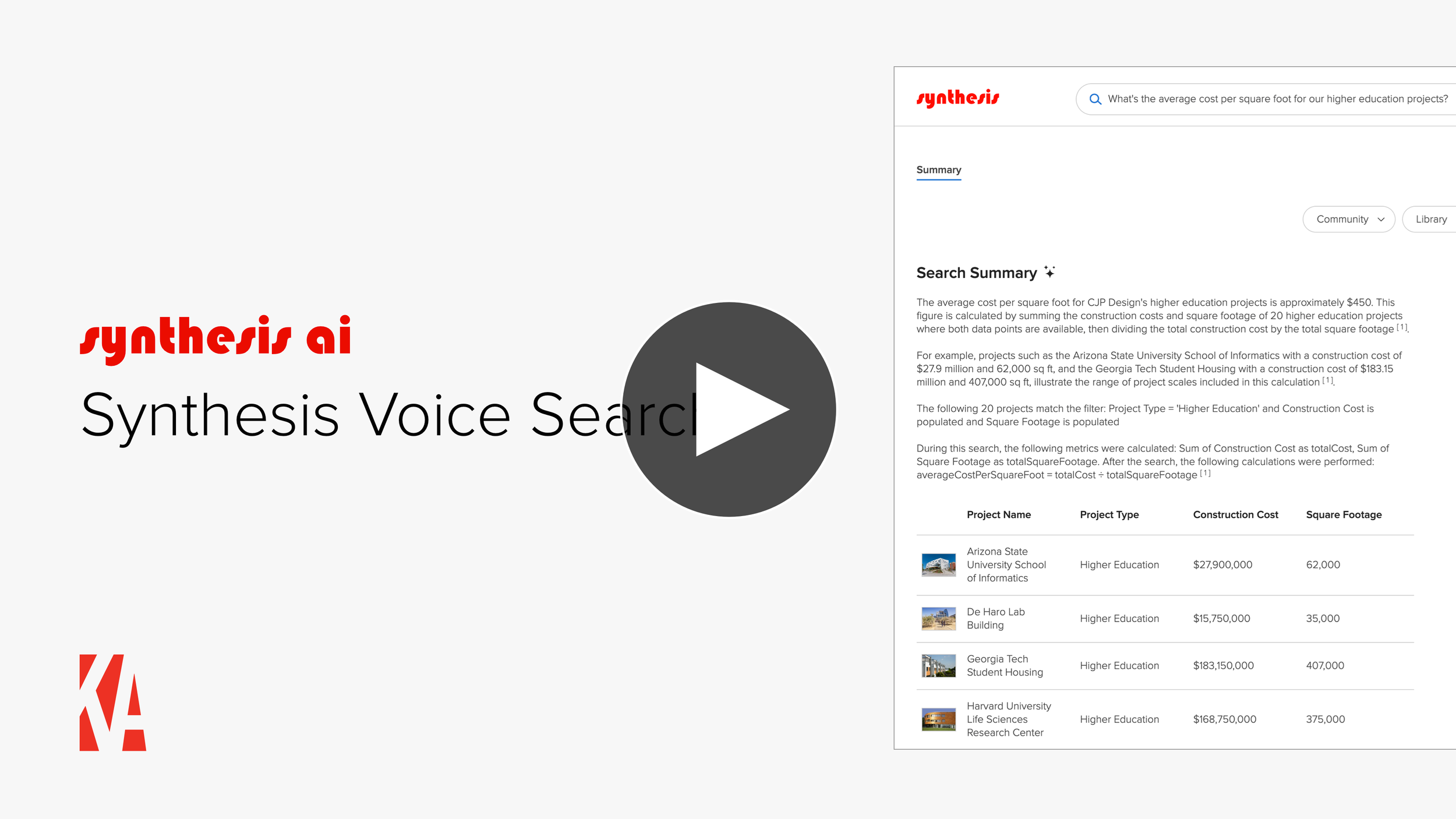
NEW FEATURES | Synthesis Voice Search + Continue Watching
We’re excited to announce that two new features are coming to Synthesis at the end of the day on Friday, January 9th: Voice Search and Continue Watching.
Below is a quick overview of what’s coming.
Voice Search
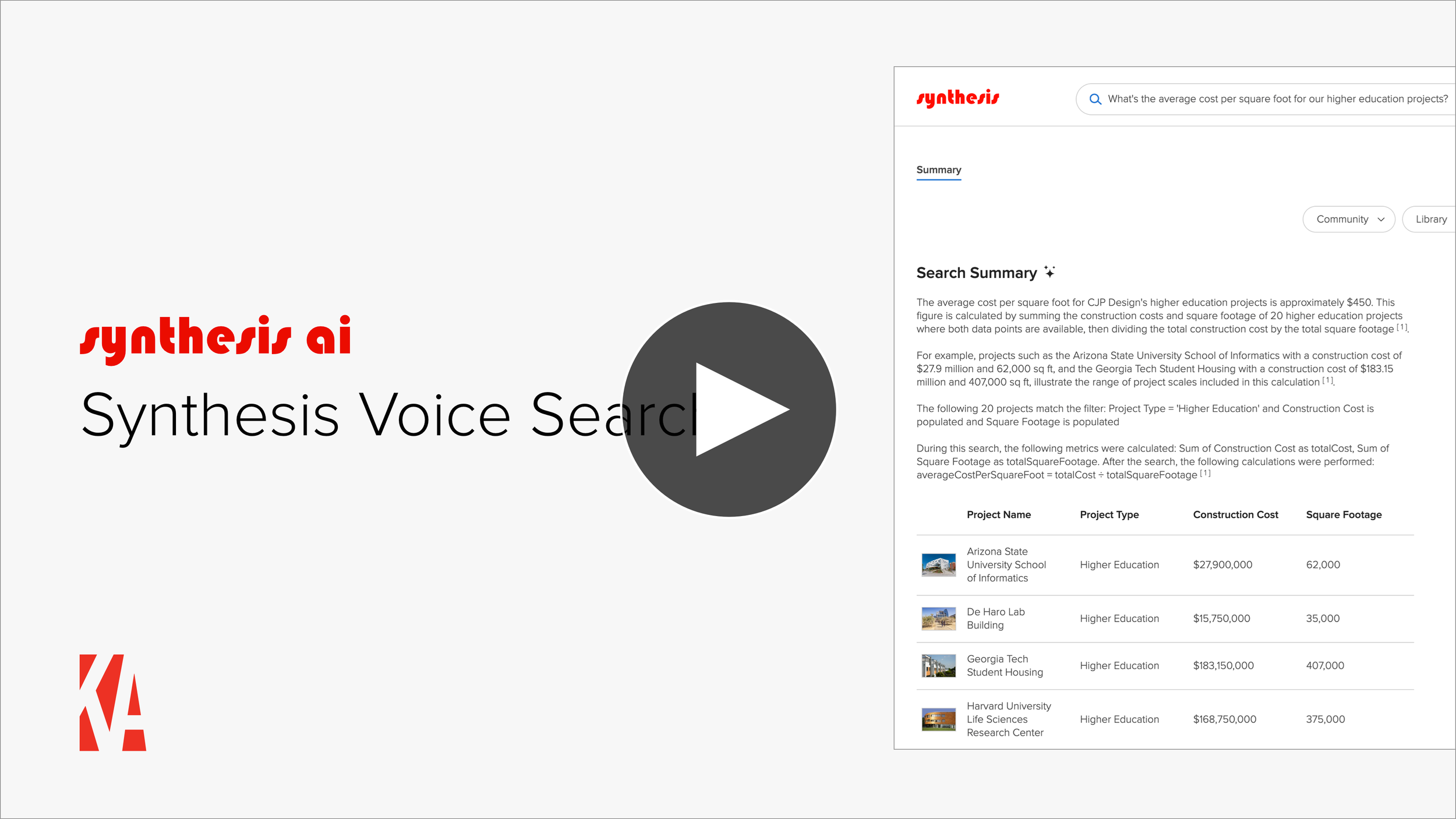
Voice Search lets you interact with your firm’s knowledge in a natural, conversational way.
You can use Voice Search for:
Simple keyword searches
Longer, more conversational questions
Exploratory or multi-part queries where you’re not quite sure what you’re looking for yet
Voice Search works on both web and mobile and it supports follow-up questions so you can refine your search as you go.
Watch a short demo here.
Pro Tip: When you’re finished speaking, you can press Enter / Return on your keyboard to submit the search immediately.
Continue Watching
We’ve also added Continue Watching for videos across the platform.
Since September 23, 2025, Synthesis has been tracking video progress behind the scenes. With this update, that progress becomes visible and actionable.
What this means for you:
Videos now remember where you left off
A progress bar appears on videos you’ve started watching
You can easily resume unfinished videos or see which ones you’ve completed
This applies to all videos in Synthesis, and it’s especially useful as firms continue to use video more heavily for training, onboarding, and learning programs.
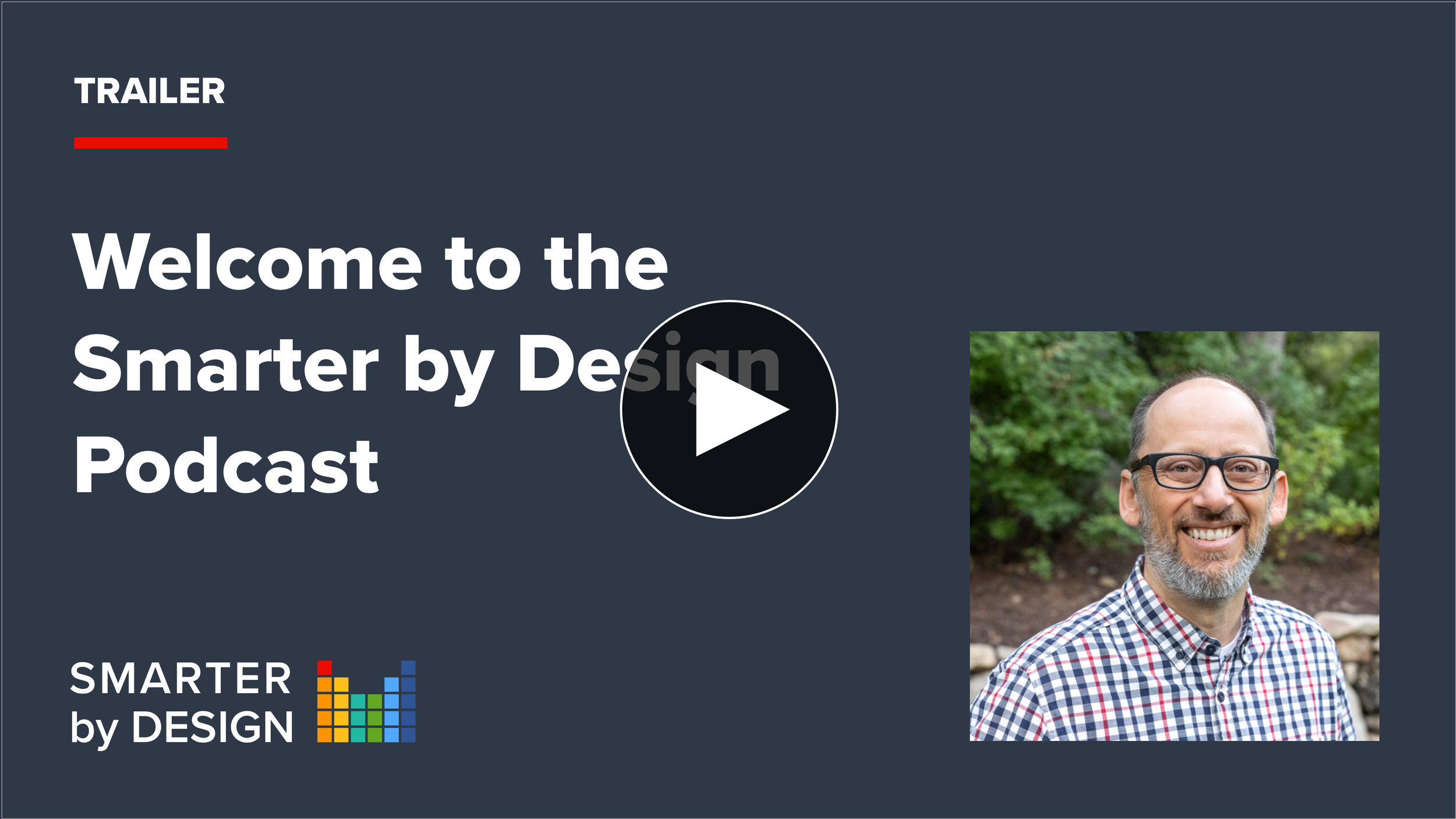
Welcome to the Smarter by Design Podcast!
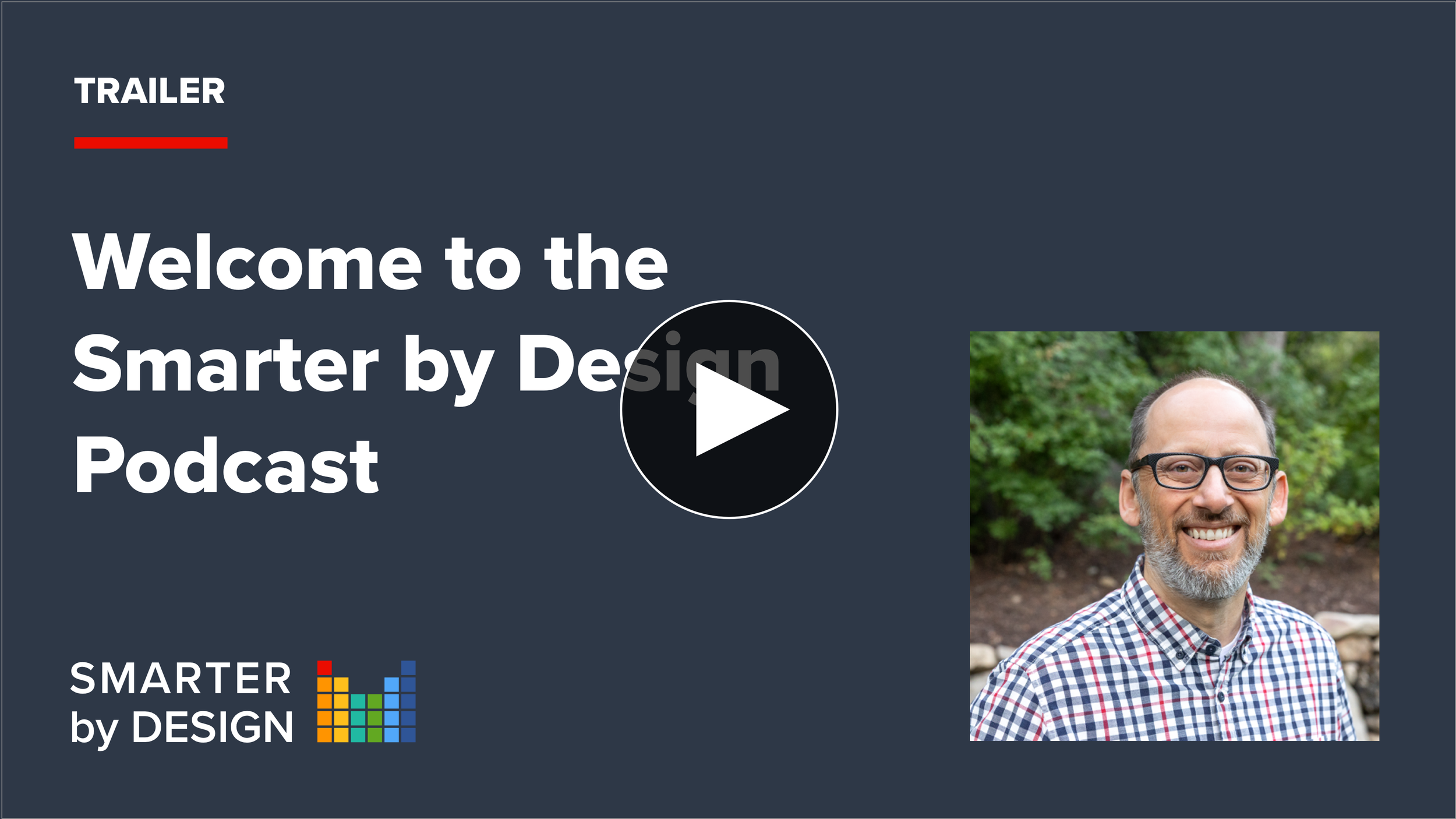
The Smarter by Design podcast explores how leading architecture, engineering, and construction (AEC) firms are reimagining knowledge management, learning, and AI to build smarter, more adaptive practices.
Hosted by Christopher Parsons, Founder and CEO of Knowledge Architecture, the show dives into the real stories behind how firms are scaling expertise, transforming culture, and creating modern learning organizations.
At the heart of the show is a simple belief: AEC firms should spend as much time designing their businesses as they do designing buildings, bridges, and infrastructure. The systems we design for capturing, sharing, and distributing knowledge shape everything else we create.
Through thoughtful conversations with AEC leaders, knowledge managers, and innovators, we explore how design, leadership, and technology intersect to shape the future of practice.
If you’re curious about how AEC firms are learning faster, working smarter, and designing better ways to grow—this is your show.
Subscribe to the Smarter by Design Podcast
Subscribe via YouTube, Spotify, Apple Podcasts or wherever you get your podcasts. New episodes start January 7th.
Partnering with AI to Solve Knowledge Problems | KM 3.0 Podcast Series - Episode 7
In this episode of Welcome to KM 3.0, we talk with Todd Henderson—Director of Practice Improvement at Boulder Associates—about how one of the most inventive thinkers in our community is using AI, structured inquiry, and thoughtful experimentation to reshape how knowledge flows inside an expert-driven firm.
Todd takes us inside a series of real-world practices: from building a repeatable “conversation-to-content” pipeline that makes it effortless for subject matter experts to share what they know, to designing a medical planning accelerator that surfaces hidden assumptions, closes knowledge gaps, and strengthens a critical area of practice.
We also explore some of Todd’s more experimental work—building lightweight role-play scenarios to help teams practice difficult client interactions, designing short internal “med talks” to spread tacit expertise, and prototyping ways to use AI during medical planning interviews without losing the human nuance that matters most.
This episode is rich with practical ideas: how to extract high-value insight from busy experts; why interviewing novices reveals blind spots an organization can’t see from the top; and what it looks like to treat AI as a thinking partner—not a replacement, but a tool that sharpens inquiry, surfaces missing knowledge, and helps teams build a more resilient understanding of their work.
If you’re interested in designing learning organizations, exploring how experimentation can reshape learning inside AEC firms, or understanding how AI can help teams think more clearly—this episode is for you.
In this episode of Welcome to KM 3.0, we talk with Todd Henderson—Director of Practice Improvement at Boulder Associates—about how one of the most inventive thinkers in our community is using AI, structured inquiry, and thoughtful experimentation to reshape how knowledge flows inside an expert-driven firm.
Todd takes us inside a series of real-world practices: from building a repeatable “conversation-to-content” pipeline that makes it effortless for subject matter experts to share what they know, to designing a medical planning accelerator that surfaces hidden assumptions, closes knowledge gaps, and strengthens a critical area of practice.
We also explore some of Todd’s more experimental work—building lightweight role-play scenarios to help teams practice difficult client interactions, designing short internal “med talks” to spread tacit expertise, and prototyping ways to use AI during medical planning interviews without losing the human nuance that matters most.
This episode is rich with practical ideas: how to extract high-value insight from busy experts; why interviewing novices reveals blind spots an organization can’t see from the top; and what it looks like to treat AI as a thinking partner—not a replacement, but a tool that sharpens inquiry, surfaces missing knowledge, and helps teams build a more resilient understanding of their work.
If you’re interested in designing learning organizations, exploring how experimentation can reshape learning inside AEC firms, or understanding how AI can help teams think more clearly—this episode is for you.
▶ Watch or Listen:
📺 YouTube
🎧 Spotify
🎧 Apple Podcasts
About the Welcome to KM 3.0 Series
Knowledge Management has always evolved alongside technology. Today, powered by AI, a new golden era of KM is emerging — KM 3.0.
In this limited series produced by Christopher Parsons, CEO and Founder of Knowledge Architecture and Evan Troxel, host of the TRXL Podcast, we’ll profile a range of firms—each with a distinct approach to knowledge management. From program structure to measurable impact, we’ll explore how AEC firms are using knowledge management to get smarter in an AI-driven world.
You’ll hear from a CEO, a marketing director, a technology leader, a sustainability expert, and a dedicated knowledge manager. Each will bring a different lens—showing us how knowledge leadership can emerge from different corners of an organization and take shape in distinct ways.
In every episode, we’ll aim to get to the heart of how AEC knowledge management functions in practice—what’s working, what’s changing, and what’s next.
About the TRXL Podcast
The TRXL podcast is a leading voice at the intersection of architecture and emerging technology, hosted by Evan Troxel. Each episode features thoughtful conversations with architects, technologists, and industry leaders who are shaping the future of the built environment. With a focus on innovation, practice, and the people behind the work, TRXL offers listeners an inside look at how architecture is evolving—one insight at a time.
In addition to the free weekly show, TRXL+ offers an extended experience with bonus content, early access, behind-the-scenes commentary for subscribers who want to go deeper, ad-free episodes, and the Leadership Edge newsletter. You can explore the full archive and learn more about TRXL+ at https://trxl.co.
The AI and Expertise Paradox
I found myself in a fascinating conversation with the COO of one of our clients last week. We were talking about something I’ve been circling around for months, but this discussion finally snapped the pieces into place.
It’s what I’m starting to call the AI and Expertise Paradox.
We all know the demographic story by now. Baby boomers are retiring in large numbers and there aren’t enough Gen Xers to replace them.
In AEC, that often means we’re losing some of the deepest technical knowledge in our organizations—codes, construction standards, quality practices, the kind of judgment that only comes from decades of watching real projects go from concept to completion.
Technical experts possess the kind of deep smarts that can look at a drawing and feel that something isn’t quite right.
And they are retiring.
At the same time, we’re seeing a wave of AI-powered tools arrive that promise to help fill the gap. Automated code checks. QA/QC scanners. Plan reviewers that highlight potential issues a junior architect or engineer would never recognize. Assistants that allow someone to work across jurisdictions with different codes and standards and at least have a baseline level of support.
In some ways, it feels like knowledge augmentation—almost like the moment in The Matrix when the character Tank uploads the knowledge to fly a helicopter into Trinity’s brain.
Similarly, there are numerous emerging AI tools in our industry which, if they deliver on their vision, will enable a junior team member to run a basic code review, an expert who is stretched thin across multiple projects to offload routine checks, or an architect or engineer working on a project in a different region to get a helpful second set of eyes on local code compliance.
On the surface, this looks like the perfect solution: AI tools that allow those with less expertise or who are super busy to do more.
But here’s where the paradox emerges.
I found myself in a fascinating conversation with the COO of one of our clients last week. We were talking about something I’ve been circling around for months, but this discussion finally snapped the pieces into place.
It’s what I’m starting to call the AI and Expertise Paradox.
We all know the demographic story by now. Baby boomers are retiring in large numbers and there aren’t enough Gen Xers to replace them.
In AEC, that often means we’re losing some of the deepest technical knowledge in our organizations—codes, construction standards, quality practices, the kind of judgment that only comes from decades of watching real projects go from concept to completion.
Technical experts possess the kind of deep smarts that can look at a drawing and feel that something isn’t quite right.
And they are retiring.
At the same time, we’re seeing a wave of AI-powered tools arrive that promise to help fill the gap. Automated code checks. QA/QC scanners. Plan reviewers that highlight potential issues a junior architect or engineer would never recognize. Assistants that allow someone to work across jurisdictions with different codes and standards and at least have a baseline level of support.
In some ways, it feels like knowledge augmentation—almost like the moment in The Matrix when the character Tank uploads the knowledge to fly a helicopter into Trinity’s brain.
Similarly, there are numerous emerging AI tools in our industry which, if they deliver on their vision, will enable a junior team member to run a basic code review, an expert who is stretched thin across multiple projects to offload routine checks, or an architect or engineer working on a project in a different region to get a helpful second set of eyes on local code compliance.
On the surface, this looks like the perfect solution: AI tools that allow those with less expertise or who are super busy to do more.
But here’s where the paradox emerges.
AI Still Needs Experts (The First Problem)
Right now, AI tools are most effective when an expert is in the loop.
An experienced architect or engineer can look at an AI-generated report and instantly separate signal from noise:
“This is a real issue. Excellent catch. Might have missed this one.”
“This doesn’t apply in this jurisdiction.”
“This is technically true, but not material to the design.”
“This won’t matter in the new version of the code which applies to our building.”
“This is just wrong.”
They can also see what’s missing—the issues the AI tool didn’t include in the report.
Without the judgement acquired through years of practice, junior staff can easily fall into false confidence, unnecessary rework, or worse, risky decisions. AI tools help them do more, but they don't yet help them know whether what they are doing is correct.
In other words, AI is not currently a replacement for expertise.
It’s a force multiplier for expertise.
Technical Experts Are Retiring (The Second Problem)
At the exact moment when AI tools require expert oversight, those experts are retiring in large numbers.
Many firms are watching their deepest technical knowledge walk out the door.
This isn’t simply the loss of skills—it’s the loss of judgment, intuition, pattern recognition, and hard‑earned lessons about what actually happens in the field.
And the timing couldn’t be worse.
Fewer People Want to Become Technical Experts (The Third Problem)
From what we’re hearing across our client community, many emerging professionals simply aren’t as interested in developing deep technical expertise.
They’re drawn to the front end of the profession:
design
visualization
design technology
developing custom software
— not the intricate, technical work of codes, detailing, constructability, and quality assurance.
You can argue this has always been somewhat true, but the difference now is scale and timing.
The Apprenticeship Model Is Breaking (The Fourth Problem)
For generations, our industry relied on a fairly consistent apprenticeship model.
Emerging professionals sat near someone more experienced. They listened to their phone calls. They watched them mark up drawings. They absorbed judgment by proximity—not through a training module, but by seeing how decisions were made in real time.
The craft was transmitted osmotically and serendipitously.
That model is breaking.
Hybrid work and distributed teams make it harder for an emerging professional to “listen over the shoulder” of a technical expert. Project teams are spread across offices and time zones. Much day-to-day interaction happens through scheduled Zoom calls and Teams chats rather than shared physical space. And the informal learning that once happened between those moments is evaporating.
Layer onto that a generation raised on Google, YouTube, TikTok, and instant messaging. The next generations are highly self‑directed and expect immediate answers and on‑demand knowledge in the flow of work.
Meanwhile, the half‑life of technical knowledge keeps shrinking. Codes change. Materials evolve. Project delivery models shift. Digital tools proliferate. There’s simply too much to teach relying solely on the old apprenticeship model.
As one of our clients likes to say, “We can’t wait 30 years to get a 30‑year architect.”
We need to develop people faster.
Putting The Paradox Together
So now we have four problems converging:
AI still needs experts.
Those experts are retiring.
Fewer emerging professionals want to become technical experts.
The apprenticeship model that once created experts is breaking.
Put together, these four problems form the heart of the AI and Expertise Paradox.
It’s a paradox in the truest sense: the very thing that appears to solve the problem depends on the thing we’re losing.
So Where Do We Go From Here?
The COO I spoke with last week isn’t slowing down.
Their firm is moving ahead with AI adoption—not because they believe AI will replace expertise, but because they know it can help their experts work smarter today while helping connect emerging professionals to the right knowledge and expertise in the flow of work.
At the same time, they’re rethinking how learning and development happens inside the firm. They’ve already revamped their leadership development program. Now they’re turning their attention to project managers and emerging professionals, experimenting with new approaches and new technologies to help people grow faster.
They’re building a more intentional, modern learning environment.
And they’re not alone.
Across our community, we’re seeing more firms begin to rethink learning and development in deeper and more intentional ways.
Many are adopting a continuous onboarding mindset—recognizing that people don’t just onboard once when they join the firm. They onboard every time they:
take on new responsibilities, like project management or technical architecture
work on a new project type, such as shifting from retail to healthcare
enter a new project phase, like doing construction administration for the first time
Firms are looking for ways to continually equip their people with the knowledge they need at the moment they need it.
We’re also seeing firms:
create rewarding career paths for technical experts that provide leadership opportunities, meaningful influence, and strong compensation
invest in hybrid and flipped classroom models—using on‑demand training for the 101 basics, and reserving face‑to‑face time with experts for applied work and real examples
move beyond simply pointing people to hour‑long Lunch & Learn recordings to also offering short, modular, on-demand content that fits into the flow of work
apply adult learning principles to elevate the quality and effectiveness of their training
build feedback loops to continually improve learning efforts
automate the delivery of key knowledge so it reaches the right person before they need it, whenever possible
build integrated knowledge and learning teams, technologies, and processes
In other words, firms are starting to design modern learning environments—ones that help people grow faster, develop judgment, and apply what they’re learning in meaningful ways.
It’s early, but the work has begun.
What We’re Doing at Knowledge Architecture
Ari de Geus, in his book The Living Company, studied organizations that survived for generations. One of his most famous conclusions was:
“The only sustainable competitive advantage is learning faster than your competitors.”
That idea feels especially relevant right now. If anything, AI is raising the stakes. It is giving firms the opportunity to move faster, but only if their people can learn, adapt, and apply judgment at the same pace.
That’s the work we’re committing to.
From a technology perspective, we’re continuing to expand Synthesis into the integrated knowledge and learning platform that AEC firms need to support this transition—adding new capabilities like Synthesis LMS (Learning Management System) and Synthesis AI Search on top of the intranet foundation to provide the connective tissue that helps firms capture, share, transfer, and find what they know, as well as identify knowledge gaps and outdated knowledge, to help them evolve and grow their practices.
From a community perspective, we’re going to stay close to the question “What does a modern learning organization in AEC look like?” We’ll continue sharing what we’re hearing, what we’re seeing, and the stories of firms who are pushing the boundaries.
In fact, the theme of KA Connect 2026, our annual knowledge and learning management conference for the AEC industry, will be Designing Modern Learning Organizations.
We’ll keep exploring this theme both here in the Smarter by Design newsletter and in our new Smarter by Design podcast, launching in January 2026. And it will continue to shape the products we build and the conversations we convene.
I believe this is the work of the next decade in our industry. And if we’re successful as a community, we’ll have figured out how to build smarter, more adaptable AEC practices. By design.
Questions for You
If your AEC firm is investing in AI tools in technical domains—QA/QC, code review, automated checking, etc.—what are you seeing?
Is it true in your firm that emerging professionals are less interested in developing deep technical expertise?
And how are you thinking about approaching the problems and paradox I laid out in this issue?
I’d love to hear your thoughts.
👉 Email me at cparsons@knowledge-architecture.com.