

Discovering the Value of AI Through Experimentation | KM 3.0 Podcast Series - Episode 6
In this episode of Welcome to KM 3.0, we talk with Jim Martin, Chief Information Officer, and Jess Purcell, Design Technology Manager from Shepley Bulfinch about how one of the country’s most forward-thinking AEC firms is using AI, video, and thoughtful processes to reshape how knowledge is captured, shared, and sustained.
Jim and Jess walk us through a range of real-world practices—from compressing 200-hour technical documentation projects into five-hour video-first workflows, to using AI search as a tool not just for discovery but for surfacing outdated or irrelevant content. They also share how their team is managing the shift from informal knowledge sharing to intentional knowledge transfer—especially in the context of rolling out a new learning management system.
This episode is full of practical insights: how short, modular videos make knowledge more durable; why it’s essential to choose learning technology that fits your culture; and how caring more, leading behind the scenes, and crafting thoughtful processes can produce extraordinary knowledge sharing outcomes.
We also explore what it means to cultivate discernment in an age of AI, and how Shepley’s hybrid work model has made them double down on intranet-based connection, informal mentoring, and social learning.
If you care about making knowledge more accessible, adaptable, and human—this one’s for you.
I hope you enjoy it.
Best,
Chris
In this episode of Welcome to KM 3.0, we talk with Jim Martin, Chief Information Officer, and Jess Purcell, Design Technology Manager from Shepley Bulfinch about how one of the country’s most forward-thinking AEC firms is using AI, video, and thoughtful processes to reshape how knowledge is captured, shared, and sustained.
Jim and Jess walk us through a range of real-world practices—from compressing 200-hour technical documentation projects into five-hour video-first workflows, to using AI search as a tool not just for discovery but for surfacing outdated or irrelevant content. They also share how their team is managing the shift from informal knowledge sharing to intentional knowledge transfer—especially in the context of rolling out a new learning management system.
This episode is full of practical insights: how short, modular videos make knowledge more durable; why it’s essential to choose learning technology that fits your culture; and how caring more, leading behind the scenes, and crafting thoughtful processes can produce extraordinary knowledge sharing outcomes.
We also explore what it means to cultivate discernment in an age of AI, and how Shepley’s hybrid work model has made them double down on intranet-based connection, informal mentoring, and social learning.
If you care about making knowledge more accessible, adaptable, and human—this one’s for you.
I hope you enjoy it.
Best,
Chris
▶ Watch or Listen:
📺 YouTube
🎧 Spotify
🎧 Apple Podcasts
Episode Highlights
Here are a some standout moments from the conversation:
15:10 - How Shepley Bulfinch Accelerated Expert Knowledge Transfer with Video and AI
23:18 - How Short, Modular Videos Make Knowledge Assets More Sustainable
28:51 - How Shepley Bulfinch Is Managing Outdated Knowledge in the Age of AI Search
52:48 - Why It’s Critical to Adopt Learning Technology That Fits the Culture of Your AEC Firm
1:05:59 - How Caring More, Leading Behind the Scenes, and a Thoughtful Process Create Meaningful Knowledge Sharing
About the Welcome to KM 3.0 Series
Knowledge Management has always evolved alongside technology. Today, powered by AI, a new golden era of KM is emerging — KM 3.0.
In this limited series produced by Christopher Parsons, CEO and Founder of Knowledge Architecture and Evan Troxel, host of the TRXL Podcast, we’ll profile a range of firms—each with a distinct approach to knowledge management. From program structure to measurable impact, we’ll explore how AEC firms are using knowledge management to get smarter in an AI-driven world.
You’ll hear from a CEO, a marketing director, a technology leader, a sustainability expert, and a dedicated knowledge manager. Each will bring a different lens—showing us how knowledge leadership can emerge from different corners of an organization and take shape in distinct ways.
In every episode, we’ll aim to get to the heart of how AEC knowledge management functions in practice—what’s working, what’s changing, and what’s next.
About the TRXL Podcast
The TRXL podcast is a leading voice at the intersection of architecture and emerging technology, hosted by Evan Troxel. Each episode features thoughtful conversations with architects, technologists, and industry leaders who are shaping the future of the built environment. With a focus on innovation, practice, and the people behind the work, TRXL offers listeners an inside look at how architecture is evolving—one insight at a time.
In addition to the free weekly show, TRXL+ offers an extended experience with bonus content, early access, behind-the-scenes commentary for subscribers who want to go deeper, ad-free episodes, and the Leadership Edge newsletter. You can explore the full archive and learn more about TRXL+ at https://trxl.co.

WEBINAR | Real-World AI for AEC: How 5 Firms Are Creating Business Value through Knowledge Management
Featured Guests
Christopher Parsons, Founder and CEO, Knowledge Architecture
Webinar Summary
Are you taking advantage of the data gold mine your AEC firm is sitting on? Is the institutional knowledge of your firm’s most valuable professionals available to others? Christopher Parsons of Knowledge Architecture shares 5 “We Gotta Try That!” examples of AEC firms applying an Intranet + AI Search solution to unlock the full value of their in-house knowledge:
BWBR created a healthcare upskilling series with 18 learning modules, best practice guides, and expert-curated content. AI search makes it all accessible to new hires so they can quickly get answers to their questions.
Turner Fleischer combined structured standards, #TechTalk videos, a searchable eTutor library, and an internal learning academy to build a robust KM foundation. AI search delivers just-in-time answers that support technology adoption at scale.
Boulder Associates uses expert interviews to capture knowledge, such as seismic compliance strategies and Bluebeam project workflows. AI search then surfaces this expertise so project teams can get answers and connect directly with in-house experts.
Bora Architecture & Interiors built a digital twin of their sustainability lead, Corey Squire, by integrating his best practices, project reflections, and even his book into their intranet. AI search (aka “Robo Corey”) now helps employees find standards, strategies, and subject matter experts for sustainable design decisions.
Shepley Bulfinch created a comprehensive onboarding knowledge ecosystem, answering questions such as “How do I get staffed on projects?” or “Who knows Affinity Photo in Houston?” in the flow of work. AI search allows access to answers long after orientation.
Enjoy!
Featured Guests
Christopher Parsons, Founder and CEO, Knowledge Architecture
Webinar Summary
Are you taking advantage of the data gold mine your AEC firm is sitting on? Is the institutional knowledge of your firm’s most valuable professionals available to others? Christopher Parsons of Knowledge Architecture shares 5 case study examples of AEC firms applying an Intranet + AI Search solution to unlock the full value of their in-house knowledge:
BWBR created a healthcare upskilling series with 18 learning modules, best practice guides, and expert-curated content. AI search makes it all accessible to new hires so they can quickly get answers to their questions.
Turner Fleischer combined structured standards, #TechTalk videos, a searchable eTutor library, and an internal learning academy to build a robust KM foundation. AI search delivers just-in-time answers that support technology adoption at scale.
Boulder Associates uses expert interviews to capture knowledge, such as seismic compliance strategies and Bluebeam project workflows. AI search then surfaces this expertise so project teams can get answers and connect directly with in-house experts.
Bora Architecture & Interiors built a digital twin of their sustainability lead, Corey Squire, by integrating his best practices, project reflections, and even his book into their intranet. AI search (aka “Robo Corey”) now helps employees find standards, strategies, and subject matter experts for sustainable design decisions.
Shepley Bulfinch created a comprehensive onboarding knowledge ecosystem, answering questions such as “How do I get staffed on projects?” or “Who knows Affinity Photo in Houston?” in the flow of work. AI search allows access to answers long after orientation.
Enjoy!
Webinar Timeline
00:00 Introduction
05:33 Three Eras of Knowledge Management Tech in AEC
09:13 BWBR: Upskilling Emerging Professionals
15:42 Turner Fleischer: Driving Technology Adoption
20:36 Boulder Associates: Scaling Expert Knowledge
25:32 Bora: Scaling Expert Knowledge
30:39 Shepley Bulfinch: Improving Onboarding
36:39 What’s Next: Advanced Project Search, Synthesis LMS, Knowledge Agents
43:57 Q+A
More Case Study Webinars

Register for our next Office Hours Webinar
BEHIND THE SCENES | How We Built Synthesis AI Search
Featured Guests
Christopher Parsons, Founder and CEO of Knowledge Architecture
Sean Mahan, Director of Software Engineering, Knowledge Architecture
Webinar Summary
Ever wonder how AI solutions actually work?
In this behind-the-scenes session, Christopher Parsons (Founder and CEO) and Sean Mahan (Director of Software Engineering) share how Knowledge Architecture designed and built Synthesis AI Search, tracing its evolution through multiple generations of design and engineering. You’ll see the real problems they set out to solve, the obstacles they overcame, and the lessons they learned along the way.
This is a deep dive for the curious—ideal for anyone who wants to understand how AI retrieves, reasons, and improves over time. We explore architecture diagrams and code concepts in plain language, connecting each layer of the system back to design strategy and business outcomes.
By understanding how AI search works, you’ll also gain insight into how to capture and structure knowledge more effectively, helping your firm better connect the right person to the right knowledge at the right time.
We close with a look ahead at how Synthesis AI Search is laying the foundation for knowledge agents—AI-powered assistants that will help your firm make better use of its collective knowledge, streamline workflows, and accelerate learning.
Enjoy!
Featured Guests
Christopher Parsons, Founder and CEO of Knowledge Architecture
Sean Mahan, Director of Software Engineering, Knowledge Architecture
Webinar Summary
Ever wonder how AI solutions actually work?
In this behind-the-scenes session, Christopher Parsons (Founder and CEO) and Sean Mahan (Director of Software Engineering) share how Knowledge Architecture designed and built Synthesis AI Search, tracing its evolution through multiple generations of design and engineering. You’ll see the real problems they set out to solve, the obstacles they overcame, and the lessons they learned along the way.
This is a deep dive for the curious—ideal for anyone who wants to understand how AI retrieves, reasons, and improves over time. We explore architecture diagrams and code concepts in plain language, connecting each layer of the system back to design strategy and business outcomes.
By understanding how AI search works, you’ll also gain insight into how to capture and structure knowledge more effectively, helping your firm better connect the right person to the right knowledge at the right time.
We close with a look ahead at how Synthesis AI Search is laying the foundation for knowledge agents—AI-powered assistants that will help your firm make better use of its collective knowledge, streamline workflows, and accelerate learning.
Enjoy!
Webinar Timeline
Introduction
00:00 Overview of Synthesis + Knowledge Management
03:09 As Little AI as Possible
PART 1: General Knowledge Base Search
05:03 Goal: Improve User Experience for General Knowledge Base Searches
09:02 Design Approach (v 0.5): Retrieval Augmented Generation (RAG)
10:28 Rapid Prototyping
13:50 Design Approach (v 1.0): Hybrid RAG + Content Chunking
18:50 Context Engineering
21:20 Comprehension Upgrades
PART 2: Advanced Employee Search
27:10 Goal: Connecting People to People
31:28 Design Approach (v 1.1): Agentic RAG + Query Tree
37:37 Employee Filter Query Tool
40:44 Additional Context
44:44 Testing
PART 3: Advanced Project Search
45:14 Goal: Connect People to Projects, Clients, and Consultants
46:38 Design Approach (v 1.2): Agentic RAG + Disambiguation
52:00 The Lookup Tool
53:26 Relationship Filter Query Tool
56:08 Calculations + Tools for Math
Part 4: What’s Next?
59:10 Synthesis LMS Search, More AI?, Composability
1:02:16 In Design: Knowledge Agents
Q+A
1:08:10 Can using certain keywords in the prompt help steer the AI to a specific tree?
1:11:04 Are you introducing MCP for tools?
1:12:58 Do you provide an open API for custom integrations?
More Case Study Webinars
Register for our next Office Hours Webinar

Five Observations: The Future of Marketing, Knowledge Management, and AI in AEC
A few weeks ago I joined Katie Cash from Smartegies on the AEC Marketing for Principals podcast to talk about how knowledge management is evolving in the AI era. The episode is called “Knowledge is Power: How AEC Firms Are Leveraging Data to Win Smarter.”
The upside of AI for AEC marketing is enormous: faster research, better positioning, richer storytelling, and time saved on repetitive work. But those gains depend on high-quality firmwide knowledge. Marketers are discovering that AI doesn’t magically retrieve the right information from existing systems and network drives — it only accelerates what has been made accurate, structured, and accessible.
This is why marketing teams are increasingly becoming the builders and stewards of their firms’ knowledge foundation.
As I re-listened to the episode, five observations stood out to me about where I think marketing, knowledge management, and AI go from here.

A few weeks ago I joined Katie Cash from Smartegies on the AEC Marketing for Principals podcast to talk about how knowledge management is evolving in the AI era. The episode is called “Knowledge is Power: How AEC Firms Are Leveraging Data to Win Smarter.”
The upside of AI for AEC marketing is enormous: faster research, better positioning, richer storytelling, and time saved on repetitive work. But those gains depend on high-quality firmwide knowledge. Marketers are discovering that AI doesn’t magically retrieve the right information from existing systems and network drives — it only accelerates what has been made accurate, structured, and accessible.
This is why marketing teams are increasingly becoming the builders and stewards of their firms’ knowledge foundation.
As I re-listened to the episode, five observations stood out to me about where I think marketing, knowledge management, and AI go from here.
Five Observations
1. AI Is Removing the Retrieval Barrier — How Solid Is Your Knowledge Foundation?
For years, many AEC firms have made progress in knowledge management — especially those that invested early in good data, well-documented project history, and stronger storytelling. Those firms are now seeing early and more substantial benefits from AI because they already have a cultural, procedural, and technical foundation in place.
The historical challenge for those early movers in AEC knowledge management was one of retrieval — for the marketing teams and others involved in marketing activities. Searching and filtering database fields for more complicated questions was difficult for even the most seasoned/tech forward users. This was a huge barrier and dampened enthusiasm for knowledge capture.
But retrieval is no longer the limiting factor — with AI solutions like Synthesis AI Search the user can now search your knowledge base using natural, conversational language, making accessing knowledge significantly easier. Now the bottleneck is the quality of the knowledge itself.
Firms increasingly recognize that AI can accelerate marketing, but only if the knowledge it draws from is accurate, structured, and ready for reuse. And that’s why this conversation has moved to the executive level: to fully unlock the promise of AI, firms need to establish solid knowledge foundations.
2. Externalizing and Digitizing Expertise Makes It Scalable and Marketable
In most AEC firms, deep expertise still lives with a handful of people — the architect who knows healthcare planning inside and out, the MEP lead who has solved fifty data center challenges, the planner who can walk into a community meeting and predict issues before they arise. That expertise is real, but it is also finite. A firm can only deploy it on as many projects as one person can personally touch.
When deep expertise remains internalized in people rather than externalized and digitized, your firm’s ability to scale is limited. Once the expertise is documented, structured, and made available to others, the expert is no longer the bottleneck — they become the force-multiplier. Plus, they can spend more time advancing the practice, mentoring emerging experts, and less time re-explaining what they already know.
The same shift that unlocks the capacity to scale and deliver expertise also fuels marketing capacity. When knowledge is digitized, marketing teams don’t need to chase subject matter experts or depend on recall — they can draw directly from the firm’s knowledge base to assist in positioning, pursuit strategy, and storytelling.
3. Why AEC Firms Are Moving Toward a Mindset of Continuous Onboarding
The pace of change in AEC means people are stepping into new responsibilities faster than ever before — not only because technology is evolving rapidly, but because of demographics. As Baby Boomers retire and the smaller Gen X cohort caps out in capacity, Millennials and Gen Z are being asked to lead earlier: managing teams, interfacing with clients, and pursuing work long before prior generations would have performed those roles. This demographic shift creates a new urgency around faster and more intentional upskilling.
This is why continuous onboarding is becoming a mindset rather than a moment. It doesn’t replace apprenticeship — people still need repetition, coaching, and judgment earned through real work — but digital knowledge and learning foundations can dramatically accelerate readiness. When people can access the 101s and 201s of a building type, client type, or delivery method on their own time via a learning management solution like Synthesis LMS, they arrive at the mentoring moment better prepared, more confident, and able to learn at a higher altitude.
As firms move toward being modern learning organizations, marketing isn’t just telling the firm’s story externally — it is helping to create and shape learning experiences internally as well. By influencing the UX of knowledge access, the design of learning touchpoints, and the clarity of internal narratives, marketing plays a direct role in the firm’s ability to scale capability — which is now a prerequisite for growth.
4. Create Business Value First — Then Scale KM Roles and Tools
The question many firms are asking right now is whether they need to hire a knowledge manager or stand up a new KM function. In practice, the more strategic starting point would be to create visible business value using the resources you already have. When knowledge work is tied directly to growth, quality, or talent outcomes, it earns executive sponsorship naturally — because leaders can see the return.
This is why the most successful KM efforts don’t begin with staffing or platforms; they begin with solving a problem the business already cares about. For example, faster proposals, clearer positioning, better onboarding for a key practice area, or more consistent storytelling. If you solve one or more of these problems in a measurable way, it quickly becomes obvious why the firm should invest in a durable KM capability that can be formalized and scaled.
For marketers specifically, this might mean improving project data to support better search and pursuit strategy, mining past proposals into more accurate and reusable language, or helping experts translate what they know into teachable formats that can scale beyond them. Once leadership sees that kind of lift, the question shifts from “Why KM?” to “How soon can we get more of this?”
5. Structured Knowledge Unlocks the Upside of AI for Marketing
AI delivers its strongest value when it can operate on top of a clear and trustworthy representation of what the firm actually knows. High-quality, structured knowledge doesn’t just help marketing move faster; it enables confident marketing — positioning rooted in verified truth..
Right now, firms are approaching AI in two very different ways:
In Approach 1, AI is pointed at a large pile of past deliverables — hundreds of proposals or narratives that contain an array of slightly different “truths.” When you ask a question like “What was the square footage of the Canal Street residential project?” — you have no idea which proposal the AI system will use as a source.
In Approach 2, the firm curates and structures critical knowledge so there is a single authoritative answer in their knowledge base — one that is easily explainable, maintainable, and integrated with other systems. The result is dramatically higher reliability and interpretability.
Taking the time to structure core knowledge — project data, expertise narratives, client histories, differentiators, and boilerplate language — is what enables AI to become a strategic accelerant instead of a slot machine. Structured knowledge is what allows AI to operate as a force multiplier for your marketing team.
Listen to the Full Conversation

If these observations resonate, you’ll enjoy the full discussion with Katie — especially the examples of how firms are reorganizing themselves around knowledge as a growth capability.
Listen or Read:

LEARNING LAB | How Learning & Development, Knowledge Management, and Marketing Drive Growth and Attract Talent at Shive-Hattery
Featured Guests
Greg S. Kanz, Marketing Director, Shive-Hattery
Amy Anderson, Knowledge Manager, Shive-Hattery
Webinar Summary
Shive-Hattery is redefining its value proposition by placing expertise at the heart of its growth and recruitment strategy. By aligning learning and development, knowledge management, recruiting, and marketing, the firm accelerates business development while positioning itself as a destination employer.
In this session, Marketing Director Greg Kanz and Amy Anderson, Knowledge Manager, share how Shive-Hattery is leveraging initiatives like Shive-Hattery University, AI-powered internal search, and firmwide knowledge-sharing efforts to scale expertise and deepen collaboration. They also highlight programs like the Emerging Professionals Program, designed to engage early-career staff in meaningful, hands-on learning.
Watch and learn how this integrated approach supports business growth and talent attraction, creating a culture where learning fuels long-term success.
Enjoy!
Featured Guests
Greg S. Kanz, Marketing Director, Shive-Hattery
Amy Anderson, Knowledge Manager, Shive-Hattery
Webinar Summary
Shive-Hattery is redefining its value proposition by placing expertise at the heart of its growth and recruitment strategy. By aligning learning and development, knowledge management, recruiting, and marketing, the firm accelerates business development while positioning itself as a destination employer.
In this session, Marketing Director Greg Kanz and Amy Anderson, Knowledge Manager, share how Shive-Hattery is leveraging initiatives like Shive-Hattery University, AI-powered internal search, and firmwide knowledge-sharing efforts to scale expertise and deepen collaboration. They also highlight programs like the Emerging Professionals Program, designed to engage early-career staff in meaningful, hands-on learning.
Watch and learn how this integrated approach supports business growth and talent attraction, creating a culture where learning fuels long-term success.
Enjoy!
Webinar Timeline
Introduction
00:00 Knowledge Architecture + Synthesis
01:36 Introduction to Shive-Hattery
Learning & Development, Knowledge Management, and Marketing at Shive-Hattery
03:06 Rethinking Marketing's Value
05:46 Expanded Marketing Diagram
07:05 Recruiting + Business Development
11:38 Learning as a Recruiting Differentiator
12:12 Learning + Marketing Components Diagram
12:30 Swarms
14:10 Leadership Development Program
15:25 Shive-Hattery University + Synthesis
19:09 Learning Through Connection: Advanced Employee Search
19:40 AI Search + Learning
20:40 Knowledge Management
21:40 What’s Next?
23:50 Marketing’s Redefined Value Proposition
Q+A
25:33 Is leadership development part of the value proposition for entry level employees?
27:14 How can a smaller company scale this approach?
30:30 How do you get your team to engage and participate?
33:36 How do you get the interns to engage and participate?
35:03 What is the investment philosophy behind the Swarms?
39:22 How do you budget time for the learning program?
41:00 Do you think the learning investment is the cause of your profitability?
43:43 AI Agents + Learning and Knowledge Management
46:25 How much time do you allocate for each employee’s involvement?
47:56 How does this program benefit clients?
51:40 How does marketing handle this L&D work?
53:10 Have you expanded your leadership development program to senior leaders?
More Case Study Webinars
Register for our next Office Hours Webinar

How Lionakis Built a Distributed Network of Design Technology Change Agents
The design technology landscape has fundamentally changed. What was once a manageable stack of tools has become a sprawling ecosystem—and the questions coming with it are no longer just about what the tools can do, but how they work right now, in this specific project context, under these particular constraints. Meanwhile, technical knowledge itself has a shorter shelf life than ever before.
This creates an impossible burden for centralized DT teams. No matter how talented or dedicated, they eventually hit the same breaking point: there's simply too much surface area to cover. Knowledge can't travel fast enough through a hub-and-spoke model when every market sector, project type, and team operates differently.
In this issue of Smarter by Design, we explore how Lionakis has approached this problem by making a fundamentally different organizational design choice. Rather than growing their central team, they distributed expertise into project teams—creating a network of 30 embedded change agents who bring design technology support directly to where the work is happening.
What makes their Design Technology Support Specialist (DTSS) program so compelling isn't just that it works—it's how it works. It scales support without scaling headcount. It builds resilience into the organization. And it transforms how knowledge moves through the firm—from hub-and-spoke to peer-to-peer, from reactive to proactive, from bottleneck to network.
But this distributed organizational design also does something else: it creates the foundation for AI-powered learning tools to amplify the network even further. By externalizing expertise from the core DT team's heads into structured digital learning content, Lionakis is making that knowledge accessible not just to humans, but to AI search and knowledge agents that can surface the right answer at the right moment. The human network and the digital infrastructure work together—each making the other more powerful.
This is a story about what happens when you stop trying to be everywhere at once and instead design conditions under which expertise can live close to the work. It's about the shift from instructor to architect, from delivering answers to building systems that help people find them. And it is a glimpse into the future of what the AEC learning organizations of the future will look like.

Over the past few years, the volume and variety of design technology tools inside AEC firms have exploded. What used to be a finite stack of tools has become a diverse ecosystem: modeling platforms, energy analysis, computational design, visualization, BIM coordination, AR/VR, collaboration tools, automation scripts, and now an entirely new layer of AI-powered tools arriving faster than firms can officially adopt them.
In addition, the half-life of technical knowledge keeps shrinking. What was considered best practice two years ago often needs re-examination today. And as the number of tools grows, the questions multiply alongside them—immediate, project-level questions about how this works right now inside this model, for this client, under these constraints.
All centralized Design Technology (DT) teams, even the strongest ones, eventually reach the same breaking point: there is simply too much surface area to cover. It isn’t just the volume of tools — it’s the diversity of use cases. Every market sector works differently. Every project type introduces its own constraints. Every team has a different mix of skills, habits, and readiness levels. The burden isn’t only knowing the technology — it’s translating that knowledge into the right context at the right moment for the right people.
No matter how talented the individuals, no matter how many hours they put in, a centralized DT team cannot possibly keep up.
As projects demand faster answers and as tools evolve on shorter cycles, the bottleneck becomes painfully obvious: knowledge cannot travel fast enough through a hub-and-spoke model. When all expertise flows through a small handful of people, it creates knowledge debt, slows down projects, and makes the firm vulnerable when key individuals are unavailable or leave the firm.
So the strategic question shifts:
If centralization alone can’t solve the problem, what kind of knowledge and learning architecture can?
DTSS: A Hybrid Strategy for Scaling
If centralization alone can’t solve the problem, what kind of knowledge and learning architecture can? — is the main question that Kristina Williams, Director of Design Technology at Lionakis, began wrestling with more than a decade ago. She and Design Technology Specialist, Sophie Edwards — who joined the firm in 2023 — now make up the firm’s core DT team supporting a 200-person practice spread across five offices and four major market sectors.
Lionakis is a California-based architecture, structural engineering, and interior design firm with offices in Sacramento, Oakland, Irvine, San Jose, and San Diego — serving education, healthcare, civic, and commercial markets.
That means design technology must stretch across multiple disciplines, multiple geographies, and multiple project types — each with its own patterns, constraints, and pace of change. In a firm like Lionakis, there isn’t a single context for technology — there are many local contexts, shaped simultaneously by office, market, and discipline. And when the work lives in local contexts, support has to live there too.
Instead of growing a larger DT department or adding another layer of central oversight, Kristina and Sophie made a fundamentally different design choice — one that feels strikingly modern in retrospect: rather than concentrating expertise in the core, they distributed it into project teams.
In 2013, Lionakis launched the Design Technology Support Specialist (DTSS) program with a simple but powerful premise: if real help needs to show up in real time, it must live close to the people doing the work. So rather than trying to scale the core DT team by hiring more full-time technologists, the firm embedded capability inside the studios — architects, designers, and BIM technicians who remain billable but carry an added role as technology stewards.
At first glance, the DTSS program might simply look like “developing more power users.” But it’s far more than that.
The core DT function stays intentionally light, while its reach is extended through a distributed network of empowered practitioners who sit with project teams, see constraints firsthand, and intervene before inefficiency calcifies. Because support is embedded in project environments rather than external to them, knowledge travels faster. Adoption becomes peer-to-peer rather than top-down. And support shifts from reactive triage to proactive problem-solving.
The Power of the Distributed DTSS Network
The genius of the DTSS program is that it doesn’t depend on a single personality or regular surges of heroic effort. It works because it changes the way knowledge moves through the firm.
Scaling Support Without Scaling Headcount
Instead of the core DT team fielding every question, dozens of embedded stewards handle most issues before they escalate — saving time for everyone involved and dramatically reducing support debt.
Building Resilience Into the Organization
Because capability is distributed rather than concentrated, the firm is less vulnerable to the impacts of turnover. When people leave, knowledge doesn’t walk out the door with them; it is embedded in the network of Design Technology Support Specialists.
Putting DT Expertise Closer to the Work
Project-level nuance is hard to see from a distance. Embedded specialists see inefficiencies early and are best positioned to recommend contextual solutions that fit the local environment of each office, studio, or market.
Developing Emerging Leaders
DTSS are not just learners; they are force multipliers. The role invites them into a larger field of influence, cultivating confidence, technical judgment, and peer leadership much earlier in their careers.
Growing Collective Intelligence
Instead of bottlenecking expertise through the firm’s core DT team, knowledge flows laterally across offices, studios, and markets — shared peer-to-peer rather than routed up and back down.
This is why DTSS is more than a training program. It is an operating philosophy: knowledge belongs where the work is happening.
And when knowledge lives in a distributed network, the organization is adaptive—able to metabolize new tools, new workflows, and new expectations without overtaxing the core DT team.
Who Makes Up the DTSS Network
Lionakis currently has 30 DTSS across the firm — roughly 25% of all production staff. That ratio means that on any given project, in any studio, there is likely someone sitting only a desk or two away who can provide guidance in real time. These individuals are architects, designers, structural BIM technicians, and emerging professionals — not “IT” or “support staff,” but peers who understand the project context and the stakes of the work.
Each DTSS goes through a structured DTSS Boot Camp before taking on the role — a program originally shaped by a small team in its early years (2013–2015) and stewarded and significantly evolved by Kristina after she became Director of Design Technology in 2016. What began as a promising concept became a durable system once she took it under her wing and continuously refined it to meet the firm’s changing needs.
DTSS remain billable in their studios, but now carry a second responsibility: serving as local stewards of technology, workflow quality, and continuous learning. They are the eyes and ears of design technology in the places where the work is actually happening.
Importantly, they are not an informal help network or an “ad hoc committee.” They are selected intentionally, invested in meaningfully, and supported as part of a system.
This intentionality matters because it sets up what comes next: the program is not primarily about knowledge transfer — it is about identity shift. DTSS Boot Camp is where that transformation begins.
DTSS Boot Camp: From Individual Contributor to Change Agent
Boot Camp is where the DTSS role turns outward — from “my work” to “the work around me.” It is where participants begin to understand themselves not only as modelers or designers, but as stewards of practice inside the firm.
The cohort is intentionally small and the sessions are conversational. Participants gain a window into how other studios operate: how a healthcare team manages documentation under strict regulatory pressure, how a civic studio balances public transparency with design iteration, how education projects navigate community engagement while moving at speed. They come to understand design technology as a living system — one that behaves differently in different project environments.
Because the format is immersive and relational, the mindset shift begins early. Graduates don’t return to their studios as “people who know more about Revit.” They return as people who are expected to see differently — to notice patterns, to intervene early, to improve the work around them. The role creates a lens, and once you’ve seen through it, it’s hard to unsee.
One of the most striking pieces of feedback Kristina has heard from DTSS graduates is that the program changed their perspective about their role in the organization. Once they were trained to look for inefficiencies, they could no longer “walk past” them. It wasn’t a task added to their job — it became part of their professional identity.
DTSS leave Boot Camp wired to advocate for better tools, smoother workflows, and stronger practices. They are the connective tissue between projects, between offices, and between what the firm intends and what it actually becomes.
That mindset shift — from individual contributor to steward and change agent — is what gives the DTSS program its strength and staying power.
The Day-to-Day Role of DTSS
The impact of the DTSS network is felt not in big announcements or new policies, but in the quiet, steady way the work gets better. Their impact is felt in the daily rhythm of project life — in the way teams learn, the way problems get resolved, and the way knowledge stays current across the firm.
Teaching in Small, Continual Moments
After Boot Camp, DTSS become gentle amplifiers of learning inside the firm. At Lionakis, this takes the form of short, firmwide knowledge sharing sessions called “DTea Times”—five-to-fifteen-minute Teams calls that keep new ideas circulating. The concept has proven so useful that it has spread across the organization: Ops Tea Times, ITea Times, and Design Tea Times now carry the same spirit of peer-based learning. Teaching becomes less of a classroom event and more of a cultural habit.
Providing Real-Time Project Support
Because DTSS sit inside the studios, support is not distant — it’s immediate. Teams can turn to a colleague who already understands the project, the deadline pressure, the client expectations, and the quirks of the model. Help arrives in the moment of need, not after an escalation. This keeps projects moving and reinforces a sense of momentum rather than interruption.
Stewarding the Firm’s Knowledge Base
DTSS play a quiet but essential role in maintaining the accuracy of shared knowledge on Leo, Lionakis’ Synthesis intranet. They help ensure that resources match reality — updating documentation, refining standards, and identifying where guidance needs to evolve. Lionakis’ production standards guide — a fully annotated mock set with linked best practices — originated from this stewardship mindset and remains one of the most used resources in the firm.
Helping the Firm Stay Adaptive and Resilient
Working so close to project conditions, DTSS notice shifts early — new tools gaining traction, pain points emerging in a specific market, or workflows beginning to drift. They become an early-sensing mechanism for the core DT team, helping the firm adjust before pressure turns into disruption. They act as connectors between real conditions on the ground and the strategic decisions that shape practice.
The day-to-day work of DTSS is not flashy, but it is foundational. By keeping people unblocked, keeping knowledge accurate, and keeping learning alive in the flow of work, they strengthen the firm quietly and continuously. This is how stewardship becomes culture — not through policy or mandate, but through presence, relationship, and the steady rhythm of support woven into daily practice.
What’s Next? Leveling Up the DTSS Program through Synthesis LMS + AI Search
As successful as the DTSS model has been, it has also surfaced a quiet constraint that every learning system eventually encounters: there is only so much live instruction a human can sustainably deliver.
Kristina still loves the part of Boot Camp where she and Sophie get to roll up their sleeves with participants — solving real project problems, talking through judgment calls, translating nuance into practice. But teaching the fundamentals over and over via live lecture has become a tax on time and energy. Not because the basics are unimportant, but because they are exactly the kind of knowledge that should be durable, reusable, and available on demand.
This is where Synthesis LMS changes the shape of the program. Shifting the foundational DTSS Boot Camp material from live lecture into a high-quality, on-demand curriculum — refined once, updated periodically, and accessible whenever a learner needs it — means humans can do what they do best during live sessions: coaching, context, judgment, and stewarding real growth.
Instead of spending instructional time “covering” content, Kristina and Sophie can invest their time helping people apply it.
But the impact doesn’t end there. Once the DTSS curriculum lives inside Synthesis LMS, it also becomes part of the firm’s broader knowledge infrastructure. Every video, transcript, explanation, and troubleshooting pattern becomes searchable through Synthesis AI Search.
This creates a second kind of decentralization inside the firm. The first is human — distributing expertise into a network of embedded change agents so support can live close to the work. The second is digital — externalizing expertise into knowledge platforms so it no longer relies on the memory or availability of experts. When knowledge is both distributed across people and stored in a way the whole firm can access, learning stops bottlenecking through any single individual.
What begins as training material for a small cohort becomes institutional intelligence available to anyone in the firm — designers, emerging professionals, new hires, future DTSS candidates, even curious power users. A DTSS might encounter an unfamiliar problem six months after Boot Camp and instantly resurface the right resource through AI search or an LMS lookup — without waiting for Kristina or Sophie to explain it again.
In this way, the DTSS program stops relying on memory and starts relying on access. Knowledge is no longer tied to the room in which it was first delivered. It becomes something the organization can return to, reinforce, and build upon over time. LMS provides the structure; AI Search provides the discoverability; the DTSS network provides the human connection that turns knowledge into practice.
The result is a major leap in capability: DTSS learn faster, need less reteaching, and have more time for stewardship. And the firm itself becomes more self-teaching — not because every person becomes an expert, but because the path to expertise becomes frictionless, repeatable, and right-sized to the moment of need.
And just as importantly, the shift protects the people who have been carrying the teaching load the longest. With the basics handled by the system, Kristina and Sophie regain the time and creative bandwidth to do the work that actually energizes them: coaching, experimenting, innovating, solving hard problems, and shaping what comes next. They are no longer running on a treadmill of repetition — they are leading a learning ecosystem.
The sustainability of the DTSS program is stronger not just because the content is scalable, but because the humans who steward it now have room to thrive.
Kristina Williams: Designer of a Modern Learning Organization
The lasting strength of the DTSS program is not accidental — it is architectural.
Kristina Williams didn’t simply run a program; she designed one. She treated knowledge and learning as something that requires structure, care, and intentionality so it could scale beyond the core DT team.
In doing so, she made a crucial shift in her identity — from instructor to designer. Instead of trying to be the person who could answer every question, she built a network through which others could carry knowledge forward and make change. Instead of her and Sophie serving as the hub of every workflow, she created conditions under which support could live close to where the work happens.
The success of DTSS is inseparable from this design instinct: she architected a structure that does not depend on the individual heroic efforts of the core DT team to succeed.
And the firm noticed. Recently, Lionakis formally expanded Kristina’s role so that half of her time is now dedicated to knowledge and learning management across the firm — a clear acknowledgment that what she is leading is not “support,” but system design. In other words, the organization recognized her as not only the steward of its tools, but the architect of its knowledge and learning infrastructure.
This is what modern knowledge and learning management leadership actually looks like: less about “delivering training” and more about designing conditions through which people can learn sustainably, repeatedly, and in the flow of work. It is a recognition that teaching and learning cannot remain a serendipitous add-on — it must be treated as a core business function, and like every other form of design, it requires intention, structure, iteration, resources, and craft.
In many ways, Kristina’s work is a living embodiment of the Smarter by Design philosophy: that AEC firms should design their knowledge systems with the same rigor and intentionality that they bring to the buildings, bridges, and infrastructure they create. Kristina didn’t just improve how learning happens at Lionakis through the DTSS program — she designed a learning ecosystem, one in which a distributed network of change agents is supported by a knowledge and learning platform that can deliver the right knowledge to the right person at the right time.
Closing Thoughts
One of my favorite books on organizational design is The Living Company by Arie de Geus — a study of institutions that have endured for centuries. His central insight is as relevant today as it was then: “the only sustainable competitive advantage is the ability to learn faster than your competitors”. Not to deploy more technology, but to metabolize change more quickly than the environment demands.
This is why distributed learning matters so deeply now. A centralized team cannot update a firm’s knowledge base fast enough on their own. And no amount of documentation can replace the judgment required in real project conditions. But a network of change agents can. A network notices new challenges and opportunities immediately. A network efficiently spreads knowledge through relationships. And above all, a network learns faster than a hierarchy.
This is the heart of Smarter by Design: treating learning as something you design into the organization, not something you bolt on afterward. In the years ahead, the firms that thrive will be the ones that intentionally create the conditions under which their people — and their organization — can adapt faster than the environments around them.
Onward.
Go Deeper
📽️ Watch Deep Dive: The Power of Embedded Change Agents — Kristina Williams’s KA Connect 2021 talk on the Lionakis DTSS program
Watch this to see how the DTSS story first unfolded, a more detailed look at the Boot Camp program, and what the early challenges and breakthroughs looked like.

Aligning AI with Firm Values | KM 3.0 Podcast Series - Episode 5
In this episode of Welcome to KM 3.0, we sit down with Kate Grimes, Director of Knowledge at Snøhetta, for a wide-ranging conversation about how one of architecture’s most respected design studios is navigating the AI era—without losing what makes its culture special.
Since joining the firm in 2012, Kate has helped Snøhetta build its first knowledge management program from the ground up. She shares what it’s taken to build momentum with AI in a firm that prizes technological experimentation and innovation—while still prioritizing human connection.
We explore the tensions between speed and thoughtfulness, innovation and risk, structure and improvisation. From developing AI strategies that honor studio culture to reimagining learning and development through modular content, Kate shares a vision of KM that’s as much about people and values as it is about tools and data.
You’ll hear stories about how Snøhetta is using AI to augment its design process, bridge gaps in custom coding, and connect team members to the right knowledge at the right time. We also talk about how on-demand learning can create space for deeper human connection, and why being thoughtful about when and how to use AI might be the most important design decision of all.
Kate’s insights are thoughtful, pragmatic, and grounded in real-world practice. If you’re thinking about the future of knowledge, culture, or learning in your AEC firm, this conversation will give you a lot to think about.
I hope you enjoy it.
Best,
Chris
In this episode of Welcome to KM 3.0, we sit down with Kate Grimes, Director of Knowledge at Snøhetta, for a wide-ranging conversation about how one of architecture’s most respected design studios is navigating the AI era—without losing what makes its culture special.
Since joining the firm in 2012, Kate has helped Snøhetta build its first knowledge management program from the ground up. She shares what it’s taken to build momentum with AI in a firm that prizes technological experimentation and innovation—while still prioritizing human connection.
We explore the tensions between speed and thoughtfulness, innovation and risk, structure and improvisation. From developing AI strategies that honor studio culture to reimagining learning and development through modular content, Kate shares a vision of KM that’s as much about people and values as it is about tools and data.
You’ll hear stories about how Snøhetta is using AI to augment its design process, bridge gaps in custom coding, and connect team members to the right knowledge at the right time. We also talk about how on-demand learning can create space for deeper human connection, and why being thoughtful about when and how to use AI might be the most important design decision of all.
Kate’s insights are thoughtful, pragmatic, and grounded in real-world practice. If you’re thinking about the future of knowledge, culture, or learning in your AEC firm, this conversation will give you a lot to think about.
I hope you enjoy it.
Best,
Chris
▶ Watch or Listen:
📺 YouTube
🎧 Spotify
🎧 Apple Podcasts
Episode Highlights
Here are a some standout moments from the conversation:
17:52 - What Drew Kate Grimes of Snøhetta to Lead Knowledge Management
22:01 - How Snøhetta Balances AI Experimentation With Studio Consistency
34:55 - The Challenge of Adopting AI Tools While Preserving Studio Culture at Snøhetta
39:20 - Learning Where AI Amplifies the Design Process—And Where It Slows Us Down
44:38 - Can AI Help AEC Firms Innovate by Building Custom Tools—Without the Downside?
50:00 - Structured Data Drives Better AI: How Snøhetta Is Using Unstructured Data as a Bridge
58:37 - Measuring the Impact of Knowledge Management in an AEC Firm
1:04:25 - Reimagining Learning at Snøhetta: Modular Content, Knowledge Transfer, and AI
1:08:50 - How On-Demand Learning Can Make Room for Deeper Studio Culture in AEC Firms
1:17:37 - How On-Demand Learning Can Reignite Passion for Teaching in AEC Firms
About the Welcome to KM 3.0 Series
Knowledge Management has always evolved alongside technology. Today, powered by AI, a new golden era of KM is emerging — KM 3.0.
In this limited series produced by Christopher Parsons, CEO and Founder of Knowledge Architecture and Evan Troxel, host of the TRXL Podcast, we’ll profile a range of firms—each with a distinct approach to knowledge management. From program structure to measurable impact, we’ll explore how AEC firms are using knowledge management to get smarter in an AI-driven world.
You’ll hear from a CEO, a marketing director, a technology leader, a sustainability expert, and a dedicated knowledge manager. Each will bring a different lens—showing us how knowledge leadership can emerge from different corners of an organization and take shape in distinct ways.
In every episode, we’ll aim to get to the heart of how AEC knowledge management functions in practice—what’s working, what’s changing, and what’s next.
About the TRXL Podcast
The TRXL podcast is a leading voice at the intersection of architecture and emerging technology, hosted by Evan Troxel. Each episode features thoughtful conversations with architects, technologists, and industry leaders who are shaping the future of the built environment. With a focus on innovation, practice, and the people behind the work, TRXL offers listeners an inside look at how architecture is evolving—one insight at a time.
In addition to the free weekly show, TRXL+ offers an extended experience with bonus content, early access, behind-the-scenes commentary for subscribers who want to go deeper, ad-free episodes, and the Leadership Edge newsletter. You can explore the full archive and learn more about TRXL+ at https://trxl.co.

Automating AEC L&D: Possibilities and Limitations
For as long as I’ve been thinking about learning and development in AEC, the guiding ambition has been clear — deliver the right knowledge to the right person at the right time. It sounds simple, but anyone who’s managed L&D in a design firm knows how complicated that really is.
When people have timely access to the right resources, they are better prepared for the projects in front of them, more confident in their roles, and more likely to grow into future leaders. But timing matters. If knowledge arrives too early—before there’s a chance to apply it on a real project—it often doesn’t stick. If it comes too late, you can miss a golden learning opportunity.
That’s why the topic of automation drew so much energy in our recent conversations with private beta cohorts about Synthesis LMS. Could technology finally solve the “right person, right time” problem? What if assignments, reminders, and learning paths could run on autopilot?
It’s an exciting vision. But as we talked it through, a more nuanced picture emerged. Automation will help—sometimes enormously. However, you can’t automate all delivery of learning content. Just as we’ve learned with AI, automation without a human in the loop can quickly go off in wild directions. The real challenge isn’t simply automating more, but deciding when and how to keep humans close to the process—ensuring assignments come with judgment, empathy, and context.

For as long as I’ve been thinking about learning and development in AEC, the guiding ambition has been clear — deliver the right knowledge to the right person at the right time. It sounds simple, but anyone who’s managed L&D in a design firm knows how complicated that really is.
When people have timely access to the right resources, they are better prepared for the projects in front of them, more confident in their roles, and more likely to grow into future leaders. But timing matters. If knowledge arrives too early—before there’s a chance to apply it on a real project—it often doesn’t stick. If it comes too late, you can miss a golden learning opportunity.
That’s why the topic of automation drew so much energy in our recent conversations with private beta cohorts about Synthesis LMS. Could technology finally solve the “right person, right time” problem? What if assignments, reminders, and learning paths could run on autopilot?
It’s an exciting vision. But as we talked it through, a more nuanced picture emerged. Automation will help—sometimes enormously. However, you can’t automate all delivery of learning content. Just as we’ve learned with AI, automation without a human in the loop can quickly go off in wild directions. The real challenge isn’t simply automating more, but deciding when and how to keep humans close to the process—ensuring assignments come with judgment, empathy, and context.
The Air Traffic Control Problem
One of the metaphors that has guided us in designing Synthesis LMS is air traffic control. In every firm, there are many learners, many learning resources, and countless situations where knowledge could make a difference. The real art is in connecting the right learning opportunity to the right person at just the right moment—or even slightly ahead of when they need it, which can be the most powerful timing of all.
That responsibility often falls to L&D teams. In some firms, it lives in HR; in others, with departmental managers or individual project leaders. Sometimes all of the above. Whoever plays the role, they are in effect the air traffic controllers—tracking people, courses, learning paths, and the situations that call for them. Much of this orchestration happens informally, held in people’s heads or cobbled together in spreadsheets, with everyone doing their best to keep things moving.
Automation offers a chance to relieve some of that burden. Instead of manually tracking, managers could set rules and let the system route learning automatically. Promotions, new hires, compliance deadlines—these are clear, predictable triggers where automation can help ensure that learning content is delivered reliably and on time.
As we explored the possibilities of automation with our private beta cohort, it became clear that not every “flight plan” can—or should—be created by software. Some assignments will always require the judgment, empathy, and context that only humans can provide.
In other words, automation isn’t just a technology question—it’s a design problem. How do we design systems that reliably connect the right knowledge at the right time to the right person, without overwhelming them, or losing the human touch?
Low-Hanging Fruit: Smarter Assignments Through Employee Profile Fields
In version one of Synthesis LMS, we’ve started with practical, low-hanging fruit — automation that builds on information firms already keep in employee profiles. Titles, departments, locations, years at the firm, and custom fields can all become the basis for smarter assignments.
There are three types of assignments in Synthesis LMS:
Basic assignments: Directly assigning a course or learning path to an individual or group. Simple, manual, and useful in day-to-day situations.
Smart assignments: Rules-based assignments using employee profile fields. These can be one-time (“assign to everyone currently in the Structural Engineering department”) or ongoing (“any time someone is promoted to Project Manager, assign the Project Management Essentials path”).
Global assignments: Firmwide distribution, well-suited for compliance training or company-wide initiatives.
Even this first layer of automation goes a long way toward the goal of connecting the right knowledge with the right person at the right time. New hires can automatically move through onboarding. Newly promoted managers can receive leadership training right away. Compliance requirements can be met reliably without manual tracking.
Of course, not every learning need can be met this way. But for many firms, these simple tools will feel like real relief. They will take pressure off the teams who have been managing learning assignments manually, and make structured development feel less daunting for firms that haven’t had a system at all.
More Low-Hanging Fruit: Automating Staggered Assignments in Learning Paths
A Learning Path is a structured sequence of courses designed to guide employees through a series of topics or competencies. Learners can be assigned to a path, receive a recommendation, or discover and self-enroll directly.
In version one of Synthesis LMS, learning paths can also be automated so that courses are delivered gradually — over days, weeks, or months — rather than all at once. This helps avoid overloading new hires on day one. New employees need space to absorb onboarding information at a human pace. A project manager in training is better served by a steady sequence of learning rather than being overwhelmed all at once. Even in technical areas like Revit 101 or Introduction to Project Management, staggering content gives people time to practice, apply, and retain what they’ve learned before moving on.
This approach balances the efficiency of automation while honoring the human limits of attention and absorption. It also respects the reality of billable work, ensuring that learning is woven into people’s schedules instead of competing with them. For managers and L&D leaders, staggered assignments remove the burden of remembering when to release each course—the system takes care of pacing, while managers and mentors stay focused on providing context, encouragement, and support.
Can We Take Automation Further? The Jury’s Still Out
Beyond the basics, there are scenarios where automation could, in theory, go much further. These ideas are exciting to imagine, but it’s not yet clear whether they’re the right path—or whether the trade-offs will make sense in practice. For example:
A failed phishing test could automatically trigger a security refresher.
Products like Guardian for Revit or Bimbeats, which track inefficiencies and trends in the way employees model, could automatically suggest tutorials at just the right time
Deltek Vantagepoint could recognize that someone has been assigned to their first behavioral health project and surface a learning path tailored to that market.
An assessment or quiz could automatically assign follow-up courses, creating a more personalized learning path.
At first glance, these possibilities sound powerful. They could save managers time, provide just-in-time guidance, and reduce errors. They could also make learning feel more relevant, because it would be tied directly to the work at hand.
At the same time, our private beta cohort reminded us that this space is full of uncertainty. The data we’d need often doesn’t exist, isn’t reliable, or doesn’t capture important nuances. And even when it does, automating L&D without a human in the loop can miss the point. A system may know what happened, but it takes a person to explain why it matters and how it fits into the bigger picture.
What Can’t Be Automated: The Human Layer That Will Always Matter
There are dimensions of learning that no system will ever replace.
A mentor encouraging a young architect to explore mass timber, even before they have a project in that space.
A project manager noticing it’s someone’s first time detailing a roof or the first time doing a site visit.
A leader suggesting project management courses to a designer considering a career pivot.
Sometimes, the difference is not the content itself but the context in which it arrives. One example raised in our beta cohort was an employee being assigned to their first Kaiser Permanente project. In theory, a resource planning system could detect the project staffing decision and automatically push a “Welcome to Kaiser” course. But what if the person hasn’t yet been told they’re moving to that project? Without the human conversation first, the assigned course would feel disconnected, even disorienting. What makes the difference is the manager who says, “I know this is your first Kaiser project. Here’s some background that will help you feel prepared.” The course may live in the LMS, but the meaning comes from the relationship.
The same is true in technical training. Imagine working in Revit, thinking you’re doing fine, when suddenly a course on “detailing tips and tricks” is automatically assigned to you out of the blue. Without context, it could feel like a judgment. Or even a mistake. Far better would be a BIM manager—perhaps noticing signals from a tool like Guardian or Bimbeats—sitting down and saying, “Hey, it looks like you might be struggling with this part of the workflow. Is everything okay? I recommend this course—it’ll give you some basics that can make things easier.” The content is the same, but the empathy, timing, and communication make all the difference.
These kinds of moments happen in conversations, not systems. They depend on judgment, relationships, and intuition. They are how culture is transmitted. And they are too granular, too nuanced, or too aspirational to be captured in a data field.
This doesn’t mean technology has no role. A platform like Synthesis LMS can make it easy for mentors and managers to turn these conversations into concrete learning assignments or recommendations, helping ensure that good intentions lead to action. But it’s the human in the loop that gives learning its meaning, context, and sense of care.
Even in these areas that can’t truly be automated, there may be ways for technology to play a supportive role. Instead of auto-assigning a course out of the blue, a system like Synthesis LMS could nudge a manager, mentor, or HR lead with: “This is Denise’s first Kaiser project—consider assigning the Kaiser onboarding course,” or “It looks like Chad may be struggling with detailing in Revit—here’s a resource you might suggest.” The assignment itself still comes from a person, but automation can surface the right moment for the assignment and even use AI to propose language to help frame the conversation. It’s a future possibility worth exploring—one that uses automation not to replace judgment, but to strengthen it.
Assignments vs. Recommendations
One of the insights that came through strongly in our beta conversations was the importance of distinguishing between assignments and recommendations. In Synthesis LMS, we’ve intentionally built space for both—because they serve different purposes and carry different weight.
Assignments are binding. They come with authority, deadlines, and accountability. They are essential when the firm needs to ensure something gets done—whether it’s compliance training, onboarding for new hires, or role-specific development for project managers. Assignments can be made manually, but they can also be automated. Much of this issue has been about exploring those possibilities: when automation can help, when it should be tempered, and when a human in the loop is still needed to provide context.
Recommendations are different from assignments. They are always human-to-human, and they are not designed to be automated. Any employee can recommend a course or learning path to any other employee. These recommendations are non-binding—they don’t carry deadlines—but they create opportunities. A recommendation might be a mentor nudging a younger colleague toward a resource, a peer sharing something they’ve found helpful, or a manager encouraging curiosity in an area outside someone’s current role. Recommendations are at their best when they are responsive, personal, and even anticipatory of someone’s aspirations.
By supporting both structured assignments and open recommendations, Synthesis LMS helps firms balance the possibilities of automation with the limits of what can be automated. Assignments create efficiency and accountability where consistency matters. Recommendations preserve the relational, serendipitous layer of learning that will always depend on people. Together, they create a system where technology can amplify—but never replace—the human spark at the heart of learning.
The Limits of Automating AEC L&D Go Beyond Technology
The limits of automation are not just technical. Some are cultural, some are relational, and some are simply human.
Data limits: Not all the data we would need for perfect automation exists in today’s systems, and the data which do exist aren’t always reliable enough to drive learning decisions. Even if the right data did exist and were perfectly reliable, the cost of capturing, cleaning, and maintaining that data may not be worth the return. Sometimes the effort required to enable a given automation outweighs the benefit it delivers.
Context limits: Automation struggles to communicate why a course is being assigned. Is it developmental, a sign that the firm is investing in your growth? Is it corrective, a form of performance feedback? Or is it simply exploratory, a way of encouraging curiosity? Without a human explaining the intent, assignments can easily be misinterpreted—sometimes in ways that undermine the very learning they were meant to support.
Relationship limits: Learning often flows best through trust—between manager and employee, mentor and mentee, peer and peer. That relational context shapes how a course is received, and no system can replicate it.
Learning limits: Even when automation delivers the right course at the right time, real learning often requires practice and social connection. Role-playing a difficult conversation, shadowing someone on a job site, or working through a Revit scenario with an expert all benefit from the richness of human instruction or mentorship. In education circles this is sometimes called the “flipped classroom”: the basics can be automated and delivered on-demand, but deeper learning happens when people engage together—asking questions, hearing others’ perspectives, and learning alongside peers with a trusted subject matter expert in the room.
In the end, the boundary of automation isn’t just about what’s technically possible. It’s also about what’s wise. Just because we can doesn’t always mean we should. That’s why keeping a human in the loop is so important: it ensures that automation supports learning without stripping away the empathy, communication, and care that make it meaningful.
These are design challenges. Becoming smarter by design means acknowledging where technology can help and where human judgment must stay at the center.
Automation as a Pillar of the Modern Learning Organization
For firms aspiring to become modern learning organizations, automation will be one of several essential pillars. Alongside governance, curation, on-demand access, AI, and other capabilities, automation helps create the foundation for a new way of learning. Automation can take care of predictable L&D work, reduce administrative burdens, and ensure essential requirements don’t fall through the cracks. In doing so, it frees up the energy and attention needed for deeper growth. And by handling the routine work in the background, automation gives L&D leaders and people managers more space to do what they do best: teaching, mentoring, and coaching.
But automation alone will not get us there. The firms that thrive will be those that balance automation with culture—using technology to provide structure while keeping space for judgment, empathy, and context. They’ll let algorithms suggest, but let humans contextualize. They’ll recognize that automation can route knowledge, but only people can give it meaning.
As one participant in our private beta group put it: “I love me some automation, but I’m dubious about our firm’s ability to articulate automation rules in a way that won’t create more problems than they solve.”
That tension—between the possibilities of automation and the limits of what can be automated—is precisely the space we are learning into together. It’s one of the many shifts—technological, cultural, human, and procedural—that firms will need to navigate as knowledge management, learning and development, and AI converge.
Working Out Loud
I share all this not as a polished conclusion, but as part of our ongoing exploration. We’re learning together with our beta cohort about what should be automated, what should be left human, and what lies in that middle zone of possibility.
The future of learning and development in AEC will balance the possibilities of automation with the timeless necessity of human connection.
In the end, the goal isn’t automation for its own sake. The goal is helping people grow, projects succeed, and firms thrive. You can’t automate care—but you can automate with care.
This is the journey we’ll be pursuing, as a community, in the months and years ahead: exploring the possibilities and the limitations of automation in AEC L&D, and getting smarter together as we go.
Join the Conversation
I’ve shared these reflections as part of working out loud, but I’d love to hear your perspective. How are you thinking about automation—and its limits—in your firm’s learning journey?
Where do you see automation genuinely helping, and where do you believe human connection is critical?
Send me a note at cparsons@knowledge-architecture.com.
PODCAST | Knowledge Is Power: How AEC Firms Are Leveraging Data to Win Smarter
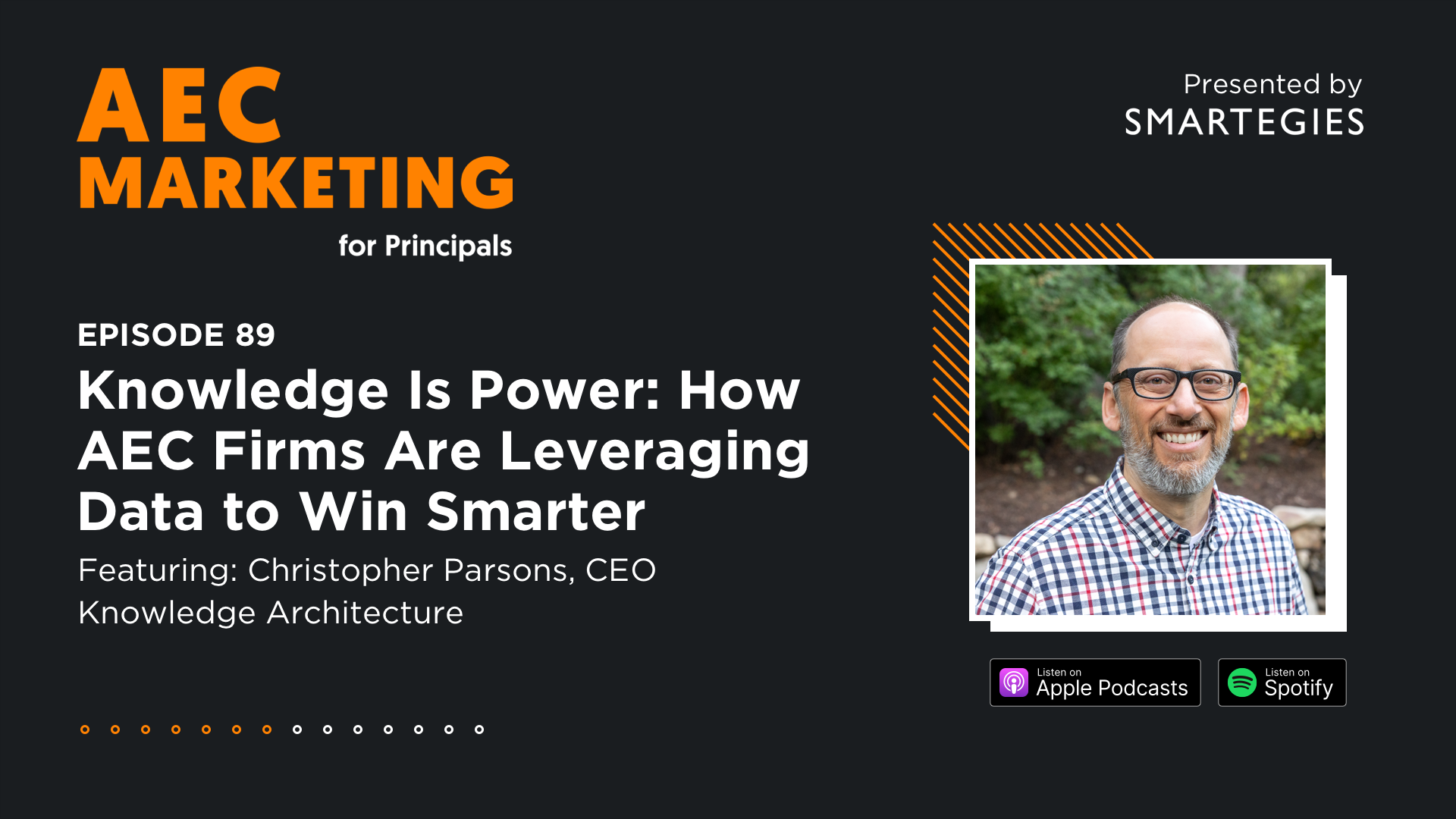
Christopher Parsons, our Founder and CEO, recently Katie Cash from Smartegies on the AEC Marketing for Principals podcast to talk about how knowledge management is evolving in the AI era. The episode is called “Knowledge is Power: How AEC Firms Are Leveraging Data to Win Smarter.”
They discussed how the upside of AI for AEC marketing is enormous: faster research, better positioning, richer storytelling, and time saved on repetitive work. But that those gains depend on high-quality firmwide knowledge. Marketers are discovering that AI doesn’t magically retrieve the right information from existing systems and network drives — it only accelerates what has been made accurate, structured, and accessible.
Christopher and Katie also explored why marketing teams are increasingly becoming the builders and stewards of their firms’ knowledge foundation.
Enjoy!
Listen or Read:

Christopher Parsons, our Founder and CEO, recently Katie Cash from Smartegies on the AEC Marketing for Principals podcast to talk about how knowledge management is evolving in the AI era. The episode is called “Knowledge is Power: How AEC Firms Are Leveraging Data to Win Smarter.”
They discussed how the upside of AI for AEC marketing is enormous: faster research, better positioning, richer storytelling, and time saved on repetitive work. But that those gains depend on high-quality firmwide knowledge. Marketers are discovering that AI doesn’t magically retrieve the right information from existing systems and network drives — it only accelerates what has been made accurate, structured, and accessible.
Christopher and Katie also explored why marketing teams are increasingly becoming the builders and stewards of their firms’ knowledge foundation.
Enjoy!
Listen or Read:
KA Connect 2025: Talks Are Up!
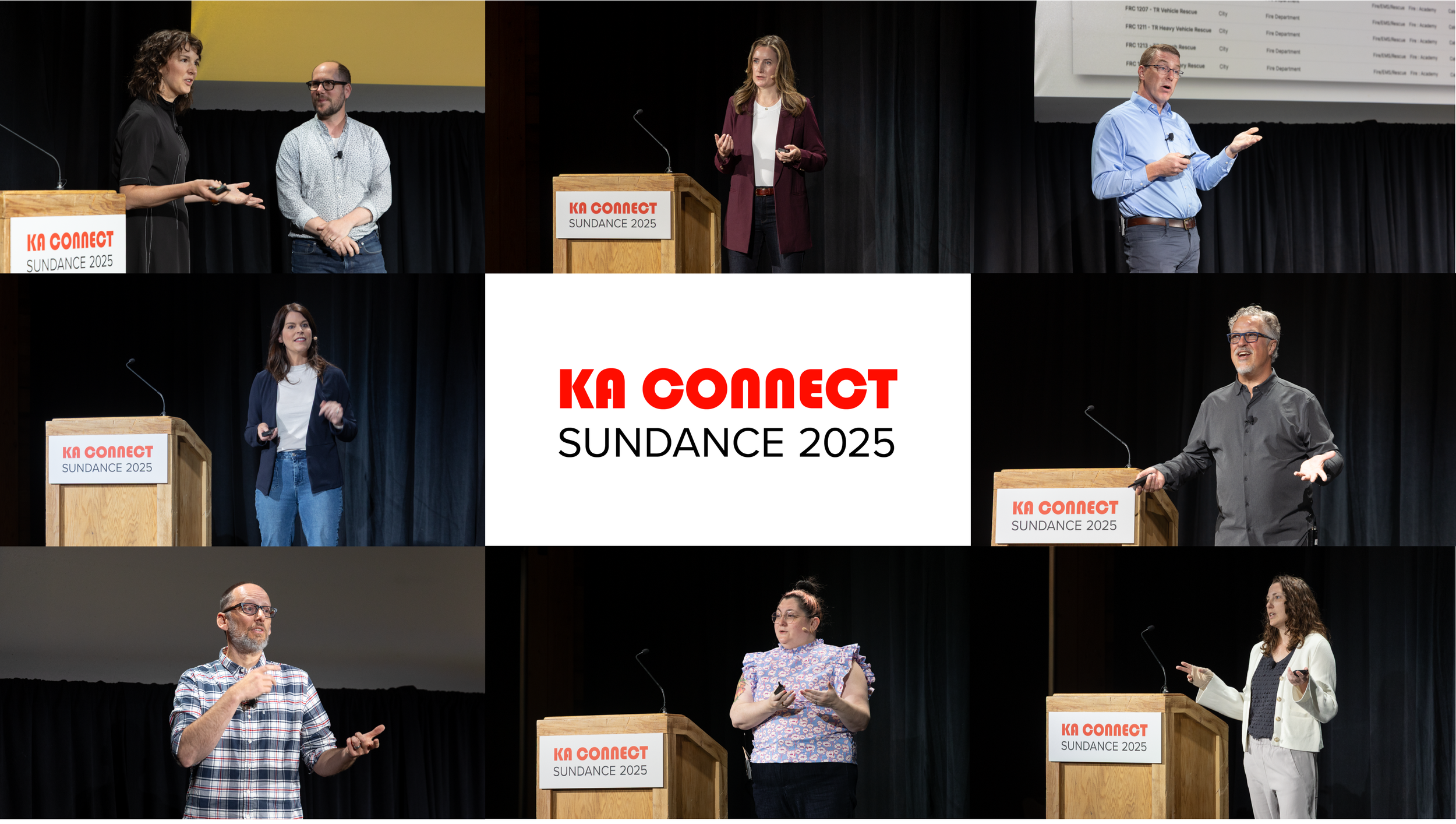
All of the talks from KA Connect 2025 are now available.
For folks who are new to our community, KA Connect is our annual knowledge and learning management conference for the AEC industry.
We had a great time sharing knowledge, building connections, and getting smarter together as a community around the theme of "Unlocking the Promise of Knowledge Management with AI” in the fresh mountain air of Sundance, Utah.
Please feel free to share these talks with your friends and colleagues.
Enjoy!
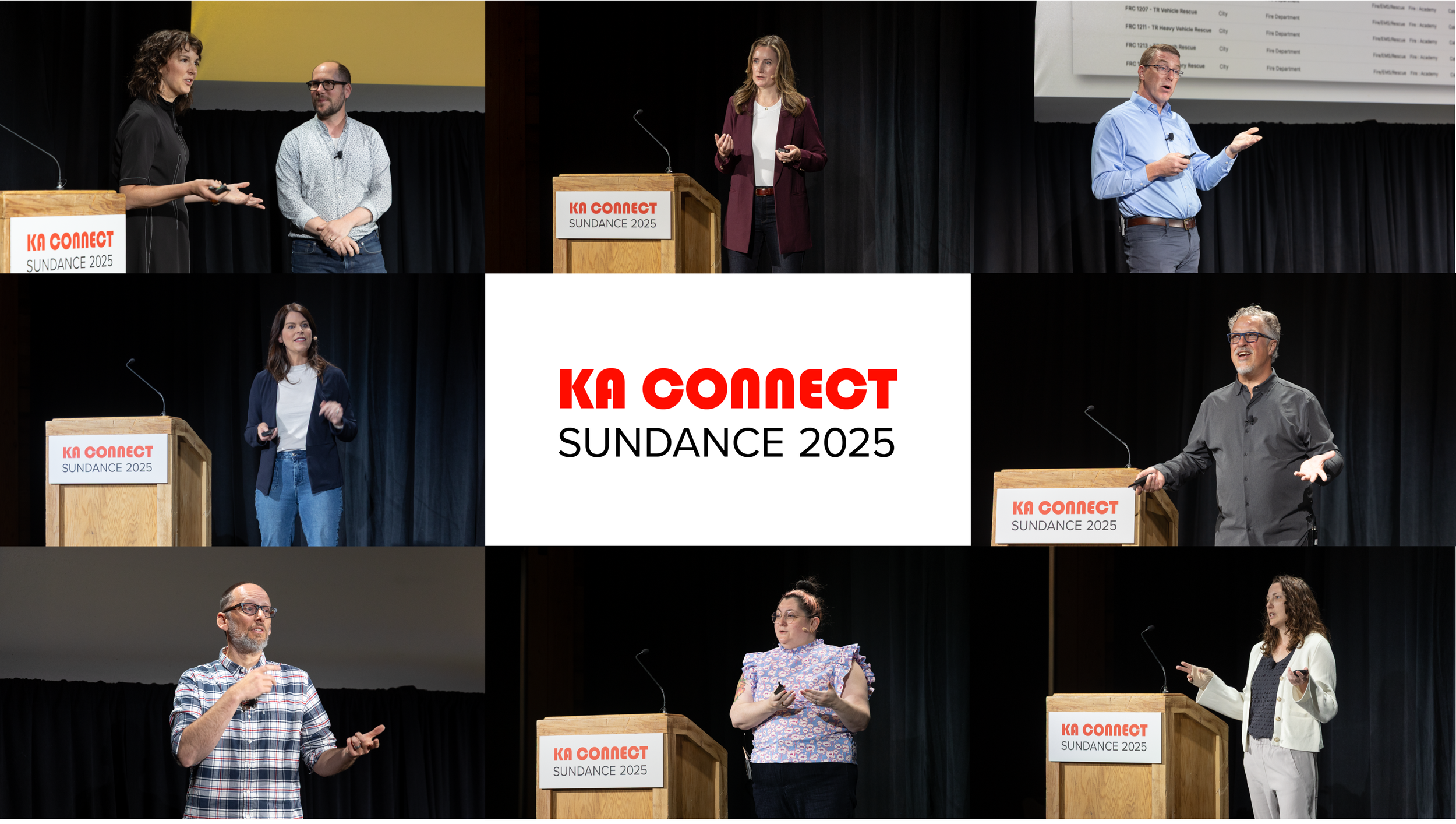
All of the talks from KA Connect 2025 are now available.
For folks who are new to our community, KA Connect is our annual knowledge and learning management conference for the AEC industry.
We had a great time sharing knowledge, building connections, and getting smarter together as a community around the theme of "Unlocking the Promise of Knowledge Management with AI” in the fresh mountain air of Sundance, Utah.
Please feel free to share these talks with your friends and colleagues.
Enjoy!

Leveling Up as Learning Organizations
We’re about ten weeks into the private beta for Synthesis LMS and the biggest lessons we’ve learned so far aren’t really about technology at all.
At first, there was a flurry of activity in the LMS. Firms jumped in, created content, uploaded videos, and built out their first courses. It was exciting to watch. But what happened next was just as important. Across both beta cohorts, people paused and said, “Oh, I see — if we really want to take advantage of this new technology, if we really want to maximize the opportunity here, it’s going to take more than just building content. We’re going to need to level up as learning organizations.”
And by that I don’t mean throwing away what firms have already been doing. Quite the opposite. These are some of the smartest firms in our community, and they’ve been investing in knowledge sharing and informal learning for years. They have lunch & learns, peer-to-peer mentoring, recorded talks from subject-matter experts, even entire libraries with hundreds of videos.
Those are strengths, and they’ve served firms well. But what we’re realizing together is this moment calls for something more. It’s not just about uploading content into a new tool. It’s about taking the next step, rising to the next level, and moving toward becoming modern AEC learning organizations.
That means going beyond volunteer-driven knowledge sharing into something more curated, something built around adult learning principles and intentional knowledge transfer. Because while serendipitous learning is valuable, firms are starting to recognize that it won’t be enough — not on its own — to prepare people for the challenges in front of them.

We’re about ten weeks into the private beta for Synthesis LMS and the biggest lessons we’ve learned so far aren’t really about technology at all.
At first, there was a flurry of activity in the LMS. Firms jumped in, created content, uploaded videos, and built out their first courses. It was exciting to watch. But what happened next was just as important. Across both beta cohorts, people paused and said, “Oh, I see — if we really want to take advantage of this new technology, if we really want to maximize the opportunity here, it’s going to take more than just building content. We’re going to need to level up as learning organizations.”
And by that I don’t mean throwing away what firms have already been doing. Quite the opposite. These are some of the smartest firms in our community, and they’ve been investing in knowledge sharing and informal learning for years. They have lunch & learns, peer-to-peer mentoring, recorded talks from subject-matter experts, even entire libraries with hundreds of videos.
Those are strengths, and they’ve served firms well. But what we’re realizing together is this moment calls for something more. It’s not just about uploading content into a new tool. It’s about taking the next step, rising to the next level, and moving toward becoming modern AEC learning organizations.
That means going beyond volunteer-driven knowledge sharing into something more curated, something built around adult learning principles and intentional knowledge transfer. Because while serendipitous learning is valuable, firms are starting to recognize that it won’t be enough — not on its own — to prepare people for the challenges in front of them.
Why Level Up Now?
Here are just a few reasons:
Retirements. Baby Boomers are leaving the workforce and there aren’t enough Gen Xers to backfill the gap.
Acceleration. Projects are moving faster and layering in more technical, contractual, regulatory, and interpersonal complexity.
The half-life of knowledge is shrinking. What we know today doesn’t hold as long as it used to. Codes, tools, and best practices are evolving more quickly than ever.
Emerging professionals. Designers and project managers are stepping into big responsibilities sooner than ever before. In the past, they might have had years to learn by osmosis. One project at a time. Now, the timeline is compressed.
Of course, project-based learning and serendipitous knowledge sharing will always matter. Those things aren’t going away. But there’s a growing sense across the community that we also need ways to accelerate people into new roles — not just new hires, but new project managers, new market and building type specialists, and new team leaders.
The question is — What can AEC firms do, intentionally and systematically, to support them?
When Less is More: The Leap to Knowledge Transfer
The abundance of content that many AEC firms already have can be a double-edged sword.
For example, one firm in our beta has 80 separate recordings on project management. Those are incredible assets, but they can also be overwhelming. What’s a new project manager supposed to do with 80 hour-long project management recordings? How do they know which best practices are still current and which are outdated? What if there is conflicting information?
Levelling up as a learning organization isn’t just about producing more. It’s also about curation. It’s about turning hundreds of recordings into a handful of structured courses. It’s about designing learning paths that actually guide someone forward, instead of leaving them with a mountain of options and no map. Sometimes less really is more.
One of the big differences between knowledge sharing and knowledge transfer is governance.
Knowledge sharing tends to be organic. Anyone with something interesting to contribute is invited to share. It’s ad hoc, volunteer-driven, and generous. And that’s a good thing — it builds community, it sparks serendipity, and it keeps ideas flowing.
Knowledge transfer, on the other hand, raises a whole different set of questions. It’s not just what gets shared, but how. Is this the right topic? Is it presented in a way that actually works as an on-demand learning asset for future employees?
Take an hour-long live presentation. Live and in person, it can be great — the audience is in the room, following the energy, and connecting with the speaker. But watching the recording after the fact might not be as effective or enjoyable. The recording of the live session might be filled with side stories and digressions as well as announcements and logistics.
That’s why leveling up as a learning organization means taking curation seriously. It means ensuring the knowledge we capture is packaged in ways that follow adult learning principles, so it’s just as effective on-demand as it was in the room. It means setting standards, building review processes, and investing in quality.
And the opportunity doesn’t stop there. Courses in an LMS aren’t one-and-done. They can evolve. Learners can give feedback so instructors can update and improve their courses over time. That continuous loop turns a single course into a living knowledge asset — one that not only captures expertise but teaches, consistently, “the [Your Firm Name] way.”
The Cultural Challenges of Curation
“Curation” is the nice word we use, but in practice it means drawing lines. It means saying no to an individual who wants to add a course to your LMS, or at least saying not yet, or not this way. That’s a new muscle for many firms — and it can feel uncomfortable at first.
The firms in our beta program have all emphasized that their approach to knowledge sharing is open to all. Anyone with something valuable to say is welcome to say it, without any reviews or guardrails.
Yet, as these same firms have begun building out their LMS strategy and content, they have expressed a desire to take a more intentional, structured, and yes, curated approach to knowledge transfer. Reviewing which ideas get turned into courses and which don’t. Setting guidelines for what good looks like when it comes to learning content. Prioritizing which topics to invest limited resources in developing.
One of the companies in our beta has tackled this transition head-on by creating a course on how to build courses using adult learning principles. They’re not just setting a bar — they’re teaching people how to clear it. What’s interesting is that this hasn’t only improved the learner experience — it’s also made the instructors more engaged. Most of these subject matter experts don’t come from a teaching background and may feel imposter syndrome when asked to “be a teacher.” But when given the right tools and guidance, they’re able to build confidence and fully enjoy the process of teaching.
So this leap we’re making as a community isn’t only organizational. It’s personal. It’s about leveling up not just as firms, but as teachers, facilitators, and learning professionals. And it’s a leap we’re making together.
The Staffing Question
All of this also raises an organizational question — Who does this work?
Volunteer committees have done a remarkable job building a culture of knowledge sharing. But can those same groups level up to create knowledge-transfer–ready assets? Can they take what’s organic and ad hoc and evolve it into curated, on-demand learning resources?
Or will firms need new roles — learning managers, instructional designers, even outside consultants — to help bridge the gap? Will they invest in upskilling their existing committees and champions, giving them the tools to become better learning and development professionals?
In other words — Is the team that got us here the team that’s going to take us there?
That’s not an abstract question. It’s a practical one in an industry where margins can be tight and resources limited. What does a sustainable model for L&D look like in AEC? How do we honor the volunteer spirit while also ensuring the quality, consistency, and intentionality needed for knowledge transfer?
At this point, we don’t know. We’re early in this journey with our community and will be exploring these questions and more in the coming months and years and will report our findings along the way.
The Challenge of Delivering the Right Knowledge to the Right Person at the Right Time
Becoming a modern AEC learning organization isn’t only about creating the best content. It’s also about delivering it to the right person at the right time.
Great content delivered at the wrong moment is only marginally useful. Unless you can apply it directly to a project or a role you’re stepping into, it doesn’t stick. At best, it plants a seed — a sense that something is possible, that the knowledge exists somewhere. But without immediate application, that knowledge tends to drift away.
This is one of the biggest challenges AEC firms face as they scale learning. You might run an excellent training session on construction administration or bathroom detailing, but unless someone happens to be taking on those responsibilities right then, they’re unlikely to retain much. Six months later, when the situation does arise, the training is a faint memory — and the person is back to searching, asking around, or reinventing the wheel.
That’s why knowledge transfer requires more than just producing great content. It demands timely delivery — ideally, just-in-time, aligned with someone’s role, project type, or current challenge.
Sometimes automation can help. In Synthesis LMS, that might mean automatically assigning a learning path when someone gets promoted, or recommending a course as a project moves into a new phase. Other times, it takes human judgment — a project manager pointing a junior architect to exactly the right course or courses as they step into new responsibilities.
Without that kind of intentionality, even the best-designed courses risk becoming just another layer in the archive: more content, but not necessarily more capability.
L&D + AI = 🔥
Most of our learning and development practices were designed long before AI came into the picture. But now, with tools like Synthesis AI Search (and soon Synthesis Knowledge Agents) AEC firms have an entirely new dimension to work with.
Knowledge can be surfaced in at least three ways:
Serendipitous sharing — Lunch & Learns, intranet posts, hallway conversations, project work.
Structured transfer — courses, learning paths, curated recordings.
AI-driven discovery — search and agents that connect people to exactly what they need, when they need it.
That last category is new — and it’s powerful. Synthesis AI search and agents can cut across silos and content types: intranet posts, best practices, project pages, lessons within courses, and video libraries. They can link someone directly to the specific piece of knowledge required to solve a problem in the flow of work, including sending them to the exact minute of a relevant video.
And often, that pinpoint moment of discovery does something else: it opens a door. In solving one problem, a learner may stumble into a whole new area of knowledge they didn’t know existed. AI can spark curiosity as much as it satisfies immediate needs.
This is why discovery is just as important as sharing and transfer. Together, they form a three-part system: the openness of sharing, the structure of transfer, and the personalization of discovery.
But — and this is crucial — AI only amplifies what’s already there. If the underlying knowledge base is overwhelming or inconsistent, AI magnifies the noise. If it’s curated and intentional, AI magnifies the value. Which is why the work of governance, curation, and timing is so central right now: it sets the stage for discovery to actually deliver on the promise of AI.
What’s Next?
So what we’re seeing, ten weeks into this beta, is that firms aren’t just implementing a new tool. They’re taking a leap. It’s a leap in people, process, culture, and governance — a leap in how AEC firms think about building and sharing knowledge. And it’s not something any one firm, or even Knowledge Architecture, can figure out alone. It’s something we’re working on out loud, together, as a community.
For me, that’s what makes this work exciting. We’re not just experimenting with a new LMS. We’re exploring, with our community, what it means to become modern AEC learning organizations. And that’s the journey I’ll continue writing about in the months ahead.
Looking forward to the conversation!
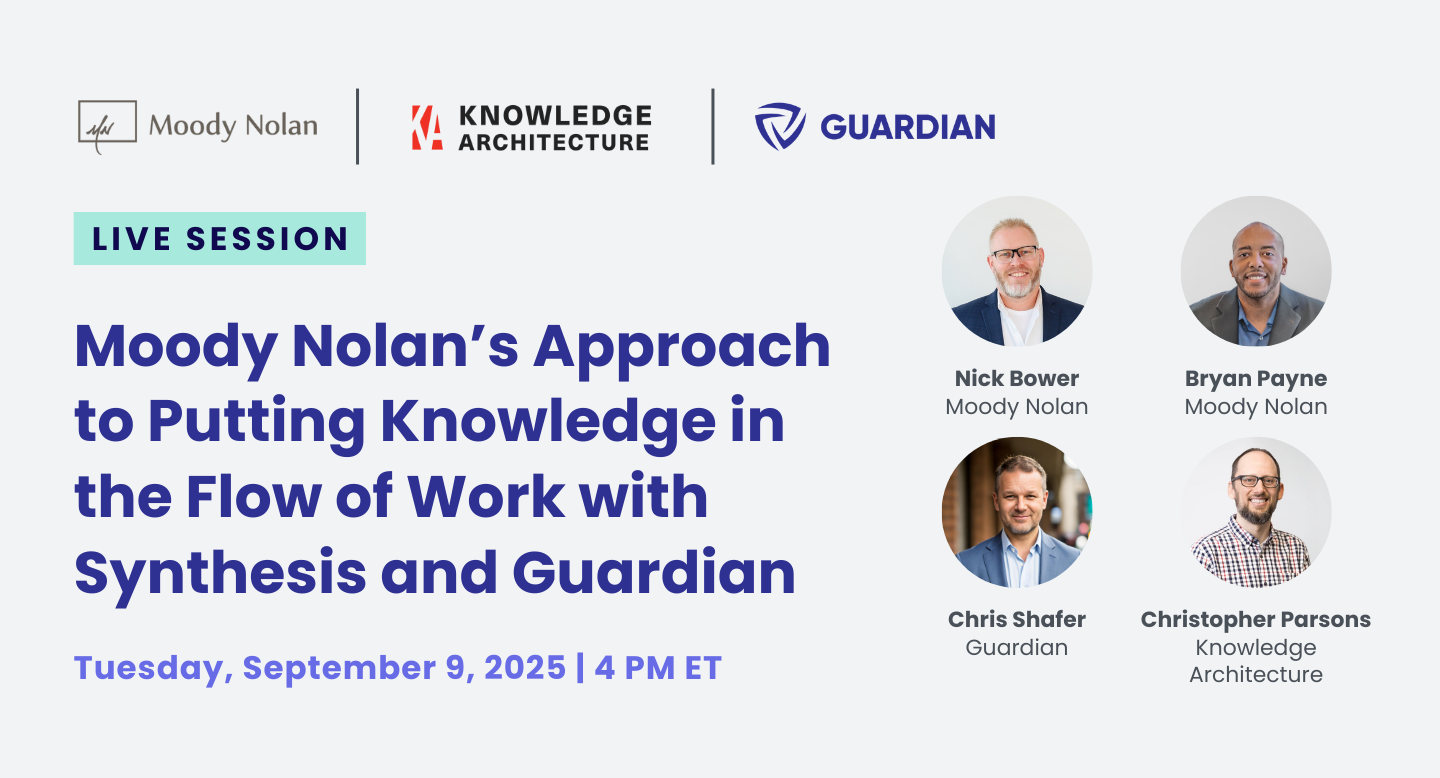
RECORDING | Moody Nolan's Approach to Putting Knowledge in the Flow of Work with Synthesis and Guardian Inbox Summary
On September 9th, Christopher Parsons joined Chris Shafer of Guardian and Nick Bower and Bryan Payne of Moody Nolan to explore how Moody Nolan integrates Synthesis and Guardian to foster a culture of continuous learning and excellence.
During the live session, Moody Nolan showcased how their commitment to education and training comes to life through innovative technology integration — empowering their team, elevating project quality, and driving consistent success.
They explored:
The Synthesis LMS
Using Guardian for real-time training in Revit
How Moody Nolan uses Synthesis and Guardian together
Enjoy!
On September 9th, Christopher Parsons joined Chris Shafer of Guardian and Nick Bower and Bryan Payne of Moody Nolan to explore how Moody Nolan integrates Synthesis and Guardian to foster a culture of continuous learning and excellence.
During the live session, Moody Nolan showcased how their commitment to education and training comes to life through innovative technology integration — empowering their team, elevating project quality, and driving consistent success.
They explored:
The Synthesis LMS
Using Guardian for real-time training in Revit
How Moody Nolan uses Synthesis and Guardian together
Enjoy!
Talking Knowledge Strategy on the Bold Brand Show
I recently joined Josh Miles on the Bold Brand Show for an episode called The Secrets to Unlocking Your Firm’s Knowledge.
In our conversation, we explored how AEC firms can use knowledge strategy not just to organize information, but to win work, grow stronger, and future-proof their business. We talked about how smarter collaboration, better content, and emerging tools like AI are helping firms tackle real challenges today while building long-term advantage for tomorrow.
Here’s a guide to the conversation:
4:18 – What does knowledge management look like in an AEC firm?
9:21 – How KM solves the real problems AEC firms care about
11:54 – What every AEC firm should know about critical knowledge transfer
16:14 – How AI agents are becoming part of the AEC workforce
19:04 – How AEC firms know it’s time to invest in knowledge management
24:00 – What AEC firms should expect when implementing a Synthesis intranet
26:56 – Why intranet projects in AEC are really about change management
32:27 – Do AEC firms still need to organize information in the AI era?
47:30 – Why video is supercharging knowledge management in AEC firms
52:41 – Why AEC firms “built to sell” are just better firms—even if you never sell
I hope you enjoy it!
Best,
Chris
▶ Watch or Listen:
I recently joined Josh Miles on the Bold Brand Show for an episode called The Secrets to Unlocking Your Firm’s Knowledge.
In our conversation, we explored how AEC firms can use knowledge strategy not just to organize information, but to win work, grow stronger, and future-proof their business. We talked about how smarter collaboration, better content, and emerging tools like AI are helping firms tackle real challenges today while building long-term advantage for tomorrow.
Here’s a guide to the conversation:
4:18 – What does knowledge management look like in an AEC firm?
9:21 – How KM solves the real problems AEC firms care about
11:54 – What every AEC firm should know about critical knowledge transfer
16:14 – How AI agents are becoming part of the AEC workforce
19:04 – How AEC firms know it’s time to invest in knowledge management
24:00 – What AEC firms should expect when implementing a Synthesis intranet
26:56 – Why intranet projects in AEC are really about change management
32:27 – Do AEC firms still need to organize information in the AI era?
47:30 – Why video is supercharging knowledge management in AEC firms
52:41 – Why AEC firms “built to sell” are just better firms—even if you never sell
I hope you enjoy it!
Best,
Chris
▶ Watch or Listen:
📺 YouTube
🎧 Spotify
🎧 Apple Podcasts

Knowledge Management is Everyone's Job | KM 3.0 Podcast Series - Episode 4
In my view, Katie Robinson, Chief Marketing Officer at LS3P, has built one of the most inspiring knowledge management programs in the AEC industry. What began as a creative solution to gather project data for proposals over a decade ago has grown into a firmwide practice where knowledge management truly is everybody’s job.
Today, Katie leads a small but mighty KM team—while also orchestrating the contributions of over 120 LS3P employees who capture and share project data as part of the firm’s Data Manager program. It’s a remarkable model for scaling KM beyond a single department.
In this episode of Welcome to KM 3.0, Katie shares how LS3P’s Data Manager program empowers emerging professionals to make project data collection both sustainable and developmental, giving them mentorship opportunities while providing the firm with reliable information.
She also describes how Expert Hours—casual, live, recorded conversations with subject-matter experts—have become a powerful way to transform everyday storytelling into searchable knowledge that fuels marketing, mentorship, and practice alike.
Along the way, we explore how LS3P is driving business value with AI, preparing to fold learning and development into their KM program, and experimenting with innovative new ways to capture and expand project data. Katie’s story is full of practical wisdom on how to start small, solve real problems, and build momentum for KM in AEC.
I hope you enjoy this conversation as much as I did.
Best,
Chris
In my view, Katie Robinson, Chief Marketing Officer at LS3P, has built one of the most inspiring knowledge management programs in the AEC industry. What began as a creative solution to gather project data for proposals over a decade ago has grown into a firmwide practice where knowledge management truly is everybody’s job.
Today, Katie leads a small but mighty Knowledge M team—while also orchestrating the contributions of over 120 LS3P employees who capture and share project data as part of the firm’s Data Manager program. It’s a remarkable model for scaling KM beyond a single department.
In this episode of Welcome to KM 3.0, Katie shares how LS3P’s Data Manager program empowers emerging professionals to make project data collection both sustainable and developmental, giving them mentorship opportunities while providing the firm with reliable information.
She also describes how Expert Hours—casual, live, recorded conversations with subject-matter experts—have become a powerful way to transform everyday storytelling into searchable knowledge that fuels marketing, mentorship, and practice alike.
Along the way, we explore how LS3P is driving business value with AI, preparing to fold learning and development into their KM program, and experimenting with innovative new ways to capture and expand project data. Katie’s story is full of practical wisdom on how to start small, solve real problems, and build momentum for KM in AEC.
I hope you enjoy this conversation as much as I did.
Best,
Chris
▶ Watch or Listen:
📺 YouTube
🎧 Spotify
🎧 Apple Podcasts
Episode Highlights
Here are a few standout moments from the conversation:
9:44 How Emerging Professionals Make Project Data Collection Scalable and Sustainable at LS3P
40:21 How LS3P Turns Live Expert Interviews Into Knowledge, Mentorship, and Marketing Assets
55:01 How to Build Momentum for KM in AEC: Start Small and Solve Real Problems
About the Welcome to KM 3.0 Series
Knowledge Management has always evolved alongside technology. Today, powered by AI, a new golden era of KM is emerging — KM 3.0.
In this limited series produced by Christopher Parsons, CEO and Founder of Knowledge Architecture and Evan Troxel, host of the TRXL Podcast, we’ll profile a range of firms—each with a distinct approach to knowledge management. From program structure to measurable impact, we’ll explore how AEC firms are using knowledge management to get smarter in an AI-driven world.
You’ll hear from a CEO, a marketing director, a technology leader, a sustainability expert, and a dedicated knowledge manager. Each will bring a different lens—showing us how knowledge leadership can emerge from different corners of an organization and take shape in distinct ways.
In every episode, we’ll aim to get to the heart of how AEC knowledge management functions in practice—what’s working, what’s changing, and what’s next.
About the TRXL Podcast
The TRXL podcast is a leading voice at the intersection of architecture and emerging technology, hosted by Evan Troxel. Each episode features thoughtful conversations with architects, technologists, and industry leaders who are shaping the future of the built environment. With a focus on innovation, practice, and the people behind the work, TRXL offers listeners an inside look at how architecture is evolving—one insight at a time.
In addition to the free weekly show, TRXL+ offers an extended experience with bonus content, early access, behind-the-scenes commentary for subscribers who want to go deeper, ad-free episodes, and the Leadership Edge newsletter. You can explore the full archive and learn more about TRXL+ at https://trxl.co.

Essential Content Reviews: Keeping Firmwide Knowledge Fresh and Relevant at AKF Group
Lately, I’ve been thinking a lot about the relationship between AI and firmwide knowledge—not just how AEC firms use knowledge to power AI, but how AI is pushing them to care for their knowledge more intentionally.
When employees use AI-powered tools like Synthesis AI Search to ask questions, they’re finding useful answers from knowledge distributed across content silos and content types, including video. But these benefits are also revealing something else: the quality of those answers depends entirely on the quality of the content behind them.
Outdated content leads to outdated answers. Gaps in documentation mean missed opportunities. Conflicting versions create confusion.
As a response, AEC firms are becoming much more attuned to the importance of maintaining high-quality, up-to-date knowledge across the business. They’re not just investing in AI. They’re investing in the knowledge powering the AI—acquiring it, updating it, and retiring it when it no longer serves the firm.
This raises an old but important question:
How do you keep a large intranet from decaying over time?
Instead of treating a new intranet launch as a one-time project, it may be more helpful to think of it like painting the Golden Gate Bridge. Crews begin at one end, make their way across, and by the time they reach the other side, it’s time to start again. The goal isn’t to finish, but to stay in motion—a continuous cycle of proactive care. And the earlier you can establish that rhythm, the healthier your knowledge base will remain.
That’s why I want to revisit a story from the KA community that feels even more relevant today than when it was first shared at KA Connect back in 2019. It’s the story of how AKF Group, at the time a 500-person multidisciplinary engineering firm with nine offices in the U.S. and two in Mexico, built a simple but powerful process for keeping their knowledge fresh—and how that process became the foundation for what we now call Essential Content Reviews.
You can read more about the Essential Content Review Framework on our website, under Intranet Best Practices. But what I want to share here is the origin story—how one firm, led by a thoughtful and practical knowledge manager named Shannon Kaplan, created a rhythm of content care that’s still shaping how our community maintains knowledge today.

Lately, I’ve been thinking a lot about the relationship between AI and firmwide knowledge—not just how AEC firms use knowledge to power AI, but how AI is pushing them to care for their knowledge more intentionally.
When employees use AI-powered tools like Synthesis AI Search to ask questions, they’re finding useful answers from knowledge distributed across content silos and content types, including video. But these benefits are also revealing something else: the quality of those answers depends entirely on the quality of the content behind them.
Outdated content leads to outdated answers. Gaps in documentation mean missed opportunities. Conflicting versions create confusion.
As a response, AEC firms are becoming much more attuned to the importance of maintaining high-quality, up-to-date knowledge across the business. They’re not just investing in AI. They’re investing in the knowledge powering the AI—acquiring it, updating it, and retiring it when it no longer serves the firm.
This raises an old but important question:
How do you keep a large intranet from decaying over time?
Instead of treating a new intranet launch as a one-time project, it may be more helpful to think of it like painting the Golden Gate Bridge. Crews begin at one end, make their way across, and by the time they reach the other side, it’s time to start again. The goal isn’t to finish, but to stay in motion—a continuous cycle of proactive care. And the earlier you can establish that rhythm, the healthier your knowledge base will remain.
That’s why I want to revisit a story from the KA community that feels even more relevant today than when it was first shared at KA Connect back in 2019. It’s the story of how AKF Group, at the time a 500-person multidisciplinary engineering firm with nine offices in the U.S. and two in Mexico, built a simple but powerful process for keeping their knowledge fresh—and how that process became the foundation for what we now call Essential Content Reviews.
You can read more about the Essential Content Review Framework on our website, under Intranet Best Practices. But what I want to share here is the origin story—how one firm, led by a thoughtful and practical knowledge manager named Shannon Kaplan, created a rhythm of content care that’s still shaping how our community maintains knowledge today.
Designing a Strategy to Help AKF’s Knowledge Base Evolve with the Firm
This story begins in 2017, before AKF launched their new Synthesis intranet.
AKF had outgrown the limitations of their legacy intranet. Like many AEC firms, they had accumulated a wide and varied body of internal knowledge—standards, procedures, forms, checklists, documentation—and no clear system for how to keep it current. Content rarely got deleted. Updates happened inconsistently. It wasn’t unusual to find multiple versions of the same document, authored by different people, with no easy way to tell which one was current. Said another way, it became hard to trust what you found.
So when they launched their new Synthesis intranet—named Willis—they came at it with a fresh mindset and a different set of habits. They didn’t just want better content. They wanted a better culture of content stewardship.
Shannon Kaplan, AKF’s Knowledge Manager at the time, helped lead that shift. From the start, she and her team embedded two core strategies into their approach:
Distribute ownership of content across six core communities (People, Technical, Marketing and BD, Learning, Project Management, and IT), so that those closest to the work could keep it current.
Establish a rhythm of proactive content reviews, beginning on day one, to make upkeep a habit—not a scramble.
Shannon proposed a cadence for content maintenance that was simple and sustainable: she would facilitate one proactive content review per month for each of Willis’ six communities. That meant each of the six communities on Willis would get reviewed twice a year. She wanted to get started right away and called the first meeting one month after launch.
Shannon understood that most intranets don’t fall behind because people don’t care. They fall behind because momentum fades. The big launch gets all the energy—and like the tip of an iceberg, it’s the part above the waterline that everyone sees. And rightly so. Launching a new intranet takes vision and commitment. It means setting a clear strategy, aligning stakeholders, building an information architecture, creating a brand, and establishing a compelling value proposition. That is very real work—and it matters.
But it’s only part of the journey. The majority of the iceberg—the mass beneath the surface—is what comes next: the steady, ongoing work of maintenance and evolution. That’s where content needs to be reviewed, updated, and retired. That’s where platform governance takes shape. That’s where habits form. And that’s where trust is either sustained or quietly eroded. This invisible but essential work is what keeps the intranet aligned with the business—and what turns a successful launch into a living, useful system.
This isn’t to say that content should only be updated twice a year. Of course, firms need to respond in real time when a new standard is adopted, a policy shifts, or a new office opens. That kind of responsive content work is essential. But what Shannon understood—and what many firms now recognize—is that reactive updates alone aren’t enough. Proactive reviews are just as important as responsive updates. Together they create a reliable rhythm that ensures every part of the intranet gets touched on a regular basis.
That early commitment—to make maintenance a built-in behavior, not a one-time clean-up effort—would go on to shape what we now call Essential Content Reviews.
How Essential Content Reviews Work
Shannon’s content review process wasn’t complicated. In fact, its simplicity is part of what made it work.
Each month, she’d meet with the community manager for one of the six core intranet communities. That created a cadence of two check-ins per year, per group—a pace that felt both manageable and meaningful. The meetings were short, informal, and deliberately low-pressure. They weren’t designed to catch people off guard or to hold them accountable in a punitive way. They were designed to help.
“Just come,” Shannon would tell them. “You don’t need to prepare anything.”
That simple invitation removed a major barrier. No one could say, “I didn’t have time to look at things yet.” They didn’t need to because Shannon designed Essential Content Reviews to be working meetings.
Each session followed a familiar rhythm. Shannon would start by reviewing intranet analytics and search history with the content owner—live, on the spot. Where are people going? What are they using? What’s dropped off in traffic? Then they’d navigate into the intranet itself and begin looking at pages one by one, asking questions like: Is this still true? Is this still needed? Is this the version we want someone to use next week?
Shannon would take notes along the way, flag outdated or broken content, and assign follow-ups where appropriate.
Shannon also knew that not everything would get done after the meeting—and that was okay. Many of her content owners were billable technical staff, with project demands that understandably came first. So she followed up gently. If something felt important, she’d offer to help, or ask if someone else on the team might be better positioned to take it on. The goal wasn’t to enforce perfection. It was to create a consistent, recurring moment where content owners felt seen, supported, and reminded that their work mattered.
“I wanted them to want to come to the meeting,” she said. “I didn’t want to force it. I wanted it to feel useful.”
That combination—a low ask, a working session, and consistent but gentle follow-up—worked. In the two years following their Synthesis launch, AKF Group never missed a review meeting. Some were rescheduled. None were canceled.
That consistency speaks volumes.
The magic of Shannon’s approach is how it turns maintenance into something relational. Each review is a kind of ritual: a check-in with the people closest to the knowledge, supported by data, grounded in real-world use, and driven by a spirit of stewardship—not control.
What began as one firm’s idea for keeping firmwide knowledge fresh and relevant, evolved into a lightweight framework that continues to serve the KA community today. It’s simple. It’s scalable. And it works.
At its core, the Essential Content Review process looks like this:
Cadence: One review per month, twice a year per community
Inputs: Page analytics, search logs, organizational updates, content owner knowledge
Outputs: Updated content, removed content, improved navigation, new content ideas
Participants: Knowledge manager + community content owner(s)
Outcomes: Fresh, trusted knowledge; stronger relationships; embedded culture of care
In many ways, it’s not just a content review. It’s a ritual of attention. A way to continually ask: What’s still true? What’s changed? What’s missing?
It’s one of the most grounded, humane examples I know of operationalizing continuous improvement in a knowledge system. And it’s very Smarter by Design.
Case Study: Uncovering Hidden Knowledge in the Technical Community
Of all AKF’s content communities, the Technical section was one of the most complex—and most consequential. It housed engineering tools, discipline-specific standards, and firmwide technical guidance. If they could keep this community current and relevant, Shannon felt, the rest would follow.
So in October 2017, just three months after launch, she met with the Technical community’s content owners for their first Essential Content Review.
At first, it wasn’t obvious what to focus on. “We just launched,” someone said. “Nothing’s out of date yet.” That was true. But Shannon came prepared with analytics—and that’s where the conversation started to shift.
Usage was lower than expected. Pages were being visited, but not as often—or by as many people—as the team had hoped. They didn’t think everyone in the firm needed to see their content. But they wanted engineers in other offices to see it. They wanted all engineering disciplines to know these resources existed.
Together, they began to ask different questions: Who do we expect to use this section? Who’s not coming? What might be missing?
That conversation opened the door to a bigger insight. Because AKF was a multidisciplinary, multi-office firm, the content owners realized they couldn’t represent all the relevant knowledge on their own. They needed help surfacing hidden tools, untapped expertise, and office-specific resources that hadn’t yet made their way into the system.
So they tapped Jake Lawrence, AKF’s Technical Director, to rally the team.
Jake created posts with humorous, eye-catching appeal on the intranet—urging engineers across the firm to contribute content, share what they’d created, and help grow the knowledge base. The posts struck a chord. Contributions started coming in.
One of the most important discoveries came soon after.
Through one of those contributions, Jake learned that AKF’s Boston office had created a robust internal guide for navigating codes and standards, but it wasn’t on their intranet, Willis. It was widely known and heavily used in Boston. But almost no one else in the firm had ever seen it.
Recognizing its value, Jake reached out to Caitlin Angelli, one of the architects of the Boston guide, and invited her to take the lead in building out the Codes and Standards section of the Technical community on Willis for the entire firm. Caitlin accepted and got to work.
Within weeks, this section was transformed. New content rolled out regularly. People started finding what they were looking for.
But that was just the beginning.
Uncovering the Boston office’s codes and standards guide sparked a broader realization: many tools, references, and insights across the firm were still siloed by office or discipline. The Essential Content Review process helped surface that blind spot.
It also sparked a change in mindset. People didn’t just start using the Technical community more, they started thinking differently about it. Willis, AKF’s intranet, was becoming the expected home for firmwide knowledge. And contributing content wasn’t just possible, it was encouraged.
That shift fulfilled the deeper intent of AKF’s knowledge strategy. Shannon didn’t just launch a new intranet. She helped design a system where content stewardship was distributed, visible, and supported. Content owners from each of the firm’s six communities took the lead for their respective areas, but they didn’t do it alone. They tapped others—technical directors, subject matter experts, local champions—to help keep the content fresh, accurate, and useful.
Instead of relying on a team of two to maintain a static knowledge base, as they had on their legacy intranet, AKF moved toward a culture of shared responsibility, where knowledge management became everyone’s job.
Sustaining the Habit: Onboarding New Content Owners with Purpose
By the time Shannon shared this story at KA Connect 2019, AKF’s Essential Content Review process had been running smoothly for more than two years. Each community cycled through a structured review twice a year. But maintaining that rhythm required more than a calendar—it required thoughtful onboarding as roles shifted and new content owners stepped in.
Rather than simply updating a calendar invite and adding a name to the next review meeting, Shannon treated onboarding as an opportunity to instill purpose. She took the time to explain how the process had come to be—why it mattered, what it was designed to prevent, and how it helped the firm maintain a living, trustworthy knowledge base.
That context helped new content owners see their role not just as caretakers of content, but as stewards of shared knowledge. Equipped with that perspective, they were more likely to bring thoughtful questions, suggest improvements, and connect the dots between their work and the needs of the broader firm.
In that way, the Essential Content Review program became more than a checklist. It became a habit rooted in shared responsibility. And as people cycled in and out of content ownership roles, the process held together—not just because it was documented, but because its values were carried forward, person to person.
From One Firm to Many: A Shared Best Practice Emerges
When Shannon first shared this story at KA Connect, it was clear she had created something special—not just for AKF, but for anyone grappling with how to keep their knowledge base healthy over time. The process was simple, repeatable, and deeply human. And we knew right away it was worth sharing.
So we did. We invited a small working group of clients to test and refine the approach. We gave it a name: Essential Content Reviews. And over time, it became the foundation of what we now call the Essential Content Review Framework—a core KM practice we’ve recommended to every intranet team we work with.
In 2024, AKF Group was acquired by WSP, and they’re sadly no longer part of the Synthesis community. But Shannon’s work lives on—not just in our best practices, but in the rhythms and rituals of dozens of other firms who’ve made this framework their own. That’s the power of community knowledge: it doesn’t disappear when people or firms move on. It gets passed down, reshaped, and kept alive.
And it continues to evolve.
Today, many firms are incorporating feedback from Synthesis AI Search into their Essential Content Reviews. After running a search, employees can rate the result from one to five stars and leave written comments. That feedback is often specific and actionable—flagging outdated guidance, pointing out missing resources, or identifying when the wrong contact is listed. In some cases, it even surfaces entirely new topics the firm hasn’t documented yet.
This real-time commentary from the people who rely on the intranet every day has become a powerful tool for keeping knowledge accurate, current, and aligned with the firm’s evolving needs. And when paired with a thoughtful program like Essential Content Reviews, it becomes something even more powerful—a virtuous cycle.
Closing Thoughts
Shannon’s work on AKF’s Essential Content Review process illustrates something I’ve seen again and again: the best knowledge managers find success through others.
She didn’t build and sustain momentum by going it alone. She built it by helping others succeed—by making it easier for them to contribute, by showing them why it mattered, and by creating a rhythm that brought people together around shared knowledge.
Success through others is one of the most critical skills in knowledge management. KM leaders rarely have direct authority over the people who own essential content or whose behaviors they’re hoping to influence. So they partner. They coach. They look for win-win opportunities. They build trust. And over time, they embed good habits into the fabric of the firm and knowledge stewardship becomes not just the responsibility of a few, but a shared way of working for everyone.
The other thing great knowledge managers do is design simple programs that have a disproportionate impact.
That’s what I love about this program. It reflects a clear-eyed understanding of human nature and the realities of how an AEC firm operates—how attention ebbs, how deadlines get missed, how good intentions fade over time—and it offers a realistic, durable design in response.
Shannon didn’t just create a content review process. She created a living ritual that honors the knowledge her firm works so hard to produce. That’s why it’s lasted. That’s why it’s spread. That’s why it continues to shape the way firms across our community think about knowledge stewardship today.
Go Deeper
📽️ Watch A Sustainable Approach to Technical Content Maintenance — Shannon Kaplan’s KA Connect 2019 interview on Essential Content Maintenance
📖 Read Planning for Essential Content Maintenance on our website

Company Wide Teams: How AEI Turns Lessons Learned Into Firmwide Knowledge
Every day, on every project, lessons are happening inside AEC firms. But without the right infrastructure, those insights often remain tucked away in meeting notes or siloed with project teams—making it likely that future teams will repeat the same mistakes on their projects.
It doesn’t have to be this way. With the right infrastructure in place, AEC firms can learn faster than one project at a time and turn individual insights into organizational knowledge.
At Affiliated Engineers, Inc. (AEI), Company Wide Teams (CWTs) provide that infrastructure. For more than 25 years, these peer-led, cross-office teams have served as the scaffolding for firmwide learning, continuous improvement, and leadership development. The idea is simple but powerful: Don’t just share lessons, learn from them—and not just as a project team, as an organization.
The structure is clear and repeatable. Project lessons are identified and prioritized during monthly CWT meetings. From there, lessons are shared across the firm through a variety of lightweight formats: curated presentations, short-form write-ups, and open technical forums. When a lesson points to a deeper need, it’s operationalized—transformed into templates, toolkits, or shared guidelines—improving how the whole firm works.
Of course, none of that happens without trust. AEI has also invested deeply in building a culture where people feel safe naming their mistakes, confident their insights will help others grow.
What follows is a look at one of the most durable and dynamic knowledge-sharing programs in the AEC industry—what it looks like in action, and what other firms can learn from it.

Every day, on every project, lessons are happening inside AEC firms. But without the right infrastructure, those insights often remain tucked away in meeting notes or siloed with project teams—making it likely that future teams will repeat the same mistakes on their projects.
It doesn’t have to be this way. With the right infrastructure in place, AEC firms can learn faster than one project at a time and turn individual insights into organizational knowledge.
At Affiliated Engineers, Inc. (AEI), Company Wide Teams (CWTs) provide that infrastructure. For more than 25 years, these peer-led, cross-office teams have served as the scaffolding for firmwide learning, continuous improvement, and leadership development. The idea is simple but powerful: Don’t just share lessons, learn from them—and not just as a project team, as an organization.
The structure is clear and repeatable. Project lessons are identified and prioritized during monthly CWT meetings. From there, lessons are shared across the firm through a variety of lightweight formats: curated presentations, short-form write-ups, and open technical forums. When a lesson points to a deeper need, it’s operationalized—transformed into templates, toolkits, or shared guidelines—improving how the whole firm works.
Of course, none of that happens without trust. AEI has also invested deeply in building a culture where people feel safe naming their mistakes, confident their insights will help others grow.
What follows is a look at one of the most durable and dynamic knowledge-sharing programs in the AEC industry—what it looks like in action, and what other firms can learn from it.
Company Wide Teams: A Volunteer Army
Company Wide Teams are AEI’s grassroots framework for peer-led knowledge sharing. CWTs share standards and tools, create consistency across offices and teams, enable workload sharing across disciplines and locations, improve quality, provide training, and implement continuous improvement.
The program began in 1999, when AEI had approximately 400 employees and five offices. CWTs have scaled alongside the firm’s growth, and now, in 2025, support nearly 1,000 people across 21 offices.
Each of the 13 disciplines at AEI has a dedicated CWT.
Each CWT consists of:
One or two representatives per office, depending on the size of the discipline
Two team co-leaders who facilitates the group and drives agendas
Regular monthly meetings, with notes shared firmwide
Working groups focused on top priorities identified by team leaders
All CWT co-leaders meet as a multidisciplinary team four times per year to share ideas and best practices for CWT leadership.
Trust and connection are foundational to AEI’s Company Wide Teams. That’s why, approximately every other year, each discipline’s CWT gathers in person for a summit. These meetings are designed to help CWT members build relationships, align on shared priorities, and recharge the team’s energy. Participants spend time together face-to-face, working on tools, surfacing challenges, and setting direction for the next phase of improvement.
After the summit, CWT members divide into smaller working groups focused on specific areas: quality, specifications, design toolkits, process improvements, or other shared priorities. This distributed model allows progress to continue between summits while staying rooted in the connections built during these in-person gatherings. Summits ground the work in trust and connections—a key to making AEI’s decentralized knowledge-sharing model successful.
Krista Murphy, a Principal at AEI who has led the CWT program for the last decade, likens CWTs to a “volunteer army,” whose “many hands make light work” in building new tools and guidelines on behalf of the firm.
Monthly CWT Meetings: Where Lessons Are Identified and Priorities Are Set
Each of AEI’s 13 discipline-specific Company Wide Teams meet online once a month. These monthly meetings are the lifeblood of the system. They are where new lessons surface—sometimes organically through stories from office representatives, sometimes in response to targeted prompts or firmwide initiatives.
CWTs record meeting notes and post them on FiL, AEI’s Synthesis intranet, where they are accessible to the whole firm.
But identifying and documenting lessons learned is only the first step. Krista Murphy emphasizes the importance of going further by asking:
– Which lessons should we share with the whole firm?
– Which lessons should become tools, templates, or shared training moments?
– Which lessons are ripe for turning into process improvements or knowledge assets?
In other words, just as top priority lessons should move beyond individual project teams, they should also move beyond the CWTs themselves so they can benefit the entire organization.
Sharing Lessons Learned Across the Organization
Here are a few of the mechanisms AEI uses to share lessons learned across the firm:
Tech Talks: Curated Conversations That Scale
AEI’s Tech Talk program is a firmwide learning series featuring short, structured presentations by employees on recent project experiences, technical lessons, and emerging tools or practices. Each of the 13 discipline-specific Company Wide Teams typically organizes one Tech Talk per year. Sessions are hosted on Zoom or recorded on Microsoft Teams, and recordings are uploaded to FiL for broader access across the firm.
Talks are kept short—typically 20-30 minutes—to encourage viewership and respect people’s time. The shorter format also makes it easier for people to prepare and share confidently, and for the firm to scale participation across disciplines and offices.
Tech Talks cover topics ranging from technical to strategic, foundational to future-looking:
Adapting for AI: Delivering Smarter Infrastructure Tomorrow
Advanced Coil Selection
Chilled Beams 2.0
Commissioning Critical Facilities
Heat Recovery Chillers and Heat Pumps
Intro to Controls
Project Management and Cost Estimating
Variable Frequency Drives (VFD) Basics
Water Reuse and Conservation
The Engineering Excellence Series: Bite-Sized Lessons That Stick
In 2021, AEI started a new program to share lessons learned on FiL called Engineering Excellence.
Engineering Excellence posts are short, digestible write-ups that capture timely technical lessons. Designed to be faster and more scalable than Tech Talks, they offer a lightweight format for sharing insights across the firm.
The idea evolved organically during the pandemic, when Tech Talks became harder to produce and the firm was focused on rapidly rolling out its 2019 strategic plan. The strategic plan emphasized engineering excellence as the key to making AEI the firm of first choice for clients and employees.
The result was the Engineering Excellence series: short-form knowledge sharing published directly to FiL. Some posts are authored by Company Wide Team leaders. Others come from individuals in the field or principals in the firm. The format makes it easier to document smaller but meaningful lessons and distribute them quickly to peers.
Krista Murphy points to one post in particular as a strong model. Authored by the co-leader of AEI’s Piping CWT, it shares a real-world problem her team encountered with a client. The story begins with the office trying to solve the issue on their own. When that didn’t work, they reached out across AEI via a Quiz Bowl (see next section), inviting insights from other offices. Still no luck. Then came collaboration with the contractor, a site visit, client engagement—and finally, after three tense weeks, a solution.
Krista loved the fact that:
“She wasn't just addressing technical possibilities in the post, but also the AEI process. What should an office do when they hit a wall? Don’t try to tackle it alone—reach out. That was the real lesson.”
The post ends with three crisp takeaways and a note of gratitude to the team. For Krista, it’s a perfect example of what the format does well: it shares not just what happened, but how the team worked through it, and how others can learn from the process.
While Engineering Excellence posts vary in topic, tone, and authorship, their unifying goal is simple: help AEI’s engineers avoid common mistakes, learn from each other’s experience, and improve the quality of their work—with minimal time investment and maximum reach.
Quiz Bowls: Tapping into AEI’s Collective Knowledge
Quiz Bowls are one of AEI’s most distinctive quality assurance and learning tools. These lively, interactive sessions give project teams the chance to pressure-test their thinking with senior engineers and peers—sometimes across offices, sometimes across disciplines, and often under the friendly scrutiny of seasoned leaders.
It begins with a project challenge. The gnarlier the better.
Here’s an example of a recent Quiz Bowl prompt:
“There’s a building served by a utility transformer Delta-Wye—2500kVA into the building with 3000A main breaker switchgear. The owner reports intermittent opening of the main breaker 2–3 times a year, no pattern. The equipment is about 15 years old. What would you investigate?”
The format varies by team and moment. Some Quiz Bowls are structured, recurring peer reviews. Others are spontaneous. Sometimes they are held in person, sometimes over Teams, and sometimes entirely on FiL as a Virtual Quiz Bowl through posts and comments.
While the format is flexible, the intent is clear: elevate design quality, surface lessons learned, and accelerate shared learning. The idea is to get more eyes on important or ambiguous design challenges, often in real-time, before issues surface in the field.
Sometimes a Quiz Bowl is sparked by uncertainty. Other times it’s a quality check on the way to a major deadline. Either way, the tone is inviting—not punitive.
As Krista puts it, “Even when I’m feeling good about things, I want to know what I’m missing. That’s as much a part of a Quiz Bowl as solving a problem.”
Though Quiz Bowls operate as a parallel workflow to Company Wide Teams, they’re closely aligned in spirit. CWTs champion the practice, promote it, and integrate lessons from Quiz Bowls into shared standards and tools. As Krista says, “CWTs are about quality, training, and continuous improvement—and Quiz Bowls support all three.”
They’ve also become an important expression of AEI’s engineering culture: transparent, rigorous, and curious. There’s even a bit of friendly competition to Quiz Bowls—teams striving not just to defend their ideas, but to learn from each other, see around corners, and continuously raise the bar.
Operationalizing Lessons Learned Into Tools and Guidelines
As we’ve seen in the examples above, AEI has multiple ways to share lessons learned throughout the organization. Equally important—if not more so—is the practice of operationalizing those lessons into firmwide tools and guidelines. This ensures learning doesn’t just live in meeting notes or recordings; it becomes embedded in how work actually gets done.
In other words, future project teams at AEI benefit from the lessons without ever having heard the underlying story.
It’s worth noting that at AEI, the word "policy" tends to raise eyebrows—maybe even cause allergic reactions. It’s not that the firm resists consistency; it resists rigidity. AEI doesn’t want policies that stifle innovation or discourage critical thinking. So instead of enforcing standards and policies, they build and share tools and guidelines.
“Policies is a bit of a cringy word around here,” said Krista Murphy. “No one wants to have to follow strict rules that do not account for client and project specific needs. So how do you have efficiency and consistency without mandating firm policy? Well, we offer tools. We have design toolkits. We have pilot programs. We have recommended practices. We’re not telling you you have to use this—but we sure as heck recommend it.”
That distinction—between offering and mandating—is fundamental to AEI’s culture. They pride themselves on client-specific, innovative engineering, not cookie-cutter solutions. And they believe the best way to encourage adoption is not to impose from above but to empower from within.
“We really believe every client is different,” Krista said. “Our mission is to deliver engineering excellence and innovative solutions for complex projects. We’re not a one-size-fits-all firm. We don’t want to produce groupthink or repetitive behavior. We want to be accepting of multiple ways to do things.”
Of course, some tools—like panel schedules or Revit families—do benefit from reuse. But even then, AEI resists the urge to require them in order to support individual client needs. Instead, they share tools that have been tested and refined by the teams who actually use them.
“Here is a whole group of people—including two representatives from every office—who have gotten behind this,” Krista explained. “And if you don’t like it, there’s a forum to suggest a tweak to the detail, the intranet page, or the BIM process. You’re not holding up improvement at the top. You’re empowering people to make something better—and make it better quickly and incrementally.”
That’s what gives AEI’s tools their strength. Rather than publishing a rigid playbook, they maintain a growing, living library of shared resources, including:
Standard Specifications
Standard Details
Standard Basis of Design
Design Toolkits
Revit Families + Tools
Standard Schedules
Templates, checklists, and more
And if someone creates something new that works? There’s a clear path for adding it to the library.
“We have a forum to bring that new thing into the repertoire of tools people can choose from,” Krista said.
This is where the Company Wide Teams shine. They’re not enforcers—they’re stewards. They help the firm divide and conquer the work of turning lessons into usable, durable resources. They ensure good ideas spread—but without forcing every office to solve problems the same way.
“We’re not trying to create a guideline so people are so efficient they don’t have to think,” Krista said. “We’re trying to provide tools where it makes sense—and we’re sharing knowledge to the best of our ability. That’s the objective.”
This approach doesn’t slow down innovation, it amplifies it. When people aren’t afraid to try new things—and they have a way to share what works—great ideas move faster.
Cultural Wisdom: Focus on the Lesson, Not the Mistake
One of the most important cultural questions AEI has wrestled with is deceptively simple:
How do you get people to admit their mistakes, share what they’ve learned, and capture those lessons so others can benefit?
It turns out how you share matters as much as what you share.
The goal of sharing lessons learned isn’t to spotlight failure or assign blame—it’s to surface insights that make the whole firm smarter. That means stripping away names of individuals, clients, or even specific projects. As Krista puts it: “Focus on the lesson, not the mistake.”
Some lessons are too hot to share as-is. In those cases, the team pulls out the core technical issue and re-frames the scenario as a more universal design challenge.
“There’s no way we could have recorded this particular hot case and posted it on the intranet as it was,” Krista said, referring to a recent lessons learned session. “But by focusing on the core of the incident—what happened and what should have happened—and removing the client name and project details, we were able to share the story in a way that reached a much wider audience.”
The frequency of these moments matters, too. AEI doesn’t just share one or two lessons per quarter—they share dozens, sometimes hundreds, each year. In Madison, for example, the Electrical Company Wide Team runs through ten lessons learned in a single meeting, and those meetings might happen six times a year. That’s 60 shared lessons—each one reinforcing that learning is normal, expected, and not tied to personal fault.
“When you’re presenting 60 lessons in a year,” Krista said, “it’s not about any one person’s mistake. It’s about what the collective group can learn from the experience.”
This is how AEI is building a learning culture: not by punishing errors, but by making improvement routine.
Over time, it stops being scary to share a mistake—because it’s no longer your mistake. It’s the firm’s opportunity to get better.
What’s Next: From Ad Hoc Learning to Intentional Training
For more than 25 years, AEI has been building and refining its Company Wide Teams program—an infrastructure for identifying, sharing, and operationalizing lessons learned. It’s a system designed to put project knowledge directly into the hands of employees, in the flow of work.
All along, training has been one of the program’s core mandates—alongside quality and continuous improvement. And training has happened: through Quiz Bowls, Tech Talks, and Engineering Excellence posts. But until recently, it’s been largely ad hoc—informal, distributed, and situational.
Now, Krista and the CWTs are working to take that training mandate to the next level. The opportunity isn’t just to share knowledge—it’s to design learning. Structured, intentional, and built with AEI’s younger engineers in mind.
“We have all this information on FiL—design toolkits, 101 videos, process guidance—but our younger folks didn’t even know it existed,” Krista said. “They said, ‘It’s just too much. We can’t find it.’”
To meet that need, AEI is launching a new Intro to Engineering page, designed for engineers early in their careers. Built around three “springboards,” it will offer curated access to essential knowledge:
A Technical Springboard for design toolkits, discipline intro 101 videos, and discipline-specific how-tos
A Professional Springboard for soft skills like communication, relationship-building, and running an effective meeting
An Industry Springboard that introduces AEI’s project delivery models, contracting basics, and financials overview
The rollout will be phased—starting with the technical springboard, then expanding. And wherever strong content already exists, AEI will link to it rather than reinvent it.
CWTs will remain central—not just as content creators, but as curators and stewards of training resources. They’re ideally positioned to manage toolkits, champion best practices, and align learning efforts across the firm.
AEI is also preparing to take this work even further through Synthesis LMS. For Krista, the platform offers a way to formalize what’s already working—and create structured, scalable training experiences led by the CWTs themselves.
“There’s been a lot of desire for more formal training than what we have,” she said. “I’m excited about making the Company Wide Teams responsible for what those courses might look like.”
Closing Thoughts
In the decade-plus I’ve been watching this program evolve—from my first glimpse in 2013 to the present—I’ve been continually impressed by its thoughtfulness, intentionality, and durability. This isn’t a flash-in-the-pan initiative. It’s a living system that has grown stronger over time and I believe it’s been a key contributor to AEI’s sustained success.
It also illustrates something I say often: great firms spend as much time designing their business as they do designing buildings and infrastructure. AEI’s Company Wide Teams are a case in point. They’re not just supporting project work—they’re building the future of the firm. And they’re doing it consistently, collectively, and intentionally. They’re becoming smarter. By design.
Go Deeper
🎥 Watch Engaging Engineers with Company Wide Collaboration at AEI — Krista Murphy’s KA Connect 2019 talk on the origins and evolution of the Company Wide Teams program.
🎥 Watch The Evolution of Knowledge Management at AEI — Krista Murphy’s KA Connect 2016 talk on the origins and evolution of AEI’s Knowledge Management program.
🎥 Watch Improving Knowledge Flow: The AEC Lessons Learned Pipeline — my KA Connect 2018 talk outlining the Knowledge Architecture's Lessons Learned Pipeline framework.

Unlocking Sustainability with AI-Powered Knowledge Management | KM 3.0 Podcast Series - Episode 3
Years ago, Corey Squire told me he believed that knowledge management was the secret to unlocking sustainability in architectural practice. At the time, that insight struck me as bold and prescient. Now, after watching Corey apply that philosophy across his roles at Lake Flato, through his consulting work, and most recently as Director of Sustainability at Bora Architecture & Interiors, I believe it’s something much more: a model.
In this episode, Corey walks us through how Bora is transforming sustainability from a siloed department into a shared operating system—powered by a thoughtful culture, a living knowledge base, and now, AI Search. He shares how their Synthesis intranet (Chaco) helps capture institutional knowledge from experts and make it accessible to the entire firm, freeing up time for deeper innovation and mentorship. We talk about the importance of pairing sustainable knowledge with a supportive culture, and the flywheel effect that happens when you give people not just facts, but context and clarity about why design choices matter.
Corey’s insights are grounded, generous, and deeply practical—shaped by his own experience building firmwide programs, writing the AIA Framework for Design Excellence, and publishing People, Planet, Design, a book that blends design philosophy, actionable strategies, and an entire chapter on knowledge management as the foundation for sustainable practice.
Whether you're trying to scale sustainability, upskill your teams, or figure out how AI fits into your firm’s future, this is a conversation full of takeaways you can borrow, adapt, and implement.
Enjoy!
Years ago, Corey Squire told me he believed that knowledge management was the secret to unlocking sustainability in architectural practice. At the time, that insight struck me as bold and prescient. Now, after watching Corey apply that philosophy across his roles at Lake Flato, through his consulting work, and most recently as Director of Sustainability at Bora Architecture & Interiors, I believe it’s something much more: a model.
In this episode, Corey walks us through how Bora is transforming sustainability from a siloed department into a shared operating system—powered by a thoughtful culture, a living knowledge base, and now, AI Search. He shares how their Synthesis intranet (Chaco) helps capture institutional knowledge from experts and make it accessible to the entire firm, freeing up time for deeper innovation and mentorship. We talk about the importance of pairing sustainable knowledge with a supportive culture, and the flywheel effect that happens when you give people not just facts, but context and clarity about why design choices matter.
Corey’s insights are grounded, generous, and deeply practical—shaped by his own experience building firmwide programs, writing the AIA Framework for Design Excellence, and publishing People, Planet, Design, a book that blends design philosophy, actionable strategies, and an entire chapter on knowledge management as the foundation for sustainable practice.
Whether you're trying to scale sustainability, upskill your teams, or figure out how AI fits into your firm’s future, this is a conversation full of takeaways you can borrow, adapt, and implement.
Enjoy!
Best,
Chris
▶ Watch or Listen:
📺 YouTube
🎧 Spotify
🎧 Apple Podcasts
About the Welcome to KM 3.0 Series
Knowledge Management has always evolved alongside technology. Today, powered by AI, a new golden era of KM is emerging — KM 3.0.
In this limited series produced by Christopher Parsons, CEO and Founder of Knowledge Architecture and Evan Troxel, host of the TRXL Podcast, we’ll profile a range of firms—each with a distinct approach to knowledge management. From program structure to measurable impact, we’ll explore how AEC firms are using knowledge management to get smarter in an AI-driven world.
You’ll hear from a CEO, a marketing director, a technology leader, a sustainability expert, and a dedicated knowledge manager. Each will bring a different lens—showing us how knowledge leadership can emerge from different corners of an organization and take shape in distinct ways.
In every episode, we’ll aim to get to the heart of how AEC knowledge management functions in practice—what’s working, what’s changing, and what’s next.
About the TRXL Podcast
The TRXL podcast is a leading voice at the intersection of architecture and emerging technology, hosted by Evan Troxel. Each episode features thoughtful conversations with architects, technologists, and industry leaders who are shaping the future of the built environment. With a focus on innovation, practice, and the people behind the work, TRXL offers listeners an inside look at how architecture is evolving—one insight at a time.
In addition to the free weekly show, TRXL+ offers an extended experience with bonus content, early access, behind-the-scenes commentary for subscribers who want to go deeper, ad-free episodes, and the Leadership Edge newsletter. You can explore the full archive and learn more about TRXL+ at https://trxl.co.

INTRANET TOUR | Refabricating DSX: How Diamond Schmitt Is Evolving Its Knowledge Platform for AI Search + Learning
Featured Guests
Jeanette Parker, Director of Knowledge Management
Wendy Gomoll, Manager, Knowledge Management
Sam Horton, Learning and Development Manager
Webinar Summary
In this webinar, you’ll see how Diamond Schmitt is strategically evolving their knowledge platform to capitalize on emerging capabilities in AI-powered search and learning management.
Featured Guests
Jeanette Parker, Director of Knowledge Management
Wendy Gomoll, Manager, Knowledge Management
Sam Horton, Learning and Development Manager
Webinar Summary
Diamond Schmitt first launched their Synthesis intranet, DSX, seven years ago. Today, DSX is at the center of an active, ongoing transformation which reflects how knowledge management priorities are shifting in the KM 3.0 era.
In this webinar, you’ll see how Diamond Schmitt is strategically evolving their knowledge platform to capitalize on emerging capabilities in AI-powered search and learning management, including:
How project updates and behind-the-scenes storytelling help emerging professionals and experienced staff alike engage with project knowledge and design decisions across the firm
How technical documentation, such as drawing manuals and BIM standards, have been transformed from static PDFs into dynamic, searchable guides
The structured, staged approach Diamond Schmitt used to test, refine, and launch Synthesis AI Search to the entire firm, including early success stories and emerging search patterns
How they are now preparing DSX for the next chapter: integrating video-based learning and on-demand education through Synthesis LMS
Throughout the tour, we also looked at how AI-powered search has surfaced knowledge gaps, exposed outdated content, and created a continuous feedback loop that is actively driving new content creation, standards updates, and cross-team collaboration—all in support of better answers, better context, and better onboarding for the next generation of architects.
Enjoy!
Webinar Timeline
Introduction
00:00 KA Introduction
01:09 Introduction to Diamond Schmitt
01:50 DSX Overview
03:09 AI Search Demo
Launching AI Search on DSX
05:52 AI Search Roadmap to Launch + Beyond
06:56 Test Groups
08:27 Testing Content Priority List
09:25 Search Optimization: Feedback
11:40 Testing Evaluation, Launch Roll Out + Beyond
12:34 Launch Presentation + Post
14:45 Lessons Learned for AI Search Optimization
DSX Tour
17:41 DSX Core Committee
18:21 Information Architecture Overview
How AI Search is Shaping Our Content
21:48 Content Review
23:19 Structuring Our Content
24:43 Restructuring Existing Content
25:43 Coordination of Efforts
26:27 Bite Size Content
27:10 Mining Project Updates
28:54 Sourcing New Content
Learning Community & Preparing for Synthesis LMS
29:55 Introduction to DSU
30:50 Course Creation Before + After Synthesis
33:14 On Demand Content
32:37 Learning Paths
35:00 External Course Wrappers
35:25 Metrics
35:55 LMS Lessons Learned
Q+A
37:10 How do you decide what to prioritize?
41:23 Frequency of and responsibility for content reviews?
44:06 Transferring content from project updates into pages or guides?
45:30 Who are the content owners and how does that change over time?
47:38 How much effort is involved in creating short videos?
49:01 What are your “approved AI services”?
50:54 How are you tracking all of this?
More Case Study Webinars
Register for our next Office Hours Webinar

How Leading AEC Knowledge Management Teams Are Evolving to Thrive in the AI Era | 12 Trends
Over the past year, much of the conversation around AI and knowledge management in AEC has rightly focused on technology. Generative AI platforms, AI search offering, and emerging capabilities like AI agents are transforming how firms surface and share what they know.
We’ve also spent a lot of time exploring the benefits: how AI can support emerging professionals, elevate subject matter experts, improve onboarding, streamline marketing, and accelerate learning and development, to name a few.
But one deceptively simple question from the Q&A session at the end of our KM 3.0: Connecting People to Knowledge and Expertise in the Flow of Work webinar has stayed with me:
“How is the work of AEC knowledge management teams changing because of AI?”
In many ways, that question became the organizing impulse for this issue—because KM 3.0, this new era of AI-powered knowledge management, isn’t just about technology. KM 3.0 is also about people, process, and culture, and how AI is reshaping the work of knowledge management teams.
Over the past few months, I’ve spoken with some of the most thoughtful and forward-thinking KM leaders in our community—members of Knowledge Architecture’s Research Council and others leading mature programs across firms of all sizes.
And to be clear, not everyone doing this work has “knowledge” in their title. Across the AEC industry, we see knowledge management being led by a diverse mix of roles—knowledge managers, design technology leaders, operations directors, IT leaders, marketing and communications professionals, learning and development leads, innovation strategists, practice leaders, quality assurance directors, and even CEOs.
Regardless of their title or department, what they share is a deep investment in how knowledge flows across the firm and a commitment to making it more usable, accessible, and strategic.
What follows is a synthesis of 12 key trends—emergent patterns in how the smartest KM teams are evolving their work to thrive in this new era of AI-powered knowledge management.

Over the past year, much of the conversation around AI and knowledge management in AEC has rightly focused on technology. Generative AI platforms, AI search offering, and emerging capabilities like AI agents are transforming how firms surface and share what they know.
We’ve also spent a lot of time exploring the benefits: how AI can support emerging professionals, elevate subject matter experts, improve onboarding, streamline marketing, and accelerate learning and development, to name a few.
But one deceptively simple question from the Q&A session at the end of our KM 3.0: Connecting People to Knowledge and Expertise in the Flow of Work webinar has stayed with me:
“How is the work of AEC knowledge management teams changing because of AI?”
In many ways, that question became the organizing impulse for this issue—because KM 3.0, this new era of AI-powered knowledge management, isn’t just about technology. KM 3.0 is also about people, process, and culture, and how AI is reshaping the work of knowledge management teams.
Over the past few months, I’ve spoken with some of the most thoughtful and forward-thinking KM leaders in our community—members of Knowledge Architecture’s Research Council and others leading mature programs across firms of all sizes.
And to be clear, not everyone doing this work has “knowledge” in their title. Across the AEC industry, we see knowledge management being led by a diverse mix of roles—knowledge managers, design technology leaders, operations directors, IT leaders, marketing and communications professionals, learning and development leads, innovation strategists, practice leaders, quality assurance directors, and even CEOs.
Regardless of their title or department, what they share is a deep investment in how knowledge flows across the firm and a commitment to making it more usable, accessible, and strategic.
What follows is a synthesis of 12 key trends—emergent patterns in how the smartest KM teams are evolving their work to thrive in this new era of AI-powered knowledge management.
Trend 1: Slowing Down to Spend More Time on Strategy and Prioritization
The best knowledge management teams I know are slowing down. By design.
In an environment where new AI tools, platforms, and plugins seem to emerge daily, many firms are facing what you might call a paradox of opportunity. There’s no shortage of potential—new ways to streamline workflows, capture knowledge, improve onboarding, enhance reuse, and deliver value across the business. But the sheer volume of choices can overwhelm, distract, and increase the risk of chasing too many things at once.
It’s not just the technology that’s moving fast—the knowledge itself is changing, too. The half-life of internal expertise is shrinking. Legacy content needs revision. Systems need rethinking. And no firm can manage it all. That’s always been true in AEC knowledge management, but it’s even more true in the AI era.
The best KM teams are cutting through the noise by returning to first principles:
What are our firm’s core business goals and strategic priorities?
What knowledge matters most in service of those goals?
Which AI use cases meaningfully advance that strategy?
They’re becoming filters, not funnels—connecting new opportunities back to firm strategy, identifying high-leverage areas, and gently heading off “random acts of KM or AI” before they become distractions.
This kind of prioritization only happens with strong executive sponsorship. Whether it’s the CEO, COO, or a managing principal, the best firms ensure that someone at the leadership table is aligned with knowledge management—and empowered to say: work on this, not that. With that support, KM leaders don’t have to guess which projects or investments will matter most. They can shape long-term initiatives that actually move the business forward.
Yes, there’s a lot of opportunity right now. But there’s also risk—the risk of building what should have been bought, buying what should have been built, or investing time, money, and attention on things that don’t matter.
That’s why the smartest firms are taking a beat. They’re trading speed for strategic clarity—and setting their KM and AI efforts up to create real, sustained value.
Trend 2: Thinking Like Knowledge Architects
Another shift I’m seeing in leading KM teams is a deeper focus on designing knowledge systems—not just launching tools or programs, but thinking like architects.
Imagine the role of a campus architect. They’re not just placing buildings; they’re sequencing long-term investments, coordinating infrastructure, and making decisions today that will shape the flow of people, ideas, and resources for decades to come.
The best KM leaders are approaching their work in much the same way—but as knowledge architects. They’re designing the scaffolding, flows, and integrations that support smarter, more connected learning organizations. Not just managing content, but shaping the knowledge ecosystems their firms will rely on well into the future.
They’re asking foundational questions like:
Have we identified the right systems to serve as reliable single sources of truth for critical firmwide knowledge?
Are our systems integrated correctly to make knowledge available in the right applications for both human and agentic users?
Do we have the right people in place to design and maintain the knowledge ecosystem? Not just content owners, but stewards of structure and flow?
Are our human processes for capturing, updating, and sharing knowledge well-defined, monitored, and measured?
Can knowledge move across our organization in a way that’s timely, trustworthy, and tied to real business needs?
KM leaders are increasingly stepping into a knowledge architect role—working across a design canvas that spans:
Software platforms
Data pipelines
Human processes, like Design and Engineering Reviews, Communities of Practice, QA/QC, and Project Closeout
Cultural practices around stewardship and content ownership
The context and data needs of AI systems
They’re mapping how knowledge flows—or should flow—across the firm. They’re thinking not just about features, but dependencies. Not just implementation, but maintainability.
This long-view mindset is a necessary counterweight to the hype cycle of AI. The best KM leaders I know aren’t chasing tools—they’re building infrastructure. And that requires a different kind of vision: one that sees the future clearly, but understands how to get there step by step.
Trend 3: From Gatekeeping to Stewardship
In the early days of intranets and knowledge management systems, publishing content required technical skill—HTML knowledge, even light programming. Most firms relied on one or two people to act as gatekeepers: everything flowed through them. If you wanted something published, you sent it to the KM team. If it needed an update, you sent it back again.
That bottleneck was born of necessity—but it also created a certain culture: the KM team as gatekeeper. Not just of quality, but of access.
Today, that model no longer fits. Publishing tools are better. Content creation is easier. Platforms like Synthesis, and others, have dramatically lowered the barrier to sharing knowledge. The bottleneck is gone.
But in many firms, the expectations of gatekeeping still linger. Even as tools have lowered the barrier to contribution, the perception remains that the KM team is still the central publisher, the quality control checkpoint, the place where all content must pass through. It’s a legacy mindset—and one that many KM teams are now working to actively shed, because it’s no longer sustainable.
The best KM teams are moving away from managing all the knowledge themselves and toward creating the conditions for others to manage knowledge well. They’re not trying to control every document or library. Instead, they’re designing roads, lanes, and guardrails—establishing taxonomies, setting information architecture, configuring integrations, and building publishing workflows—so others can move through the system with clarity and confidence.
In this newer model, the KM team becomes:
A steward of the system, not the sole source of truth
A strategic facilitator, not a bottleneck
A coach and enabler, not a gatekeeper
They still set the standards. They still design the structure. But they’re empowering others—subject matter experts, department leaders, operations staff, committees—to contribute, maintain, and improve content within those guardrails.
This shift frees KM leaders to focus on more strategic work. But more importantly, it distributes responsibility for knowledge across the organization—which is the only way to sustain it at scale.
Trend 4: A Renewed Focus on Content Quality and Curation
One of the most immediate—and durable—shifts I’m seeing in AEC knowledge management is a renewed investment in content quality. Not just adding more knowledge, but improving what already exists.
AI has been the catalyst. Tools like Synthesis AI Search are surfacing knowledge that used to be siloed by department, locked in videos, buried in long documents, scattered across years of posts and comments, or isolated in employee and project databases. These tools are revealing what firms know—but they’re also exposing what’s outdated, redundant, or just plain wrong.
And that’s triggered a shift.
KM teams are doubling down on digital hygiene:
Proactively reviewing high-traffic content
Rotating through content areas on a cadence
Developing processes to capture and maintain key employee and project data
Using search analytics and feedback to identify top queries and outdated content
Nearly every KM leader I interviewed said the same thing: if they had to choose between filling knowledge gaps or cleaning up existing content, they’d start with cleanup. Because when something is missing, users assume it just hasn’t been added yet. But when something is wrong, they lose trust in the whole system.
This shift from collection to curation has made KM teams more operationally focused—and more collaborative. They’re designing frameworks that allow content owners to maintain their own material, while providing the structure, guidance, and tools to keep things consistent, current, and findable.
It’s a mindset shift: from knowledge as “something we store” to knowledge as a living asset. And now that AI tools are making that asset more visible—and more valuable—leading firms are treating it with the care it deserves.
Trend 5: The Way We Organize Information Is Changing
This question came up several times in our recent conversations with KM leaders:
“If AI can find anything, do we still need to organize everything?”
It’s not a wild question. AI search—especially semantic and vector-based search—has changed the game. In the past, if you didn’t enter the exact keyword or phrase, you might not find what you were looking for. Search engines were brittle, and the burden fell on KM teams to make content findable through tagging, naming conventions, synonyms, best bets, and structured taxonomies.
But in AEC, where KM teams are often lean and stretched across many responsibilities, the approach was always more pragmatic. Everyone knew structure mattered, but few had the time or resources to build elaborate ontologies or maintain perfect hierarchies. And now, with AI magically surfacing related content across silos, understanding context and synonyms, and summarizing results in plain language, it’s easy to wonder if we can stop worrying about organizing altogether.
Nobody I know is seriously advocating for that.
What we’re hearing instead is a more thoughtful shift—a move away from rigid, all-or-nothing taxonomies toward intentional scaffolding at the right level of detail. One KM leader put it this way:
“I still believe in strong Level 1, Level 2, Level 3 structure on our intranet—the major categories and subcategories that reflect how our firm works. But beyond that, I’m okay with being less organized at deeper levels of hierarchy. I know that AI can handle it.”
That framing—high-level scaffolding with deeper flexibility—feels like where many firms are landing.
The KM leaders I talked to believe you still need to signal what matters. You still need to make your values, workflows, and key knowledge areas legible to new employees. And you still need to support those in your firm who prefer to browse and navigate rather than search. But once you’ve done that, you can afford to loosen up.
It’s a question of resolution. Just like in BIM, where you choose the Level of Development (LOD) based on the purpose of the model, KM leaders are learning to tune their information architecture to the right level of development for clarity, usability, and sustainability. If the structure is too coarse, it becomes meaningless. If it’s too fine, it becomes unmanageable. But at the right resolution—that high-level scaffolding—it tells a story. It shows how your firm works. And it gives both humans and AI enough context to find their way.
AI search has changed how we think about structure, but it hasn’t made structure irrelevant. In fact, as one KM leader put it, “The way we structure our information says something about who we are, and what we value, to our employees.”
KM in the age of AI isn’t about abandoning organization. It’s about applying it more strategically and at the right level of detail.
Trend 6: Optimizing Content for Human and Agentic Retrieval
As AI becomes more deeply embedded in daily workflows, firms are realizing that the way content is written—and for whom—matters more than ever. What used to be internal shorthand or insider knowledge is now being surfaced, summarized, and remixed by AI agents.
As new hires and emerging professionals retrieve more information from AI, versus solely from experts, a challenge has emerged.
For years, many technical standards, guidelines, and process documents were written at an expert level. They were packed with acronyms, layered assumptions, and firm-specific shorthand that only seasoned employees understood. That might have worked when knowledge moved mostly through mentorship and meetings with experts on hand to provide the missing context. But now, as new hires and emerging professionals are increasingly turning to internal AI for technical or procedural advice, those missing layers of explanation and context become serious blockers to understanding—or worse, sources of misinformation.
So teams are changing how they write.
They’re adding context and backstory. They’re defining terms and acronyms. They’re organizing content with clearer titles and section headers. They’re asking subject matter experts to write as if they’re speaking to an intern.
And the beautiful thing is that when you make content more clear and accessible for AI, you also make it more clear and accessible for humans.
Nice.
This shift also includes a stronger focus on communicating the why, not just the what. Instead of simply stating that a window-to-wall ratio should be between 20–40%, teams are now adding explanations: Why does it matter? When would you want to push higher or lower? What trade-offs are involved? What’s the firm's preferred approach—and when might it make sense to deviate?
These kinds of insights help junior staff make better decisions. But they also help AI return better answers—ones that are grounded in firm context and aligned with real-world constraints.
In fact, some KM leaders are starting to describe AI agents as a new kind of learner—one whose knowledge, literacy, and developmental path must be managed just like any human team member. That doesn’t mean turning everything into rigid datasets or structured fields. It means treating content quality and clarity as essential infrastructure—the foundation on which human learning and agentic performance both depend.
When knowledge is written with both audiences in mind, it becomes more usable, more trustworthy, and more adaptable. And that’s not just good for AI. It’s good for humans, too.
Trend 7: KM Leaders as AI Scouts and Shepherds
As AI sweeps across the AEC industry, KM leaders are stepping up to help their firms navigate the shift. In many cases, they’re not just supporting AI initiatives—they’re leading them.
Some are acting as AI Scouts—testing new tools, exploring emerging capabilities, and experimenting with how existing systems can be extended or adapted. They’re often early adopters, curious coders, and strategic experimenters. They evaluate new features as they roll out in their existing software. They prototype integrations and pilot projects. And critically, they bring those learnings back to their firms—translating experiments into insights, and surfacing opportunities with real value potential. They ask: What’s possible? What’s practical? And what’s worth pursuing now?
At the same time, these same leaders are increasingly taking on the role of AI Shepherds—guiding their firms through the new territory of AI adoption. They teach AI literacy across departments. They facilitate training on creating effective AI prompts and validating AI-generated outputs. They create how-to guides and usage policies. They help teams assess what level of literacy different roles need—and what it really means to be an “informed user” of AI tools.
Some KM leaders are helping write firmwide policies on responsible use. Others are working closely with leadership, legal, HR, marketing, design technology, and practice teams to craft governance plans that reflect both risk and opportunity.
They understand that implementing AI isn’t just a technical challenge—it’s a cultural one. And that makes KM leaders, with their change management skills and deep understanding of how knowledge flows, uniquely suited for the job.
Some of them are officially part of AI task forces. Others are simply jumping in. But across the board, we’re seeing KM leaders play a pivotal dual role in this new era: scouting the terrain ahead, and shepherding their teams through it.
Trend 8: Accelerating Knowledge Transfer from Experts to Emerging Professionals
One of the evergreen promises—and persistent challenges—of knowledge management in AEC is scaling expert knowledge. In a business built on expertise and results, firms need to help emerging professionals become more effective healthcare architects, bridge engineers, project managers, or sustainability experts. Historically, that kind of learning has happened slowly: one project at a time, one mentor at a time.
But today, the urgency is rising. Many firms are facing a real-time talent crunch: senior experts are retiring, hiring is competitive, and there’s pressure to ramp up new staff faster than ever.
That’s where KM teams are stepping in—not just to collect or store knowledge, but to accelerate the transfer of critical insight from experts to emerging professionals. One increasingly popular method is structured expert interviews. Instead of asking a senior architect to write down everything they know (which rarely works), KM teams are capturing informal conversations on video, then using AI tools to transcribe, summarize, and transform them into searchable, reusable knowledge. In some cases, those interviews also form the basis for courses or training programs.
These interviews take different forms. Sometimes they’re one-on-one conversations recorded in a conference room or over Zoom. Other times, they’re held as live learning events—inviting staff to listen in, ask questions, and absorb the exchange in real time. In some firms, experts are even interviewing one another, creating space for reflection and storytelling while modeling a culture of shared learning. Regardless of format, the resulting videos become assets that can be reused across onboarding, training, and AI-powered search.
KM teams act as knowledge brokers, working across departments and generations to extract tacit expertise and make it available in the flow of work. That includes surfacing bite-sized insights through search, packaging repeatable methods into standards, or embedding lessons learned into onboarding programs.
AI is playing a major role throughout this process—making transcription and summarization faster, enabling retrieval through tools like AI search, and helping turn raw insights into new knowledge assets for experts to review. But the shift is as much cultural as it is technical. The best KM teams are creating lightweight, repeatable ways to scale expert knowledge without putting all the burden on the experts themselves.
For the first time in years, it feels like firms are making real progress on this long-standing challenge. And it’s not just about efficiency—it’s about continuity, capability, and preparing the next generation to lead.
Trend 9: Recording Knowledge in the Flow of Work
One of the most promising shifts in KM 3.0 is a growing instinct to record knowledge as it’s being shared in the flow of work. For years, we’ve asked experts to step away from their billable work and carve out time to share what they know—usually through interviews, write-ups, or one-off learning events. And sometimes that is still the right approach. But the best firms are now recognizing that some of the most valuable knowledge doesn’t get surfaced in a vacuum, it emerges organically in the flow of work.
Design crits, town halls, QA/QC reviews, tech talks, team debriefs—these are not new practices. What’s new is a heightened awareness that these moments often surface insights worth capturing. What used to be a fleeting comment or forgotten answer can now become a reusable, searchable knowledge asset with the tap of a record button. And increasingly, KM teams are positioning themselves to capture that magic in real time.
Sometimes that magic is obvious: an expert says something that surprises even them. A nuanced decision gets explained in a way that suddenly clicks for everyone. A great question surfaces a new pattern. You can feel the room shift when it happens. These moments aren’t just insightful—they’re irreplaceable. And when they’re recorded, they become learnable for others across time, location, and role.
There’s also a growing recognition that video is one of the richest, most efficient formats for knowledge transfer. People speak more naturally than they write. They gesture. They emphasize with rhythm, tone, or volume. They build on the ideas of others. With AI-powered transcription, summarization, and timestamped search, those recordings can now be turned into assets—either as raw clips searchable by topic, or as inputs for more polished summaries and structured documentation.
Some firms are migrating entire archives of recorded content—town halls, team meetings, learning sessions—into their intranet or search system to make them accessible long-term. Others are starting smaller: recording select moments and uploading them as short clips. Either way, KM teams are becoming curators of the recordable workplace, helping ensure that what gets said once doesn’t have to be said a hundred more times.
Of course, this shift also brings new tensions and decisions. Not everything should be recorded. Firms are actively negotiating when it’s appropriate to capture a conversation and how to handle sensitive topics like client names, project challenges, or QA/QC reviews that might carry legal risk. Some are developing shared norms or lightweight policies. Others are relying on good judgment—learning to recognize when the knowledge being shared should (or should not) be captured on video.
What’s most important is the mindset: a collective posture that says, this moment matters—let’s preserve it. Whether that recorded moment stands on its own or becomes a stepping stone to something more formal, the thinking is the same—if knowledge is being surfaced, let’s make it last.
In the KM 3.0 era, recording isn’t just about efficiency—it’s about equity and scale. It ensures that the insights from today’s conversation aren’t only shared with its participants. It turns a one-time conversation into a source of organizational (and searchable) knowledge. And it helps build a smarter firm—one recording at a time.
Trend 10: KM and L&D Are Converging
Historically, knowledge management and learning & development often existed as adjacent but separate functions within AEC firms. KM might report through IT, operations, or marketing—or sometimes directly to the CEO—while L&D often lived under HR, design technology, or as a standalone team focused on compliance and professional development. Despite their clear overlap in purpose and shared emphasis on capability building, these two domains have, until recently, followed fairly distinct paths.
Across the KA community, we’re seeing a clear trend: KM and L&D teams are partnering more deeply or merging entirely. In some firms, knowledge managers now lead the L&D function. In others, learning professionals are embedded in KM teams to strengthen coordination and ensure closer alignment between learning programs and knowledge strategy. And even when the two functions remain distinct, they’re working more closely than ever before.
Why now? In part, because of AI.
As AI search tools like Synthesis become central to the way firms access knowledge, the boundary between "learning content" and "knowledge content" is blurring. A video about stair detailing best practices might once have lived only in a learning management system (LMS) and only been accessed when assigned as part of an individual’s development plan. Today, that same video, recorded and transcribed, becomes searchable organizational knowledge for the entire firm. And so it matters less whether something is structured as formal learning or informal documentation. What matters is: Can people find it? Can it help them learn? Can it help them improve their performance?
That shift is reshaping how firms think about both strategy and structure. If AI search is going to index and surface both learning and knowledge assets, then those assets need to live in the same system—or at least in integrated systems. And increasingly, they do.
At Knowledge Architecture, we recognized this shift and decided to build a learning management system into Synthesis. With Synthesis LMS now in private beta—and headed for public release later this year—clients will soon be able to host all their courses, learning paths, and training videos in the same place they manage standards, policies, best practices, internal communications, Q&A, discussions, and employee and project data.
One platform. One search. One integrated experience.
This shift isn’t just about software consolidation—it’s about strategic alignment. When knowledge and learning content live side-by-side in one platform, they’re easier to manage, curate, and improve. It also becomes easier to deliver a cohesive user experience: employees don’t need to think about where to look, just what they need to learn or find. And with generative AI powering both search and structured learning, there’s a growing recognition that KM and L&D need a shared roadmap.
It’s too early to tell whether firms will formally adopt new titles like Chief Knowledge and Learning Officer or Knowledge and Learning Manager. That language hasn’t fully emerged yet. But even without title changes, the spirit of integration is unmistakable. Knowledge and learning have always been two sides of the same coin. In the AI era, firms are beginning to treat them that way—building programs, platforms, and teams that reflect the full arc of how expertise is developed and delivered.
Trend 11: Short, Flexible, and On Demand: The New Era of Learning Content
Across the AEC community, learning content is becoming more agile. Formal presentations are being complemented by quick, focused recordings. And behind it all is a thoughtful shift—driven not just by technology, but by a deeper understanding of how people actually learn and share knowledge at work.
From the learner’s perspective, shorter, asynchronous content offers flexibility and control. It enables people to learn in a way that fits their schedule, their preferences, and their energy. Some prefer to start the day with a focused burst of learning. Others absorb ideas better in the quiet of late afternoon. When longer training videos are broken down into shorter lessons, it’s easier to learn at your own pace.
It’s not just about convenience. This shift also encourages more intentional engagement. When content is delivered in digestible pieces, learners can focus more deeply on each idea. Some firms are even adjusting their defaults—aiming for 15 or 30 minute sessions instead of the traditional hour—not to cut corners, but to focus attention. The goal is clarity, not compression.
For content creators, shorter formats make it easier to share insights. You don’t have to build a long presentation around a single topic. You can speak to one idea—something fresh, relevant, or timely—and share it in a natural, human way. Whether it’s a one-take Zoom recording or a brief conversation with a colleague, the lower effort required makes it easier for more people to participate in creating learning content.
This more flexible approach doesn’t mean we’re saying goodbye to live training. In fact, many firms are elevating their live sessions by pairing them with asynchronous content. In a “flipped classroom” model, the core material is delivered in advance—through short videos or modular lessons—freeing up in-person time for questions, reflection, and group discussion. It’s a more intentional, more interactive use of shared time.
And from a KM perspective, shorter lessons offer real advantages. Yes, AI Search can find insights in long-form recordings, but short, focused content is easier to maintain. If a policy or workflow changes, it’s much easier to update a ten-minute clip than to revisit and revise an entire hour-long training. This lowers the cost of maintenance and increases the overall health of your learning library over time.
Ultimately, this trend reflects a broader cultural shift. We’re moving toward a learning environment that’s more learner-centered, more adaptive, and more sustainable. We’re giving people the tools and permission to share what they know in ways that feel natural—and making it easier for others to find and apply that knowledge when they need it most.
And perhaps most importantly, we’re adjusting to the pace of change.
In a world where the half-life of knowledge is shrinking—where technologies evolve, workflows shift, new materials become available, and new ideas surface daily—we need learning strategies that can keep up. Not everything we teach will be relevant in five years. Sometimes, it needs to be relevant this quarter. Or this week. Or just long enough to move a project forward.
That’s why short, flexible, and on demand content matters. It meets the moment. It embraces the velocity of change. It lets us respond in real time, without being slowed down by perfectionism or production bottlenecks. In this environment, lightweight doesn’t mean lower quality. It means better fit.
Trend 12: Orchestrating the Learning Organization
Knowledge management has never been a solo act. It’s been more like a band. But in the AI era, it’s becoming a full-blown orchestra.
For years, KM teams have worked to cultivate a culture of contribution across their firms—to help people understand that knowledge management isn’t just a department, it’s a shared mindset and responsibility. That’s not new. What is new is the level of energy, engagement, and demand that KM teams are now experiencing from across their organizations. Everyone wants in.
AI is the accelerant. When people see how easy it is to retrieve knowledge—how fast and accurate AI-powered search can be, how rich and accessible video transcripts are, how training content can now be tracked and tailored—they get it. Senior leadership, subject matter experts, business unit leaders, project managers, and emerging professionals are all suddenly leaning in. They understand the value of well-organized project data. They see the benefit of surfacing hard-won expertise. They realize that what used to live in silos—spreadsheets, email threads, hallway conversations—now has a place to land, and a way to be retrieved.
That enthusiasm is reshaping the role of KM leaders, too. Many are stepping into new, cross-functional roles as educators and guides—teaching AI literacy, co-writing usage policies, and coaching teams on how to contribute content that’s both human-friendly and machine-readable. Some are helping their firms explore what’s possible with AI; others are helping shepherd adoption responsibly. Often, they’re doing both. This work goes beyond deploying new tools—it’s about building confidence, trust, and shared capacity across the firm.
That’s the opportunity. It’s also overwhelming.
The best KM leaders are meeting this moment not by trying to do it all themselves, but by building distributed capacity. They’re developing networks of curators and contributors across the firm. They’re embedding knowledge management roles and responsibilities into project teams, practice areas, and operational departments. They’re formalizing stewardship of key content areas, investing in reusable patterns and systems, and coaching others to think like knowledge managers—even if that’s not their title.
KM is shifting from gatekeeping to orchestration.
This transition requires new mindsets and new muscle: teaching people how to manage content with care, encouraging them to think about storytelling and context, showing them how to align their contributions with firm-wide knowledge and learning goals. It means getting serious about content ownership, metadata, and governance—but doing it in a way that scales. It also means helping teams connect the dots across learning, operations, digital tools, and culture.
The work is no longer just KM work. It’s organizational work. It’s the work of building a learning organization.
That phrase—learning organization—has been the North Star of this whole Smarter by Design series. And in many ways, this final trend is the foundation that makes all the others sustainable. The future of knowledge management in AEC isn’t just smarter technology or better systems. It’s a shared commitment to learning, growth, and contribution—distributed across the firm and guided by a strong, strategic core.
And on a personal note: I’ve never been more excited about this work than I am right now. The past year of collaborating with KM leaders, technologists, and firm executives across the AEC industry has been one of the most inspiring of my career. The energy, the creativity, the generosity—this moment we’re in feels like a once-in-a-generation opportunity. And I couldn’t be more grateful to be part of it.
Let’s keep going.

Introducing Stock Icons 2.0
We are excited to introduce Stock Icons 2.0, our latest update to the stock icon feature in Synthesis.
This new feature allows users to:
Filter Stock Icon Results by Style – Use the new style and weight filters to adjust the look of your stock icons for visually consistent results.
Set the Default Stock Icon Style – Set sitewide defaults in the branding settings to maintain a cohesive look across your intranet site.
Show or Hide Stock Icon Filter in the UI – Choose whether contributors see style filters in the stock icon interface—or hide them to preserve consistency.
Stock Icons 2.0 makes it easier to stay on brand and quickly find the icons you need.
We’ll release this update after the close of business on Friday, July 18th to all Knowledge Architecture clients.
Enjoy!
We are excited to introduce Stock Icons 2.0, our latest update to the stock icon feature in Synthesis.
This new feature allows users to:
Filter Stock Icon Results by Style – Use the new style and weight filters to adjust the look of your stock icons for visually consistent results.
Set the Default Stock Icon Style – Set sitewide defaults in the branding settings to maintain a cohesive look across your intranet site.
Show or Hide Stock Icon Filter in the UI – Choose whether contributors see style filters in the stock icon interface—or hide them to preserve consistency.
Stock Icons 2.0 makes it easier to stay on brand and quickly find the icons you need.
We’ll release this update after the close of business on Friday, July 18th to all Knowledge Architecture clients.
Enjoy!