
Smarter by Design Podcast
How Leading AEC Firms Integrate Knowledge Management, Learning & Development, and AI to Build Smarter, More Adaptive Practices
Recent Episodes
In this episode of the Smarter by Design podcast, I’m joined by Nicole Chavas, President and COO of Greenprint Partners, and Hillary Thompson, Principal at MBH Architects, for a candid conversation about what they are learning as they turn AI experiments into meaningful business transformation.
Both Nicole and Hillary are senior leaders who are also personally building agents and redesigning workflows, which gives them a close-up view of not only what the technology can do, but what it reveals about their firms. Again and again, they have found that building with AI exposes the same underlying questions: What does good look like? Is this actually our standard, or just what we happen to do today? Is the knowledge documented clearly enough to use? And are we redesigning the work itself, or simply bolting AI onto an existing process?
One of the clearest lessons is that scalable transformation often means going smaller, slower, and together. Nicole describes initially trying to move quickly, work largely on her own, and use agents to redesign entire business processes at once. What she learned was that proposal development and project management are really collections of interconnected subprocesses, and that lasting change requires a different approach: involve the people doing the work, break the system into smaller pieces, focus on the highest-impact opportunities, define what good looks like, redesign each subprocess for an AI-enabled way of working, and then train the firm on the new process.
Hillary describes a parallel journey at MBH, where rapid prototyping with firm leaders through an “agent charrette” surfaced her leadership team’s dreams for AI-driven business transformation. Rapid prototyping then exposed the undocumented processes, conflicting standards, duplicated effort, and poor data quality standing in the way of their dreams. In that sense, AI serves as an organizational mirror because when agents struggle, they often teach you something about the business.
But process redesign is only part of the challenge. The other major constraint is change capacity. Nicole and Hillary are both operating in environments where the technology is improving faster than their organizations can realistically absorb change. They discuss experimenting with “good enough” solutions, following the energy of early adopters, sharing successful use cases between peers, building trust with skeptics, and giving leaders closer to day-to-day project work permission to control the pace of change.
The goal is to build a trusted core of people at their firms who can experiment, interpret what is changing, and act as a kind of shock absorber for the rest of the organization. This helps the firm move fast without forcing everyone to experience the full chaos of living at the bleeding edge of the AI frontier.
The throughline is that AI itself is not the point. It is an increasingly powerful catalyst for redesigning the business around the fundamentals AEC firms have always cared about: high-quality work teams are proud of, profitably run projects, happy clients, and engaged employees.
I think you’ll love this one.
▶ Watch or Listen
Watch or listen to this episode via YouTube, Spotify, Apple Podcasts or wherever you get your podcasts.
📺 🎧 YouTube
📺 🎧 Spotify
📺 🎧 Apple Podcasts
KTGY was founded in 1991 with an ambition to build a firm that would outlast the people who built it. Six founding partners set out to create a firm which would endure from generation to generation — a firm whose culture, values, and capability would compound over time rather than walk out the door when any one person retired. What they couldn’t have anticipated is how deliberately, and how systematically, KTGY would eventually design its way toward that goal.
In this episode of the Smarter by Design podcast, I’m joined by John Robison, Chief Operating Officer at KTGY, and Donovan Helminiak, Director of Knowledge Management, to trace the evolution of KTGY's learning ecosystem and examine how it has become one of the firm's most consequential strategic investments.
The conversation goes behind the scenes of how KTGY built four key components of its learning ecosystem:
ELEVATE Leadership — a year-long, cohort-based program built to teach emerging leaders what great leadership looks like at KTGY
ELEVATE Essentials — a foundational knowledge program which grew from a pandemic-era intern series into a hybrid on-demand and workshop model open to the entire firm
ELEVATE Talent Management — a newer program targeting first-time people managers, focused on the day-to-day nuance of leading teams
FUEL — a grassroots mentorship community driven entirely by emerging professionals, deliberately mixing offices and experience levels to build connections that wouldn't otherwise exist across seven offices
The old apprenticeship model — learning one project at a time from the people around you — served KTGY well for decades, but is no longer sufficient for a firm with over 400 employees, seven offices, a generation of retiring principals, and a profession being radically reshaped by technology.
KTGY's answer has been to design something more intentional: a learning ecosystem where cohort-based programs, on-demand curricula, and grassroots community reinforce each other, and where building trust is a primary goal.
As we discussed in the episode, trust is the catalyst that determines how fast AEC firms can change and evolve. To move faster, means intentionally investing in building trust and KTGY’s learning ecosystem has proven remarkably effective at doing exactly that.
If you lead an AEC firm thinking seriously about what it takes to build a culture that connects distributed teams, and stays ahead of change, and endures across generations, this episode is an honest accounting of what that investment (and the returns) look like.
▶ Watch or Listen
Watch or listen to this episode via YouTube, Spotify, Apple Podcasts or wherever you get your podcasts.
📺 🎧 YouTube
📺 🎧 Spotify
📺 🎧 Apple Podcasts
Jennifer Bennett didn't think she had what it took to be a leader. As a structural engineer coming up at Shive-Hattery, she assumed leadership required a natural charisma she didn't have. In 2007 she was invited to participate in the firm's Leadership Development Program and changed her mind. Today she's President and CEO of the 750-person, 18-office architecture and engineering firm, and she runs the program herself.
In this episode of the Smarter by Design podcast, Jennifer takes us inside how Shive-Hattery’s Leadership Development Program actually works: the cohort structure, the Socratic teaching method, the five curriculum pillars (business acumen, negotiation, high-performance teams, culture and values, emotional and social competence), and the real strategic projects each cohort tackles over their 15-18 months together. She also shares how she builds the trust a cohort needs to succeed and how the program itself is evolving as she brings her executive team in to teach modules so the firm can double how many future leaders it reaches each year.
At its core, Shive-Hattery’s Leadership Development Program isn't just about developing individual leaders — it's about teaching people to lead change in a way that's consistent with Shive-Hattery's culture and to carry that culture forward as they rise. That's part of a bigger act of stewardship. Shive-Hattery is a firm with more than 125 years of history and Jennifer sees investing in future leaders as central to how the firm sustains, evolves, and grows for decades to come. Past leaders invested in her generation; now it's her generation’s turn to pay forward.
If you lead an AEC firm or are thinking about what it takes to build a leadership culture and an enduring firm, this episode is for you.
▶ Watch or Listen
Watch or listen to this episode via YouTube, Spotify, Apple Podcasts or wherever you get your podcasts.
📺 🎧 YouTube
📺 🎧 Spotify
📺 🎧 Apple Podcasts
In this episode of the Smarter by Design podcast, I’m joined by Jackie Baxley, Principal and Practice Leader for Environmental Health, Safety, and Sustainability at HRP Associates. Jackie has spent years helping HRP evolve from a more organic, apprenticeship-driven learning culture into a more intentional learning organization that thinks carefully about competency, capability, incentives, mentorship, and organizational performance. Her perspective is shaped by the realities of consulting work, where the product is ultimately the people themselves.
One of the central ideas Jackie returns to throughout this conversation is that not every learning experience is trying to accomplish the same thing. Organizations often get into trouble when they fail to define the actual goal upfront. Is the goal simply communication? Awareness? Skills development? Demonstrated competency? Different goals require different approaches, different investments, and different ways of evaluating success.
Jackie walks through the practical frameworks HRP uses to think more intentionally about learning design, including her “inverted pyramid” model of communication, awareness, training, and competency, as well as the EDGE framework: Educate, Demonstrate, Guide, and Evaluate. We explore why awareness is not the same thing as competency, why repetition matters, how HRP approaches skills validation and quality audits, and why some learning experiences work best asynchronously while others must remain in person.
The conversation also explores the operational and economic realities of learning inside consulting firms. Jackie discusses how HRP has worked to remove the stigma around training and development by redesigning incentives, rethinking billability, and treating learning as a strategic investment rather than overhead. We also discuss HRP’s evolving employee lifecycle programs, their growing focus on soft skills and management development, and the challenge of building deeper organizational capability without turning learning into bureaucracy.
If you lead an AEC firm, manage teams, oversee operations, or are thinking about how to scale expertise more intentionally inside your organization, this episode offers a thoughtful and highly practical conversation about designing learning around real outcomes. A conversation about clearer goals, stronger capability development, and building modern learning organizations that keep getting smarter, by design.
▶ Watch or Listen
Watch or listen to this episode via YouTube, Spotify, Apple Podcasts or wherever you get your podcasts.
📺 🎧 YouTube
📺 🎧 Spotify
📺 🎧 Apple Podcasts
In this episode of the Smarter by Design podcast, I’m joined by Kent Jonasen, CEO of the Leadership Pipeline Institute and co-author of the third edition of The Leadership Pipeline as well as author of The Specialist Pipeline. Kent has spent decades helping organizations rethink leadership development, succession planning, and the challenge of scaling expertise inside complex companies.
His work starts from a deceptively simple premise: leadership is not leadership.
Each transition—from leading yourself to leading others, leading leaders, leading functions, and eventually leading an enterprise—is fundamentally a different job that requires different skills, different priorities, and even different values.
But this conversation goes far beyond leadership development.
Many organizations unintentionally build systems where leadership becomes the only visible path for growth, recognition, and advancement. Specialists—deep technical experts, practitioners, strategists, and problem-solvers—often feel forced toward management roles simply to continue progressing in their careers. Over time, this creates frustration, weak leadership transitions, and the gradual loss of highly valuable expertise.
Kent and I explore why organizations need both leadership pipelines and specialist pipelines working together. We discuss:
Why leadership transitions so often fail
The hidden importance of discovering and aligning with your “work values” in career progression
Why many specialists feel alienated inside traditional organizations
The difference between knowledge experts and knowledge leaders
How companies accidentally push people into management roles they never truly wanted
Why specialist career paths need more than just new titles
How dual leadership and specialist pipelines create healthier long-term organizational design
Along the way, we connect these ideas directly to architecture, engineering, and construction firms, where specialized expertise is often the core engine of competitive advantage. From healthcare planners to sustainability experts to technical design specialists, many AEC firms are wrestling with how to scale expertise, accelerate development, and reduce dependency on a shrinking number of senior experts.
If you lead an AEC firm, oversee learning and development, manage technical teams, or are thinking about succession planning and long-term capability building, this episode offers a powerful framework for rethinking how careers evolve inside organizations. More importantly, it raises a deeper question: what if building a stronger company starts not just with developing better leaders, but with designing better systems for developing expertise itself?
▶ Watch or Listen
Watch or listen to this episode via YouTube, Spotify, Apple Podcasts or wherever you get your podcasts.
📺 🎧 YouTube
📺 🎧 Spotify
📺 🎧 Apple Podcasts
In this episode of the Smarter by Design podcast, I'm joined by Angela Watson, President and CEO of Shepley Bulfinch, a nationally recognized architecture firm whose work spans healthcare, higher education, and civic design. Angela leads with a conviction she traces back to her time teaching at MIT: that real learning doesn't happen through lecture — it happens through doing, through struggle, and through the kind of exploration that only comes when people are given room to fail safely and try again. That belief didn't stay in the classroom. It became the foundation for how she thinks about leading a firm.
Learning by doing is the foundation of how AEC professionals and firms develop. The problem is that great ideas stay trapped in pockets — one team figures something out, another team struggles with the same thing, and the knowledge never travels. Angela saw that dynamic playing out at Shepley Bulfinch as the firm grew into a national practice, work-sharing across five offices with project cycles too long and feedback loops too slow to rely on informal transfer alone. Becoming a learning organization became an operational necessity, but it turned out to be much harder than it looked.
The conversation traces the full arc of what that effort has looked like in practice and what Angela has learned leading it. Why it's so hard for subject matter experts to codify and teach what they know. Why the traditional apprenticeship model is breaking down as plates get fuller and mentorship gets crowded out. What Shepley Bulfinch learned from building Birdfeeder, their internal peer-to-peer learning platform — what worked, what was too ambitious, and what the firm is rethinking now. And why the harder problem isn't building a course catalog — it's connecting learning to where someone actually wants to go in their career.
The thread running underneath all of it is psychological safety. Angela talks about "Back to the Future," Shepley Bulfinch's reframe on lessons learned — a format designed to celebrate the imperfect and make it safe to share what went wrong. She reflects on what it took for her, as CEO, to model that vulnerability publicly, and why she believes culture is the soil in which any learning organization either takes root or doesn't.
If you lead an AEC firm, manage a team, or are thinking seriously about how your organization develops its people, this episode is for you. Angela offers deep insight into what's worked, what hasn't, and what is still to be figured out on Shepley Bulfinch's journey to becoming a learning organization.
▶ Watch or Listen
Watch or listen to this episode via YouTube, Spotify, Apple Podcasts or wherever you get your podcasts.
📺 🎧 YouTube
📺 🎧 Spotify
🎧 Apple Podcasts
In this episode of the Smarter by Design podcast, I’m joined by Clark Quinn, a cognitive scientist who has spent his career translating decades of learning research into practical guidance for organizations. He is the founder of Quinnovation and co-founder of the L&D Accelerator. His work is grounded in a simple conviction: most organizations are leaving enormous potential on the table — not for lack of effort or care, but because the science of how people actually learn has rarely made it into the room where learning decisions get made.
In most AEC firms, learning and development didn’t start with a formal strategy. It emerged organically. Executives responsible for talent came up through practice. L&D leaders stepped into their roles because they wanted to make their firms better, not because they were trained in the discipline. Subject matter experts shared what they know without ever having been taught how to teach.
As a result, most learning organizations in the AEC industry were largely built by accident rather than by design. And in that gap lies a significant opportunity: to create learning that doesn’t just inform, but actually improves capability and performance.
That is what this conversation is about.
Clark walks us through the science that most accidental L&D leaders never had access to. He explains why training so often stops at information transfer, what it really takes to design for performance rather than content delivery, and what the research says about learning design that actually moves the needle. We explore the shift from content-heavy training to practice-led learning, how to identify the root causes behind critical performance gaps before reaching for a training solution, and how to determine whether learning is even the right intervention.
We also step back and look at what a true learning ecosystem requires: not just courses, but performance support, job aids, communities of practice, mentoring, and the cultural conditions where learning compounds over time. Where knowledge is shared openly. Where failure is discussed. And where leadership sets the tone.
Finally, we go deep on one of the most important dynamics in any AEC firm: how to effectively work with busy and highly billable subject matter experts by drawing out what they know, pairing them with skilled learning designers, and building a coaching culture that makes expertise transferable at scale.
If you lead an AEC firm, build learning programs, or teach others what you know—and you’ve largely been figuring it out as you go—this conversation offers a foundation for doing it smarter. By design.
▶ Watch or Listen
Watch or listen to this episode via YouTube, Spotify, Apple Podcasts or wherever you get your podcasts.
📺 🎧 YouTube
📺 🎧 Spotify
🎧 Apple Podcasts
In this episode of Smarter by Design, I’m joined by Laura Knauss, President and Chief Practice Officer at Lionakis, and Kristina Williams, Director of Design Technology at Lionakis, for a conversation about how their firm is modernizing learning to scale quality and consistency across their practice.
At the heart of that shift is a deep respect for the apprenticeship model. For generations, one-on-one mentorship has been the foundation of how architects and engineers learned their craft—and it remains essential today. But as firms grow, diversify, and take on increasingly complex work, Lionakis has recognized that apprenticeship alone isn’t enough to provide the consistent, firmwide foundation that today’s environment demands.
In response, Lionakis is repositioning apprenticeship by building a more intentional and scalable learning system that ensures every team member starts from a shared baseline, while still allowing mentorship to do what it does best: helping people apply that knowledge in the context of real projects.
We explore two major shifts behind that transformation.
First, the evolution of Lionakis’s Design Technology Boot Camp. What began as long, lecture-heavy training sessions has been reimagined into a more modular, learner-centered experience built around short, focused video lessons, hands-on exercises, and live, collaborative sessions. Along the way, Kristina shares what they’ve learned about attention, retention, and how to design learning that actually sticks.
Second, we look at how those same principles are being applied beyond Boot Camp to reshape how the firm teaches practice itself. From specifications and building envelope design to programming and coordination, Lionakis is moving away from ad hoc training toward a more strategic learning roadmap that captures core project knowledge, standardizes how it’s taught, and makes it accessible across the entire firm.
The goal is both simple and ambitious: to create a shared foundation that allows any team member, in any office, to step into any project and contribute with confidence, consistency, and clarity.
What emerges is a picture of a firm learning how to operate as a modern learning organization—where knowledge, learning, and practice are tightly connected, and where investment in learning is directly tied to the quality of the work.
If you’re thinking about how to scale expertise, support the next generation of talent, or move beyond training as a one-time event, this conversation offers a clear and compelling path forward.
▶ Watch or Listen
Watch or listen to this episode via YouTube, Spotify, Apple Podcasts or wherever you get your podcasts.
📺 🎧 YouTube
📺 🎧 Spotify
🎧 Apple Podcasts
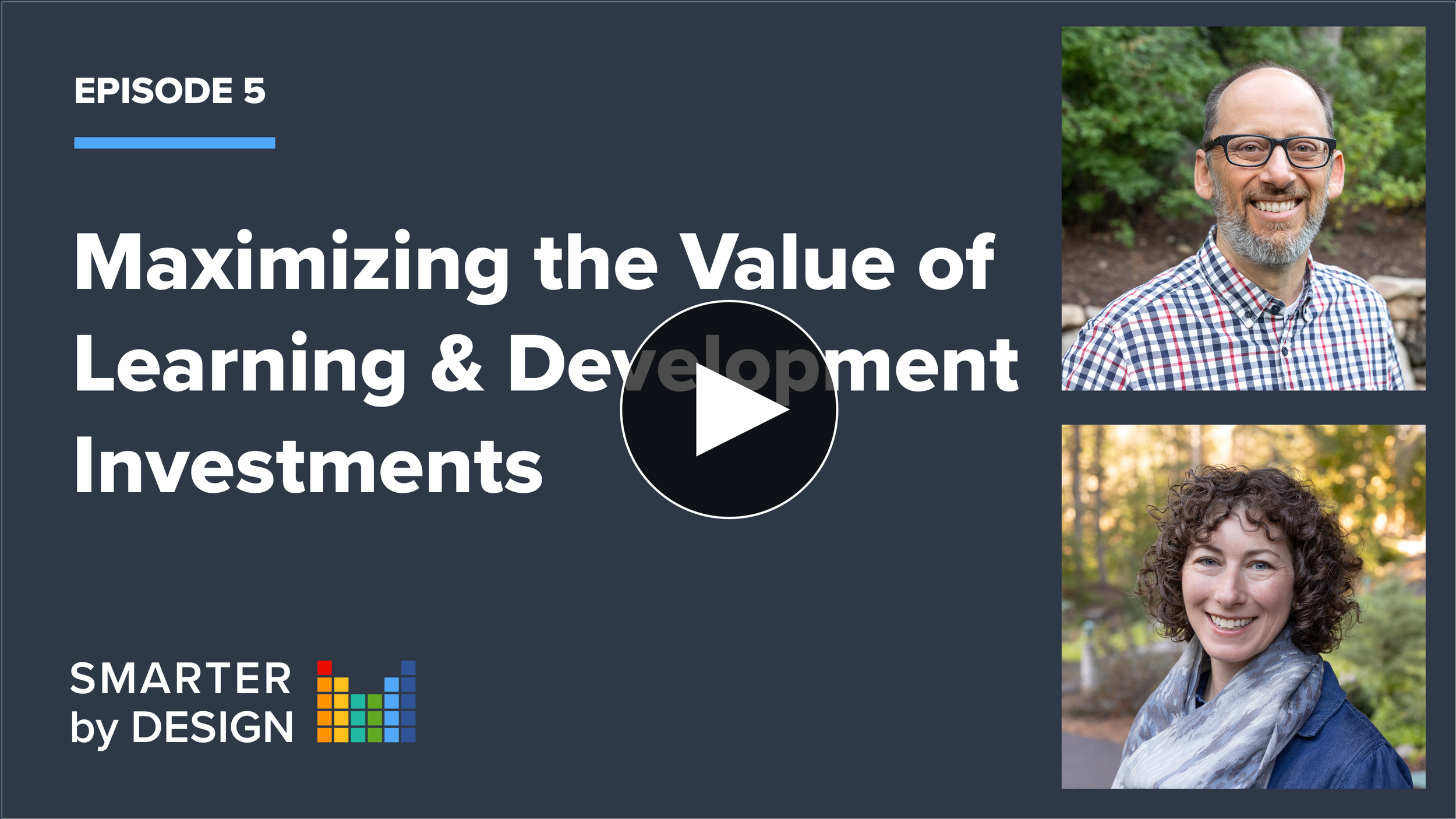
In this episode of the Smarter by Design podcast, Susan Strom and I discuss The Modern Learning Organization Pipeline—a framework for helping AEC firms prioritize and maximize the return on their learning and development investments.
For decades, most AEC learning programs have relied on familiar formats: lunch-and-learns, live training sessions, and recorded presentations. But a new generation of tools—AI search, modern intranets, modular learning systems, and knowledge agents—is dramatically increasing the potential ROI of learning assets. When knowledge can be searched instantly, accessed on demand, and revisited whenever someone needs it, learning assets become far more valuable than they used to be.
That shift creates a new challenge: how do firms decide where to invest their time and energy? You can’t manage all the knowledge in your firm. So the real question becomes: which knowledge and learning investments produce the greatest return?
In this conversation, Susan and I walk through how to identify, prioritize, and design high-impact learning experiences in AEC firms using the Modern Learning Organization Pipeline.
Along the way, we explore:
Why AEC firms need to evolve into modern learning organizations
How firms can maximize the value of learning and development investments
The DESIRE framework, a practical tool for prioritizing learning opportunities
Why learning experiences should increasingly be treated like products
How firms are modernizing learning experiences for the AI era
How learning content can become searchable organizational knowledge
Why learner involvement and piloting are essential to good learning design
The rise of dedicated knowledge and learning roles inside AEC firms
Underlying the discussion is a broader idea: the industry is entering a platform shift in how knowledge, learning, and expertise are developed and distributed. As AI-powered knowledge and learning platforms like Synthesis make knowledge more accessible and reusable, the potential return on learning investments is rising dramatically. The challenge for firms is where to invest their time and energy to create the greatest impact.
If you’re leading an AEC firm and wondering where to invest in learning, knowledge, and capability building, this episode introduces a practical framework for prioritizing the opportunities that will matter most.
▶ Watch or Listen
Watch or listen to this episode via YouTube, Spotify, Apple Podcasts or wherever you get your podcasts.
📺 🎧 YouTube
📺 🎧 Spotify
🎧 Apple Podcasts
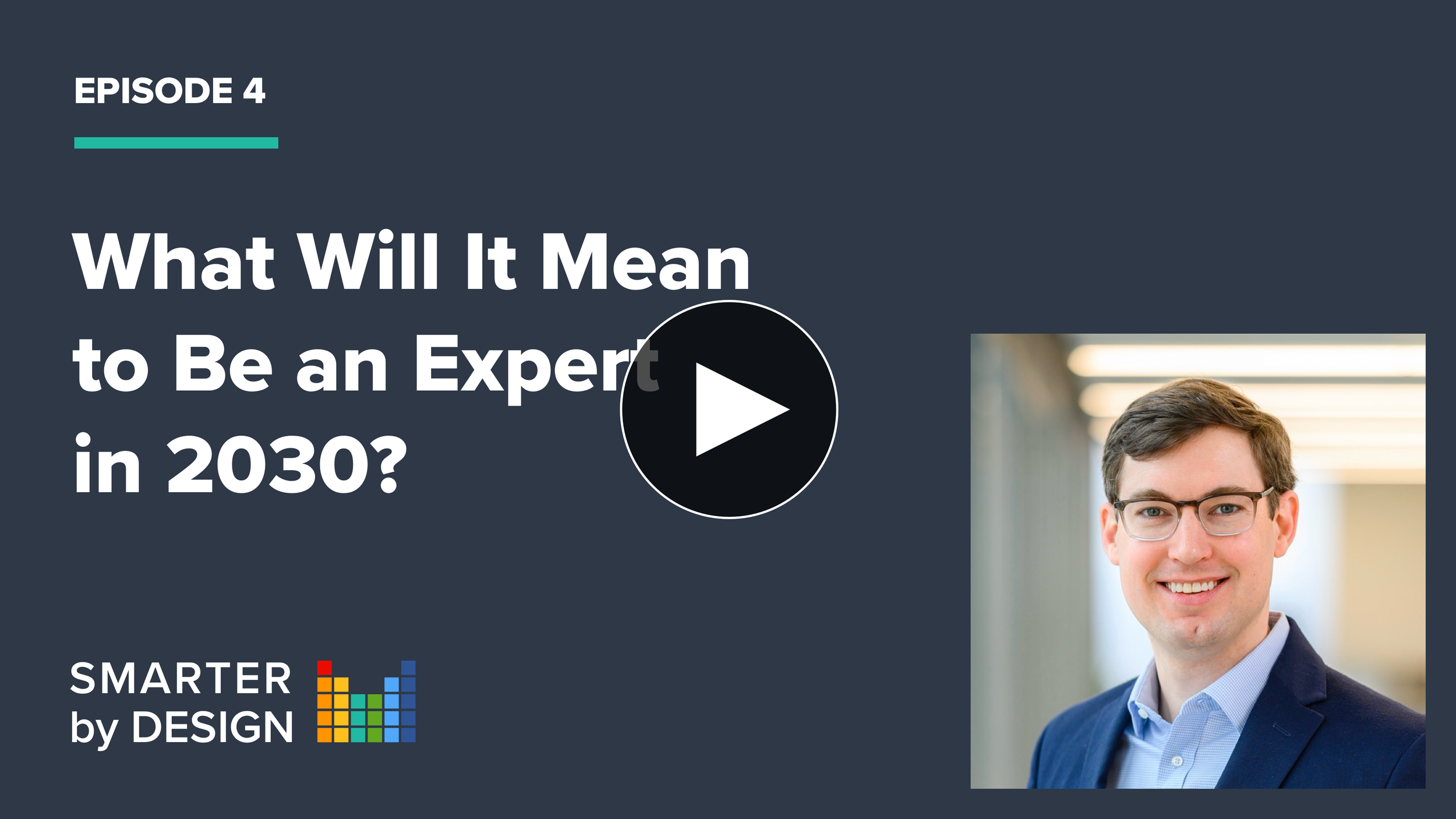
In this episode of the Smarter by Design podcast, I’m joined by Christopher Myers, Peetz Family Professor of Leadership and Faculty Director of the Center for Innovative Leadership at Johns Hopkins University, for a wide-ranging conversation about expertise, learning, and how AI is reshaping knowledge-intensive organizations like healthcare providers and AEC firms.
Christopher studies how professionals learn from experience and from one another. Together, we explore what happens when AI becomes extraordinarily good at synthesizing information but still struggles with judgment, context, and tacit nuance. In fields like healthcare, architecture, and engineering—where decisions carry real liability and long feedback loops—the distinction between synthesis and judgment matters deeply.
We examine a growing paradox: In the near future AI may be able to perform much of the “junior work” that once served as the apprenticeship path to becoming an expert. If AI creates the slide decks, drafts the notes, checks the drawings, and summarizes the literature, how do emerging professionals gain the reps, exposure, and judgment that traditionally came from doing those tasks? And if organizations eliminate junior roles in pursuit of efficiency, what happens to the future pipeline of senior expertise?
The conversation also explores how expertise actually forms. Christopher shares his research on vicarious learning—how professionals learn from stories, informal conversations, and communities of practice—and why hybrid work may be compressing or eroding some of those learning opportunities. We discuss why informal knowledge sharing sometimes outperforms formal systems, and how simulation and AI-powered scenarios may offer new ways to scale apprenticeship in the future.
At the center of the episode is a deeper question: What will it mean to be an expert in 2030? As AI raises the “standard of care” across industries, leaders must rethink not only how work gets done, but how judgment, responsibility, and organizational intelligence are developed over time.
If you’re leading an AEC firm and wondering how AI will affect your talent pipeline, apprenticeship model, or long-term expertise, this conversation offers a thoughtful and research-backed perspective on what may lie ahead.
▶ Watch or Listen
Watch or listen to this episode via YouTube, Spotify, Apple Podcasts or wherever you get your podcasts.
📺 🎧 YouTube
📺 🎧 Spotify
🎧 Apple Podcasts
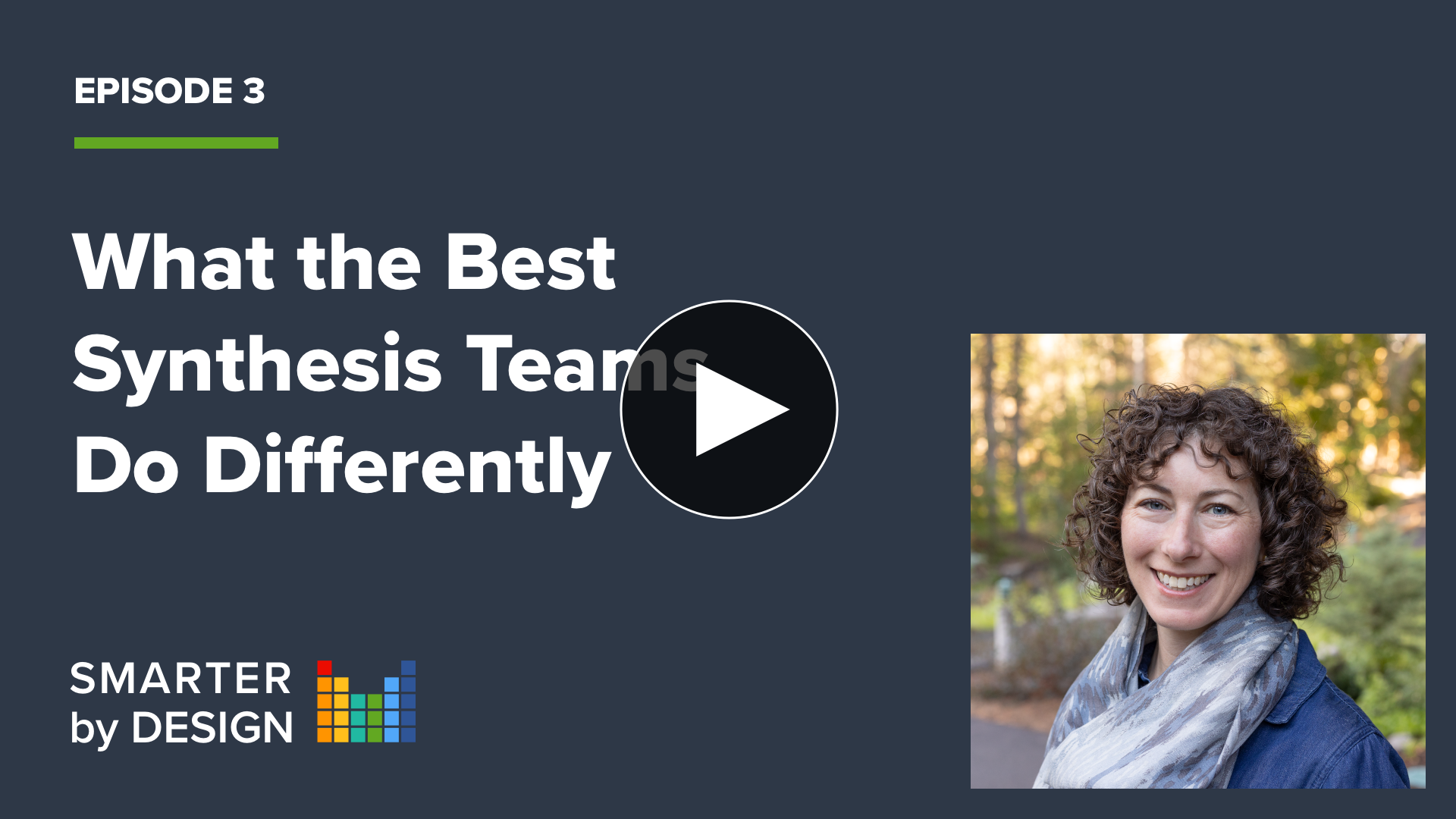
In this episode of Smarter by Design, I talk with Susan Strom, Chief Client Officer at Knowledge Architecture, about the patterns she’s seen across the most successful Synthesis teams. Drawing on years of implementation experience, Susan explains how great teams build momentum, lead change intentionally, and bring people into the process one person at a time.
We explore the human side of intranet, LMS, and AI Search rollouts—what strong project champions do, how they prepare their organizations, and the leadership behaviors that consistently set teams up for long-term success.
Whether you're evaluating Synthesis, preparing for a new implementation, or trying to take Synthesis to the next level at your firm, this conversation offers practical insight into what the best teams do differently.
▶ Watch or Listen
Watch or listen to this episode via YouTube, Spotify, Apple Podcasts or wherever you get your podcasts.
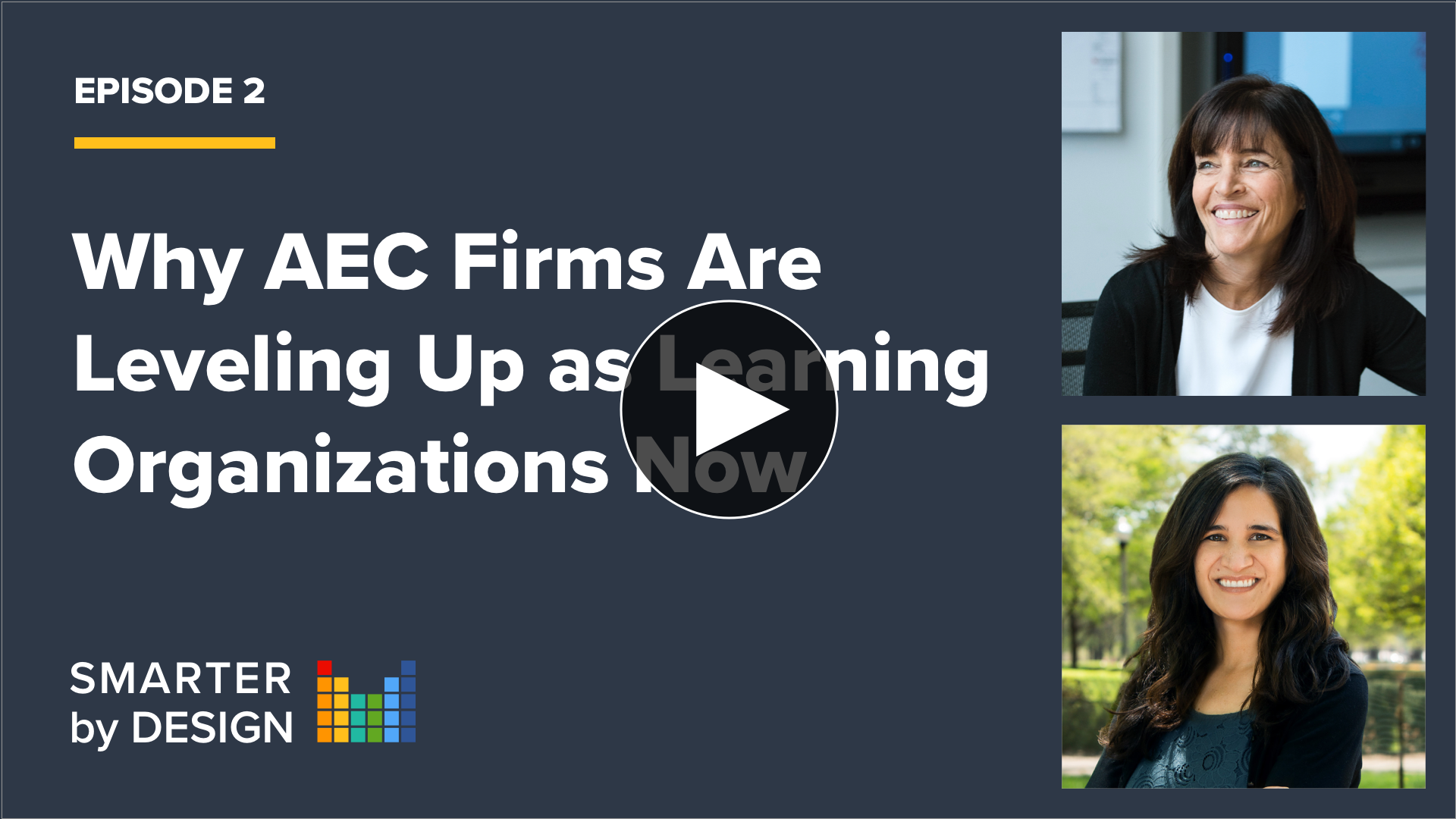
In this episode of the Smarter by Design podcast, I’m joined by Ellen Bensky, CEO of Turner Fleischer, and Nicole Chavas, President and COO of Greenprint Partners, for a wide-ranging conversation about what it takes to level up as a learning organization in the AEC industry.
As both firms evolve beyond primarily live and synchronous training models, Ellen and Nicole share how they’re building systems to deliver the right knowledge, to the right people, at the right time—while reducing overload and lifting the burden from learning leaders to serve as “air traffic controllers.”
We explore how integrating their learning management systems with their intranets and AI Search is helping their teams access critical information in the flow of work, as well as how that shift is also encouraging more subject matter experts to contribute knowledge, knowing it will reach the right audience at the right moment.
We also dive into the mindset shifts required to scale learning effectively. From navigating the balance between live and on-demand learning, to designing hybrid programs that combine asynchronous content with meaningful human interaction, Ellen and Nicole show how their teams are rethinking training as a design problem—one centered on empathy, access, and adaptability.
This episode is a candid, behind-the-scenes look at how two growing firms are building learning organizations that reflect the pace of modern practice, the needs of emerging professionals, and the realities of day-to-day AEC work.
If you’re grappling with learning at scale, looking to reduce information overload, or wondering how to balance video, in-person, and AI-powered tools, this conversation offers fresh insight and practical ideas.
▶ Watch or Listen
Watch or listen to this episode via YouTube, Spotify, Apple Podcasts or wherever you get your podcasts.
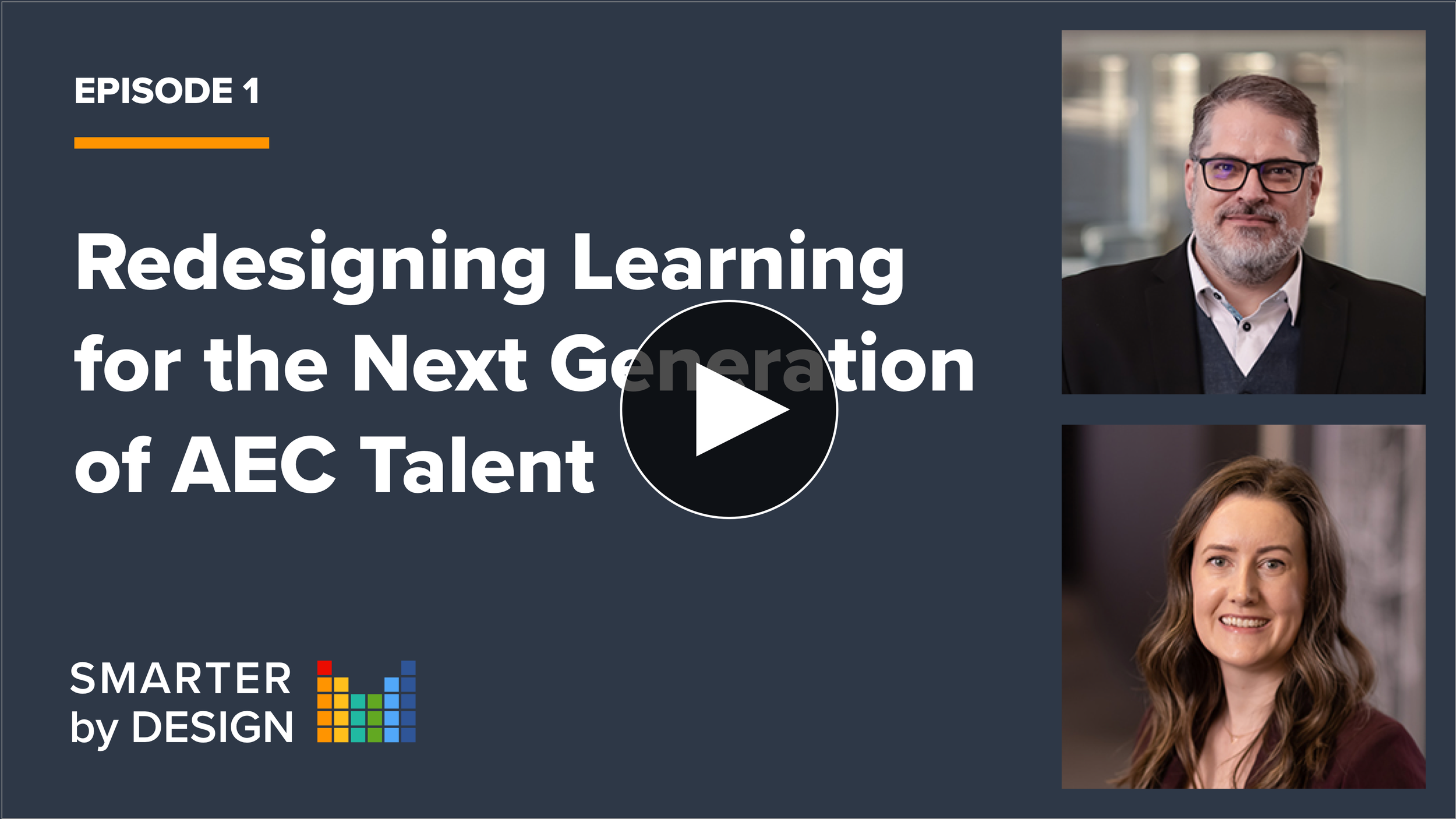
In this episode of the Smarter by Design podcast, I’m joined by Dan Hottinger, Principal and Director of Professional Services at BWBR, and Kari Shonblom, Knowledge Manager at BWBR, for a deep conversation about how their firm is redesigning learning to meet the realities of today’s AEC industry and the expectations of the next generation of talent.
Dan and Kari take us inside BWBR’s Landmark Learning program, a decade-long effort to help emerging professionals build judgment, confidence, and technical fluency faster than experience alone would allow. We explore how BWBR uses quality assurance (QA) and construction administration (CA) feedback loops to identify recurring gaps in practice, translate real project issues into targeted learning, and continuously evolve what and how the firm teaches technical skills to emerging professionals.
Along the way, we talk about how learning itself is changing. As the next generation of AEC professionals has grown up searching first, watching short-form videos, and expecting knowledge on demand, BWBR is rethinking traditional training models. Dan and Kari share how the firm is experimenting with shorter, more focused content while preserving the value of longer, story-driven sessions where context, judgment, and tacit knowledge can be shared.
The conversation also explores a hybrid approach to learning: pairing on-demand resources with live discussion, designing learning paths that evolve across career stages, and connecting technical instruction with the softer skills—such as communication, leadership, and decision-making—that become critical over time. At the center of it all is a simple but demanding idea: learning only matters if it shows up as improvement in the work.
This episode offers a behind-the-scenes look at how learning, QA, and career development can be woven into a single system that allows BWBR to develop talent from within, adapt to changing expectations, and build resilient expertise over time.
If you’re thinking about how your AEC firm can redesign learning for a new generation, connect knowledge management to real project outcomes, or move beyond training as a one-off event, this conversation is for you.
▶ Watch or Listen
Watch or listen to this episode via YouTube, Spotify, Apple Podcasts or wherever you get your podcasts.
📺 🎧 YouTube
📺 🎧 Spotify
🎧 Apple Podcasts
About the Smarter by Design Podcast
The Smarter by Design podcast explores how leading architecture, engineering, and construction (AEC) firms are reimagining knowledge management, learning, and AI to build smarter, more adaptive practices.
Hosted by Christopher Parsons, Founder and CEO of Knowledge Architecture, the show dives into the real stories behind how firms are scaling expertise, transforming culture, and creating modern learning organizations.
At the heart of the show is a simple belief: AEC firms should spend as much time designing their businesses as they do designing buildings, bridges, and infrastructure. The systems we design for capturing, sharing, and distributing knowledge shape everything else we create.
Through thoughtful conversations with AEC leaders, knowledge managers, and innovators, we explore how design, leadership, and technology intersect to shape the future of practice.
If you’re curious about how AEC firms are learning faster, working smarter, and designing better ways to grow—this is your show.