
I believe learning and development in AEC is going to change more in the next five years than it has in the last twenty-five.
Outside of work, people have grown accustomed to immediate, searchable, personalized access to information. That experience is reshaping what they expect from learning and knowledge inside their firms.
Many AEC professionals now expect knowledge and learning to be accessible exactly when they need it, in the flow of their work, rather than scheduled far in advance. And they would like to be able to find answers to their questions on demand, without having to attend hour-long, day-long, or week-long training delivered in linear formats. That shift is being shaped by generational change, the increased pace of work, and the growing availability of on-demand and AI-enabled tools.
For the first time, AEC firms have a real opportunity to deliver the right knowledge and learning to the right person at the right time. Technology is a major part of that story—including recent advances in AI and video capture, editing, and transcription—but it’s not the whole story. The real shift will come from how firms bring together people, process, technology, and culture to support learning as a core organizational capability.
That kind of change doesn’t happen organically. It happens by design.
I believe the firms that take full advantage of this moment will be the ones that intentionally evolve into what I’ve been calling Modern Learning Organizations.
In simple terms, a Modern Learning Organization does three things:
Builds and maintains collective intelligence
Leverages technology to deliver knowledge in the flow of work
Continuously adapts and thrives in a rapidly changing environment
This issue of Smarter by Design is the first in a multipart series exploring what it means to design a Modern Learning Organization in the AEC industry.
In this issue, I’ll introduce the Modern Learning Organization Pipeline—a practical, end-to-end model for turning learning opportunities into real, durable organizational capability. The pipeline reflects my nearly 25 years of knowledge management work in AEC, insights from the Knowledge Architecture community, and lessons emerging from firms in the Synthesis LMS public beta actively experimenting with new learning approaches.
Some parts of this model reflect practices that have always mattered: thoughtful prioritization, intentional design, and continuous improvement. Other parts reflect what has changed dramatically—especially the ability to unlock just-in-time, dynamically assembled learning that meets people where work actually happens.
My goal with this model isn’t to prescribe a single “right” way forward for all AEC firms. It’s to offer a shared framework you can react to, adapt, and refine as you think about how learning really works inside your firm—and how it could work better.
Here we go.
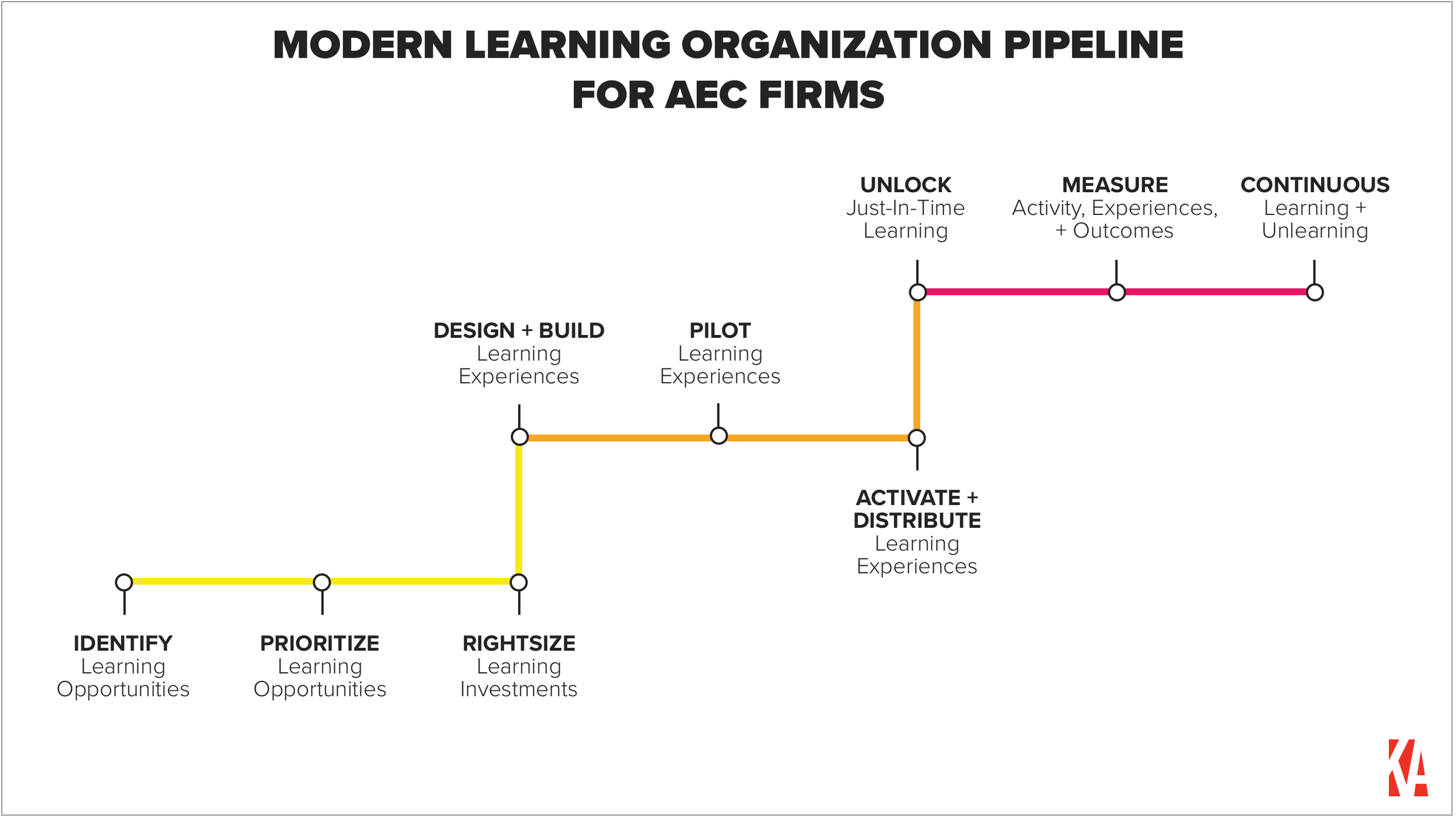
Step One: Identify Learning Opportunities
When I look at AEC firms that are making real progress in learning and development, I notice that they tend to have more consistent processes for identifying potential learning opportunities.
Those processes usually combine multiple channels—top-down, bottom-up, and side-to-side—and draw signals from across the organization. Some of those signals come from formal operational processes. Others come from informal conversations and day-to-day interactions. Together, they create a wide net for capturing what organizations—and the people within them—are trying to learn.
Here are some of the most reliable places potential learning opportunities come from:
Annual performance conversations.
Many firms already ask thoughtful questions during reviews about growth, preparedness, and what would help people do their jobs better. Individually, those answers inform development plans. Collectively, they reveal patterns. When the same needs show up again and again—deepening technical knowledge, better client communication, project management readiness—it’s a signal worth paying attention to at the organizational level.
Common issues caught in QA or CA.
Some of the clearest learning opportunities emerge downstream. Firms like BWBR regularly engage their construction administration and quality assurance teams to understand the most common and impactful issues caught late in the design process. Those insights often point to knowledge or context that, if shared earlier through intentional training, would improve quality and reduce friction long before a project reaches QA or CA.
Informal conversations with learners.
Not all learning needs show up in surveys or systems. Many surface in hallway conversations, over lunch, or during project check-ins. What’s confusing? What feels hard? What would help right now? Modern Learning Organizations treat these informal signals as valuable input, not anecdotal noise.
Subject matter experts and project managers.
Experts and PMs see patterns others don’t. They know which questions come up repeatedly, where teams struggle, and what they wish people understood before joining a project. Their perspective often reveals learning opportunities that save time, reduce interruptions, and raise the baseline capability of the firm.
Strategic direction and future capabilities.
Some learning opportunities aren’t about today’s problems, but tomorrow’s. Strategic plans surface new markets, project types, services, or technologies that require intentional upskilling. Reviewing your firm’s strategy for potential learning opportunities helps connect learning & development programs to where the organization is headed next.
Knowledge continuity and planned retirements.
Many AEC firms face the urgency of impending retirements. Long-tenured architects, engineers, and project leaders carry decades of tacit knowledge—judgment, context, and lessons learned that rarely live in formal documentation. Identifying these moments early creates opportunities for intentional knowledge transfer, mentoring, and learning experiences that preserve expertise before it walks out the door.
Client feedback and external signals.
Clients are often telling firms where learning could make a difference—through formal feedback or everyday interactions. Patterns around communication, coordination, or delivery can reveal opportunities to strengthen skills and shared understanding across teams.
Open intake and suggestion channels.
Many learning teams create simple ways for ideas to surface at any time: suggestion boxes, intake forms, or open calls for topics. These channels rarely produce perfectly formed ideas, but they broaden the aperture and reinforce that learning is a shared responsibility.
Step Two: Prioritize Learning Opportunities
Once learning opportunities begin to surface, most firms run into the same challenge: there are far more good ideas than time, energy, or attention to pursue them all.
Firms that make progress at this stage tend to create simple, shared ways to make trade-offs visible. Prioritization becomes a collective exercise—one that feels thoughtful rather than political, and disciplined rather than reactive.
One approach I’ve found especially effective is using a simple scoring framework to help teams compare and prioritize learning opportunities. I’ve created a framework based on conversations and patterns I’ve seen across many firms that I call DESIRE.
At a high level, it looks like this:
(Demand × Enthusiasm × Strategy × Impact x Reach) ÷ Effort
Each factor is typically scored on a simple 1–5 scale. The goal isn’t mathematical precision, it’s consistency. When teams evaluate learning opportunities using the same lens, patterns emerge quickly and disagreements become productive instead of personal.
Here’s how each part of DESIRE tends to show up in practice.
Demand
How strongly is this learning opportunity being requested? Is it showing up repeatedly in performance conversations, project retrospectives, expert feedback, or informal discussions? High demand is often the clearest signal that a learning experience is needed even if the solution isn’t obvious yet.
Enthusiasm
Who would create or teach this? How motivated are they to do so? Learning experiences are more effective, more engaging, and easier to sustain when the people involved are genuinely excited to contribute and maintain them over time.
Strategy
How closely does this align with where the firm is headed? Does it support future markets, critical capabilities, succession planning, or core business priorities? Strategy helps connect today’s learning opportunities to tomorrow’s outcomes.
Impact
How much difference will this make for each learner? Is it light enrichment, required competence, or potentially transformative? Impact looks at how meaningfully this learning changes someone’s ability to do their job, grow into new roles, or contribute at a higher level.
Reach
How many people will this affect? A learning opportunity that touches a large portion of the firm can sometimes outweigh a highly specialized experience, even if the per-person impact is lower.
Effort
What will it take to design, build, deliver, and maintain this learning opportunity? Effort includes time, coordination, and ongoing upkeep, especially from your subject matter experts. High-impact, low-effort opportunities often rise to the top quickly; high-impact, high-effort opportunities require more intentional planning.
Beyond creating a shared way to score learning opportunities, the most valuable part of using a scoring framework like DESIRE is the conversation it enables.
When learning opportunities are scored by a cross-functional group—often including learning and development, knowledge management, project leaders, principals, subject matter experts, and learners themselves—the differences in scores reveal critical information. Why does one person rate an opportunity as high impact while another doesn’t? Why does effort feel manageable to some and overwhelming to others? Those conversations surface assumptions, risks, and dependencies that would otherwise stay hidden.
Just as importantly, this kind of shared prioritization builds alignment and trust. People are far more willing to contribute ideas when they understand how decisions are made, even when their idea isn’t the one pursued next.
DESIRE isn’t meant to be prescriptive. You should adapt the formula, simplify it, or use a different lens altogether. What matters isn’t the acronym—it’s having a transparent, repeatable process for deciding, together, what learning to invest in now and what to defer.
Step Three: Rightsize Learning Investments
Once learning opportunities have been identified and prioritized, the next question is a deeply strategic one:
How much investment does each prioritized learning opportunity actually warrant?
No firm has unlimited time, attention, or instructional capacity. Strategy, at its core, is the art of distributing limited resources in service of what matters most. Step Three is where that reality meets learning and development.
Not every learning opportunity deserves the same level of polish, permanence, or production effort. In fact, treating them all the same is often counterproductive. Modern Learning Organizations focus on rightsizing learning investments so that effort, quality, and durability are matched to the impact a learning experience is meant to have.
One useful way to think about this is as a spectrum.
On one end are elective enrichment experiences. These are often exploratory, timely, curiosity-driven, and optional. A design crit. A presentation on a new technology. A session sharing research into new materials or emerging practices. These experiences are frequently delivered live, creating space for discussion and exchange, and may be recorded for those who can’t attend or for future reference. Elective enrichment experiences can be incredibly valuable, but they don’t need to be perfect. Light editing, minimal structure, and informal delivery are often exactly right.
On the other end are foundational learning experiences. These are the topics nearly everyone needs to understand to do their job well: firm standards, core technologies and tools, project management practices, quality expectations, and onboarding essentials. These experiences tend to have high reach and high durability. They’ll be used repeatedly, across roles and over time. That’s where deeper investment of intentional design, clearer structure, higher production quality, and a plan for ongoing maintenance pays off.
Between those poles is a wide range of possibilities.
Some learning opportunities may begin as recorded live sessions and later, as demand increases, be refined into higher quality, on-demand courses. Others may combine self-paced content with live discussion, social learning, or role play exercises. Some may be role-specific rather than firmwide, or critical for a particular window of time rather than evergreen.
The key question isn’t what format should we use? It’s what level of investment makes sense given the reach, impact, and durability of this learning opportunity?
When teams ask that question explicitly, they make better tradeoffs. They avoid over-engineering one-off experiences and under-investing in the foundations that quietly shape daily work. They preserve energy for what truly matters, while still leaving room for experimentation and learning in the open.
Rightsizing learning investments also supports sustainability. Learning experiences that are appropriately scoped are more likely to be maintained, updated, and actually used. Over time, this discipline compounds by freeing up capacity to create better experiences where they will have the greatest effect.
Step Four: Design and Build the Learning Experience
Once you’ve identified, prioritized, and right-sized a learning opportunity, this step is about turning that intent into a concrete experience.
Designing and building a learning experience starts with the end in mind. What problem are we trying to solve? What should someone be able to do differently afterward? And when will this knowledge actually matter in their work?
Those questions help ensure that whatever you build—simple or sophisticated—is purposeful, relevant, and worth people’s time.
Designing in proportion to the opportunity
In Step Three, you made a deliberate call about the projected return on investment for a given learning opportunity. This step simply honors that decision.
For many learning needs, a live session taught by a trusted subject matter expert is exactly the right approach. These experiences can be timely, practical, and deeply grounded in real work. Designing here might mean clarifying the audience and outcomes in advance, ensuring strong audio quality, and doing some light editing and post-production afterward so the recording works well for people who engage with it on demand.
That is intentional learning design.
For learning opportunities with a higher projected return—those that are foundational, evergreen, or likely to be reused dozens or hundreds of times—the design choices expand.
This is where it often makes sense to design for on-demand or hybrid delivery from the start. When an experience will be used repeatedly over several years, investing in clarity and quality pays off. Multiple takes allow instructors to refine explanations and create a “golden version.” Thoughtful post-production creates a smooth learning experience. Content can be intentionally broken into shorter sections so people can learn what they need, when they need it.
In many cases, pairing on-demand fundamentals with a live, interactive component—discussion, application, or role play—creates a stronger overall experience than either format alone.
When learning assets are durable and widely used, small improvements in design compound quickly.
Learning experiences can take many forms
As you design, it helps to think broadly about what a learning experience can be.
Sometimes learning is best delivered through a short video. Other times through a written guide someone can reference in the flow of work. It might involve an exercise, a checklist, a worked example, a role play, or a site tour. Often, the most effective experiences combine several of these elements.
Good learning design is about choosing the right mix of activities to support understanding, application, and confidence.
Designing for how people learn and work today
One important factor shaping learning design today is how people now access and use information in their daily work.
Across roles and generations, many of us have grown accustomed to finding what we need quickly, skimming for relevance, going deep when necessary, and having confidence that we can find information again when we need it in the future. Public platforms like YouTube, Google, ChatGPT, and others have reshaped how we solve problems and learn outside of formal settings.
That experience should carry over into work.
AEC professionals want to get to the learning or knowledge they need, apply it, and keep moving. They’re comfortable learning in short bursts, revisiting material as needed, and combining different formats depending on the task at hand.
Modern Learning Organizations recognize this shift and design accordingly. They invest in on-demand-first experiences when the return justifies it, not as a replacement for live learning, but as a complementary mode that aligns with how people now prefer to work and learn.
Involving learners early in the design
Before investing heavily in building a learning experience, it’s often valuable to involve the people you’re designing for.
A few early conversations can go a long way. How do they prefer to learn this topic? What feels confusing today? What would actually help them feel more prepared? Reviewing outlines or early drafts with real learners often surfaces clarity issues long before they become expensive to fix.
Involving learners early helps ensure relevance, strengthens adoption, and makes the eventual pilot far more effective.
Designing and building learning experiences this way—grounded in purpose, scaled to return on investment, and shaped by the people who will use them—is what allows Modern Learning Organizations to move beyond one-size-fits-all training and toward learning that works and engages learners.
Step Five: Pilot the Learning Experience
Before distributing a learning experience more broadly, it’s valuable to pilot it with a small, intentional group.
The goal of a pilot is to increase confidence that the learning experience does what it’s intended to do. Piloting helps clarify where learners get stuck, whether the material helps learners understand the topic, and whether the experience feels relevant and usable in day-to-day work.
One important reason pilots are so effective—especially in expert-led, AEC organizations—is something often referred to as the curse of knowledge.
The curse of knowledge is a common cognitive bias: once you know something deeply, it becomes difficult to remember what it feels like not to know it. Experts may skip steps that feel obvious, use terminology without realizing it needs explanation, or assume shared context that newer learners don’t yet have. None of this is intentional, it’s simply a byproduct of expertise.
Piloting learning experiences with people who are newer to a topic helps surface these hidden assumptions. Their questions and points of confusion reveal where more context is needed, where language can be simplified, and where explanations can be sharpened to better support beginners without diluting rigor.
In Synthesis LMS, learning experiences can be shared as private courses and piloted with a defined group of users. Participants can provide feedback directly within the course, making it easy to capture questions and reactions in context.
Because the experience isn’t live to the whole firm, learning and development teams can pair this built-in feedback with short follow-up conversations to gather deeper, qualitative insight. These conversations often surface nuances that written feedback alone can miss.
Not all feedback needs to be incorporated. But identifying patterns—and addressing the most meaningful points—helps strengthen the experience before it reaches a wider audience.
For evergreen, foundational learning experiences in particular, this brief pilot phase creates space to refine, adjust, and clarify before broader distribution—ensuring that what ultimately scales is clear, usable, and genuinely supportive of learner growth.
Step Six: Activate and Distribute the Learning Experience
Once a learning experience is ready to go live, the focus shifts to helping it reach the people it’s meant to support.
Activating Awareness
Activation begins by letting people know what’s available and why it matters.
New learning experiences may be highlighted through intranet posts, shared in staff meetings or town halls, included in internal communications, or cascaded through managers and team leads. Many organizations use a combination of these approaches, reinforcing awareness through familiar channels.
The goal is clarity. People should quickly understand what the learning experience is, who it’s for, and when it’s most useful.
Distributing with Intention
Beyond awareness, modern learning platforms make it possible to distribute learning experiences in more structured and consistent ways.
In Synthesis LMS, learning can be assigned directly to individuals or groups or distributed automatically using smart assignments. These use attributes such as role, discipline, tenure, or other firm-defined criteria to route learning experiences to both current and future employees.
This approach is especially valuable for onboarding, role transitions, and foundational learning—situations where timing and consistency are critical.
Supporting Self-Directed Learning
Activation and distribution also support autonomy.
Learners in Modern Learning Organizations are able to explore the learning catalog, search for topics they’re curious about, and engage with learning experiences at their own pace. Peer-to-peer recommendations can add another layer, allowing colleagues to surface relevant learning for one another based on real experience.
Together, these pathways create multiple, complementary ways for learning to reach people.
Creating Intelligent Flow
At its best, activation and distribution help learning move through the organization smoothly.
Learning and development teams often describe this work as routing—similar to air traffic control—where the goal is to deliver the right learning experience to the right person at the right moment. With automation, assignments, recommendations, and discovery tools in place, that routing becomes both more reliable and easier to sustain as the organization grows.
Step Seven: Unlocking Just-in-Time Learning
Up to this point, much of this pipeline could have been written years ago.
Identifying learning opportunities. Prioritizing thoughtfully. Designing learning experiences with care. Piloting before broad distribution. These are enduring practices, and they matter just as much today as they did a decade ago.
This step is where something genuinely new enters the picture.
What’s changing now isn’t simply when people learn. It’s how learning happens in the moment of real work.
From Linear Learning to Dynamically Assembled Learning
Traditionally, learning has been consumed in a linear way. You read a document from top to bottom. You watch a video from beginning to end. You attend a session and follow the sequence as it’s presented.
Even on-demand learning largely follows this model. The learner adapts themselves to the structure of the content.
What platforms like Synthesis make possible—by integrating intranet content, learning experiences, and AI-powered search—is a fundamental shift in how learning happens in the flow of work.
Instead of moving through pre-assembled learning in a fixed order, people can now dynamically assemble the knowledge and learning they need, in response to a specific question or situation. Learning becomes non-linear, contextual, and highly personal.
A Concrete Example
Imagine an architect working through a nuanced design question late in a project—something specific enough that it doesn’t map cleanly to a single course or document.
They ask a question.
In response, the AI search draws from across the firm’s knowledge and learning foundation: a relevant standard, a lesson from a course, a best practice captured in a guide, a recent lesson learned from another project. These sources are synthesized into a clear, grounded answer with the underlying sources cited so the architect can explore further if needed.
They’re not just handed a list of resources to sort through. They’re given an answer, tailored to their context, with clear links to validate the response if needed.
That’s a fundamentally different learning experience. A just-in-time learning experience.
Why This Changes the Return on Learning
For most of the history of learning and development, organizations have been good at knowledge capture and distribution, but they have struggled with knowledge retrieval—especially in the flow of work.
This is the breakthrough.
When learning is dynamically retrievable, it stops being something people “complete” and starts being something they use. Courses, guides, and expert insights gain a second life through recall and application. The return on every learning investment increases.
Just as importantly, subject matter experts see that what they create is easier to find, more likely to be used, and more clearly connected to real outcomes. That visibility changes behavior. People are more willing to contribute when they know their knowledge will be used.
Unlocking just-in-time learning doesn’t replace traditional learning experiences. It amplifies them by making knowledge and learning available in the exact moments they’re needed.
Step Eight: Measure Activity, Experience, and Outcomes
A Modern Learning Organization treats learning experiences as assets that can be measured and improved over time.
In practice, I’ve found it helpful to think about learning measurement across three distinct levels: activity, experience, and outcomes. Each one answers a different question, and together they provide a clearer picture of how learning is functioning across the organization.
Activity
At the most basic level, organizations need to understand whether learning is actually being used.
Are people engaging with the learning experiences you’ve created? Are they enrolling in courses? Are they completing the courses? If not, where does engagement stay strong, and where does it drop off?
Activity data also reveals patterns across the organization. You can begin to see which roles or teams are highly engaged in learning and which aren’t. That opens up more constructive conversations: Are certain groups unaware of what’s available? Do they not see the relevance? Do they feel too busy to engage? Are the formats effective? Are there important topics which aren’t being addressed?
Activity data like this provides invaluable signals for strengthening learning experiences over time.
Experience
Engagement alone isn’t enough. Understanding how people experience learning is critical to creating high quality learning programs.
This is where qualitative feedback plays a critical role. Are learning experiences clear and well-paced? Do they feel relevant to real work? Do learners leave feeling more confident, or more confused? Would they recommend this experience to a colleague?
Modern learning platforms, like Synthesis LMS, make it easier to gather this feedback directly, while the experience is still fresh. Learning teams can supplement that data with short follow-up conversations—especially for foundational or high-impact courses—to better understand what resonated and what didn’t.
Over time, this creates a feedback loop that improves quality. Learning content becomes clearer. Formats become more intentional. And trust grows between learners and the system that’s meant to support them.
Outcomes
Ultimately, learning exists to improve something.
Sometimes that improvement is visible quickly: fewer errors, better project coordination, smoother onboarding. Other times it shows up more gradually: stronger judgment, more consistent practices, or increased confidence in new roles.
One of the strongest examples of this comes again from BWBR. As mentioned above in step one, their technical learning programs are informed upstream by QA and CA feedback—where patterns in drawings and project issues are surfaced. But they don’t stop there. BWBR also maintains a QA/CA scorecard for projects, which allows them to see whether those learning investments are actually moving the needle over time.
That feedback loop matters. It connects learning directly to performance, and it gives firm leaders and subject matter experts something rare: evidence that their work is improving outcomes the firm already cares about.
Step Nine: Continuous Learning and Unlearning
The work of designing, building, and maintaining a Modern Learning Organization is never finished.
In AEC, the conditions that shape our work are constantly shifting. Technologies evolve. Codes and standards change. New materials and methods emerge. Firms enter new building types, services, and markets. Client expectations rise. Buildings become more complex. What mattered deeply a few years ago may have changed, become less relevant, or need to be understood differently today.
Continuous improvement isn’t a phase at the end of the pipeline. It’s the posture of the organization itself.
Continuous improvement starts with continuous learning. New learning opportunities will keep surfacing as firms grow, experiment, and adapt. The pipeline you’ve built doesn’t run once and stop. It keeps cycling—identifying emerging needs, prioritizing thoughtfully, and investing where learning can make a meaningful difference.
But just as important is continuous unlearning.
As knowledge and learning become more integrated into daily work—especially through AI-powered retrieval and just-in-time access—everything becomes easier to surface. That’s a powerful shift. It also means that outdated, incomplete, or no-longer-authoritative content doesn’t simply hide in obscurity anymore.
Modern Learning Organizations design for this reality. They review learning experiences over time. They clarify what’s current and what’s historical. They retire content that no longer serves the firm. They make space for new thinking to replace old assumptions.
Continuous improvement also means staying open to new ways of learning. As technologies change and new formats become possible—digital, in-person, hybrid, synchronous, asynchronous—learning leaders continue to experiment. They listen closely to learners across roles, generations, and career stages. They pay attention to what builds confidence, accelerates capability, and supports real work.
Over time, this creates something deeper than a learning program. It creates an organization that expects learning and unlearning to be part of professional practice. One that sees knowledge as something living—shaped, refined, and renewed as the firm itself evolves.
That’s how learning stops being episodic and becomes systemic. And that’s how a Modern Learning Organization stays adaptable, resilient, and effective over the long arc of change.
A Closing Note
I don’t expect this definition of the Modern Learning Organization Pipeline to be the final word. Like the learning systems it describes, it will evolve as firms experiment with it, adapt it to their context, and discover what works best in practice. My goal here is to offer a shared starting point which can be refined over time through use.
If the pipeline model resonates with you, I’d love to hear what rings true, what’s missing, and where your firm’s experience aligns—or challenges—the model. Much of this thinking has been shaped by conversations with this community, and it will continue to evolve through it.
We’ll be unpacking these ideas across the Smarter by Design ecosystem this year—here in the newsletter, on the Smarter by Design, and through upcoming webinars—as we learn alongside firms putting this work into practice.
This theme will also be at the heart of KA Connect 2026, our knowledge and learning management conference for the AEC industry, taking place August 11–14.
I hope you’ll join us. Stay tuned for the next issue!