
Intranet Best Practices

If the term “information architecture” is new to you, think of it as the navigation structure on your intranet. Effective information architecture makes it easy for employees to find what they’re looking for.
This playbook is designed to help you understand your intranet’s current information architecture and make improvements as needed. We’ve broken this process into 5 steps, some of which will be completed by Knowledge Architecture, and others that will be completed by your team. Each step is described in detail below. We look forward to partnering with you on your new information architecture.

Featured Guests
Kathryn Whitenton, Director of Digital Strategy at Nielsen Norman Group
Page Laubheimer, Senior User Experience Specialist at Nielsen Norman Group
Summary
In this month’s Office Hours, Nielsen Norman Group (NN/g) and Knowledge Architecture share insights based on our recent study of over 120 Synthesis intranets. We discuss patterns and pitfalls of intranet navigation, share best practices for building effective and intuitive intranet navigation, and introduce you to a process for validating proposed changes to intranet navigation.

Essential Content comprises the policies, procedures, templates, forms, standards, documentation, how-tos, and FAQs you need to run your AEC firm. Your corporate operating system, if you will.
Getting your essential content on the intranet is a huge feat and generally happens during your implementation process. Keeping your essential content up-to-date is just as important. It is critical that your end users can trust that the content on the intranet reflects the way your firm does business today, not how it did business at some point in the past. “Trust” is the operative word here. Building trust in the quality of your essential content will lay the foundation required to leverage the intranet for a multitude of strategic initiatives outlined on the Intranet Maturity Model.
In this Quick Reference Guide, we offer a systematic approach for ensuring your essential content is always relevant and up-to-date.


Clients often ask us, “what content is essential to a successful intranet?”
Because we have built over 100 intranets for architecture, engineering, and construction firms over the last seven years using Synthesis, Knowledge Architecture is uniquely positioned to answer this question.
We find that this question typically arises when a firm is either:
- Preparing for the launch of a new intranet, or
- Conducting a content audit of an existing intranet
Both of these events provide an opportunity to step back and evaluate how your intranet can give employees what they need, when they need it. Our Essential Content Checklist will help you do just that.
In this article you’ll learn…
5 Benefits of a Q+A Program
3 Key Roles in a Q+A Program
9 Steps to Roll Out a Q+A Program at Your Firm
“If you can teach people to help themselves you get an additive effect: they not only help each other; they grow themselves as experts. Essentially, you have little experts pop up left and right and they sort of grow on their own. Over time, you raise people up from basic competency towards expert level.” — Jack Chaffin, LMN Architects.
Four years ago LMN Architects hired Jack Chaffin to lead the firm’s transition from CAD-based MicroStation to Revit. They knew they had an expert to guide the process because he’d led similar transitions twice before. Jack’s expertise met such a critical need that after a short while, Jack found that “help desk issues were taking up an increasingly larger portion of [his] energy; taking focus away from other strategic activities” related to the transition.
When it comes to this problem, LMN is not alone. According to research published by Rob Cross, Reb Rebele, and Adam Grant in HBR, “up to a third of value-added collaborations [in any organization] come from only 3% to 5% of employees.” As a result, often the people who are most in demand (those with the answers) are becoming increasingly over-taxed by the burden of responding to requests for their expertise. The really scary thing is that in most organizations leadership doesn’t even know who their top collaborators are. As many as 50% of an organization’s top collaborators can’t even be identified by the organization.
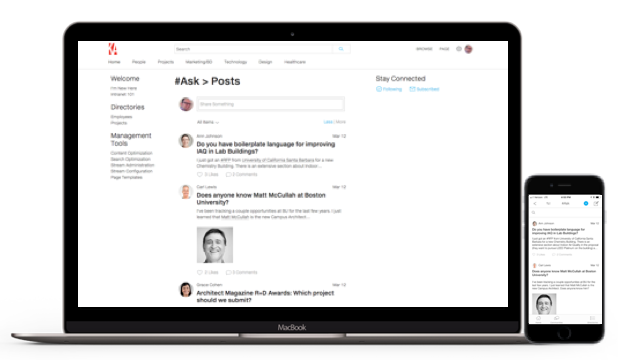
Enter a Q+A program. Increasingly, we’re seeing more and more firms successfully implement formal Q+A programs inside Synthesis to identify and activate subject matter experts. We’ve learned from firms like LMN, brainstormed what this looks like at previous Synthesis Workshops, and shared some successful programs through our Office Hours webinar series. In this article we’re going to share the benefits of a Q+A program along with some of the roles and steps necessary to roll one out in your firm.