
Welcome to KM 3.0
A Podcast Series on AI-Powered Knowledge Management in AEC
Episodes
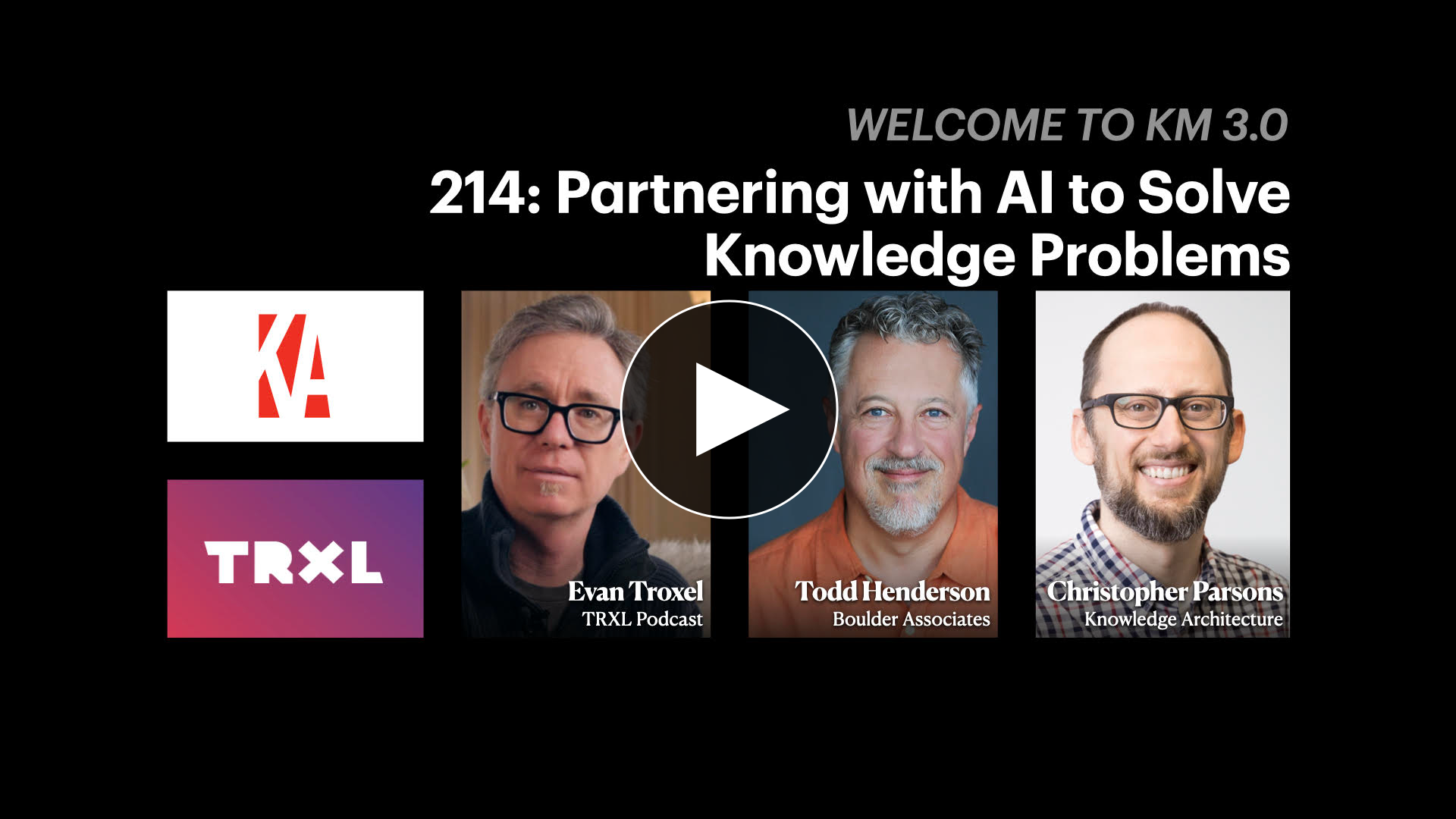
In this episode of Welcome to KM 3.0, we talk with Todd Henderson—Director of Practice Improvement at Boulder Associates—about how one of the most inventive thinkers in our community is using AI, structured inquiry, and thoughtful experimentation to reshape how knowledge flows inside an expert-driven firm.
Todd takes us inside a series of real-world practices: from building a repeatable “conversation-to-content” pipeline that makes it effortless for subject matter experts to share what they know, to designing a medical planning accelerator that surfaces hidden assumptions, closes knowledge gaps, and strengthens a critical area of practice.
We also explore some of Todd’s more experimental work—building lightweight role-play scenarios to help teams practice difficult client interactions, designing short internal “med talks” to spread tacit expertise, and prototyping ways to use AI during medical planning interviews without losing the human nuance that matters most.
This episode is rich with practical ideas: how to extract high-value insight from busy experts; why interviewing novices reveals blind spots an organization can’t see from the top; and what it looks like to treat AI as a thinking partner—not a replacement, but a tool that sharpens inquiry, surfaces missing knowledge, and helps teams build a more resilient understanding of their work.
If you’re interested in designing learning organizations, exploring how experimentation can reshape learning inside AEC firms, or understanding how AI can help teams think more clearly—this episode is for you.

In this episode of Welcome to KM 3.0, we talk with Jim Martin, Chief Information Officer, and Jess Purcell, Design Technology Manager from Shepley Bulfinch about how one of the country’s most forward-thinking AEC firms is using AI, video, and thoughtful processes to reshape how knowledge is captured, shared, and sustained.
Jim and Jess walk us through a range of real-world practices—from compressing 200-hour technical documentation projects into five-hour video-first workflows, to using AI search as a tool not just for discovery but for surfacing outdated or irrelevant content. They also share how their team is managing the shift from informal knowledge sharing to intentional knowledge transfer—especially in the context of rolling out a new learning management system.
This episode is full of practical insights: how short, modular videos make knowledge more durable; why it’s essential to choose learning technology that fits your culture; and how caring more, leading behind the scenes, and crafting thoughtful processes can produce extraordinary knowledge sharing outcomes.
We also explore what it means to cultivate discernment in an age of AI, and how Shepley’s hybrid work model has made them double down on intranet-based connection, informal mentoring, and social learning.
If you care about making knowledge more accessible, adaptable, and human—this one’s for you.
I hope you enjoy it.
Best,
Chris

In this episode of Welcome to KM 3.0, we sit down with Kate Grimes, Director of Knowledge at Snøhetta, for a wide-ranging conversation about how one of architecture’s most respected design studios is navigating the AI era—without losing what makes its culture special.
Since joining the firm in 2012, Kate has helped Snøhetta build its first knowledge management program from the ground up. She shares what it’s taken to build momentum with AI in a firm that prizes technological experimentation and innovation—while still prioritizing human connection.
We explore the tensions between speed and thoughtfulness, innovation and risk, structure and improvisation. From developing AI strategies that honor studio culture to reimagining learning and development through modular content, Kate shares a vision of KM that’s as much about people and values as it is about tools and data.
You’ll hear stories about how Snøhetta is using AI to augment its design process, bridge gaps in custom coding, and connect team members to the right knowledge at the right time. We also talk about how on-demand learning can create space for deeper human connection, and why being thoughtful about when and how to use AI might be the most important design decision of all.
Kate’s insights are thoughtful, pragmatic, and grounded in real-world practice. If you’re thinking about the future of knowledge, culture, or learning in your AEC firm, this conversation will give you a lot to think about.
I hope you enjoy it.
Best,
Chris

In my view, Katie Robinson, Chief Marketing Officer at LS3P, has built one of the most inspiring knowledge management programs in the AEC industry. What began as a creative solution to gather project data for proposals over a decade ago has grown into a firmwide practice where knowledge management truly is everybody’s job.
Today, Katie leads a small but mighty KM team—while also orchestrating the contributions of over 120 LS3P employees who capture and share project data as part of the firm’s Data Manager program. It’s a remarkable model for scaling KM beyond a single department.
In this episode of Welcome to KM 3.0, Katie shares how LS3P’s Data Manager program empowers emerging professionals to make project data collection both sustainable and developmental, giving them mentorship opportunities while providing the firm with reliable information.
She also describes how Expert Hours—casual, live, recorded conversations with subject-matter experts—have become a powerful way to transform everyday storytelling into searchable knowledge that fuels marketing, mentorship, and practice alike.
Along the way, we explore how LS3P is driving business value with AI, preparing to fold learning and development into their KM program, and experimenting with innovative new ways to capture and expand project data. Katie’s story is full of practical wisdom on how to start small, solve real problems, and build momentum for KM in AEC.
I hope you enjoy this conversation as much as I did.
Best,
Chris

Years ago, Corey Squire told me he believed that knowledge management was the secret to unlocking sustainability in architectural practice. At the time, that insight struck me as bold and prescient. Now, after watching Corey apply that philosophy across his roles at Lake Flato, through his consulting work, and most recently as Director of Sustainability at Bora Architecture & Interiors, I believe it’s something much more: a model.
In this episode, Corey walks us through how Bora is transforming sustainability from a siloed department into a shared operating system—powered by a thoughtful culture, a living knowledge base, and now, AI Search. He shares how their Synthesis intranet (Chaco) helps capture institutional knowledge from experts and make it accessible to the entire firm, freeing up time for deeper innovation and mentorship. We talk about the importance of pairing sustainable knowledge with a supportive culture, and the flywheel effect that happens when you give people not just facts, but context and clarity about why design choices matter.
Corey’s insights are grounded, generous, and deeply practical—shaped by his own experience building firmwide programs, writing the AIA Framework for Design Excellence, and publishing People, Planet, Design, a book that blends design philosophy, actionable strategies, and an entire chapter on knowledge management as the foundation for sustainable practice.
Whether you're trying to scale sustainability, upskill your teams, or figure out how AI fits into your firm’s future, this is a conversation full of takeaways you can borrow, adapt, and implement.
Enjoy!

I’m excited to share the second episode in our Welcome to KM 3.0 podcast series, a collaboration between Knowledge Architecture and the TRXL Podcast.
This week’s guest is Ellen Bensky, CEO of Turner Fleischer Architects.
We titled this episode “CEO as Knowledge Architect” because that’s exactly what Ellen models in practice. Over the past decade, she’s helped Turner Fleischer grow from 60 to 250 people—not just by adding headcount, but by connecting people, process, technology, and culture in ways that support smarter, more sustainable growth.
In short, she’s doing the work of knowledge management—or KM—but from the CEO’s chair.
Ellen shares how KM became a strategic priority at Turner Fleischer, how her team embedded it into roles and workflows, and why AI is now playing a central role in simplifying and scaling the firm’s institutional knowledge. From employee onboarding to digital practice, project management to culture building, she shows how KM, done well, can become both an operational advantage and a leadership philosophy.
It’s one of the clearest, most thoughtful conversations on modern KM in AEC that I’ve ever been part of and we’re so happy to share it with you.
Enjoy!

About the Welcome to KM 3.0 Series
Knowledge Management has always evolved alongside technology and today, powered by AI, a new golden era of KM is emerging — KM 3.0.
In this limited series produced by Knowledge Architecture and Evan Troxel of the TRXL Podcast, we’ll profile a range of firms—each with a distinct approach to knowledge management. From program structure to measurable impact, we’ll explore how AEC firms are using knowledge management to get smarter in an AI-driven world.
You’ll hear from a CEO, a marketing director, a technology leader, a sustainability expert, and a dedicated knowledge manager. Each will bring a different lens—showing us how knowledge leadership can emerge from different corners of an organization and take shape in distinct ways.
In every episode, we’ll aim to get to the heart of how AEC knowledge management functions in practice—what’s working, what’s changing, and what others can learn.
Stay in the Loop
Want to catch every new episode of Welcome to KM 3.0?
Join our mailing list and we’ll notify you when future episodes drop.