
Agent: One Word, Very Different Meanings

Over the past year, I've had countless conversations about AI agents across the AEC industry — with clients, partners, peers, and practitioners at every level.
I keep noticing we're using the same word to describe wildly different systems.
Sometimes "agent" means an informational chatbot that can answer questions using firm knowledge. Sometimes it means a workflow assistant that helps generate proposals. Sometimes it means a system executing repeatable business processes with minimal human input. And sometimes it means fully autonomous systems coordinating multiple specialized agents across an entire operation.
That ambiguity matters. The way a firm should approach an informational agent is fundamentally different from how it would approach a fully autonomous system operating across multiple workflows. The technical requirements are different. The governance requirements are different. The trust, risk, and organizational implications are different. And yet most conversations about AI agents flatten all of this into a single category.
Autonomous vehicle companies solved a similar problem. Rather than debating whether a car was "autonomous" or not, they introduced a spectrum of capability levels — a shared language for discussing current capabilities, where they were headed, and what human oversight was still required along the way.
That framing inspired me. So I started sketching something similar for AEC: not a single definition of "agent," but a spectrum of increasingly capable systems — each with different strengths, risks, requirements, and use cases.
I've been calling it the Agent Capability Spectrum.
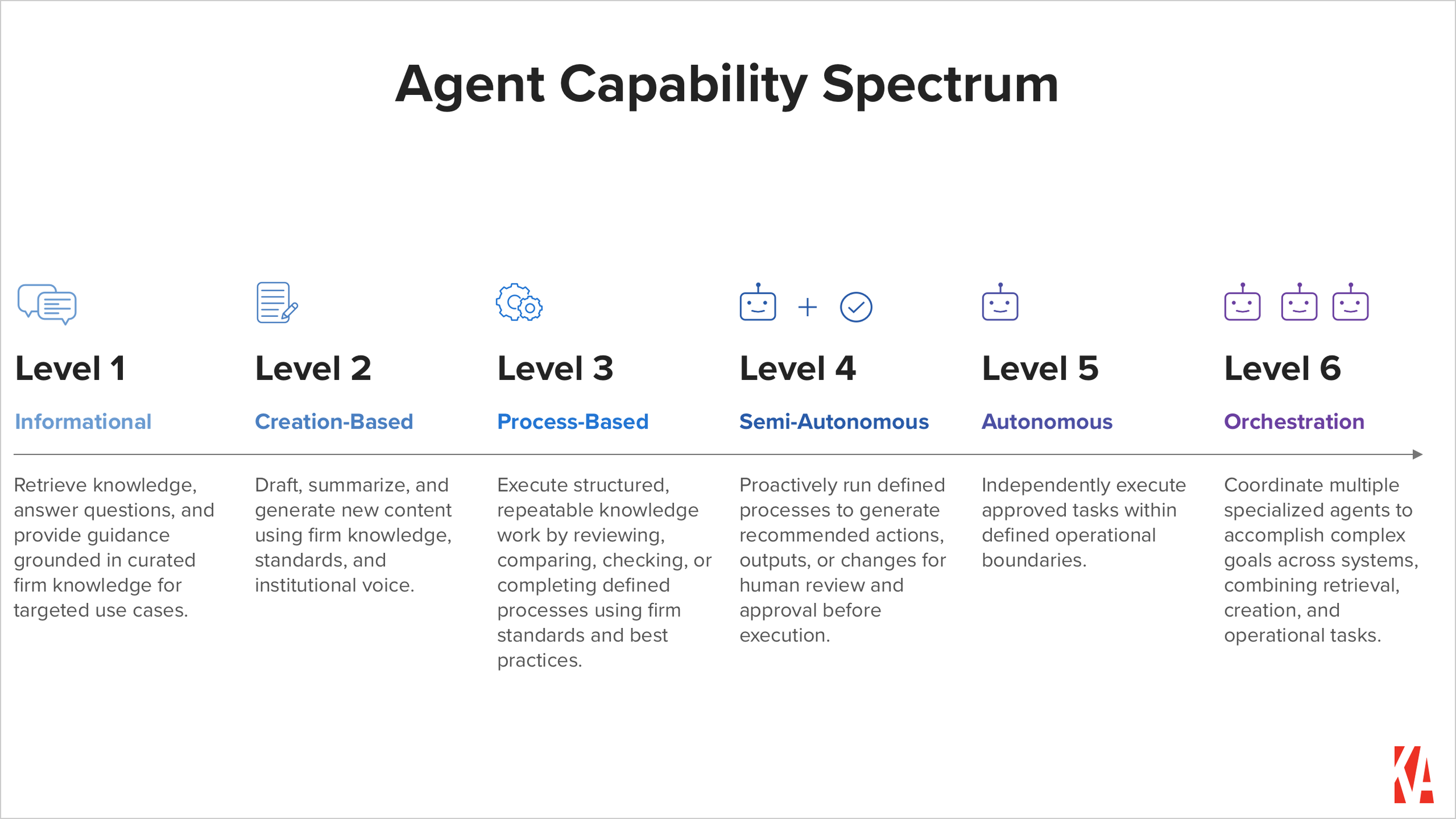
As you move from left to right across the spectrum, the role of human oversight changes. The operational implications become more significant. And perhaps most importantly, the nature of the knowledge required to make agents effective begins to evolve.
At the lower end of the spectrum, firms are often working primarily with existing institutional knowledge: standards, policies, project histories, technical guidance, lessons learned, contact information, and documented processes. In many cases, that knowledge already exists inside intranets, learning management systems, project databases, and other digital platforms. Agents help make that knowledge easier to access, navigate, and apply.
As organizations move further across the spectrum, the challenge becomes less about simply retrieving knowledge and more about operationalizing expertise.
A Level 1 informational agent may primarily need to answer questions about what a firm’s standards are, where information lives, or how a particular process works. A Level 2 or Level 3 agent, however, needs to understand what good looks like.
If an agent is helping draft a proposal, what makes a proposal strong? If it is helping review a fee structure, what are the red flags? If it is helping generate learning objectives, what defines a well-written learning objective? If it is supporting QA/QC workflows, how does the firm evaluate quality, consistency, completeness, or risk?
Those answers often live less in formal documentation and more inside the judgment and experience of subject matter experts.
As firms move from informational agents toward creation-based and process-based systems, they increasingly have to capture not just facts and processes, but evaluation criteria, workflow logic, operational expectations, and definitions of quality.
AEC firms are experimenting with agents in many different ways across many different platforms, and the landscape is evolving incredibly quickly. I want to be careful not to overgeneralize where the entire industry is with AI agents today.
What I can share, however, is what we’re seeing emerge inside the private beta of Synthesis Knowledge Agents.
One of the clearest patterns so far is that firms are overwhelmingly starting on the left side of the spectrum by building highly valuable Level 1, 2, and 3 agents.
Informational Agents: Making Institutional Knowledge More Accessible
The first category of agents we’re seeing firms build are informational agents: designed to help people find, navigate, and apply institutional knowledge more efficiently.
In many ways, this is the natural starting point for organizations beginning to explore AI agents.
Inside the beta, I’ve seen firms create agents that help employees identify relevant project experience, locate technical standards, answer software support questions, surface onboarding resources, navigate internal policies, and connect people with subject matter experts across the organization.
What makes these informational agents powerful is that they dramatically improve the accessibility and usability of knowledge firms already have.
That may sound simple, but the operational impact can be significant.
In many organizations, experienced staff spend an enormous amount of time answering repetitive questions, redirecting employees to existing resources, or helping people navigate fragmented systems.
Informational agents can help reduce that burden on subject matter experts while simultaneously making expertise more scalable and accessible across the organization.
One of the things I find particularly interesting about these agents is that they are designed around very specific use cases and tightly scoped areas of knowledge. Rather than searching across everything inside the organization at once, they can help narrow the signal-to-noise ratio around a particular topic, workflow, department, or business function.
For example, a Revit Assistant agent could be grounded in the firm’s Revit best practices, courses, and intranet posts. An HR Policy Advisor agent could be grounded in the employee handbook and benefits documentation. A Design Precedent Explorer agent could be grounded in the firm’s project directory and project sheet library.
That specificity can make the experience of using AI feel much more approachable for end users than general purpose chatbots or AI search interfaces.
With a chatbot or AI search, people may not know what kinds of questions the system can answer, or how to phrase requests effectively. Building agents around specific use cases helps reduce that ambiguity through clear naming, descriptions, starter prompts, and intentionally scoped knowledge domains.
We designed Synthesis Knowledge Agents to respond conservatively and stay closely grounded to source material. In addition, they can also be configured to escalate users toward human support when questions fall outside the agent’s intended scope or confidence level.
Informational agents provide a high-value and low-risk way to begin introducing your organization and your employees to AI agents.
Creation-Based Agents: Accelerating Knowledge Work
If informational agents are primarily focused on helping people find and navigate knowledge, creation-based agents begin helping people create new work products grounded in the organization’s expertise, standards, and institutional context.
This is where many firms begin moving beyond retrieval and into augmentation.
Inside the beta, I’ve seen firms experiment with creation-based agents that help draft proposal content, generate project descriptions, create onboarding materials, summarize meetings, develop learning objectives, write first-pass communications, and support a wide range of other knowledge work activities.
But there’s a catch—creation-based agents require capturing a different type of knowledge than informational agents.
With informational agents, firms are often working primarily with explicit knowledge: policies, standards, project histories, technical references, and documented procedures.
Creation-based agents require organizations to capture tacit knowledge: judgment, expectations, and definitions of what good looks like.
If an agent is helping draft a project approach, what makes a project approach compelling? If it is generating learning objectives, what defines a strong learning outcome? If it is helping write a proposal, what tone, structure, positioning, and strategic priorities should shape the output?
Building creation-based agents creates a powerful opportunity to make knowledge that was previously tacit, invisible, siloed, or unevenly distributed across teams explicit and shared. Once that knowledge becomes explicit, organizations can operationalize expertise far more intentionally and at greater scale.
That’s one of the reasons I believe these systems have the potential to become such important accelerators for both knowledge management and learning organizations over time.
Importantly, I don’t think the goal of agents is to replace humans. The strongest implementations I’m seeing are focused on helping people move through repetitive cognitive work more efficiently so they can spend more time strategizing, refining, evaluating, contextualizing, and improving the final result.
Creation-based agents are powerful tools to accelerate knowledge work.
Process-Based Agents: Operationalizing Expertise and Streamlining Workflows
If creation-based agents help accelerate knowledge work, process-based agents begin helping organizations operationalize how work actually gets done.
This is where agents start moving beyond generating outputs and into supporting repeatable workflows, procedural consistency, decision support, and operational execution.
Inside the beta, I’ve seen firms begin experimenting with agents that support proposal review workflows, check contracts for risky language, deploy QA/QC procedures, validate standards compliance, and other common AEC processes.
One of the most promising patterns I’m seeing is that these agents can help employees go much further on their own before needing escalation or executive intervention.
A project manager reviewing a fee proposal or contract, for example, can upload a draft to an agent to act as a second set of eyes: identifying low-hanging issues, surfacing potential concerns, checking alignment with standards, and helping them better understand where real risk exists before the document ever reaches a COO, operations leader, or general counsel.
That changes the nature of the workflow.
Instead of escalating every question immediately, employees can arrive at those conversations better prepared, more informed, and with a clearer understanding of both the problem and the potential solutions. Over time, that has the potential to accelerate learning, strengthen judgment, improve consistency, and in some cases perhaps even eliminate the need for a secondary review altogether.
But making process-based agents successful does raise several important questions.
If a fee proposal review agent is helping evaluate a draft submission, what exactly is it looking for? What are the common red flags? What differentiates a strong fee structure from a weak one? What issues should trigger escalation or additional review?
Similarly, if a contract review agent is helping analyze an agreement, how does the firm distinguish between preferred terms, negotiable concerns, and unacceptable levels of risk? Which clauses are considered standard? Which ones require caution? Which ones should immediately trigger legal, operational, or executive review?
At the risk of sounding like a broken record, successful process-based agents require firms to codify both their operational knowledge and their definitions of what good looks like.
And this is where things become especially interesting.
We’re learning from firms in the Synthesis Knowledge Agent beta that the potential time savings, quality-of-life improvements, and workflow efficiencies are often so compelling that experienced experts are more than willing to work alongside agent builders to externalize and operationalize their knowledge.
Watching that happen warms this long-time knowledge manager’s heart more than you can know.
The Next Frontier: Semi-Autonomous Agents and Beyond
Beyond informational, creation-based, and process-based agents, the spectrum becomes increasingly exploratory.
Exactly where the most valuable use cases for AEC firms will emerge remains an open question, and I suspect the answers will vary significantly across organizations, disciplines, workflows, and risk profiles.
But we can already begin to see some early patterns emerging.
One likely category is event-based agents: systems that respond dynamically when something changes inside an operational environment.
For example, when a new page, course, or knowledge asset is added to a knowledge base, a semi-autonomous agent might automatically evaluate whether the information duplicates existing content or introduces conflicting information. Rather than acting independently, the agent might then recommend updates, suggest edits, flag risks, or route issues toward the appropriate human reviewer for approval.
A second emerging category may involve more proactive or recurring “heartbeat” workflows. Instead of waiting for a specific event, semi-autonomous agents could periodically evaluate knowledge systems over time: identifying potentially outdated information, detecting stale content, surfacing underutilized resources, or recommending materials for archival, consolidation, or revision.
In some cases, organizations may eventually become comfortable allowing bounded non-destructive actions to happen automatically. Metadata classification, tagging, summarization, or categorization workflows are examples where automation may carry lower organizational risk than workflows involving archival and deletion of information.
And further across the spectrum, orchestration systems may begin coordinating multiple specialized agents together across larger workflows and operational sequences.
But I think it’s important to emphasize that much of this remains exploratory.
Right now, the overwhelming majority of the practical value we’re seeing inside our community is happening across Levels 1 through 3. And frankly, there is still an enormous amount of meaningful work to do there.
What feels increasingly clear is that the firms that will benefit most from AI agents are likely to be the firms that become best at identifying high-value use cases, codifying operational knowledge, and translating institutional expertise into systems that can repeatedly support better outcomes.
In many ways, that becomes the real organizational challenge.
Not simply adopting AI tools, but developing the people, processes, workflows, and operational discipline required to consistently put organizational knowledge to work.
The firms that do this well will likely become dramatically better at accelerating learning, scaling expertise, streamlining workflows, and helping their people operate with greater confidence and consistency.
I suspect the long-term story of AI agents may ultimately become less about artificial intelligence itself and more about how organizations learn to operationalize and distribute expertise at scale.
What do you think?
I'd love to hear where your firm sits on this spectrum and what you're learning along the way. The experiments, the friction, the surprises, and the concerns.
Please send your thoughts to smarter@knowledge-architecture.com.