
Modern Knowledge Capture: How AI-Enabled Teams Are Changing the Way AEC Firms Capture Expertise
I spoke at AEC Innovate last month about Synthesis Knowledge Agents and walked through several examples of what AEC firms in our beta program are beginning to build.
In the presentation I showed a contract and NDA review agent that could evaluate an agreement against a firm’s own standards and accumulated judgment. I showed a fee proposal agent grounded in how a firm approaches pricing and scope. I talked about proposal assistants that could draw not only on project information and boilerplate, but also on a firm’s own guidance for writing strong project descriptions and approach statements.
The agents were doing different jobs, but they had something important in common: they were all powered by their firms capturing some version of “this is what good looks like” from their experts.
After my talk, the CEO of one of our prospective clients came up to me and said he loved what I shared. The agents I showed seemed powerful and genuinely useful, and he could immediately imagine a whole collection of them his firm might want to build.
But there was one part he could not quite get past. Was he supposed to sit down alone and write all of those best practices from scratch? Were the people on his leadership team supposed to somehow find the time to document everything they knew before the firm could build useful knowledge agents?
The whole thing suddenly felt daunting and I saw his shoulders had slumped.
Seeing his reaction, I shared the behind-the-scenes story of how MBH Architects created their NDA review agent.
Before their CFO retired, Ryan McNulty, President at MBH Architects, made sure to get him in a room for a brain dump. Over the course of a few conversations, Ryan and his team walked through how he reviewed contracts, specifically NDAs. Which clauses were always unacceptable. Which ones the firm would negotiate, and under what circumstances. What unusual language tended to appear, and how the firm had learned to respond. Decades of contract judgment, compressed over time into instinct, were suddenly made visible.
They distilled those conversations into a set of NDA best practices. Those best practices now power a contract review agent. Any manager at MBH can upload a new client NDA, and the agent can go clause by clause, identify potential risks, explain its reasoning, and suggest a response based on the firm’s own accumulated judgment.
The CFO had not sat down alone with a blank page and written the definitive guide to reviewing NDAs. Ryan and his team had partnered with him to draw that knowledge out through conversation, examples, questions, and iteration. AI could help accelerate that process even further.
The CEO’s reaction was immediate.
“Oh my gosh. I didn’t even think I could use AI that way. It's so obvious now that you are saying it.”
Between the people on his marketing and operations teams, the experts throughout the firm, and AI, he could imagine capturing a great deal of this knowledge much faster than he had assumed.
Building useful knowledge agents no longer felt out of reach. What had changed wasn’t the technology, it was his mental model for knowledge capture.
He had been imagining an expert alone with a blank page.
But there’s a better way.
I spoke at AEC Innovate last month about Synthesis Knowledge Agents and walked through several examples of what AEC firms in our beta program are beginning to build.
In the presentation I showed a contract and NDA review agent that could evaluate an agreement against a firm’s own standards and accumulated judgment. I showed a fee proposal agent grounded in how a firm approaches pricing and scope. I talked about proposal assistants that could draw not only on project information and boilerplate, but also on a firm’s own guidance for writing strong project descriptions and approach statements.
The agents were doing different jobs, but they had something important in common: they were all powered by their firms capturing some version of “this is what good looks like” from their experts.
After my talk, the CEO of one of our prospective clients came up to me and said he loved what I shared. The agents I showed seemed powerful and genuinely useful, and he could immediately imagine a whole collection of them his firm might want to build.
But there was one part he could not quite get past. Was he supposed to sit down alone and write all of those best practices from scratch? Were the people on his leadership team supposed to somehow find the time to document everything they knew before the firm could build useful knowledge agents?
The whole thing suddenly felt daunting and I saw his shoulders had slumped.
Seeing his reaction, I shared the behind-the-scenes story of how MBH Architects created their NDA review agent.
Before their CFO retired, Ryan McNulty, President at MBH Architects, made sure to get him in a room for a brain dump. Over the course of a few conversations, Ryan and his team walked through how he reviewed contracts, specifically NDAs. Which clauses were always unacceptable. Which ones the firm would negotiate, and under what circumstances. What unusual language tended to appear, and how the firm had learned to respond. Decades of contract judgment, compressed over time into instinct, were suddenly made visible.
They distilled those conversations into a set of NDA best practices. Those best practices now power a contract review agent. Any manager at MBH can upload a new client NDA, and the agent can go clause by clause, identify potential risks, explain its reasoning, and suggest a response based on the firm’s own accumulated judgment.
The CFO had not sat down alone with a blank page and written the definitive guide to reviewing NDAs. Ryan and his team had partnered with him to draw that knowledge out through conversation, examples, questions, and iteration. AI could help accelerate that process even further.
The CEO’s reaction was immediate.
“Oh my gosh. I didn’t even think I could use AI that way. It's so obvious now that you are saying it.”
Between the people on his marketing and operations teams, the experts throughout the firm, and AI, he could imagine capturing a great deal of this knowledge much faster than he had assumed.
Building useful knowledge agents no longer felt out of reach. What had changed wasn’t the technology, it was his mental model for knowledge capture.
He had been imagining an expert alone with a blank page.
But there’s a better way.
A Conversation, Not a Blank Page
The retiring CFO at MBH did not sit down alone in front of a blank document and write the definitive guide to reviewing NDAs.
Instead, Ryan and his team partnered with him through a series of conversations. They pulled up real examples of NDAs the firm had already reviewed and talked through what he had changed and why. They explored exceptions, asked questions, and surfaced judgment that, after decades of experience, had become almost instinctive.
From there, those conversations and examples could be shaped into something structured. The expert did not have to create a finished product from scratch. He could react to something concrete, clarify what was missing, and correct where his judgment had been misunderstood.
This is a fundamentally different ask than telling a busy expert to document everything they know on their own. It is also often a better way to capture expertise.
The longer someone has practiced a craft, the more their knowledge becomes invisible to them. They recognize patterns a less experienced person would miss. They skip steps because those steps have become obvious and embedded in their tacit knowledge. They know “what good looks like” without necessarily having articulated why.
A good interviewer can slow that process down by asking questions like: Why did you make that change? Would you always handle it that way? What would a junior person miss here? Can you give me an example?
The expert brings the expertise. The interviewer brings curiosity, and their relative naïveté can be an asset because it requires the expert to make their thinking explicit.
Increasingly, AI can help both of them. It can help an interviewer prepare questions, analyze transcripts, organize ideas, identify gaps, and turn raw conversations into useful first drafts. Sometimes an expert works directly with AI to capture their knowledge. Sometimes another person is much better at drawing the knowledge out of them. Most of the time, AEC firms use a combination of approaches.
The important part is that the expert doesn’t have to do this alone.
Introducing Modern Knowledge Capture
I have started thinking of this new approach as Modern Knowledge Capture.
Modern Knowledge Capture is a collaborative, AI-enabled approach to partnering with subject matter experts to surface, shape, activate, and maintain what they know as organizational knowledge and capability.
Instead of handing an expert a blank page and asking them to create best practices from scratch, Modern Knowledge Capture starts with the knowledge that already exists—in that expert’s head, in examples of their work, in conversations, recordings, documents, and other accumulated artifacts—and builds a process that makes their knowledge useful to others.
The subject matter expert remains at the center of the process, but they no longer have to do all of the work themselves. Other people can partner with them to surface what they know, shape it into something clear and reusable, and turn it into guides, learning experiences, knowledge agents, and other resources that can be put into the flow of work. AI can accelerate every step of that process.
The result is not simply a faster way to create documentation. It is a fundamentally different approach to knowledge capture.
The traditional approach treated knowledge capture as an assignment we gave experts. Modern Knowledge Capture treats it as an AI-enabled partnership we build around them.
Interviewers, Editors, and Producers: The Partners Behind Modern Knowledge Capture
At the center of Modern Knowledge Capture is a partnership between subject matter experts and the people who help capture, distribute, and maintain their expertise. I increasingly think of three roles as especially important: interviewers, editors, and producers.
Interviewers help surface what experts know through conversation, asking questions, revealing their assumptions, and drawing out examples and judgment that experts themselves may no longer realize need to be explained.
Editors help shape those raw conversations and materials into drafts of codified knowledge, practices, and processes, then work with the experts to clarify, correct, and improve them.
Producers help turn that codified knowledge into assets the rest of the organization can actually use, such as guides, videos, courses, knowledge agents, or some combination of them.
These do not necessarily need to be three different people. One person may play all three roles. AI can support all three. The expert may take on parts of the process themselves. What matters is that we are no longer assuming the expert must personally perform every step required to capture, shape, package, and distribute their expertise.
I am seeing versions of Modern Knowledge Capture emerge across the KA community. Here are just three examples of many:
At BA (formerly Boulder Associates), Todd Henderson has developed a repeatable practice of turning conversations with experts into shareable knowledge. One of his colleagues, Darci Hernandez, had deep expertise in the politics of healthcare construction in California. She knew she had something valuable to share, but also knew she was unlikely to ever find the time to sit down and write it all out. Todd offered a much simpler proposition: give him half an hour and just talk it through. He guided the conversation, asked questions, and drew out examples, then used AI to help turn the resulting transcript into assets the rest of the firm could use.
At Shepley Bulfinch, Jess Purcell and her team have been taking a video-first approach to capturing technical knowledge. For their Autodesk Construction Cloud (now Forma) learning series, the subject matter experts spent roughly two hours preparing and three hours recording. From there, other team members handled much of the editing and production, and AI helped turn what had already been explained into written summaries and detailed step-by-step guides. Jess estimates that producing equivalent highly technical documentation through a more traditional process could have required around 200 hours of subject matter expert effort.
At Lionakis, Kristina Williams and Laura Knauss are building a more intentional modern learning program in which a subject matter expert provides the core knowledge, while a learning coordinator helps turn that knowledge into presentations, edit the resulting videos, and draft lesson descriptions and course summaries using AI. Those materials can then become part of learning experiences that combine short videos, exercises, and live collaborative discussion.
The details of each firm’s approach to Modern Knowledge Capture are different, but the direction is remarkably consistent. Experts still provide the knowledge and judgment, while others partner with them to make that expertise accessible, useful, and easier to maintain across the firm.
Knowledge Doesn’t Have to Be Perfect to Be Useful
There is another old mental model I think we need to let go of: the idea that knowledge has to be complete before we can put it to work.
Knowledge management has often borrowed its operating model from publishing. Capture everything. Create the comprehensive guide. Review it carefully. Approve it. Launch it as a finished artifact.
This can make the work feel even more daunting. If the goal is to exhaustively capture everything an expert knows before anyone can benefit from it, the bar for getting started becomes impossibly high.
The first version of MBH’s NDA best practices did not need to anticipate every contract the firm would encounter for the next twenty years. It needed to capture enough of the CFO’s judgment to become useful. Once they had that foundation, they could begin testing it against real NDAs, see where it worked well, and discover where the guidance was incomplete.
This is another important principle of Modern Knowledge Capture: capture enough of what you know to make it useful, put it to work, and continue making it better as you learn more.
In a world where the half-life of knowledge is getting shorter, the goal becomes less about producing definitive artifacts and more about creating useful starting points that can evolve with the work.
Knowledge That Gets Used Gets Maintained
Putting knowledge to work also changes what happens to it over time.
One of the persistent challenges with knowledge management is that we can spend enormous energy creating something, publish it, and then watch it slowly become outdated. A document sitting quietly on a server may never tell you when something is missing, when the practice has changed, or when the guidance no longer reflects how the work is actually being done.
Knowledge that is put into the flow of work creates a very different feedback loop.
Once MBH’s NDA best practices were deployed through an agent, every new review became another opportunity to test the underlying knowledge. A new clause could expose a missing rule. An unusual situation could reveal that the guidance needed more nuance. The agent might even surface something more fundamental: a situation where the firm itself had never fully clarified how it wanted to respond.
Those moments create much better questions for the expert. Instead of asking, “What else do you know about NDAs?” you can ask, “The agent did not know how to handle this. What are we missing?”
The same thing can happen when knowledge becomes a course people regularly take, a guide powering common AI search queries, or another resource embedded directly into the way work gets done. People encounter the gaps. They ask questions. They provide feedback. The knowledge keeps generating signals about where it needs to improve.
And this is where interviewers, editors, and producers can continue to play an important role. Their work does not have to end when something is published. They can bring the right questions back to subject matter experts, refine the underlying knowledge, and keep the courses, guides, agents, and other resources built on top of it current.
In that sense, putting knowledge into the flow of work does more than make it useful. It creates the conditions for it to stay useful because it gets maintained.
Publication is no longer the end of the process. In Modern Knowledge Capture, putting knowledge into use becomes an essential part of how we continue capturing, refining, and maintaining it.
Start with the Passion Budget
If you're that CEO from AEC Innovate I mentioned earlier, this might be the point where a new worry creeps in. Even if you believe all of this, even if you can picture the agents you'd want to build, you might be wondering who on your team actually has time to partner with experts on knowledge capture.
For years, much of the best knowledge and learning work in AEC firms has been powered by what I think of as the passion budget.
Someone in marketing starts capturing project stories because they know the firm is losing valuable knowledge. Someone in design technology gets tired of answering the same question and creates a better resource. Someone in operations sees a recurring problem and begins documenting a better way to handle it. A project manager who loves developing people starts building training for the next generation.
This is how a remarkable amount of progress gets made, and I do not think firms need to abandon that model in order to begin working differently.
You do not need to build a large knowledge and learning team before you can start practicing Modern Knowledge Capture. The interviewer, editor, and producer roles I have described throughout this piece do not necessarily need to be new job titles. They may be played by people in marketing, design technology, operations, learning and development, or by a particularly curious and motivated practitioner who sees an opportunity and wants to help.
One person may play several of those roles at once. AI can help them move much faster. The important thing is that someone has enough interest, curiosity, and capacity to help an expert get what they know out of their head, shape it into something useful, put it into the flow of work, and keep improving it over time.
So start with the passion budget.
Find a problem that matters. Find an area where valuable expertise is trapped inside too few heads, where the same questions keep getting asked, or where the next generation needs to learn something faster. Give someone enough room to experiment and see what happens.
You may be surprised by how much one motivated person, working with the right experts and increasingly with AI, can accomplish.
Beyond the Passion Budget
The interesting thing is what happens when Modern Knowledge Capture starts producing meaningful results.
One useful knowledge agent reveals three more opportunities. One successful learning experience exposes an entire body of expertise that could be captured next. One expert realizes they no longer have to personally answer every foundational question, and starts seeing other places where their knowledge could travel farther.
The question is no longer whether the work is valuable. The question becomes how much of it the organization has the capacity to do.
At this point, having knowledge and learning work remain the ninth thing on someone’s priority list starts to place a natural ceiling on how fast and how far the firm can go. There are only so many experts they can interview around the edges of another job, only so many learning experiences they can produce between other deadlines, and only so many bodies of knowledge they can help organize, activate, and maintain.
This does not mean every firm needs to run out and hire a full-time knowledge and learning management team. The next step may simply be giving an existing person more dedicated time. It may eventually mean creating a new role or building a dedicated team. Different firms will reach this point at different times.
But eventually, every AEC firm will reach the breaking point of relying on the passion budget for knowledge and learning management.
The pace of change is accelerating, the knowledge our people need is changing faster, experienced people remain one of our scarcest resources, baby boomers are retiring, and AI is creating new ways to make what those people know available to far more people, in far more situations, than was possible before.
As Modern Learning Organizations see this opportunity, they are realizing they want to move faster than the passion budget allows.
They are deciding that helping experts transfer what they know, accelerating the learning of the next generation, and turning individual expertise into organizational capability deserves more than whatever time their most committed people can find in the margins of their weeks.
They are investing in Modern Knowledge Capture to become smarter. By design.
Will you join them?
Why Firm Leaders Should Build Knowledge Agents
Before their CFO retired, Ryan McNulty, President at MBH Architects, made sure to get him in a room for a brain dump.
Over the course of a few conversations, Ryan and his team walked him through how he reviews contracts, specifically NDAs. Which clauses were always unacceptable. Which ones the firm would negotiate, and under what circumstances. What language a client should be expected to provide. What unusual clauses tend to appear, and how the firm has learned to respond. Decades of contract judgment, compressed over time into instinct, were suddenly made visible.
They distilled those conversations into a set of NDA best practices. Those best practices now power a contract review agent. Any manager at MBH can upload a new client NDA, and the agent goes clause by clause, marking each one high, medium, or low risk, explaining the rating, and suggesting a response. Expertise that once lived in one person’s head is now available to everyone in the firm, consistently, at any hour.
The technology mattered, of course. But it was not the only thing that made this possible.
What made the agent valuable was the judgment behind it. Someone had to understand that NDA review was important enough to improve. Someone had to know which expertise mattered. Someone had to help extract that expertise from the head of an experienced leader and turn it into guidance an agent could actually use. Someone had to see that this was more than an interesting AI experiment. It was a chance to take a recurring business process and make the firm’s best thinking more available, consistent, and scalable.
As we have been working with AEC firms in the Synthesis Knowledge Agent private beta, I have found myself coming back to a simple observation: the firms getting the most traction are having their firm leaders build agents themselves.
That distinction matters because high-impact knowledge agents are not created from AI enthusiasm alone. They are created when people who run AEC firms begin to personally and viscerally understand how agents can improve work that matters.
Before their CFO retired, Ryan McNulty, President at MBH Architects, made sure to get him in a room for a brain dump.
Over the course of a few conversations, Ryan and his team walked him through how he reviews contracts, specifically NDAs. Which clauses were always unacceptable. Which ones the firm would negotiate, and under what circumstances. What language a client should be expected to provide. What unusual clauses tend to appear, and how the firm has learned to respond. Decades of contract judgment, compressed over time into instinct, were suddenly made visible.
They distilled those conversations into a set of NDA best practices. Those best practices now power a contract review agent. Any manager at MBH can upload a new client NDA, and the agent goes clause by clause, marking each one high, medium, or low risk, explaining the rating, and suggesting a response. Expertise that once lived in one person’s head is now available to everyone in the firm, consistently, at any hour.
The technology mattered, of course. But it was not the only thing that made this possible.
What made the agent valuable was the judgment behind it. Someone had to understand that NDA review was important enough to improve. Someone had to know which expertise mattered. Someone had to help extract that expertise from the head of an experienced leader and turn it into guidance an agent could actually use. Someone had to see that this was more than an interesting AI experiment. It was a chance to take a recurring business process and make the firm’s best thinking more available, consistent, and scalable.
As we have been working with AEC firms in the Synthesis Knowledge Agent private beta, I have found myself coming back to a simple observation: the firms getting the most traction are having their firm leaders build agents themselves.
That distinction matters because high-impact knowledge agents are not created from AI enthusiasm alone. They are created when people who run AEC firms begin to personally and viscerally understand how agents can improve work that matters.
From Executive Sponsor to Leader-Builder
Executive sponsorship matters. It gives agent-building visibility, permission, resources, and organizational gravity. It helps signal that this work is connected to the future of the firm.
And executive sponsorship for knowledge agents becomes even stronger when it is grounded in firsthand experience.
A firm leader can sit through a demo and understand that knowledge agents are powerful. They can attend a meeting and understand the features and benefits of knowledge agents. They can hear a report from a knowledge manager, innovation leader, or technology team and understand that progress is being made.
The deeper shift happens when a firm leader begins building agents themselves.
That experience changes the quality of the questions leaders ask. They begin to see how much depends on the clarity of the workflow, the quality of the knowledge, the precision of the instructions, the strength of the examples, the usefulness of the feedback, and the judgment of the people shaping the agent over time.
Leaders see why the first version of an agent is rarely the final version. They see where the agent is powerful, where it is fragile, and where the underlying knowledge is not yet clear enough. They understand how important it is to make “what good looks like” explicit enough that an agent can reliably hit that quality bar. They see that building the agent often reveals something about the business process itself.
The act of building agents is often quite illuminating for a leader. It shows the firm where its knowledge is clearly documented and where it is tacit. It shows where standards are well documented and where they live mostly in people’s heads. It shows where workflows are repeatable and where they depend on exceptions, judgment calls, and local habits.
By building agents, a firm leader can personally experience what it feels like to have a tedious workflow streamlined enough that it saves them time and cognitive energy, and what it feels like to empower others in their firm to take on tasks which they were previously bottlenecking. In other words, they understand the personal leverage agents can create for themselves and the ability to make firm processes more scalable and efficient.
That’s the great awakening. The enlightenment.
It has to happen directly. It can’t be experienced vicariously.
The Catalytic Effect of Leaders Who Build
When firm leaders build agents, something changes in how they see the business.
They begin to notice high-impact opportunities that were previously hidden inside familiar work. A proposal process becomes a chance to improve win strategy, strengthen project descriptions, create more consistent messaging, help younger marketers learn from stronger examples, and reduce the review burden on principals. A project kickoff becomes a chance to help teams start with more context, fewer blind spots, better access to precedents, and a clearer understanding of the client, project type, risks, and lessons learned. A learning workflow becomes a chance to help subject matter experts turn their expertise into repeatable learning experiences that support career development, onboarding, project delivery, and succession planning.
This is the catalytic effect of firsthand experience.
Once a leader has personally built and refined an agent, they are no longer waiting for someone else to explain the opportunity. They begin to see it everywhere. They can look at a recurring workflow, a slow review process, a knowledge gap, a training need, or a recurring judgment call, and imagine how an agent might help the firm accelerate learning, scale expertise, or streamline the work.
That imagination matters.
The most high-impact agent opportunities often require someone who can connect the technology to the deeper levers of the firm’s operations. A person close to one task may see how to make that task easier. A firm leader can often see how improving that task might change the way a whole team, department, practice, or office works.
And when that leader has built something themselves, they bring a different kind of credibility to the conversation.
They are not simply encouraging people to experiment. They are speaking from lived experience. They know what it feels like to move from doing a task manually to building an agent that can support that task repeatedly.
That makes them force multipliers inside the firm.
They can sit with another firm leader and help them see a workflow differently. They can help a subject matter expert recognize that the knowledge in their head should become a reusable capability. They can help a team move from a narrow productivity idea to a more meaningful business outcome. They can help people expand their imagination for what agents can do because they have already gone through that shift themselves.
This is where leadership becomes especially important.
The goal is not only to build a few useful agents. The deeper opportunity is to help the firm develop a new way of seeing its own work. Where is expertise trapped? Where do people repeat the same explanation, review, or decision-support process over and over again? Where could better knowledge support improve quality, reduce friction, accelerate learning, or help people operate with more confidence?
Leaders who build agents are better equipped to ask those questions.
They bring altitude, because they understand where the firm is trying to go. They bring proximity, because they have worked directly with the medium. And they bring credibility, because they have experienced the process of turning knowledge work into reusable capability.
That combination is powerful.
In a sense, they become player-coaches: still close enough to the work to understand what needs to improve, but experienced enough with agent-building to help others imagine what could change.
Which Leaders Should Build First?
The best place to start is usually with the firm leaders who already care about making the organization smarter, more consistent, and more scalable.
For many Synthesis clients, that may be the executive sponsor who already has a vested interest in knowledge management, learning, operations, or firmwide improvement. That person has often already seen the importance of getting the firm’s best thinking into the flow of work. Knowledge agents give them a new way to act on that conviction.
In other firms, the right leader may be the person who is constantly pushing for better ways of working. They notice broken processes, recurring bottlenecks, and places where too much knowledge lives in too few heads. They are often drawn to the non-urgent but important work of improving the business itself. They care about today’s deadlines, but they are also willing to step back and ask how the firm could work differently, better, a year from now.
These leaders tend to have a builder’s mindset.
They want to understand the source of friction in the business, remove or mitigate it, and create something more durable in its place. They see the value in turning a repeated explanation into a reusable resource, a recurring review into a repeatable process, or one person’s judgment into a capability that can help an entire team.
These leaders often make the best early agent builders.
They have enough authority to connect the work to meaningful business outcomes, enough proximity to understand where the friction lives, and enough curiosity to imagine a better way forward. They are already working on the business, not just in the business. Agent-building gives them a new medium for doing that work.
So if you are trying to decide where to begin, look for the leaders who are already trying to make the firm smarter by design. Give them firsthand experience with knowledge agents. Let them build around work they understand. Let them feel the leverage for themselves.
They are often the people best positioned to help the rest of the firm see what is possible.
Leaders Do Not Have to Build Alone
Getting leaders building does not mean asking them to carry the entire agent-building process by themselves.
In fact, one of the most useful things a leader-builder can do is help assemble the right supporting cast around a promising high-impact agent.
A subject matter expert may need to clarify what good looks like. An AI specialist may need to sit beside that expert and help translate tacit judgment into instructions, examples, test cases, and feedback. A knowledge manager may need to identify, clean up, structure, or maintain the knowledge the agent depends on. A governance lead may need to help determine when the agent is ready for broader use. A change manager may need to help the agent move from available to adopted.
The leader who has built firsthand is better equipped to understand what kind of support agent building requires.
They can see when a prototype needs a subject matter expert. They can see when the real issue is the knowledge base. They can see when the agent needs better test cases, clearer ownership, or a more thoughtful rollout. They can see when a promising tool is ready to become part of a workflow, and when it needs more refinement before it should be widely used.
That judgment is hard to outsource completely.
It comes from being close enough to the building process to understand what makes an agent useful.
The Deeper Opportunity
The more I work with AEC firms on knowledge agents, the more I believe the technology itself is only part of the story.
The deeper opportunity behind high-impact knowledge agents is to identify repeatable knowledge work, clarify what good looks like, connect that work to trusted knowledge, and create reusable capabilities that help more people operate with the benefit of the firm’s best thinking.
This is knowledge management becoming more operational, learning becoming more embedded in the flow of work, and expertise becoming more scalable.
This is how leaders use AI to transform their businesses. This is why leaders should build agents.
They do not need to build every agent. They do not need to become the firm’s AI expert. But they do need enough firsthand experience building agents to recognize the opportunities that matter, ask better questions, support the people doing the work, and help other leaders understand why this is worth taking seriously.
A firm can begin with curiosity. It can begin with a knowledge manager, an innovation leader, a practice leader, or a motivated practitioner experimenting with a workflow they care about. These people are essential. Many of the strongest early ideas will come from people who are close to the work and eager to make it better.
But if knowledge agents are going to become part of how an AEC firm improves the work that matters most, at least a few of their leaders need to step into the agent building process early enough to develop their own judgment.
Leaders need to know what it feels like to turn a task into a reusable capability. They need to see how much the agent depends on the quality of the firm’s knowledge. They need to appreciate the human work required to test, refine, govern, and operationalize it.
Most importantly, they need to see the business differently.
Because once a firm leader builds a useful agent, the question changes. It is no longer only, “How can we use AI?”
It becomes, “How do we want our firm to work differently now that I see what’s possible?”
And it is why, if firms want to build high-impact knowledge agents that move the needle, they should get their leaders building.
Agent: One Word, Very Different Meanings
Over the past year, I've had countless conversations about AI agents across the AEC industry — with clients, partners, peers, and practitioners at every level.
I keep noticing we're using the same word to describe wildly different systems.
Sometimes "agent" means an informational chatbot that can answer questions using firm knowledge. Sometimes it means a workflow assistant that helps generate proposals. Sometimes it means a system executing repeatable business processes with minimal human input. And sometimes it means fully autonomous systems coordinating multiple specialized agents across an entire operation.
That ambiguity matters. The way a firm should approach an informational agent is fundamentally different from how it would approach a fully autonomous system operating across multiple workflows. The technical requirements are different. The governance requirements are different. The trust, risk, and organizational implications are different. And yet most conversations about AI agents flatten all of this into a single category.
Autonomous vehicle companies solved a similar problem. Rather than debating whether a car was "autonomous" or not, they introduced a spectrum of capability levels — a shared language for discussing current capabilities, where they were headed, and what human oversight was still required along the way.
That framing inspired me. So I started sketching something similar for AEC: not a single definition of "agent," but a spectrum of increasingly capable systems — each with different strengths, risks, requirements, and use cases.
I've been calling it the Agent Capability Spectrum.
Over the past year, I've had countless conversations about AI agents across the AEC industry — with clients, partners, peers, and practitioners at every level.
I keep noticing we're using the same word to describe wildly different systems.
Sometimes "agent" means an informational chatbot that can answer questions using firm knowledge. Sometimes it means a workflow assistant that helps generate proposals. Sometimes it means a system executing repeatable business processes with minimal human input. And sometimes it means fully autonomous systems coordinating multiple specialized agents across an entire operation.
That ambiguity matters. The way a firm should approach an informational agent is fundamentally different from how it would approach a fully autonomous system operating across multiple workflows. The technical requirements are different. The governance requirements are different. The trust, risk, and organizational implications are different. And yet most conversations about AI agents flatten all of this into a single category.
Autonomous vehicle companies solved a similar problem. Rather than debating whether a car was "autonomous" or not, they introduced a spectrum of capability levels — a shared language for discussing current capabilities, where they were headed, and what human oversight was still required along the way.
That framing inspired me. So I started sketching something similar for AEC: not a single definition of "agent," but a spectrum of increasingly capable systems — each with different strengths, risks, requirements, and use cases.
I've been calling it the Agent Capability Spectrum.
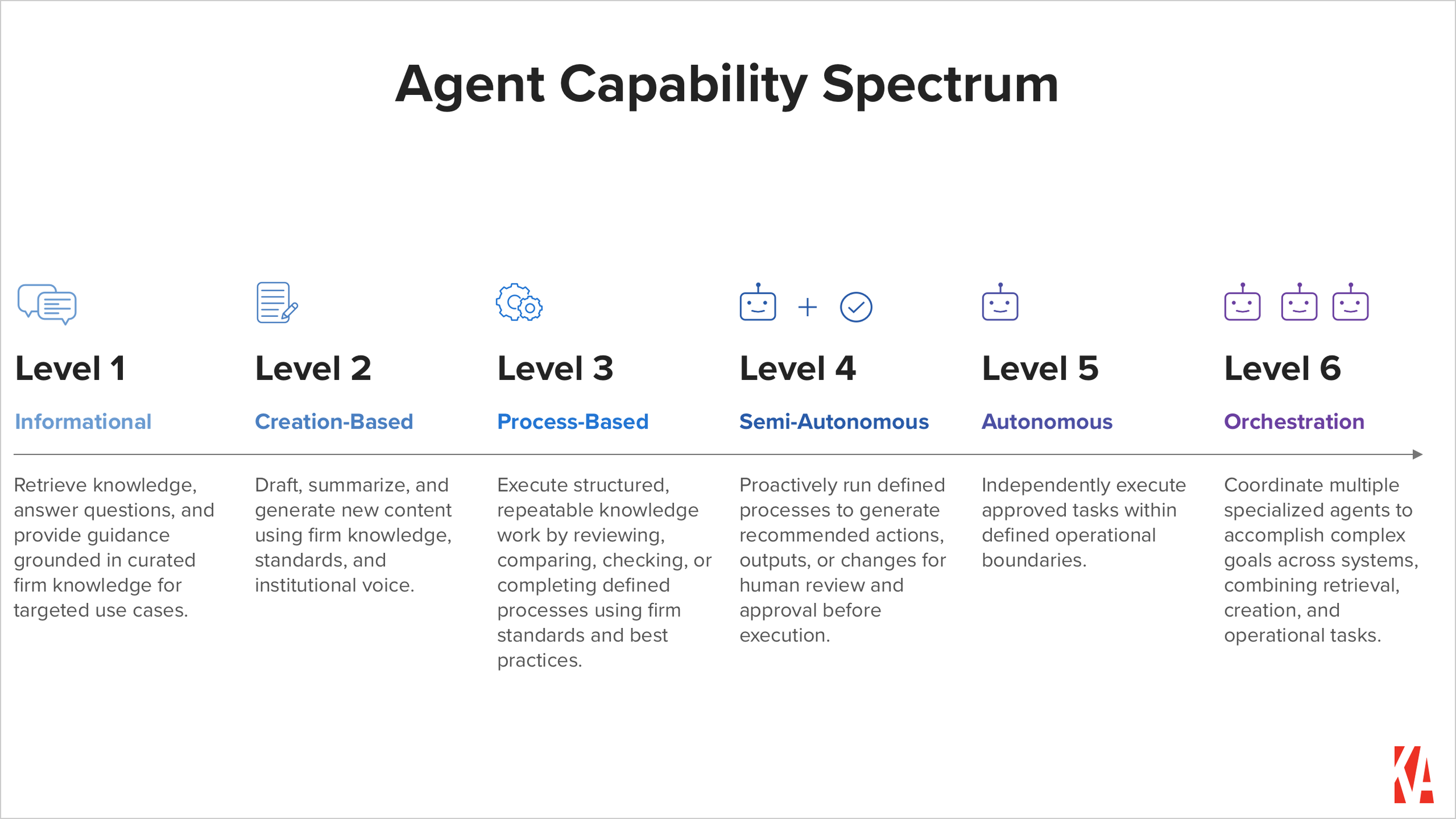
As you move from left to right across the spectrum, the role of human oversight changes. The operational implications become more significant. And perhaps most importantly, the nature of the knowledge required to make agents effective begins to evolve.
At the lower end of the spectrum, firms are often working primarily with existing institutional knowledge: standards, policies, project histories, technical guidance, lessons learned, contact information, and documented processes. In many cases, that knowledge already exists inside intranets, learning management systems, project databases, and other digital platforms. Agents help make that knowledge easier to access, navigate, and apply.
As organizations move further across the spectrum, the challenge becomes less about simply retrieving knowledge and more about operationalizing expertise.
A Level 1 informational agent may primarily need to answer questions about what a firm’s standards are, where information lives, or how a particular process works. A Level 2 or Level 3 agent, however, needs to understand what good looks like.
If an agent is helping draft a proposal, what makes a proposal strong? If it is helping review a fee structure, what are the red flags? If it is helping generate learning objectives, what defines a well-written learning objective? If it is supporting QA/QC workflows, how does the firm evaluate quality, consistency, completeness, or risk?
Those answers often live less in formal documentation and more inside the judgment and experience of subject matter experts.
As firms move from informational agents toward creation-based and process-based systems, they increasingly have to capture not just facts and processes, but evaluation criteria, workflow logic, operational expectations, and definitions of quality.
AEC firms are experimenting with agents in many different ways across many different platforms, and the landscape is evolving incredibly quickly. I want to be careful not to overgeneralize where the entire industry is with AI agents today.
What I can share, however, is what we’re seeing emerge inside the private beta of Synthesis Knowledge Agents.
One of the clearest patterns so far is that firms are overwhelmingly starting on the left side of the spectrum by building highly valuable Level 1, 2, and 3 agents.
Informational Agents: Making Institutional Knowledge More Accessible
The first category of agents we’re seeing firms build are informational agents: designed to help people find, navigate, and apply institutional knowledge more efficiently.
In many ways, this is the natural starting point for organizations beginning to explore AI agents.
Inside the beta, I’ve seen firms create agents that help employees identify relevant project experience, locate technical standards, answer software support questions, surface onboarding resources, navigate internal policies, and connect people with subject matter experts across the organization.
What makes these informational agents powerful is that they dramatically improve the accessibility and usability of knowledge firms already have.
That may sound simple, but the operational impact can be significant.
In many organizations, experienced staff spend an enormous amount of time answering repetitive questions, redirecting employees to existing resources, or helping people navigate fragmented systems.
Informational agents can help reduce that burden on subject matter experts while simultaneously making expertise more scalable and accessible across the organization.
One of the things I find particularly interesting about these agents is that they are designed around very specific use cases and tightly scoped areas of knowledge. Rather than searching across everything inside the organization at once, they can help narrow the signal-to-noise ratio around a particular topic, workflow, department, or business function.
For example, a Revit Assistant agent could be grounded in the firm’s Revit best practices, courses, and intranet posts. An HR Policy Advisor agent could be grounded in the employee handbook and benefits documentation. A Design Precedent Explorer agent could be grounded in the firm’s project directory and project sheet library.
That specificity can make the experience of using AI feel much more approachable for end users than general purpose chatbots or AI search interfaces.
With a chatbot or AI search, people may not know what kinds of questions the system can answer, or how to phrase requests effectively. Building agents around specific use cases helps reduce that ambiguity through clear naming, descriptions, starter prompts, and intentionally scoped knowledge domains.
We designed Synthesis Knowledge Agents to respond conservatively and stay closely grounded to source material. In addition, they can also be configured to escalate users toward human support when questions fall outside the agent’s intended scope or confidence level.
Informational agents provide a high-value and low-risk way to begin introducing your organization and your employees to AI agents.
Creation-Based Agents: Accelerating Knowledge Work
If informational agents are primarily focused on helping people find and navigate knowledge, creation-based agents begin helping people create new work products grounded in the organization’s expertise, standards, and institutional context.
This is where many firms begin moving beyond retrieval and into augmentation.
Inside the beta, I’ve seen firms experiment with creation-based agents that help draft proposal content, generate project descriptions, create onboarding materials, summarize meetings, develop learning objectives, write first-pass communications, and support a wide range of other knowledge work activities.
But there’s a catch—creation-based agents require capturing a different type of knowledge than informational agents.
With informational agents, firms are often working primarily with explicit knowledge: policies, standards, project histories, technical references, and documented procedures.
Creation-based agents require organizations to capture tacit knowledge: judgment, expectations, and definitions of what good looks like.
If an agent is helping draft a project approach, what makes a project approach compelling? If it is generating learning objectives, what defines a strong learning outcome? If it is helping write a proposal, what tone, structure, positioning, and strategic priorities should shape the output?
Building creation-based agents creates a powerful opportunity to make knowledge that was previously tacit, invisible, siloed, or unevenly distributed across teams explicit and shared. Once that knowledge becomes explicit, organizations can operationalize expertise far more intentionally and at greater scale.
That’s one of the reasons I believe these systems have the potential to become such important accelerators for both knowledge management and learning organizations over time.
Importantly, I don’t think the goal of agents is to replace humans. The strongest implementations I’m seeing are focused on helping people move through repetitive cognitive work more efficiently so they can spend more time strategizing, refining, evaluating, contextualizing, and improving the final result.
Creation-based agents are powerful tools to accelerate knowledge work.
Process-Based Agents: Operationalizing Expertise and Streamlining Workflows
If creation-based agents help accelerate knowledge work, process-based agents begin helping organizations operationalize how work actually gets done.
This is where agents start moving beyond generating outputs and into supporting repeatable workflows, procedural consistency, decision support, and operational execution.
Inside the beta, I’ve seen firms begin experimenting with agents that support proposal review workflows, check contracts for risky language, deploy QA/QC procedures, validate standards compliance, and other common AEC processes.
One of the most promising patterns I’m seeing is that these agents can help employees go much further on their own before needing escalation or executive intervention.
A project manager reviewing a fee proposal or contract, for example, can upload a draft to an agent to act as a second set of eyes: identifying low-hanging issues, surfacing potential concerns, checking alignment with standards, and helping them better understand where real risk exists before the document ever reaches a COO, operations leader, or general counsel.
That changes the nature of the workflow.
Instead of escalating every question immediately, employees can arrive at those conversations better prepared, more informed, and with a clearer understanding of both the problem and the potential solutions. Over time, that has the potential to accelerate learning, strengthen judgment, improve consistency, and in some cases perhaps even eliminate the need for a secondary review altogether.
But making process-based agents successful does raise several important questions.
If a fee proposal review agent is helping evaluate a draft submission, what exactly is it looking for? What are the common red flags? What differentiates a strong fee structure from a weak one? What issues should trigger escalation or additional review?
Similarly, if a contract review agent is helping analyze an agreement, how does the firm distinguish between preferred terms, negotiable concerns, and unacceptable levels of risk? Which clauses are considered standard? Which ones require caution? Which ones should immediately trigger legal, operational, or executive review?
At the risk of sounding like a broken record, successful process-based agents require firms to codify both their operational knowledge and their definitions of what good looks like.
And this is where things become especially interesting.
We’re learning from firms in the Synthesis Knowledge Agent beta that the potential time savings, quality-of-life improvements, and workflow efficiencies are often so compelling that experienced experts are more than willing to work alongside agent builders to externalize and operationalize their knowledge.
Watching that happen warms this long-time knowledge manager’s heart more than you can know.
The Next Frontier: Semi-Autonomous Agents and Beyond
Beyond informational, creation-based, and process-based agents, the spectrum becomes increasingly exploratory.
Exactly where the most valuable use cases for AEC firms will emerge remains an open question, and I suspect the answers will vary significantly across organizations, disciplines, workflows, and risk profiles.
But we can already begin to see some early patterns emerging.
One likely category is event-based agents: systems that respond dynamically when something changes inside an operational environment.
For example, when a new page, course, or knowledge asset is added to a knowledge base, a semi-autonomous agent might automatically evaluate whether the information duplicates existing content or introduces conflicting information. Rather than acting independently, the agent might then recommend updates, suggest edits, flag risks, or route issues toward the appropriate human reviewer for approval.
A second emerging category may involve more proactive or recurring “heartbeat” workflows. Instead of waiting for a specific event, semi-autonomous agents could periodically evaluate knowledge systems over time: identifying potentially outdated information, detecting stale content, surfacing underutilized resources, or recommending materials for archival, consolidation, or revision.
In some cases, organizations may eventually become comfortable allowing bounded non-destructive actions to happen automatically. Metadata classification, tagging, summarization, or categorization workflows are examples where automation may carry lower organizational risk than workflows involving archival and deletion of information.
And further across the spectrum, orchestration systems may begin coordinating multiple specialized agents together across larger workflows and operational sequences.
But I think it’s important to emphasize that much of this remains exploratory.
Right now, the overwhelming majority of the practical value we’re seeing inside our community is happening across Levels 1 through 3. And frankly, there is still an enormous amount of meaningful work to do there.
What feels increasingly clear is that the firms that will benefit most from AI agents are likely to be the firms that become best at identifying high-value use cases, codifying operational knowledge, and translating institutional expertise into systems that can repeatedly support better outcomes.
In many ways, that becomes the real organizational challenge.
Not simply adopting AI tools, but developing the people, processes, workflows, and operational discipline required to consistently put organizational knowledge to work.
The firms that do this well will likely become dramatically better at accelerating learning, scaling expertise, streamlining workflows, and helping their people operate with greater confidence and consistency.
I suspect the long-term story of AI agents may ultimately become less about artificial intelligence itself and more about how organizations learn to operationalize and distribute expertise at scale.
What do you think?
I'd love to hear where your firm sits on this spectrum and what you're learning along the way. The experiments, the friction, the surprises, and the concerns.
Please send your thoughts to smarter@knowledge-architecture.com.
How Knowledge Agents Will Change the Way AEC Firms Scale Expertise and Accelerate Learning
Imagine you’re early in your career and newly staffed on a healthcare project. You’ve been asked to help work through the onstage/offstage model for a new facility—a concept you’ve heard before, but you don’t feel fluent enough in to start designing with confidence. You know your firm has done this work many times, and you know the knowledge exists somewhere. What you don’t know is where to look or how to get started.
So you turn to your firm’s AI-powered Healthcare Knowledge Agent.
You ask a simple, situational question: What are the key considerations when designing an effective onstage/offstage model for a healthcare project? The response you get is grounded in how your firm approaches healthcare work. It draws from internal best practices, past projects, and recorded talks from senior healthcare leaders. It highlights what to pay attention to early, where teams often run into trouble, and how different decisions affect patient experience and staff workflows.
Along the way, it points you to specific internal resources—an upskilling video on healthcare planning, linked directly to the exact moment where this concept is discussed; a standards page that captures onstage/offstage best practices; and a case study from a past project that shows how these ideas come together in the real world. If you want to go deeper, you can. If you just need enough context to start shaping a design direction, you have it.
Later that week, you’re asked to begin contributing to an imaging suite—something you’ve never worked on before. You ask the Healthcare Knowledge Agent what’s important to consider. Again, the agent synthesizes the firm’s best thinking, pulling together insights from different people, in different formats, shared at different times. And when follow-up questions move into territory it can’t answer with confidence, it doesn’t pretend otherwise. It clearly signals the limits of its knowledge and points you to the right subject-matter experts to answer the hard questions.
You’re able to stay in the flow of work—learning as you go, making progress, and building confidence.
Now imagine the same moment from the other side of the equation.
You’re one of the firm’s healthcare leaders. You’ve spent years building deep expertise through projects, research, and mentoring. You care deeply about developing the next generation, but you also know how often your time is consumed by answering the same foundational questions—important questions, but repeatable ones. Questions that interrupt deep work and pull you away from clients, strategy, and the harder problems that really need your attention.
By contributing to your firm’s digital knowledge base—through interviews, recorded talks, and curated guidance—your expertise becomes accessible on demand, 24/7, in a form that’s contextual, searchable, and connected. When emerging professionals come to you with questions, they’re better informed and more specific. Your time is spent mentoring at the right level, serving clients, advancing the firm’s thinking, and continuing to add new insights that strengthen the firm’s collective knowledge over time.
In short, your expertise has been leveraged so you can have more impact and your firm’s emerging professionals can develop faster.
Once you can imagine this working in healthcare, it’s not hard to extrapolate the same pattern applying elsewhere—whether that’s a Sustainability Knowledge Agent helping teams navigate materials and approaches, or a Revit Knowledge Agent supporting designers while freeing design technology teams to focus on innovation. Across disciplines, the dynamic is the same: expertise scales, learning accelerates, and the organization gets smarter.
This vision explains why Knowledge Agents will be the next major pillar in the Synthesis platform, alongside Intranet, LMS, and AI Search capabilities.
In this issue of Smarter by Design, I’ll take you deeper into how Knowledge Agents will work, what processes and cultural habits will make them successful, and how you can begin to lay the foundation for their arrival later in 2026.
Imagine you’re early in your career and newly staffed on a healthcare project. You’ve been asked to help work through the onstage/offstage model for a new facility—a concept you’ve heard before, but you don’t feel fluent enough in to start designing with confidence. You know your firm has done this work many times, and you know the knowledge exists somewhere. What you don’t know is where to look or how to get started.
So you turn to your firm’s AI-powered Healthcare Knowledge Agent.
You ask a simple, situational question: What are the key considerations when designing an effective onstage/offstage model for a healthcare project? The response you get is grounded in how your firm approaches healthcare work. It draws from internal best practices, past projects, and recorded talks from senior healthcare leaders. It highlights what to pay attention to early, where teams often run into trouble, and how different decisions affect patient experience and staff workflows.
Along the way, it points you to specific internal resources—an upskilling video on healthcare planning, linked directly to the exact moment where this concept is discussed; a standards page that captures onstage/offstage best practices; and a case study from a past project that shows how these ideas come together in the real world. If you want to go deeper, you can. If you just need enough context to start shaping a design direction, you have it.
Later that week, you’re asked to begin contributing to an imaging suite—something you’ve never worked on before. You ask the Healthcare Knowledge Agent what’s important to consider. Again, the agent synthesizes the firm’s best thinking, pulling together insights from different people, in different formats, shared at different times. And when follow-up questions move into territory it can’t answer with confidence, it doesn’t pretend otherwise. It clearly signals the limits of its knowledge and points you to the right subject-matter experts to answer the hard questions.
You’re able to stay in the flow of work—learning as you go, making progress, and building confidence.
Now imagine the same moment from the other side of the equation.
You’re one of the firm’s healthcare leaders. You’ve spent years building deep expertise through projects, research, and mentoring. You care deeply about developing the next generation, but you also know how often your time is consumed by answering the same foundational questions—important questions, but repeatable ones. Questions that interrupt deep work and pull you away from clients, strategy, and the harder problems that really need your attention.
By contributing to your firm’s digital knowledge base—through interviews, recorded talks, and curated guidance—your expertise becomes accessible on demand, 24/7, in a form that’s contextual, searchable, and connected. When emerging professionals come to you with questions, they’re better informed and more specific. Your time is spent mentoring at the right level, serving clients, advancing the firm’s thinking, and continuing to add new insights that strengthen the firm’s collective knowledge over time.
In short, your expertise has been leveraged so you can have more impact and your firm’s emerging professionals can develop faster.
Once you can imagine this working in healthcare, it’s not hard to extrapolate the same pattern applying elsewhere—whether that’s a Sustainability Knowledge Agent helping teams navigate materials and approaches, or a Revit Knowledge Agent supporting designers while freeing design technology teams to focus on innovation. Across disciplines, the dynamic is the same: expertise scales, learning accelerates, and the organization gets smarter.
This vision explains why Knowledge Agents will be the next major pillar in the Synthesis platform, alongside Intranet, LMS, and AI Search capabilities.
In this issue of Smarter by Design, I’ll take you deeper into how Knowledge Agents will work, what processes and cultural habits will make them successful, and how you can begin to lay the foundation for their arrival later in 2026.
Why Knowledge Agents Now?
In the fall of 2024, we released Synthesis AI Search into beta with our community. The uptake was immediate and right away we noticed that our clients were using it in ways that went well beyond what we originally imagined for a firmwide search tool.
We received feedback through every channel available to us: in-product ratings, client success conversations, community meetings, and one-on-one discussions. And as we started reviewing how people were actually working with AI Search, a clear pattern emerged.
Firms weren’t just asking broad questions across their entire knowledge base. They were trying to use AI Search to draft proposal answers, write blog posts, answer support tickets, create lesson plans based on videos, and more.
They were effectively trying to turn a general-purpose search experience into something that could act like an AI assistant—one that understood a specific domain, a specific audience, and a specific job to be done.
In other words, people were pushing AI Search to its edges.
That behavior was telling. In product design, when users are willing to work around the friction which accompanies using a tool for something other than its intended purpose, they’re usually pointing you toward something valuable that doesn’t exist yet. AI Search was getting them closer than anything they’d had before. But it wasn’t quite the thing they were reaching for.
What became clear is that AEC firms need two different things:
Firmwide AI Search: a powerful, natural-language way to explore everything the organization knows, across documents, pages, videos, and conversations.
Knowledge Agents: purpose-built, use-case-driven AI assistants grounded in a specific subset of the firm’s knowledge and designed to help people accomplish a particular goal.
Synthesis Knowledge Agents won’t be a replacement for AI Search. They’ll be a complement to it. They’ll build on the same underlying capabilities—natural language understanding, synthesis across formats, citations, feedback, and epistemic humilty—but package those capabilities into a more focused form. Instead of asking a general system to be everything at once, a Knowledge Agent will be designed to do one thing well: support a specific workflow, discipline, or role.
Some Knowledge Agents will be personal, created by individuals to support how they work. Others will be shared across a team, department, or discipline. And some will be firmwide—available to everyone as a trusted starting point for a particular kind of work.
What they all share is the same design philosophy: they’re grounded in firm knowledge, they’re clear about their boundaries, and they’re designed to know when to help and when to hand things off to a human instead.
Knowledge Agents as Digital Ambassadors for Expertise
When we first started talking about this next phase of AI-powered knowledge management, I often used the metaphor of digital twins. In AEC, it’s a familiar concept. We build digital twins of buildings and infrastructure all the time, so the idea of creating a digital twin of an expert’s knowledge felt intuitive — even a little playful. It usually landed well in presentations.
But over time, that metaphor started to feel wrong.
A Knowledge Agent will never be a true digital twin of a human being or a team of human beings. It can’t replicate their lived experience, passion, intuition, judgment, or creativity.
I think a better way to think about Knowledge Agents is as digital ambassadors for your firm.
A digital ambassador represents expertise, but within clear and intentional boundaries. It speaks on behalf of the firm’s accumulated knowledge in a particular domain — healthcare planning, sustainability, Revit standards, marketing communications.
A well-designed Knowledge Agent handles the routine, foundational, and repeatable. It answers the 101 and 201–level questions that come up again and again. It helps emerging professionals get oriented, understand terminology, and make informed early decisions. It dynamically pulls together the firm’s best thinking from guides, videos, courses, and past work, and presents it in a way that’s situational, contextual, and grounded for a special question from a special person.
Just as importantly, a good Knowledge Agent knows the limits of its knowledge. In those moments, its job is to say “I don’t know,” and route you to the right next step.
That might mean pointing you to a specific subject-matter expert whose judgment matters in that situation. It might mean recommending a deeper resource from your firm’s knowledge base. It might mean suggesting a relevant training or course to build more context before proceeding.
That epistemic humility isn’t a limitation — it’s a design feature.
Scaling Expertise and Accelerating Learning with Knowledge Agents
I don’t think we should strive for Knowledge Agents to replace human expertise. They should help AEC firms scale expertise and develop talent more effectively.
They should enable emerging professionals and other team members to make progress at their own pace and on their own schedules. And they should allow experts to spend more time on mentoring, client work, research, and advancing the firm’s thinking — rather than answering the same foundational questions over and over again.
This matters even more when you look at how the next generation of AEC professionals wants to work. Many are deeply self-directed. They’re accustomed to learning on demand, assembling context for themselves, and making progress without waiting for permission or perfect handoffs. They don’t want to bypass mentorship, but they also don’t want every question to require a conversation.
Knowledge Agents are built for that reality. They give people a way to orient themselves, research solutions, and build confidence independently before escalating. They support curiosity without friction. And over time, they make it possible for individuals and teams to shape how they access knowledge — effectively assembling their own assistants to help guide work in ways that match how they think and operate.
From a learner’s perspective, this changes how development happens. Learning becomes more personalized, more continuous, more contextual, and more closely tied to real work. People can stay in the flow, build confidence faster, and arrive at conversations with experts better prepared.
From an organizational perspective, something even more important happens. Knowledge Agents create a powerful opportunity to connect people to the right knowledge or expert at the right time because they sit at the intersection of intranet content, learning programs, and AI-powered retrieval.
Knowledge Agents are not magic. They’re not omniscient. And they’re not meant to stand alone. They’re designed to work as part of a broader knowledge ecosystem alongside firmwide AI Search, a robust digital knowledge foundation, curated learning experiences, and human relationships.
What It Will Take to Succeed in the Knowledge Agent Era
I want to talk about what it will actually take for Knowledge Agents to succeed — not technically, but organizationally. The firms that get the most value from this next era will be the ones that invest in the foundations, habits, and feedback loops that make knowledge usable in the first place.
There’s a line in The Living Company by Arie de Geus that I’ve carried with me for years. In his study of organizations that managed to survive and adapt for centuries, de Geus argued that “the only sustainable competitive advantage in business is the ability to learn faster than your competitors.”
That idea feels more relevant than ever in the AI era.
Knowledge Agents won’t create competitive advantage on their own. They’ll amplify it. They’ll reward firms that already take organizational learning seriously, while giving firms beginning their knowledge and learning management journey a clearer path to become smarter, more resilient, and more sustainable over time.
In practice, that success will show up through three commitments.
1. A sustained commitment to your digital knowledge foundation
Knowledge Agents will only be as effective as the knowledge they’re grounded in.
This sounds obvious, but it’s worth saying plainly: if the most important knowledge in your firm is outdated, fragmented, or hard to trust, no amount of AI layered on top will fix it. Knowledge Agents won’t replace the need for good knowledge management, but they will raise the ROI.
Succeeding in the Knowledge Agent era will require treating your digital knowledge foundation as a living system, not a one-time project. That means being deliberate about what knowledge actually matters, prioritizing its capture, keeping it current, and retiring what no longer reflects how the firm works today.
Firms with solid digital knowledge foundations have already seen the benefits with AI Search. It has dramatically improved the ability to find and apply knowledge in context, raising the ROI of well-captured content that may have been underutilized.
Just as importantly, AI Search surfaced gaps where the firm’s knowledge was thin, outdated, or fragmented—and, in doing so, created a powerful incentive to fill them. When experts can see exactly where a better knowledge foundation would make their work easier, faster, and more effective, high-quality contributions start to flow. In that way, AI Search has acted like a magnet for firmwide knowledge—pulling expertise into the system because the value of contributing is suddenly obvious.
Knowledge Agents will amplify that dynamic. The same standard, lesson, or project insight will be accessible via firmwide search, learning programs, and multiple use-case-specific Knowledge Agents at once.
And, once again, gaps will become visible. When a Knowledge Agent can answer many questions well but falters in specific areas, it will make the missing knowledge visible. For experts and leaders, that clarity will create a new incentive: a clear opportunity to invest time where it will have the greatest impact, strengthening the digital knowledge foundation, and improving outcomes across the firm.
2. A commitment to creating the conditions for expertise to scale
If Knowledge Agents are going to succeed, firms will need to make a clear and sustained commitment to how expert knowledge is transferred.
There are experts in every AEC firm who have accumulated years of experience through projects, client relationships, research, and hard-earned lessons. They are often generous with their time, but they are also busy. And asking them to simply “document more” has never been a realistic or effective strategy.
Succeeding in the Knowledge Agent era will require a different approach.
The firms that get this right will set a clear expectation: being a subject-matter expert isn’t only about solving client problems or mentoring one person at a time. It also means acting as a steward of the firm’s digital knowledge foundation—helping to externalize what you know so it can be shared, reused, and built upon.
But just as importantly, those firms will design systems that make that stewardship easier.
We’re already seeing strong examples of what this looks like in practice. At Shepley Bulfinch, for instance, the technology team partners directly with experts through structured interviews, captured on video. The burden of production—interviewing, editing, publishing, and packaging the content—sits with a dedicated team. The expert’s role is focused and respectful of their time: show up, share what you know, and review the result before it’s released.
At LS3P, the marketing and knowledge management teams have taken a similar approach through their Expert Hours program. They facilitate firmwide conversations with subject-matter experts—sometimes one-on-one, sometimes between peers—and then take responsibility for transforming those conversations into reusable knowledge assets. That content supports internal learning, external storytelling, and firmwide alignment, all without requiring experts to become full-time content creators.
These examples point to an important shift. This work can’t be accomplished by asking experts to just “share and document more” when their plates are already full. It requires putting programs, processes, and people in place to support knowledge transfer intentionally. Interviewers, editors, instructional designers, and knowledge and learning managers all play a role in turning lived experience into shared understanding.
3. A commitment to feedback and continuous improvement
The final commitment is what turns all of this into a living system.
Once Knowledge Agents are in use, every interaction becomes a signal. When someone rates an answer as unhelpful, asks a follow-up the agent can’t answer, or escalates to a human, it’s not a failure—it’s feedback.
Over time, those signals reveal where knowledge is missing, duplicated, conflicting, outdated, or unclear. They expose gaps in knowledge ownership. They surface assumptions that no longer hold. And when firms pay attention and act on that feedback, the system gets better—not just the agent, but the underlying digital knowledge foundation itself.
This is one of the most powerful, and often overlooked, aspects in knowledge management. Increasing the usage of your firm’s digital knowledge foundation improves it by making gaps, contradictions, and content priorities visible. The more the system is used, the clearer the firm’s thinking becomes. Learning accelerates because learning is designed into the workflow.
This is why we see Knowledge Agents not as a feature, but as part of a broader shift towards becoming more intentional about knowledge and learning management—a shift that many firms in our community are actively exploring. It’s also why so much of our work this year, including the conversations we’ll have at KA Connect 2026, is focused on what it really means to design modern learning organizations in the AI era.
So Where Do You Start?
Earlier, I mentioned that Knowledge Agents will become available to Knowledge Architecture clients later in 2026.
If this direction resonates, the question isn’t when to adopt them. It’s how to prepare now in a way that sets you up for success down the line.
I think the most useful place to start is with Jobs to Be Done.
What are the most important and recurring areas in your firm where knowledge—or access to expertise—is the bottleneck?
When you look through that lens, potential Knowledge Agents tend to reveal themselves quickly. Whether that job lives in healthcare planning, sustainability, design technology, onboarding, or operations, the pattern is the same: where expertise becomes a bottleneck, a well-designed Knowledge Agent can create leverage.
Once you can picture a specific agent, the next questions follow naturally.
Who holds the expertise that the agent would need today?
Is that knowledge concentrated in one person, a small group, or scattered unevenly across the firm?
Would making this knowledge more accessible create leverage for experts while accelerating learning for others?
In practice, one of the simplest ways into this work is to talk with your experts and department leaders and ask a direct question: What do people ask you about over and over again?
Those repeat questions are signals. They point to places where better knowledge access could meaningfully change how work gets done.
From there, you can work backward to the digital knowledge foundation.
Do you already have the guides, standards, best practices, or learning resources that Knowledge Agent would rely on?
Is that knowledge clear and current—or duplicated, outdated, or missing entirely?
What would need to be captured, updated, or archived to make that Knowledge Agent genuinely useful?
Answering those questions helps focus effort where it matters most: prioritizing use cases, interviewing experts, capturing tacit knowledge, creating learning assets, and assigning ownership so that knowledge stays alive over time.
Knowledge Agents will be here before you know it. The firms that benefit most won’t be the ones who rush at the end—they’ll be the ones who start now by identifying their highest-leverage Jobs to Be Done and preparing the knowledge those agents will depend on.
If you’re already working with Knowledge Architecture, this is a good moment to take advantage of our community events, shared resources, and Client Success team as you begin planning for Synthesis Knowledge Agents. And if you’re not a client—and this way of thinking resonates—we’d love to talk.
We’ll continue sharing what we’re learning here in the newsletter, on the Smarter by Design podcast, and across the KA Community.
Stay tuned.
The AI and Expertise Paradox
I found myself in a fascinating conversation with the COO of one of our clients last week. We were talking about something I’ve been circling around for months, but this discussion finally snapped the pieces into place.
It’s what I’m starting to call the AI and Expertise Paradox.
We all know the demographic story by now. Baby boomers are retiring in large numbers and there aren’t enough Gen Xers to replace them.
In AEC, that often means we’re losing some of the deepest technical knowledge in our organizations—codes, construction standards, quality practices, the kind of judgment that only comes from decades of watching real projects go from concept to completion.
Technical experts possess the kind of deep smarts that can look at a drawing and feel that something isn’t quite right.
And they are retiring.
At the same time, we’re seeing a wave of AI-powered tools arrive that promise to help fill the gap. Automated code checks. QA/QC scanners. Plan reviewers that highlight potential issues a junior architect or engineer would never recognize. Assistants that allow someone to work across jurisdictions with different codes and standards and at least have a baseline level of support.
In some ways, it feels like knowledge augmentation—almost like the moment in The Matrix when the character Tank uploads the knowledge to fly a helicopter into Trinity’s brain.
Similarly, there are numerous emerging AI tools in our industry which, if they deliver on their vision, will enable a junior team member to run a basic code review, an expert who is stretched thin across multiple projects to offload routine checks, or an architect or engineer working on a project in a different region to get a helpful second set of eyes on local code compliance.
On the surface, this looks like the perfect solution: AI tools that allow those with less expertise or who are super busy to do more.
But here’s where the paradox emerges.
I found myself in a fascinating conversation with the COO of one of our clients last week. We were talking about something I’ve been circling around for months, but this discussion finally snapped the pieces into place.
It’s what I’m starting to call the AI and Expertise Paradox.
We all know the demographic story by now. Baby boomers are retiring in large numbers and there aren’t enough Gen Xers to replace them.
In AEC, that often means we’re losing some of the deepest technical knowledge in our organizations—codes, construction standards, quality practices, the kind of judgment that only comes from decades of watching real projects go from concept to completion.
Technical experts possess the kind of deep smarts that can look at a drawing and feel that something isn’t quite right.
And they are retiring.
At the same time, we’re seeing a wave of AI-powered tools arrive that promise to help fill the gap. Automated code checks. QA/QC scanners. Plan reviewers that highlight potential issues a junior architect or engineer would never recognize. Assistants that allow someone to work across jurisdictions with different codes and standards and at least have a baseline level of support.
In some ways, it feels like knowledge augmentation—almost like the moment in The Matrix when the character Tank uploads the knowledge to fly a helicopter into Trinity’s brain.
Similarly, there are numerous emerging AI tools in our industry which, if they deliver on their vision, will enable a junior team member to run a basic code review, an expert who is stretched thin across multiple projects to offload routine checks, or an architect or engineer working on a project in a different region to get a helpful second set of eyes on local code compliance.
On the surface, this looks like the perfect solution: AI tools that allow those with less expertise or who are super busy to do more.
But here’s where the paradox emerges.
AI Still Needs Experts (The First Problem)
Right now, AI tools are most effective when an expert is in the loop.
An experienced architect or engineer can look at an AI-generated report and instantly separate signal from noise:
“This is a real issue. Excellent catch. Might have missed this one.”
“This doesn’t apply in this jurisdiction.”
“This is technically true, but not material to the design.”
“This won’t matter in the new version of the code which applies to our building.”
“This is just wrong.”
They can also see what’s missing—the issues the AI tool didn’t include in the report.
Without the judgement acquired through years of practice, junior staff can easily fall into false confidence, unnecessary rework, or worse, risky decisions. AI tools help them do more, but they don't yet help them know whether what they are doing is correct.
In other words, AI is not currently a replacement for expertise.
It’s a force multiplier for expertise.
Technical Experts Are Retiring (The Second Problem)
At the exact moment when AI tools require expert oversight, those experts are retiring in large numbers.
Many firms are watching their deepest technical knowledge walk out the door.
This isn’t simply the loss of skills—it’s the loss of judgment, intuition, pattern recognition, and hard‑earned lessons about what actually happens in the field.
And the timing couldn’t be worse.
Fewer People Want to Become Technical Experts (The Third Problem)
From what we’re hearing across our client community, many emerging professionals simply aren’t as interested in developing deep technical expertise.
They’re drawn to the front end of the profession:
design
visualization
design technology
developing custom software
— not the intricate, technical work of codes, detailing, constructability, and quality assurance.
You can argue this has always been somewhat true, but the difference now is scale and timing.
The Apprenticeship Model Is Breaking (The Fourth Problem)
For generations, our industry relied on a fairly consistent apprenticeship model.
Emerging professionals sat near someone more experienced. They listened to their phone calls. They watched them mark up drawings. They absorbed judgment by proximity—not through a training module, but by seeing how decisions were made in real time.
The craft was transmitted osmotically and serendipitously.
That model is breaking.
Hybrid work and distributed teams make it harder for an emerging professional to “listen over the shoulder” of a technical expert. Project teams are spread across offices and time zones. Much day-to-day interaction happens through scheduled Zoom calls and Teams chats rather than shared physical space. And the informal learning that once happened between those moments is evaporating.
Layer onto that a generation raised on Google, YouTube, TikTok, and instant messaging. The next generations are highly self‑directed and expect immediate answers and on‑demand knowledge in the flow of work.
Meanwhile, the half‑life of technical knowledge keeps shrinking. Codes change. Materials evolve. Project delivery models shift. Digital tools proliferate. There’s simply too much to teach relying solely on the old apprenticeship model.
As one of our clients likes to say, “We can’t wait 30 years to get a 30‑year architect.”
We need to develop people faster.
Putting The Paradox Together
So now we have four problems converging:
AI still needs experts.
Those experts are retiring.
Fewer emerging professionals want to become technical experts.
The apprenticeship model that once created experts is breaking.
Put together, these four problems form the heart of the AI and Expertise Paradox.
It’s a paradox in the truest sense: the very thing that appears to solve the problem depends on the thing we’re losing.
So Where Do We Go From Here?
The COO I spoke with last week isn’t slowing down.
Their firm is moving ahead with AI adoption—not because they believe AI will replace expertise, but because they know it can help their experts work smarter today while helping connect emerging professionals to the right knowledge and expertise in the flow of work.
At the same time, they’re rethinking how learning and development happens inside the firm. They’ve already revamped their leadership development program. Now they’re turning their attention to project managers and emerging professionals, experimenting with new approaches and new technologies to help people grow faster.
They’re building a more intentional, modern learning environment.
And they’re not alone.
Across our community, we’re seeing more firms begin to rethink learning and development in deeper and more intentional ways.
Many are adopting a continuous onboarding mindset—recognizing that people don’t just onboard once when they join the firm. They onboard every time they:
take on new responsibilities, like project management or technical architecture
work on a new project type, such as shifting from retail to healthcare
enter a new project phase, like doing construction administration for the first time
Firms are looking for ways to continually equip their people with the knowledge they need at the moment they need it.
We’re also seeing firms:
create rewarding career paths for technical experts that provide leadership opportunities, meaningful influence, and strong compensation
invest in hybrid and flipped classroom models—using on‑demand training for the 101 basics, and reserving face‑to‑face time with experts for applied work and real examples
move beyond simply pointing people to hour‑long Lunch & Learn recordings to also offering short, modular, on-demand content that fits into the flow of work
apply adult learning principles to elevate the quality and effectiveness of their training
build feedback loops to continually improve learning efforts
automate the delivery of key knowledge so it reaches the right person before they need it, whenever possible
build integrated knowledge and learning teams, technologies, and processes
In other words, firms are starting to design modern learning environments—ones that help people grow faster, develop judgment, and apply what they’re learning in meaningful ways.
It’s early, but the work has begun.
What We’re Doing at Knowledge Architecture
Ari de Geus, in his book The Living Company, studied organizations that survived for generations. One of his most famous conclusions was:
“The only sustainable competitive advantage is learning faster than your competitors.”
That idea feels especially relevant right now. If anything, AI is raising the stakes. It is giving firms the opportunity to move faster, but only if their people can learn, adapt, and apply judgment at the same pace.
That’s the work we’re committing to.
From a technology perspective, we’re continuing to expand Synthesis into the integrated knowledge and learning platform that AEC firms need to support this transition—adding new capabilities like Synthesis LMS (Learning Management System) and Synthesis AI Search on top of the intranet foundation to provide the connective tissue that helps firms capture, share, transfer, and find what they know, as well as identify knowledge gaps and outdated knowledge, to help them evolve and grow their practices.
From a community perspective, we’re going to stay close to the question “What does a modern learning organization in AEC look like?” We’ll continue sharing what we’re hearing, what we’re seeing, and the stories of firms who are pushing the boundaries.
In fact, the theme of KA Connect 2026, our annual knowledge and learning management conference for the AEC industry, will be Designing Modern Learning Organizations.
We’ll keep exploring this theme both here in the Smarter by Design newsletter and in our new Smarter by Design podcast, launching in January 2026. And it will continue to shape the products we build and the conversations we convene.
I believe this is the work of the next decade in our industry. And if we’re successful as a community, we’ll have figured out how to build smarter, more adaptable AEC practices. By design.
Questions for You
If your AEC firm is investing in AI tools in technical domains—QA/QC, code review, automated checking, etc.—what are you seeing?
Is it true in your firm that emerging professionals are less interested in developing deep technical expertise?
And how are you thinking about approaching the problems and paradox I laid out in this issue?
I’d love to hear your thoughts.
👉 Email me at cparsons@knowledge-architecture.com.