
The Standardization Paradox: Can AEC Firms Scale Quality Without Sacrificing Innovation?
How far should AEC firms go in standardizing the way their people work?
It's a particularly interesting question in an industry built around the expertise and judgment of creative professionals. Much of our success depends on giving talented people the freedom to solve unfamiliar problems, challenge established assumptions, and discover better ways of working.
Yet as firms grow, the different ways in which individual professionals approach their project work can make it increasingly difficult to maintain quality, collaborate effectively, and benefit from the organization's collective experience.
The challenge becomes even more consequential as AI enters the picture. To help employees do their best work, AI needs access to the knowledge, standards, and practices that make each firm distinctive.
So firms standardize.
However, in a rapidly changing environment, organizations need to both establish shared ways of working and avoid becoming so attached to those practices that they struggle to improve them.
I've become convinced that one of the most important opportunities for AEC firms aspiring to become Modern Learning Organizations is to rethink the relationship between standardization and innovation. By becoming more intentional about how they define, share, and continuously improve what good looks like, firms can establish a stronger foundation for quality and consistency while actually increasing their capacity to innovate, learn, and adapt to change.
Why Standardization Becomes More Valuable as Firms Grow
Lionakis, a multi-disciplinary design firm with offices across California, faced many of the challenges that come with growing a practice while maintaining its culture and commitment to quality.
As the firm expanded, different project leaders and offices developed their own approaches to managing work. These approaches often reflected years of professional experience and had served their teams well. But they also created differences in expectations and practices that became more apparent as people began collaborating across offices and moving between projects.
As Laura Knauss and Kristina Williams explained in our conversation on the Smarter by Design podcast, Lionakis has invested in defining and teaching the shared practices that make up “The Lionakis Way,” a common foundation for employees across the organization.
I think their experience illustrates several reasons why standardization becomes increasingly valuable as AEC firms grow.
Delivering on the firm's promise. When a client selects an established architecture or engineering firm, they're buying more than the capabilities of the individuals assigned to their project. They're placing their confidence in the organization's reputation, accumulated experience, and collective expertise. They expect those assets to translate into consistent performance, regardless of which office or project team delivers the work.
Every project presents different challenges, of course, and different professionals bring different strengths. But the experience of working with a firm shouldn't vary dramatically depending on which project manager happens to lead the team. Clients should be able to expect a common commitment to quality, coordination, communication, and professional responsibility. A firm's ability to deliver consistently on those expectations is an important part of what makes its reputation valuable.
Making the employee experience more consistent. Shared practices can also make an enormous difference for employees, particularly those who are still developing their expertise. Imagine an emerging professional who works on three projects over the course of a year, each with a different project manager and an entirely different approach to organizing and running their projects.
Each approach may work well for the project manager who developed it, but the emerging professional must spend valuable time learning how each manager operates before they can fully focus on the work itself. What works well for an individual isn't necessarily what's best for the firm as a whole.
Building on what the firm already knows. One of the great advantages of shared practices is that they allow employees to build on the firm's accumulated experience rather than continually starting from scratch. When project teams have access to proven approaches, reusable templates, established processes, and answers to recurring questions, they can benefit from work that colleagues elsewhere in the firm have already done.
The cumulative value across hundreds of employees and projects can be substantial. Instead of repeatedly investing time and energy in solving the same problems, teams can direct more of their attention toward improving quality, serving clients, and addressing the challenges that make each project unique.
Increasing organizational flexibility. Establishing shared practices can also make it easier for firms to move people between projects, share work across offices, and respond to changing business conditions. When employees understand the organization's fundamental ways of working, they can contribute more readily in unfamiliar environments. A project manager transferring to another office doesn't have to learn an entirely new operating system, and a growing team can incorporate new leadership without rebuilding its processes around individual preferences.
Creating more capacity for change. Every firm has a finite capacity to absorb new technologies, processes, and ways of working. When employees must continually adapt to unnecessary differences between teams, offices, and project managers, some of that capacity is consumed simply navigating the organization. Establishing a common foundation reduces that burden, making it easier for the firm to adopt new technologies, introduce improved processes, and respond to changing business conditions.
Enabling innovation. Shared practices can also create a stronger foundation for creativity and experimentation. When professionals can rely on established approaches to familiar challenges, they can devote more of their attention to the problems that haven't been solved before. Rather than repeatedly reinventing routine processes, project teams have more bandwidth to explore new ideas, exercise professional judgment, and develop better solutions for their clients.
Growing smarter. For leaders thinking about the future of their firms, investing in the development and maintenance of a common foundation of knowledge and proven practices creates an important form of organizational leverage. As firms grow, experienced professionals retire, and new generations enter the workforce, that foundation helps preserve what makes the organization successful. It enables smarter, more sustainable growth while maintaining the quality of the firm's work, supporting a consistent employee experience, and strengthening its ability to adapt to change.
Capturing and Scaling the Way the Firm Does Its Best Work
In Knowledge Architecture’s Modern Learning Organization Maturity Model for AEC Firms, I established Level 3 as “Codified Knowledge and Processes.” I consider this the crux of becoming a Modern Learning Organization because it establishes the shared knowledge foundation upon which more advanced learning capabilities can be built.
What Exactly Are We Teaching?
Consider a firm preparing to launch a project management development program. Perhaps it has excellent project managers who are enthusiastic about teaching the next generation, and leadership is prepared to invest in workshops, learning paths, mentoring, and on-demand courses.
Before that work begins, however, there's a fundamental question to answer: What does good project management look like at our firm?
That question may turn out to be more complicated than anyone expects. The firm might have ten successful project managers who have developed ten somewhat different approaches. Some differences may be matters of personal preference, while others may reflect important distinctions between market sectors or project types. Still others may represent improvements that one team has discovered but hasn't yet shared with the rest of the organization.
Developing a coherent learning program requires people to examine those differences and reach some agreement about what everyone should know. Questions worth exploring include:
Which principles should guide project managers regardless of the projects they lead?
What expectations should be consistent across the firm?
Which practices have proved especially effective?
Where should professionals continue exercising their own judgment?
The process of answering those questions is valuable in its own right.
Experts who may have worked successfully for years without discussing their approaches in detail with peers begin comparing experiences, examining assumptions, and discovering opportunities to learn from one another. What starts as an effort to develop project management training can build new connections and spark a broader conversation about how to capture and scale the way the firm does its best work.
And now the firm has something much more valuable to teach. Rather than building a training program around the individual approaches of whichever project managers happen to lead the sessions, it can develop a coherent curriculum grounded in the collective experience of its experts. New employees and emerging professionals benefit from a shared foundation of proven practices, while experienced project managers can focus their teaching on the judgment, nuance, and real-world situations that bring those practices to life.
This scales beyond project management. When firms create learning programs around healthcare design, sustainability, construction administration, quality assurance, business development, leadership, or any other important area of practice, the most important question to start with is: “What does good look like?”
To Be Helpful, AI Also Needs to Know How Your Firm Does Its Best Work
At Knowledge Architecture, we're helping AEC firms put their collective expertise to work through Synthesis Knowledge Agents, enabling AI to apply each firm's own knowledge, standards, and best practices to real business challenges.
Imagine that we're building an AI agent to help project managers at a fictional AEC firm called CJP Design develop fee proposals. A general-purpose AI model may be able to produce a plausible proposal based on what it knows about architecture and engineering services, but CJP Design has accumulated its own experience about how project scopes should be evaluated, which assumptions deserve attention, what risks frequently emerge, and how its most successful principals approach pricing and negotiation.
Some of that knowledge may already be captured in templates, checklists, and previous proposals. Some may be embedded in the firm's documented processes. And some may exist only in the heads of experienced professionals.
If we want the agent to help employees develop proposals the CJP Design way, we have to make our best organizational knowledge available to it.
This is one of the reasons the opportunity for Modern Learning Organizations is so significant. The investments firms make in defining and codifying their knowledge can create value across multiple dimensions simultaneously. A strong set of project management practices might inform a live workshop, become part of an on-demand course, support answers through AI search, and provide guidance to an agent helping a project manager prepare for or resolve a difficult situation.
This strong set of project management practices is now a knowledge asset that allows all employees to benefit from its accumulated experience.
But establishing that shared foundation requires navigating a tension that is particularly pronounced in creative professional industries like ours.
The Tension Between Standardization and Innovation
AEC professionals take pride in their judgment, independence, and ability to solve complex problems. Clients hire AEC firms to address unfamiliar challenges, evaluate competing priorities, and develop thoughtful solutions within complicated constraints. It's understandable, then, that experienced professionals sometimes have mixed feelings about standardization.
Imagine a project manager who has delivered successful projects for twenty-five years. Over that time, she's developed an approach to managing teams, organizing information, communicating with clients, and anticipating problems that works exceptionally well for her. Her clients are happy, her projects are profitable, and her colleagues trust her judgment. When the firm introduces a new standard project management process, she might reasonably wonder why she should change something that's working so well.
As Ron Heims, Director of Practice Innovation at RDG Planning and Design, explained in our conversation on the Smarter by Design podcast, individual project managers naturally have preferences about how information should be organized and displayed. But accommodating every preference can undermine the consistency and simplicity that make shared systems valuable. What works well for one professional isn't necessarily what's best for the firm as a whole.
In an interview for this piece, Katie Robinson, Chief Marketing and Knowledge Officer at LS3P, shared an observation that stuck with me: “One of the hardest things to unlearn is a process that still works.”
I think this gets at an important challenge for growing firms. Practices that helped individuals and teams become successful may eventually create limitations when the organization needs to operate in a more integrated and consistent way as they scale. The opportunity is to preserve the expertise behind those practices while becoming more intentional about which approaches should be shared.
Too little standardization can lead to chaos, with different teams reinventing the same processes, inconsistent expectations, and valuable lessons that never spread beyond the people who learned them.
But too much standardization brings a different risk: stagnation. Practices become entrenched, experimentation gives way to compliance, and the firm gradually loses its ability to adapt. The challenge is to create enough consistency to operate as one organization without sacrificing the creativity and innovation that keep it moving forward.
At first glance, this looks like a trade-off. Greater consistency seems to require more rules and less individual freedom, while greater innovation seems to require more flexibility and fewer constraints. But I think that's where the paradox becomes interesting: under the right conditions, greater standardization can actually increase an organization's capacity to innovate and adapt.
The Standardization–Innovation Sweet Spot
I've found it useful to think about these challenges through two dimensions: the degree to which a firm has established shared practices, and its capacity to innovate and improve those practices.
Together, they create four possible organizational conditions.
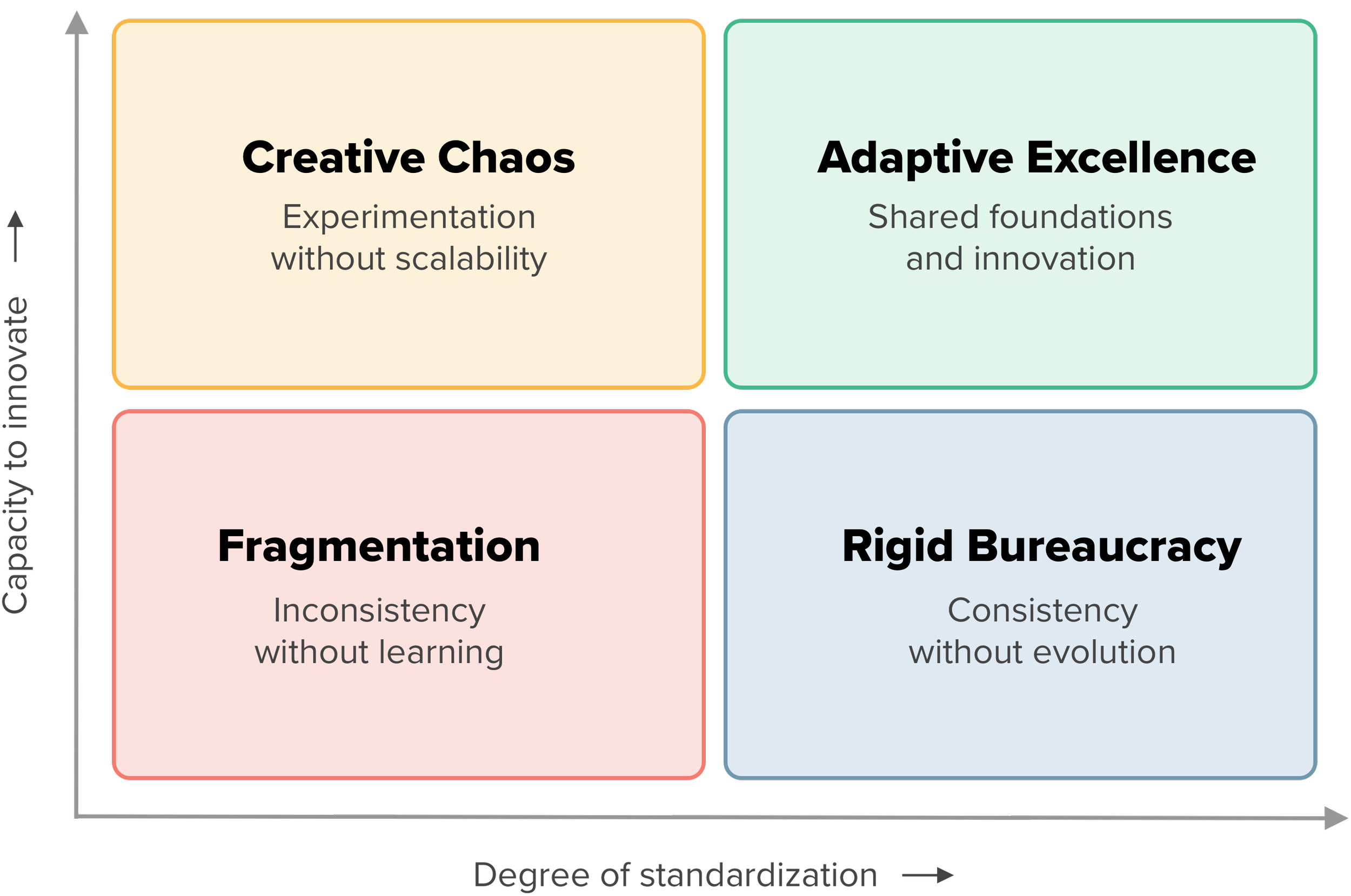
Fragmentation: Low consistency, low innovation. Different teams approach the same problems in different ways, but relatively little of that variation produces meaningful organizational learning. Employees expend energy navigating inconsistent expectations, work is repeatedly reinvented, and improvements remain difficult to scale. The firm may contain many capable individuals without consistently benefiting from their collective expertise.
Creative chaos: Low consistency, high innovation. Employees have substantial freedom to experiment, and promising ideas emerge throughout the organization. This can be an exciting environment, particularly for creative professionals. But without a shared foundation and mechanisms for spreading what works, successful innovations may remain isolated within particular projects, teams, or offices. The organization generates new knowledge without fully capturing its value.
Rigid bureaucracy: High consistency, low innovation. The firm has developed dependable processes that support coordination and predictable execution. These capabilities may have helped it achieve considerable success, but the organization is unwilling to reconsider established practices even when the world around them changes. Employees learn how to follow the system without the freedom or incentive to improve it. Over time, the firm's documented practices grow increasingly out of date.
Adaptive excellence: High consistency, high innovation. The organization has established a strong foundation of shared principles and practices, making it easier to coordinate work, teach employees, and maintain quality. At the same time, people are encouraged to identify improvements, challenge assumptions, and experiment with better approaches. When those improvements prove valuable, the firm has mechanisms for incorporating them into its shared knowledge so others can benefit.
The fourth quadrant is the aspiration.
What's interesting about this framework is that consistency and innovation are independent capabilities. A firm can be strong at one and weak at the other, and success in either dimension doesn't guarantee success in both. Each requires attention, leadership, and investment.
But they can also reinforce each other. A dependable foundation of shared practices makes it easier for employees to coordinate their work, build on the firm's accumulated expertise, and devote more attention to unfamiliar challenges. And when the organization has effective ways to evaluate improvements and incorporate them into its shared practices, innovation makes that foundation stronger.
This is how the apparent trade-off begins to disappear. The most adaptable AEC firms don't necessarily have the fewest standards. They have standards that make it easier for their people to do excellent work today while continually improving how that work gets done.
So, What Should We Standardize?
If consistency and innovation can reinforce each other, how do we create the conditions that make that possible?
One of the most important decisions is determining what actually needs to be standardized. In an industry built around professional judgment, creativity, and solving unfamiliar problems, that question deserves careful consideration. Some aspects of our work benefit enormously from a common approach, while others are better served by giving experienced professionals the freedom to determine how best to achieve the desired result.
Through conversations with AEC leaders on the Smarter by Design podcast, at KA Connect, and in my work with firms across the industry, I've developed four guiding principles that help me think about how organizations can establish greater consistency while preserving, and even expanding, their capacity to innovate.
Standardize the Floor, Not the Ceiling
One way to think about shared practices is as the operating system of a firm. A well designed operating system provides reliable services that thousands of different applications can build upon. Software developers don't have to reinvent how a computer manages its keyboard, display, storage, or network connections every time they create something new. They can concentrate on developing applications that solve new problems because the underlying infrastructure is dependable.
AEC firms can benefit from a similar approach. Shared project management practices, quality expectations, coordination standards, and access to institutional knowledge provide a common foundation for the work. Project teams can rely on that foundation while bringing their creativity, experience, and professional judgment to the distinctive challenges of each assignment.
The objective is to standardize the floor, not the ceiling. Establish the non-negotiable shared practices that everyone can and should depend on, while preserving the freedom to exercise professional judgment, experiment, innovate, and discover better ways of working. And because even the firm's foundational practices will sometimes need to evolve, they should be continually evaluated and improved as the organization learns.
Write Principles in Pen and Methods in Pencil
Michael Leckman, Principal at Diamond Schmitt Architects, shared a complementary perspective when we spoke about how his firm has navigated decades of change. Over the course of his career, Michael has seen architecture evolve from hand drawing through successive generations of digital design technology, including CAD, Rhino, Revit, and now AI. Alongside those technological changes, Diamond Schmitt has adapted to economic disruptions, changing client expectations, and the demands of a growing organization, repeatedly reconsidering its internal systems, management practices, and approaches to professional development.
Michael described the philosophy that has guided those transitions as: “We rely on working from first principles.”
I find that perspective especially useful when thinking about what firms should standardize. For an AEC firm, first principles might include commitments to design excellence, professional responsibility, client service, collaboration, or protecting the health, safety, and welfare of the public. These are the enduring expectations that define what the firm stands for and what excellent work should accomplish. The technologies, processes, and methods used to fulfill those commitments may change considerably over time, but the underlying principles provide continuity and direction.
This suggests a useful approach: write the principles in pen and the methods in pencil.
Match the Level of Standardization to the Pace of Change
Of course, the distinction isn't absolute. Some methods need to be followed consistently because of professional obligations, safety requirements, regulatory standards, or the coordination needs of the organization. A firm shouldn't encourage experimentation with a required quality review simply because someone prefers a different approach. But in many areas, leaders can be more intentional about distinguishing the outcome they want from the particular method used to achieve it.
The pen-and-pencil metaphor describes two ends of a spectrum. In practice, most firms operate somewhere in between, with different expectations for how firmly a standard should be established and how frequently it should be reconsidered. I find it helpful to think about this in three layers, each with a different expected pace of change.
Layer 1 — Principles, values, and outcomes: What matters most. These establish what the firm stands for, the results it's trying to achieve, and the expectations that should remain consistent across the organization. They include the firm's core values, commitments to clients and colleagues, principles of professional practice, and the cultural expectations that shape how people work together. Together, they provide a durable foundation for professional judgment and organizational decision making in a rapidly changing environment.
Layer 2 — Shared practices and quality criteria: What we currently believe works best. These capture approaches the firm has found effective through experience. They might include project management processes, quality assurance practices, drawing and modeling conventions, or methods for coordinating disciplines. They should be consistent enough to provide a reliable foundation for quality and collaboration, but flexible enough to evolve as the firm discovers better ways of working.
Layer 3 — Methods and tools: How we carry out the work. These include the specific technologies, workflows, and techniques professionals use. In some circumstances, consistency is essential for safety, coordination, or efficiency. In others, employees should have considerable latitude to experiment and discover better approaches.
The goal is to become more deliberate about the appropriate level of prescription. A firm can establish clear expectations for identifying and communicating project risks without necessarily dictating every detail of a project manager's personal workflow. It can articulate what excellent design quality looks like without prescribing the creative process that leads to an exceptional solution.
Treat Standards as Current Best-Known Practices
One of the people who has most influenced my thinking about knowledge management is Carla O'Dell, a leading thinker in the field and former CEO and current Chair of APQC.
Carla introduced me to the concept of current best-known practices, a phrase I've returned to many times over the years.
I love this formulation because each word matters. It acknowledges that a firm should establish shared expectations based on what it knows works today, while recognizing that it will continue to learn. A current best-known practice is neither an optional suggestion nor an immutable rule. It's the organization's present understanding of the best way to approach a particular kind of work.
This creates a different relationship between standardization and innovation. Employees benefit from the firm's accumulated experience without having to rediscover it themselves, while remaining encouraged to identify better approaches. As the organization learns, its shared practices evolve, allowing each improvement to become part of the foundation upon which future work is built.
Did the Firm Learn?
Let's return to one of the challenges we started with: how does an AEC firm maintain the quality of its work as it grows?
For much of our industry's history, the answer has depended heavily on the experience and judgment of senior professionals, supported by the informal learning that happens through collaboration and apprenticeship. Those relationships remain essential. The opportunity isn't to replace them, but to build on them by making more of the firm's accumulated knowledge available to everyone in the flow of work.
Throughout this essay, we've explored how defining and sharing the firm's best practices can help it deliver more consistent quality, accelerate learning, scale expertise, and make better use of AI. But I think there's an even more consequential opportunity.
Every day, professionals across our industry are learning through their project work. They discover better ways to manage projects, coordinate teams, solve design problems, and serve clients. And yet, much of that learning remains with the individuals and teams who experienced it.
A project can be successful. The client can be delighted. The team can come away with valuable new experience. But did the firm learn?
In an era of continuous change, firms can't afford to learn only one project at a time. They need ways to turn individual discoveries into shared organizational capabilities, so that an improvement made on one project can benefit dozens or hundreds of projects that follow.
This is where the real work of becoming a Modern Learning Organization begins.
Defining what good looks like gives the firm a shared foundation, but that knowledge must become part of how people work and learn. It needs to be accessible when employees encounter unfamiliar challenges, embedded in the learning experiences that help them develop new capabilities, and available to the AI systems that increasingly support their work. Just as importantly, the organization needs ways to recognize when its current best-known practices can be improved, evaluate new approaches, and incorporate what it learns into that shared foundation.
This doesn't happen by accident. It requires intentional investment in the people, practices, and infrastructure that connect individual learning to organizational improvement. Knowledge and learning leaders have an essential role to play, working alongside practice leaders and subject matter experts to make the firm's collective expertise easier to find, apply, teach, and improve.
I've come to believe that knowledge infrastructure is change infrastructure. The same foundation of shared knowledge that helps a new project manager learn the firm's approach can guide an experienced professional through an unfamiliar situation, inform an AI agent, and capture an improvement that makes the next project better. When those capabilities are thoughtfully connected, they become something greater than a collection of documents, courses, and technologies. They become part of how the organization learns, improves, and adapts to change.
And that learning can compound.
An improvement made on one project can influence work throughout the firm. A lesson learned in one office can inform decisions in another. Each new colleague brings experience that can enrich the organization's collective understanding. And as the firm continues to learn, its current best-known practices become better reflections of what excellent work looks like.
This is the opportunity I hope more AEC leaders will recognize. We already have extraordinarily talented people learning through their work every day. By becoming more intentional about how we capture, share, and improve what they learn, we can build organizations in which consistency and innovation reinforce each other, and the benefits of each new discovery extend far beyond the individuals who made it.
The pace of change isn't going to slow down. But Modern Learning Organizations are built to thrive in a rapidly changing environment. We can build firms that continuously improve their shared understanding of what good looks like, translate that understanding into everyday practice, and build on it as new opportunities and challenges emerge.
In other words, we can become smarter. By design.