
All AEC firms are learning organizations.
They have to be. From the moment a new firm takes on its first project, it begins a process of continuous learning. Learning how to deliver work, how to collaborate across disciplines, how to listen to clients, how to navigate permitting authorities, and how to translate ideas into drawings and built form. With each successive project that learning deepens and expands, shaped by new challenges, new contexts, and new people.
As firms grow, so does the scope of what they must learn. They learn how to recruit and onboard talent, how to develop people into capable and confident contributors, how to expand into new markets and take on unfamiliar project types, how to adopt and integrate new technologies, and how to navigate the broader cycles of the industry—periods of rapid growth as well as moments of contraction and uncertainty. Over time, many firms also learn how to transition leadership across generations, preserving what matters while adapting to what’s next.
In this sense, if a firm has endured—if it has grown, evolved, and remained relevant over time—it has done so by learning, continuously, and across every part of the organization.
And yet, while learning is ever-present, it is not always intentionally designed.
In many firms, learning emerges organically from the work itself. It is embedded in projects, carried through conversations, shaped by mentorship, and accumulated through experience. It is often rich and valuable, but also uneven—varying from team to team, from project to project, and from one moment in time to the next. It is deeply human, but not always structured in a way that allows the firm to scale with consistency.
For a long time, this has been sufficient. In fact, it has been the foundation of how the AEC industry has developed expertise for generations.
But the context in which firms operate is changing. The pace of work is accelerating. The complexity of projects is increasing while the timelines and budgets are shrinking. The demands on teams are growing as experienced professionals are stretched across more responsibilities, and we’re asking emerging professionals to take on more advanced tasks earlier in their careers than ever before. At the same time, new technologies, particularly those related to AI, are beginning to reshape how knowledge can be captured, accessed, and applied.
In this environment, the difference between firms is no longer simply what they know. It is how effectively they are able to learn, adapt, and apply that knowledge over time.
Over the past year, working closely with firms adopting Synthesis LMS and AI-powered search, I’ve started to notice a shift. The organizations that seem to be gaining the most traction are not just implementing new tools; they are becoming more intentional about how learning happens within their firms. They are stepping back and beginning to redesign the organization itself—how knowledge is created, how it is shared, how people develop skills, and how all of that connects to the work they do every day.
I’ve come to think of this shift as a movement from what we might call a traditional learning organization to a modern learning organization—one that is not defined by any single program or platform, but by a more deliberate and integrated approach to building and sustaining collective intelligence.
To better understand this change, I created a maturity model—one that reflects how learning capabilities tend to develop over time within AEC firms. This model begins with the foundational ways people learn through experience and interaction, and extends through more structured, scalable, and technology-enabled approaches, culminating in the emerging potential of AI-powered, just-in-time learning in the flow of work.
In the sections that follow, I’ll walk through that progression as a seven-level maturity model for AEC firms. Along the way, we’ll explore what each level looks like in practice, where it creates value, where it begins to show its limits, and how firms move from one stage to the next. We’ll also look at what fundamentally changes as organizations become more intentional in how they learn—and why the ability to learn well may become one of the defining characteristics of the most successful firms in the years ahead.
Here we go.
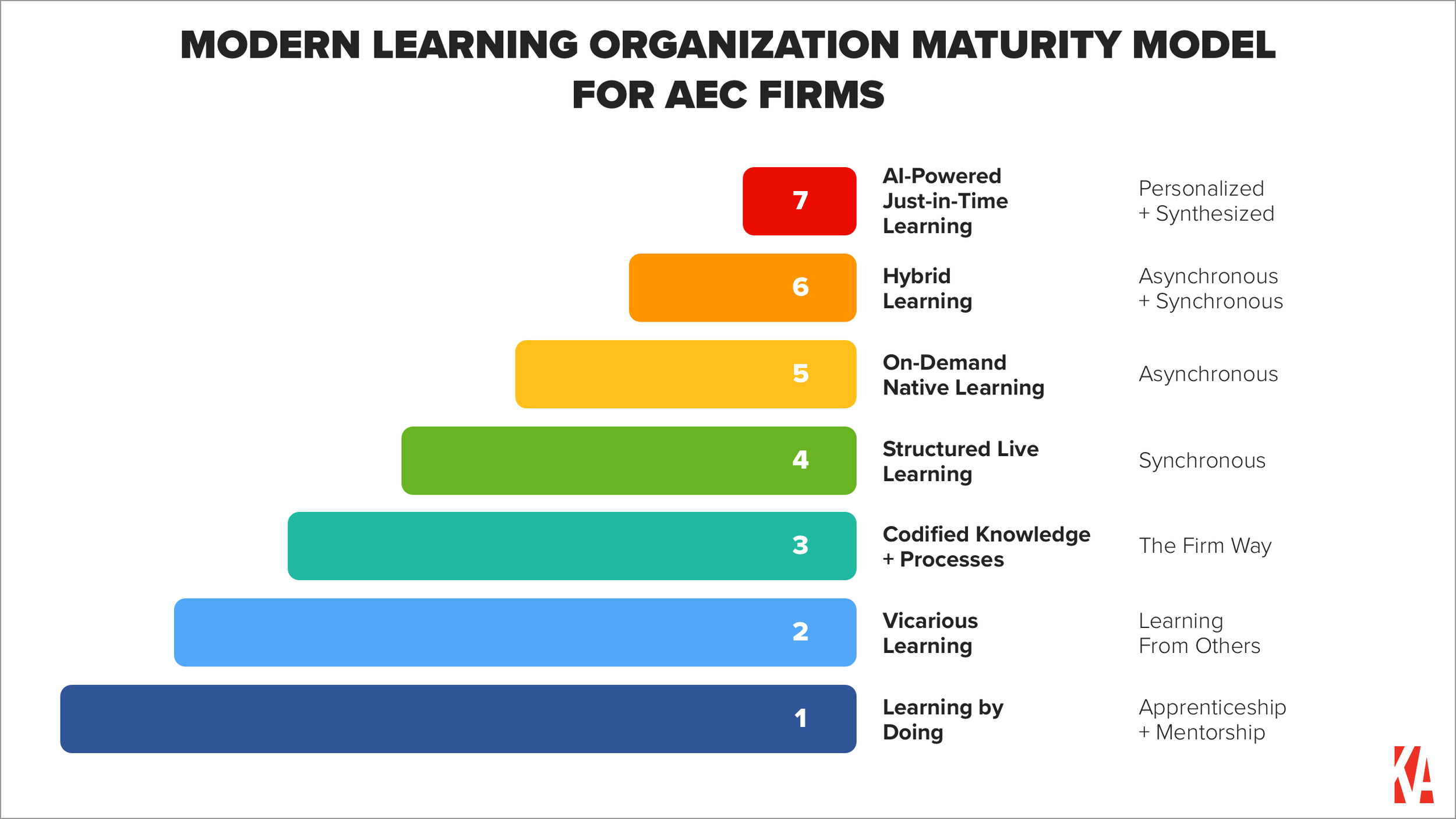
Level 1 — Learning by Doing
The foundation of every AEC firm is learning by doing.
People learn through direct experience. By working on projects, practicing skills, making mistakes, and having someone there to catch them when they fall. Over time, with the support of more experienced practitioners, they begin to develop not just competence, but confidence. They are mentored, guided, and challenged in the context of real work, and through that process, they gradually improve.
This is the apprenticeship model. But it is not simply a legacy of how the industry used to operate. It remains foundational today, even in the most advanced, technology-enabled learning organizations. No matter how sophisticated our systems become, learning by doing is still the base layer, because at some point, learning has to become action.
There is a French expression—mettre la main à la pâte—which translates to “putting your hands in the dough.” It captures something essential about how we learn. You can watch videos, read recipes, take a class, or study the theory of how to bake bread. All of those things can accelerate your understanding. They can give you structure, vocabulary, and a sense of what good looks like. But they are not, in themselves, sufficient.
At some point, you have to bake the bread. You have to put your hands in the dough, feel the texture, adjust as you go, and learn through the act of doing. You have to try, fail, and try again.
The same is true in our industry. You learn to become an architect by designing, an engineer by engineering, and a project manager by managing projects. You learn by working through real constraints, responding to real clients, and navigating real consequences. You can study best practices, attend training programs, and increasingly rely on on-demand content or AI-powered answers to guide you in the moment. These tools are valuable, and they will continue to improve. But they do not replace the experience of applying knowledge in practice.
This is what makes learning by doing so powerful. It is contextual, applied, and deeply human. It is where knowledge becomes capability, and where capability begins to evolve into judgment.
Level 2 — Vicarious Learning
As firms grow beyond a single team or a single project, a second layer of learning begins to emerge—learning that happens not just through direct experience, but through exposure to the experiences of others.
This is vicarious learning.
Instead of learning only from the project you are working on, you begin to learn from projects you are not part of. You hear how another team approached a design challenge, how a project unfolded in construction, or how a client issue was resolved. You start to build awareness of patterns, possibilities, and pitfalls beyond your immediate context.
In practice, this shows up in many familiar ways.
It can be as simple as a design crit or a pinup, where work is shared and discussed in an open setting. It can take the form of site tours, where teams walk through completed or in-progress projects and reflect on what worked and what didn’t. It often includes lessons learned sessions, lunch and learns, and informal “tips and tricks” presentations from project teams who want to share something they’ve discovered.
As firms continue to grow, these interactions expand. Communities of practice begin to form around disciplines, market sectors, or areas of specialization. Guest speakers are brought in to introduce new ideas, materials, or approaches. Conversations extend beyond individual teams, connecting people who might not otherwise work together.
In more recent years, the channels for these conversations have broadened as well. What once happened primarily in person now also takes place across platforms like Microsoft Teams, Slack, and within intranets like Synthesis, where questions can be asked, answered, and discussed across the firm.
Many of these sessions are also recorded and made available after the fact, extending their reach beyond the moment in which they occurred. A conversation that once lived only in a room can now be revisited, shared, and experienced by others who were not there when it first happened.
Over time, this has created a kind of ambient learning environment—an ongoing stream of ideas, questions, and experiences moving through the firm.
Vicarious learning expands awareness. It exposes people to ideas they might not encounter in their day-to-day work. It creates connections between individuals and teams, and it helps shape a culture where sharing is expected and where it is acceptable—even encouraged—to talk openly about both successes and failures.
In many firms, this layer represents a significant portion of learning and development activity. It is often one of the most visible and most energizing aspects of a firm’s learning culture—an enrichment layer that brings people together and helps them feel connected to the broader work of the organization.
What makes this layer so effective is also what makes it relatively easy to sustain. It does not require heavy coordination or formal design. People are typically sharing from their own experience by walking through a recent project, a lesson learned, or an approach they’ve developed. In many cases, they are building on work they have already done, whether for a client, a presentation, or an internal discussion. The barrier to contribution is low, and that makes participation feel natural rather than forced.
At the same time, this ease comes at a cost. These experiences are rarely designed around a specific individual at a specific moment in their development. They are not tightly aligned to a defined curriculum or a set of business objectives. Instead, they tend to take on a more ad hoc, broadcast-like quality—open to anyone who is interested, available when they happen, and shaped by what people are working on and willing to share.
This is part of what gives vicarious learning its energy. It is responsive, timely, and often driven by genuine curiosity. It allows ideas to circulate quickly and creates space for unexpected connections. But it also means that the impact can be uneven.
Even so, this layer plays an essential role. It broadens the field of vision within the firm and creates the conditions for knowledge to move more freely across teams, disciplines, and projects.
Level 3 — Codified Knowledge + Processes
As teams begin sharing their experiences across projects, firms begin to take a step back and ask a different kind of question: what domains of our knowledge and which core processes are important enough to codify?
This is where a firm begins to invest in making its best thinking more durable and actionable.
Rather than relying on passing along knowledge socially—through whatever someone happens to share at a given moment—the firm begins to intentionally capture and define how it works. The organization begins to articulate, in a more consistent way, what good looks like across its projects, its teams, and its areas of expertise.
Codifying knowledge and processes is how a firm begins to say, in a more concrete way, “this is how we do things here,” or “this is the firm way.”
That idea can take many forms. It might show up as standards, best practices, standard operating procedures, or playbooks. Some of these assets describe what good looks like. Others go further, outlining the steps, decisions, and workflows that guide how work is actually performed.
What is happening, fundamentally, is a shift from tacit knowledge to explicit knowledge. Knowledge that once lived in the heads of experienced practitioners, or within small groups who had worked closely together, is brought into the open.
Teams come together in committees, working groups, or task forces to reflect on their experience and distill it into something that can be shared more broadly. In some cases, firms invest in more formal approaches to critical knowledge transfer, working to surface the deep expertise of their most experienced and, at times, irreplaceable individuals—those “one and onlys” who know how to navigate a specific project type, solve a particular class of problem, or work with a certain kind of client.
Over time, this effort often extends into building a more coherent understanding of project history as well, allowing teams to draw on past work more deliberately by referencing precedents, learning from prior decisions, and building on what has already been done.
While the tools have evolved, the underlying pattern has a long history. Knowledge has moved from oral tradition to written documentation, from manuals and binders to shared drives and file systems, and eventually into searchable intranets and more integrated knowledge platforms. Each step has made it easier to document, maintain, and access what the firm knows.
But what defines Level 3 is not the format of the content. It is the intention behind it.
The firm is no longer relying on knowledge to circulate organically. It is making a deliberate investment in identifying, capturing, and maintaining the knowledge and processes that matter most and creating a shared understanding that can be accessed and applied across the organization.
Level 4 — Structured Live Learning
Once a firm has taken the time to codify its knowledge—once it has begun to define “how we do things here”—it becomes possible to teach that knowledge in a more structured and intentional way.
This is the shift to structured live learning.
If Level 3 is about defining the firm’s approach, Level 4 is about systematically delivering it to others. Instead of relying on the serendipity of whatever projects, mentors, and vicarious learning moments someone happens to encounter, the firm begins to create dedicated learning experiences designed to help people build specific skills at key moments in their development.
In practical terms, this often takes the form of project management bootcamps, technical training sessions, or introductory courses into new areas of work—healthcare 101, construction administration fundamentals, or training on how the firm uses tools like Revit. It can include leadership development programs, structured workshops, and cohort-based experiences where groups of people move through a shared learning journey together.
What makes this different from earlier levels is the intent.
In Levels 1 and 2, learning is largely shaped by circumstance—by the projects you happen to work on, the people you happen to learn from, and the conversations you happen to be part of. Over time, that can lead to uneven outcomes. Two individuals in the same role may learn very different versions of how to approach the work, depending on who was leading their project.
Structured live learning helps to address this inconsistency.
By drawing on the codified knowledge and processes developed in Level 3, organizations can more deliberately and consistently introduce people to the way the firm operates. When someone steps into a new role—becoming a project manager, entering a new market sector, or taking on a new type of responsibility—the firm can provide a more intentional learning experience to support that transition.
Even when learners are not able to immediately apply what they’ve learned on real projects, these experiences create awareness. They begin to understand that there is a standard way the firm approaches a given problem—whether it’s project scheduling, budgeting, coordination, or documentation—and that they are not expected to invent that approach from scratch.
Over time, this helps orient people within the organization. They learn not only how things are done, but where that knowledge lives. When they encounter a situation later—often under real project pressure—they have a reference point to return to. The learning may not fully stick in the moment, but it establishes a foundation that can be revisited and applied when it becomes relevant.
This creates a powerful mechanism for scaling quality and consistency across the organization, reinforcing “the firm way.”
Structured live learning offers something uniquely human that is difficult to replicate in other formats. These are often high-fidelity, synchronous learning experiences, where people engage directly with instructors and with one another. In longer or more immersive programs, participants may work through real scenarios, discuss their own experiences, and learn from the perspectives of their peers. There is space for conversation, for vulnerability, and for building trust. Over time, these experiences can strengthen not only individual capability, but also relationships across the firm, contributing to a sense of shared understanding and psychological safety.
At the same time, these experiences are typically designed for live participation. They are often cohort-based and built around a specific moment in time. While they are sometimes recorded and made available afterward, those recordings do not always fully capture the value of the original experience. The energy of the room, the interaction between participants, and the flow of discussion are difficult to reproduce when watching after the fact.
Even so, this level represents an important step forward. It allows firms to move from hoping that people serendipitously learn the right things to intentionally designing experiences that help them do so—bringing greater clarity, consistency, and support to how knowledge is developed across the organization.
From Traditional to Modern Learning Organizations
Taken together, these first four levels describe how most AEC firms have traditionally developed expertise over time.
That said, it is time to level up as learning organizations.
The traditional model works, but it is too slow, too inconsistent, too time consuming, and relies too heavily on serendipity to meet today’s challenges. It assumes that people will encounter the right projects, the right mentors, and the right learning moments at the right points in their development.
At the same time, expectations around how people access and apply knowledge have shifted. Outside of work, we are accustomed to being able to find what we need, when we need it, and to revisit it as often as necessary. That expectation does not disappear inside the firm.
Under these conditions, the limitations of the traditional model begin to surface more clearly.
The apprenticeship model remains essential, but it is difficult to scale and increasingly places too heavy a burden on experienced practitioners to develop the next generation through project work alone.
Vicarious learning continues to create valuable moments of awareness, connection, and shared experience across the firm, but much of that value remains tied to when and where those moments happen.
Codified knowledge and processes provides a durable and comprehensive foundation, but are often captured in formats that can be difficult to navigate in the moment of need—buried in long documents, manuals, or knowledge bases that require time and effort to locate, interpret, and apply effectively.
Structured learning programs provide depth and consistency, but are often scheduled via a limited number of sessions, which can make them unavailable at the moment they are needed most.
Across all four levels of the traditional learning organization, there is a common pattern: a great deal of valuable knowledge is being created and shared, but not always fully leveraged. Insights are captured in conversations, presentations, documents, and recorded sessions, but often remain underutilized—difficult to revisit, hard to navigate, or disconnected from the flow of day-to-day work.
So at this point, it has become clear: we’re going to need a bigger boat.
This is where the modern learning organization comes in.
Level 5 — On-Demand Native Learning
On-demand learning is not new. Firms have been recording presentations, training sessions, and internal knowledge-sharing events for years, with the hope that people could revisit them later if they missed something or needed a reference.
But in practice, those recordings of live events have rarely lived up to that promise.
Much of this content was not designed to be consumed on demand. It was designed to be experienced live. As a result, the recorded versions often feel like a second-class experience—long, uneven, and difficult to navigate. A one-hour session remains an hour long because that’s how meetings are scheduled, not because that’s how people learn. Introductions run long, discussions drift, questions become highly specific, and the core insight is often buried somewhere in the middle of the video.
Level 5 represents a shift in how some learning experiences are designed from the start.
Instead of recording live sessions and hoping they will be useful later, firms begin to create learning experiences that are natively on demand. They are built with the expectation that someone will access them asynchronously and independently, often in the flow of work, and often with a very specific need in mind.
This changes the design.
Content becomes more concise. A sixty-minute session is broken into shorter, focused segments. A topic is divided into lessons that can be accessed individually. Instead of asking someone to sit through an entire presentation, the goal is to make it easy to find and engage with exactly what they need.
In many cases, this leads to shorter, more targeted learning assets—five, ten, or fifteen-minute lessons that focus on a specific concept, task, or workflow. More complex topics can still be explored in depth, but are structured in a way that allows learners to move through them in manageable increments, revisiting specific sections as needed.
This allows learning to be right-sized to the problem.
Some topics are best introduced at a high level—what something is, how it works, when it matters. Others benefit from deeper explanation or step-by-step walkthroughs. Not everything needs to be delivered in the same format, and not everything needs to be delivered all at once.
On-demand native learning also changes the experience for the learner.
It allows people to move at their own pace. They can pause, rewind, and revisit material as needed. They can engage (and reengage) with content when it becomes relevant, rather than trying to retain everything in advance. In that sense, it aligns more closely with how people naturally learn—especially when they are trying to apply knowledge in real situations.
At the same time, on-demand native learning can improve the experience for subject matter experts. Instead of delivering the same material repeatedly in live sessions—particularly in areas like onboarding or foundational training—experts can invest the time to create something well-structured and reusable, increasingly by partnering with knowledge and learning management teams. Over time, this reduces repetition and allows experts to focus their energy on solving complex project issues, mentorship, and research instead of teaching the same material over and over again.
This approach also introduces more flexibility in how learning is designed. Not everything needs to be video. Text, examples, exercises, and reference materials can all be incorporated, allowing learners to engage with the content in different ways depending on the need.
As a result, learning becomes more accessible, more scalable, and more aligned with the realities of day-to-day work.
And perhaps most importantly, it becomes easier to connect learning back to practice. A project leader can point someone to a specific lesson or course before they take on a new task—reviewing site safety before a visit, or learning how to approach a door schedule before creating one—allowing the learning to happen closer to the moment it is applied.
In this way, on-demand native learning does not replace earlier levels. It builds on them. It makes the knowledge that has been shared, codified, and taught more accessible and more usable—both for the individual and for the firm as a whole.
Level 6 — Hybrid Learning
Hybrid learning blends the strengths of both live learning and on-demand learning, using asynchronous, on-demand content to deliver foundational knowledge, and reserving live, synchronous sessions for discussion, application, reflection, and practice.
In this model, the fundamentals are no longer delivered live by default. Instead, they are made available in on-demand formats that learners can engage with at their own pace—both before and after a live session. The live experience then builds on that foundation, creating space for deeper exploration, shared problem-solving, and connection between participants.
This changes the role of live learning.
Rather than trying to do everything—introducing concepts, delivering content, answering questions, and facilitating discussion in a single session—live instruction becomes more focused and more valuable. It is used to explore nuance, work through real project scenarios, and engage directly with the specific questions and experiences of the group.
In this way, each format is allowed to do what it does best via hybrid learning experiences.
On-demand learning provides consistency, accessibility, and the ability to revisit foundational material at any time. Live learning provides energy, connection, interaction, and the opportunity to learn through conversation and shared experience. Together, they create a more complete and more effective learning modality.
This approach also improves the experience for subject matter experts.
Instead of repeating the same foundational content in session after session, subject matter experts can invest in creating a clear and well-structured on-demand version of that material once, and then use live sessions to engage more deeply with learners.
Over time, this tends to be more energizing. Experts are able to focus on the parts of teaching that are most engaging: answering questions, exploring edge cases, and helping people apply what they’ve learned in real situations. Less lecture, more connection.
Hybrid learning also creates new efficiencies for the organization. Once foundational material is captured in a high-quality, on-demand native format, it can be reused across cohorts, referenced in the flow of work, and accessed without requiring a scheduled session. Live instruction can then be used more selectively, where it adds the most value.
Not every learning experience needs to be hybrid. Some—particularly those focused on leadership, culture, or relationship-building—may remain fully live and synchronous by design. But for a large portion of the firm’s core curriculum, hybrid learning offers a more scalable and effective model.
In practice, this shift is already underway for firms running Synthesis LMS. Many of the programs that were once delivered entirely through live sessions are being restructured—partially shifting foundational content into on-demand formats, and redesigning live time around interaction and application.
For a deeper look at how AEC firms are designing hybrid learning experiences, the conversation with Laura Knauss and Kristina Williams from Lionakis in Episode 6 of the offers a compelling example.
Converting learning experiences to a modern hybrid format makes them more intentional, more flexible, and more aligned with the realities of how people learn and work today.
Level 7 — AI-Powered Just-in-Time Learning
In earlier levels of the modern learning organization maturity model, firms invest heavily in creating, capturing, and organizing knowledge through experience, conversation, documentation, and structured learning.
But accessing that knowledge still requires effort. You have to know where to look, how to search, and how to interpret what you find. Even when you locate the right asset—a document, a video, or a course—you often have to work through it sequentially, reading, watching, or progressing from beginning to end in order to extract what you need.
Level 7 changes that dynamic.
With AI, it is now possible to retrieve and synthesize knowledge (in real time) in response to a specific question or need. Instead of navigating individual assets, knowledge can be dynamically assembled from many sources—documents, videos, courses, and conversations—into a response that is tailored to the problem at hand.
This is made possible, in part, by a significant improvement in video transcription technology. AI-powered transcription has become accurate enough that recorded video—a lunch and learn, a course, a lessons learned session—now carries a full, searchable text layer, making it as findable and usable as any written document. The medium is no longer a barrier to retrieval.
This enables a shift from searching for knowledge to receiving it.
Synthesis AI Search and Knowledge Agents make this possible by grounding responses in the firm’s own content and providing citations back to the underlying sources. This allows individuals not only to get an immediate answer, but also to verify that answer, explore the original context, and go deeper when needed.
In practice, this means that knowledge can be delivered in the flow of work, at the moment it is needed. Someone can ask a question and receive a personalized, synthesized response that integrates the firm’s accumulated experience—drawing on standards, past projects, training materials, and shared insights—without having to piece it together manually.
Learning becomes more immediate, more contextual, and more responsive to the specific challenges people are facing. In some cases, the AI-generated answer meets the learner’s immediate need. In others, it opens up a deeper line of inquiry, pointing back to the underlying materials and contributing experts for further exploration.
Importantly, AI-powered just-in-time learning depends entirely on the foundation built in the earlier levels.
The quality of AI-powered learning is directly tied to the quality of the underlying conversations, knowledge, processes, and courses developed in Levels 1 through 6. Without that foundation, the outputs are limited. With it, the system becomes significantly more powerful.
Level 7 does not replace the earlier levels. It amplifies them.
AI helps make the knowledge that has been created across the organization more accessible, more connected, and more usable by delivering the right knowledge to the right person at the right time.
That said, none of this replaces the need to learn by doing.
As we explored in Level 1, you still have to put your hands in the dough. You still have to bake the bread.
AI can accelerate understanding and help people get to better answers more quickly, but mastery still comes from applying that knowledge in real situations by making decisions, encountering edge cases, and learning through experience.
What Level 7 changes is not the need to do the work, but how prepared people are when they do and how well supported they are as they’re doing it.
What Changes in a Level 7 Modern Learning Organization
Reaching Level 7 does not replace the earlier stages of the model. It changes how they operate.
The introduction of AI-powered, just-in-time learning reshapes each layer—amplifying its strengths, reducing its limitations, and connecting it more tightly to the flow of work.
Level 1 — Apprenticeship Becomes More Focused and Consistent
At Level 7, the apprenticeship model is not diminished. It is elevated.
Rather than carrying the full burden of foundational knowledge transfer, apprenticeship becomes more focused on what it does best: application, judgment, and context. Learners arrive better prepared, having engaged with foundational material in advance. They are able to ask more informed questions, and mentors are able to spend less time on basics and more time on interpretation, nuance, and real project decisions.
In this way, one-on-one mentorship becomes more valuable, not less. It shifts from explaining how things work, to exploring how they should be applied.
As firms invest in defining “the firm way” through standards, guides, courses, and other shared resources—project leaders are no longer left to teach from memory alone.
In many firms, inconsistency in apprenticeship is the result of a lack of shared tools. Project leaders do not set out to teach different approaches—they do so because they don’t always have clear, accessible ways to show what “right” looks like.
When those resources exist, they are used. Leaders point team members to a course, a guide, or an example. They anchor their teaching in something shared. And as a result, apprenticeship becomes not only more focused, but more consistent—reinforcing a common standard across projects rather than reinventing it each time.
Level 2 — Vicarious Learning Becomes Searchable
At earlier levels, vicarious learning experiences—presentations, design critiques, and lessons learned—shape awareness and culture across the firm.
At Level 7, the knowledge shared in vicarious learning experiences becomes accessible via search.
Recorded sessions, once underleveraged because they were difficult to search, become part of a modern learning organization’s searchable and discoverable body of knowledge. Insights shared in a project review or a lunch and learn are no longer tied to the moment in which they occurred. They can be revisited, surfaced, and connected to new problems as they arise through AI search and knowledge agents.
What was once ephemeral becomes durable and usable.
Level 3 — Codified Knowledge and Processes Become a Living System
Codified knowledge and processes have always been foundational, but at Level 7 their importance becomes even more pronounced.
AI exposes the strengths and weaknesses of a firm’s digital knowledge foundation through daily use.
Gaps, inconsistencies, duplication, and outdated content become more visible when surfaced through AI interactions. At the same time, user behavior—what people search for, what they struggle to find, what they question—creates a feedback loop that helps prioritize what needs to be improved.
This dynamic extends beyond content. As firms begin to introduce AI into the flow of work, they are also forced to re-examine the processes that guide how work gets done.
In many cases, those processes are less defined than commonly assumed. Steps are implied rather than articulated. Decisions rely on experience rather than explicit criteria. Entire workflows may still live as tacit knowledge, understood by a few but not fully documented or shared.
As a result, bringing AI into these workflows—through agentic systems such as Synthesis Knowledge Agents—often requires firms to map, clarify, and in some cases re-engineer how their work actually happens.
This creates a second feedback loop, this time at the level of process. Just as AI reveals gaps in knowledge, it also reveals gaps in how that knowledge is applied.
The knowledge base becomes more dynamic. And increasingly, it is structured in ways that make it more usable—by both people and the AI agents designed to support them.
This is happening today with humans firmly in the loop alongside AI—using these systems to guide, accelerate, and support their work. Over time, some of these processes may become more autonomous, but always in service of the people and the organization they support, grounded in codified knowledge.
In this way, AI does not just retrieve knowledge. It helps improve it. And, in parallel, AI helps organizations design more explicit, consistent, and adaptable ways of working.
Level 4 — Live Learning Becomes More Intentional
At Level 7, structured live learning becomes more selective and more purposeful.
Rather than serving as the primary vehicle for delivering foundational knowledge, live sessions are increasingly reserved for experiences that benefit from real-time interaction, discussion, reflection, coaching, and shared exploration.
Some programs, particularly those focused on leadership, culture, and relationship-building, will remain fully live by design. But many others will evolve into hybrid experiences by shifting foundational content into on-demand formats and redesigning live time around engagement and application.
Level 4 live learning does not disappear completely, but becomes more intentional.
Level 5 — On-Demand Learning Becomes Infrastructure
At Level 5, on-demand learning improves the experience for learners. At Level 7, it becomes something more.
It becomes infrastructure.
On-demand content is no longer just a resource for individuals to consume. It becomes part of the firm’s collective intelligence—content that can be searched, retrieved, and synthesized by AI in response to real-time needs.
This creates a new design imperative. Learning content is not only created for people, it is also created in a form that can be understood and utilized by the AI-powered knowledge and learning management platform.
The result is a growing body of structured, reusable knowledge that supports both human learning and AI-powered retrieval.
Level 6 — Hybrid Learning Becomes More Fluid
Hybrid learning already blends on-demand and live formats. At Level 7, that blend becomes more fluid and more responsive.
The on-demand, foundational portion of hybrid courses becomes easier to access, revisit, and connect to real work through AI. It becomes part of a broader knowledge system that can be queried and explored at any time.
This extends the value of hybrid learning beyond the course itself. Learning does not begin and end with a scheduled experience. It becomes something that can be revisited, reinforced, and applied continuously.
Taken together, these shifts point to a broader transformation.
The earlier levels of the model focus on creating and sharing knowledge. At Level 7, the focus expands to making that knowledge accessible, connected, and usable in real time.
How to Apply the Modern Learning Organization Maturity Model
So far, this model has been presented as if a firm progresses through it as a whole.
It is natural, when encountering a framework like this, to ask: where are we? Are we a Level 3 firm? A Level 5? A Level 7?
That can be a useful exercise.
But another useful way to apply this model is to look at it through the lens of domains.
Every firm is made up of multiple domains of knowledge—markets, services, disciplines, roles, and core processes like onboarding. Each of these domains develops at its own pace, shaped by different leaders, different priorities, and different levels of investment.
When viewed this way, the model becomes less linear and more fractal.
You may find that one area of the firm is highly mature. A well-established market like higher education, for example, may have developed strong codified knowledge, standardized processes, robust learning programs, and even elements of hybrid or AI-enabled learning. At the same time, another market—perhaps one that is newer or still evolving—may be operating closer to Level 1 or Level 2, learning through project experience and early knowledge sharing.
The same pattern holds across disciplines and roles. Project management may be a strategic focus and relatively advanced, while domains like sustainability, design technology, or business development are at different stages of maturity. In many firms, onboarding provides one of the clearest windows into how the organization actually learns—revealing both strengths and gaps in how knowledge is introduced and developed.
The result is not a single maturity level for the firm, but a mosaic across domains.
The goal, then, is not to immediately push the entire firm to Level 7 across all domains. That probably wouldn’t even be possible.
The goal is to be intentional about where you deploy your resources, to understand where the firm is strong, where it is vulnerable, and where investment will have the greatest impact.
That might mean strengthening project management to improve delivery and client experience. It might mean investing in specific markets where critical knowledge is at risk of being lost due to retirements. It might mean focusing on onboarding to better support a growing team.
This model becomes most valuable not as a scorecard, but as a tool for prioritization.
It allows firms to take stock of how they learn today, and to make deliberate decisions about where to evolve next. One knowledge domain at a time.
Over time, these investments begin to add up. The overall posture of the learning organization shifts, not through a single transformation, but through a series of focused, intentional improvements across the system.
That is how modern learning organizations are built.
By design.