
Establishing a Firmwide Q+A Program Using Synthesis
In this article you’ll learn…
5 Benefits of a Q+A Program
3 Key Roles in a Q+A Program
9 Steps to Roll Out a Q+A Program at Your Firm
“If you can teach people to help themselves you get an additive effect: they not only help each other; they grow themselves as experts. Essentially, you have little experts pop up left and right and they sort of grow on their own. Over time, you raise people up from basic competency towards expert level.” — Jack Chaffin, LMN Architects.
Four years ago LMN Architects hired Jack Chaffin to lead the firm’s transition from CAD-based MicroStation to Revit. They knew they had an expert to guide the process because he’d led similar transitions twice before. Jack’s expertise met such a critical need that after a short while, Jack found that “help desk issues were taking up an increasingly larger portion of [his] energy; taking focus away from other strategic activities” related to the transition.
When it comes to this problem, LMN is not alone. According to research published by Rob Cross, Reb Rebele, and Adam Grant in HBR, “up to a third of value-added collaborations [in any organization] come from only 3% to 5% of employees.” As a result, often the people who are most in demand (those with the answers) are becoming increasingly over-taxed by the burden of responding to requests for their expertise. The really scary thing is that in most organizations leadership doesn’t even know who their top collaborators are. As many as 50% of an organization’s top collaborators can’t even be identified by the organization.
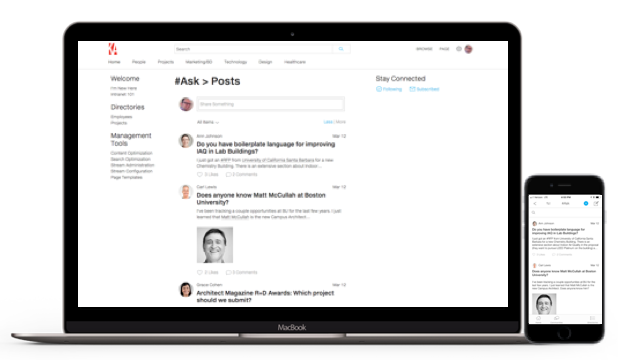
Enter a Q+A program. Increasingly, we’re seeing more and more firms successfully implement formal Q+A programs inside Synthesis to identify and activate subject matter experts. We’ve learned from firms like LMN, brainstormed what this looks like at previous Synthesis Workshops, and shared some successful programs through our Office Hours webinar series. In this article we’re going to share the benefits of a Q+A program along with some of the roles and steps necessary to roll one out in your firm.
In this article you’ll learn…
5 Benefits of a Q+A Program
3 Key Roles in a Q+A Program
9 Steps to Roll Out a Q+A Program at Your Firm
“If you can teach people to help themselves you get an additive effect: they not only help each other; they grow themselves as experts. Essentially, you have little experts pop up left and right and they sort of grow on their own. Over time, you raise people up from basic competency towards expert level.” — Jack Chaffin, LMN Architects.
Four years ago LMN Architects hired Jack Chaffin to lead the firm’s transition from CAD-based MicroStation to Revit. They knew they had an expert to guide the process because he’d led similar transitions twice before. Jack’s expertise met such a critical need that after a short while, Jack found that “help desk issues were taking up an increasingly larger portion of [his] energy; taking focus away from other strategic activities” related to the transition.
When it comes to this problem, LMN is not alone. According to research published by Rob Cross, Reb Rebele, and Adam Grant in HBR, “up to a third of value-added collaborations [in any organization] come from only 3% to 5% of employees.” As a result, often the people who are most in demand (those with the answers) are becoming increasingly over-taxed by the burden of responding to requests for their expertise. The really scary thing is that in most organizations leadership doesn’t even know who their top collaborators are. As many as 50% of an organization’s top collaborators can’t even be identified by the organization.
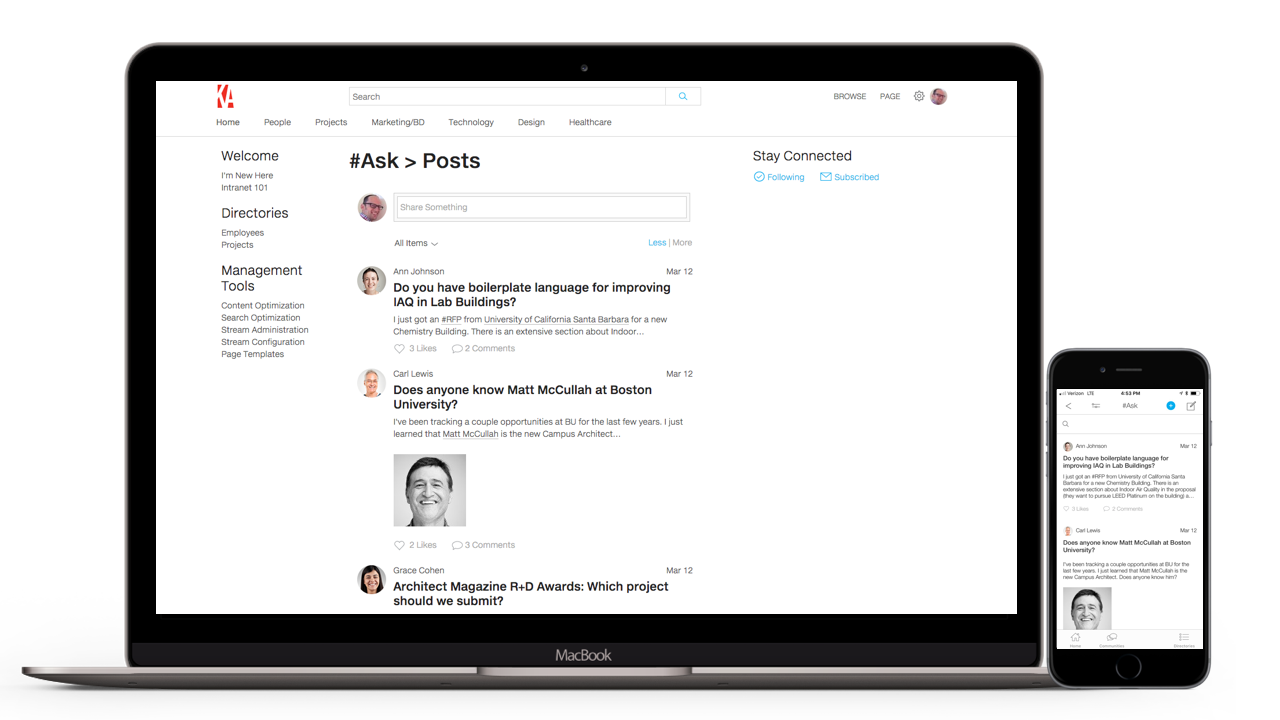
Enter a Q+A program. Increasingly, we’re seeing more and more firms successfully implement formal Q+A programs inside Synthesis to identify and activate subject matter experts. We’ve learned from firms like LMN, brainstormed what this looks like at previous Synthesis Workshops, and shared some successful programs through our Office Hours webinar series. In this article we’re going to share the benefits of a Q+A program along with some of the roles and steps necessary to roll one out in your firm.
5 Benefits of a Q+A Program
We’ve identified 5 business reasons to establish a Q+A program in Synthesis:
1. Questions and answers become more visible to the entire organization.Instead of having a question get answered over and over again dozens of times, it has the potential to be answered once and made visible to everyone.
2. Improve knowledge flow. Improving the flow of knowledge between knowledge seekers and knowledge providers is a fundamental objective of every AEC Knowledge Management Program.
3. Identify latent experts. When employees answer questions online they provide clues about expertise they’ve built which their colleagues may not otherwise be aware of.
4. Better answers. Crowdsourcing improves answers. After all, everyone knows more than anyone. An online Q+A program exposes questions to a broader audience and invites other knowledgeable experts into the conversation.
5. Prevent expert burnout. Reduce information burden on the top collaborators by encouraging any employee with expertise to participate in the Q+A process.
3 Key Roles in a Q+A Program
In our experience, the most successful Q+A Programs establish three pivotal roles within their firm:
1. Intranet Champion. The Intranet Champion is responsible for managing the plan to introduce the Q+A Program, recruiting key players, and dividing up the work. After roll out, the Intranet Champion is responsible for evolving the program’s guidelines and Service Level Agreement (SLA) in response to organizational changes.
2. First Responder. First Responders are both subject matter experts and knowledge brokers. If they don’t know the answer, they usually know who does and will connect the Asker to the appropriate resource. The First Responder(s) are responsible for making sure that the Q+A Program’s SLA is met. They will subscribe to email notifications for new posts to the Question Hashtag so that they’re proactively notified when questions are asked.
3. Asker. Askers are the keystone to every successful Q+A Program. They are responsible for using the program’s guidelines to ask questions in such a way that Answerers (including, but not limited to, First Responders) will be able to assist them as quickly as possible. Through their well-formed questions, Askers are the folks who activate the firm’s knowledge.
9 Steps to Roll Out a Q+A Program at Your Firm
With a little help from the KA Advance community, we’ve identified nine key steps to successfully roll out a Q+A program. Let’s take a look at each one:
1. Identify Topics
The most successful programs start with a tangible topic that’s not too broad nor too narrow. We’ve seen successful Q+A programs built around the following topics:
Professional Practice. Questions about Constructability, Detailing, Materials, Codes, etc.
Design Technology. Questions about software like Revit, Rhino, Grasshopper, Civil3D, ArcGIS, etc.
General Business Operations. Questions about Standards, Policies, Benefits, Go-To People, Vendors, Consultants, etc.
2. Establish Question Hashtag(s)
Many Question Hashtags are formatted as #Ask followed by the subject, or the #Subject followed by the word “Help.” For example, #AskRevit or #RevitHelp.
Many broadly defined or open-ended topics are formatted as #Ask followed by the name of your Intranet or #Ask followed by the name of your company. For example, #AskFinch (where Finch is the Intranet’s name) or #AskShepleyBulfinch (where Shepley Bulfinch is the company’s name).
3. Identify First Responders
After selecting the right topic, the most critical step towards success is selecting the right First Responders.
Referring to the role responsibilities above, look for subject matter experts who have an interest in sharing their experience, growing their knowledge, or facilitating knowledge flow on a particular topic. These experts are generally already unofficial knowledge brokers in your organization and will likely benefit personally and professionally from a more formalized role as a First Responder.
The most successful First Responders are those who care deeply about building organization knowledge in their professional practice area. These First Responders will make sure questions get answered because they’re personally invested in increasing the accessibility of this knowledge in your organization.
4. Establish Question Guidelines
Essentially, in this step you’re establishing the rules for the road. How will you activate questions and answers within the community? While this process is best done in collaboration with your First Responders, here are some example guidelines you can use to get started:
Search first. The answer may already be out there.
Ask questions on the Intranet. You build your firm’s knowledge base by making questions visible to everyone.
Ask in the form of a question. Encourage everyone to get their Alex Trebek on by structuring subject lines as questions. For example, the subject line “Do we have a Fume Hood Revit Family?” works a whole lot better than “Fume Hood”.
Subject lines matter. Make sure questions are clear and concise. Use keywords in the subject line to make them more scannable in the activity stream, easier to read in email notifications, and more discoverable via search.
Use “Q:”. Use a simple prompt as a subject line lead-in is an effective way to make it easy for scanners to find questions. For example,“Q: Do you have boilerplate language for improving IAQ in Lab Buildings?”.
Write for scanners, not readers. Structure your post by putting the ask up front, then provide the details. You don’t want folks to have to read four paragraphs to understand what exactly you are asking for.
Be specific. Consider using a simple structure like this one, “I need ____ from _____ within ____ so I can ____.”.
Use @Mentions in answers. This will help bring relevant people into the conversation.
Anyone can ask or answer. Make sure everyone knows the Q+A program is a place for everyone to participate, not just subject matter experts.
Close the loop. Ensure that Askers understand that it’s their responsibility to close the loop on their question, even if the answer was found offline.
5. Establish a Service Level Agreement (SLA)
In this step, you want to make sure that your First Responders have clarity on what’s expected of them. Ideally, you’ll develop your SLA together. Here is an example SLA used by several KA Advance members:
Timely responses. At least one response to each question within 12 business hours.
No orphaned posts. At least one answer for every question (even if it’s incomplete).
6. Prepare Synthesis for Rollout
There are a couple things you should do to prepare your Intranet for the Q+A program rollout:
Retag existing posts. Search the Intranet and find any existing questions you can use as models for the behavior you’re looking to have adopted and tag them with your Question Hashtag via a comment or in Stream Administration.
Use a soft launch. Start using the Question Hashtag with early adopters who will quickly catch on to what you’re doing and socialize it across the firm on your behalf.
7. Create a Communications Plan
You need to have a clear plan in place to communicate your new Q+A program across the firm. Here are some typical elements of an effective communications plan for a Q+A program:
Announce the new Question Hashtag. Clarify the goals of your program with this first announcement.
Communicate the role of First Responders. Make sure your First Responders know exactly what’s expected of them to make the Q+A program successful.
Communicate Question Guidelines. Use the Question Guidelines you developed in Step 4 to provide examples of what effective questions look like in Synthesis.
Communicate your Service Level Agreement. Make sure both your First Responders’ and Askers’ expectations are aligned.
8. Train First Responders
Before you launch the Q+A program you’ll want to reaffirm exactly what’s expected of the initiative’s key players and give them the tools to be successful. You should meet with your First Responders to:
Reaffirm program goals.
Review Question Guidelines.
Review your Service Level Agreement.
Review your Communications Plan.
Guide First Responders through subscribing to email notifications for the Question Hashtag.
Advise First Responders to redirect Askers to ask questions on the Intranet when possible.
9. Rollout
With all the difficult planning work behind you, you’re ready to launch your Q+A Program! All that’s left now is to:
Execute your Communications Plan.
Monitor the stream. Keep an eye out for orphaned posts and open questions; essentially you’re monitoring how your First Responders are performing.
Tag new questions. If Askers forget to use the Question Hashtag, take the time to post a reminder in the Comments. If the problem persists, schedule training (be it 1:1 or in a group if the behavior is widespread).
Decommission alternate channels. Rake away access to alternate Q+A channels like email distribution groups.
Want to learn more?
Of course, there is a lot more to supporting a Q+A program than reading a blog post. In fact, our Client Success team has devised an entire playbook that shares best practices that have worked at other AEC firms. If you are not already partnering with your Client Success Manager on your Q+A program efforts, we encourage you to reach out by emailing support@knowledge-architecture.com.
KA Connect – The time has come for a Knowledge Management Tribe in the AEC Industry.
Last fall I called Doris Pulsifer after reading “A Case for Knowledge Management in the A/E Industry,” a viewpoint article which Doris wrote for the October, 2008 issue of AECBytes. In the article, Doris comprehensively outlined the state of Knowledge Management (KM) in our industry, addressed the definition and history of Knowledge Management, listed common techniques and systems for managing knowledge, and shared insights into her approach as the leader of the Knowledge Management Department at Skidmore, Owings, and Merrill, LLP. (You can read the article here.) Doris and I discussed the need for a Knowledge Management community in the Architecture, Engineering, and Construction (AEC) Industry and I agreed that I would look into the next steps of getting one started.
Over the years, I have had similar conversations with others who were equally interested in the idea of starting an AEC Knowledge Management community. We all agreed that while Knowledge Management tends to appear on the agendas of various AEC roundtables and conferences, we could all benefit from a community and/or conference exclusively dedicated to the advancement of the practice.
Last fall I called Doris Pulsifer after reading “A Case for Knowledge Management in the A/E Industry,” a viewpoint article which Doris wrote for the October, 2008 issue of AECBytes. In the article, Doris comprehensively outlined the state of Knowledge Management (KM) in our industry, addressed the definition and history of Knowledge Management, listed common techniques and systems for managing knowledge, and shared insights into her approach as the leader of the Knowledge Management Department at Skidmore, Owings, and Merrill, LLP. (You can read the article here.) Doris and I discussed the need for a Knowledge Management community in the Architecture, Engineering, and Construction (AEC) Industry and I agreed that I would look into the next steps of getting one started.
Over the years, I have had similar conversations with others who were equally interested in the idea of starting an AEC Knowledge Management community. We all agreed that while Knowledge Management tends to appear on the agendas of various AEC roundtables and conferences, we could all benefit from a community and/or conference exclusively dedicated to the advancement of the practice.
At the same time I was having these conversations, I began watching TED. TED is a small nonprofit devoted to “Ideas Worth Spreading.” It started out in 1984 as a conference bringing together people from three worlds: Technology, Education, and Design. (Hence the name.) Over the years it has grown incredibly and become an international institution. However, the TED Conference still remains at the core of the organization, and even though TED does have a membership model, videos from the annual conference are released weekly to the public. In my “list of organizations I want to emulate,” (yes, I actually have one written down) TED is right up there at the top.
In March of this year I came across the TED talk “Seth Godin on the tribes we lead” which is embedded above. The first time I watched it, inspiration struck:
“I’m going to create an AEC Knowledge Management Tribe.”
I watched the video several times and sent it to my friends and colleagues. I committed to myself that I would bring the tribe into the world and that I would do it within a year.
KA Connect 2010 – Chicago – April 8-9, 2010
While there are still many details to be worked out, I am happy to announce that the first KA Connect Conference will be held in Chicago on April 8-9, 2010. (The KA stands for Knowledge Architecture, the founding sponsor of the event.)
I chose Chicago as the hometown for KA Connect for three reasons: Chicago’s convenient, centralized location should ensure high attendance, long history of architectural significance, and I met my wife in Chicago and I look for any excuse I can find to travel there.
Here are the “guiding principles” for the KA Connect Conference:
- Connect existing islands. The Knowledge Management community in the AEC is disconnected but has a yearning to come together to share, collaborate, and learn.
- Provide a platform for Thought Leaders. Firm leaders, industry analysts, management consultants and software vendors will share best practices, case studies, new technology, and innovative processes.
- Host at alternative venue. Natural light. Breakout rooms. Informal setting.
- Create a hybrid program. No presentation longer than TED’s 18-minute limit. Clusters of quick, 6 minute, 40 second Pecha Kucha presentations. Use “unconference” techniques popularized by groups such as Mashup Camp.
- Highly engage vendors. Software and consulting practices participate in the conference like everybody else. The flipside – no direct selling or product evangelism allowed.
- Leverage video. Film the talks given at the conference and distribute video through the KA Connect website to the public.
- Build a community. Much like TED, the KA Connect Conference will be the heart and soul of KA Connect. But membership in KA Connect will include access to exclusive resources such as forums, wikis, and webinars to keep the conversation going.
How to Connect with Us
Doris Pulsifer is currently working with me to help plan KA Connect 2010. More information on the schedule, speakers, venue, and conference fees will be announced over the next several months.
Please e-mail connect@knowledge-architecture.com if you are interested in speaking, attending and/or sponsoring KA Connect 2010.
Hope to see you there,
Chris